
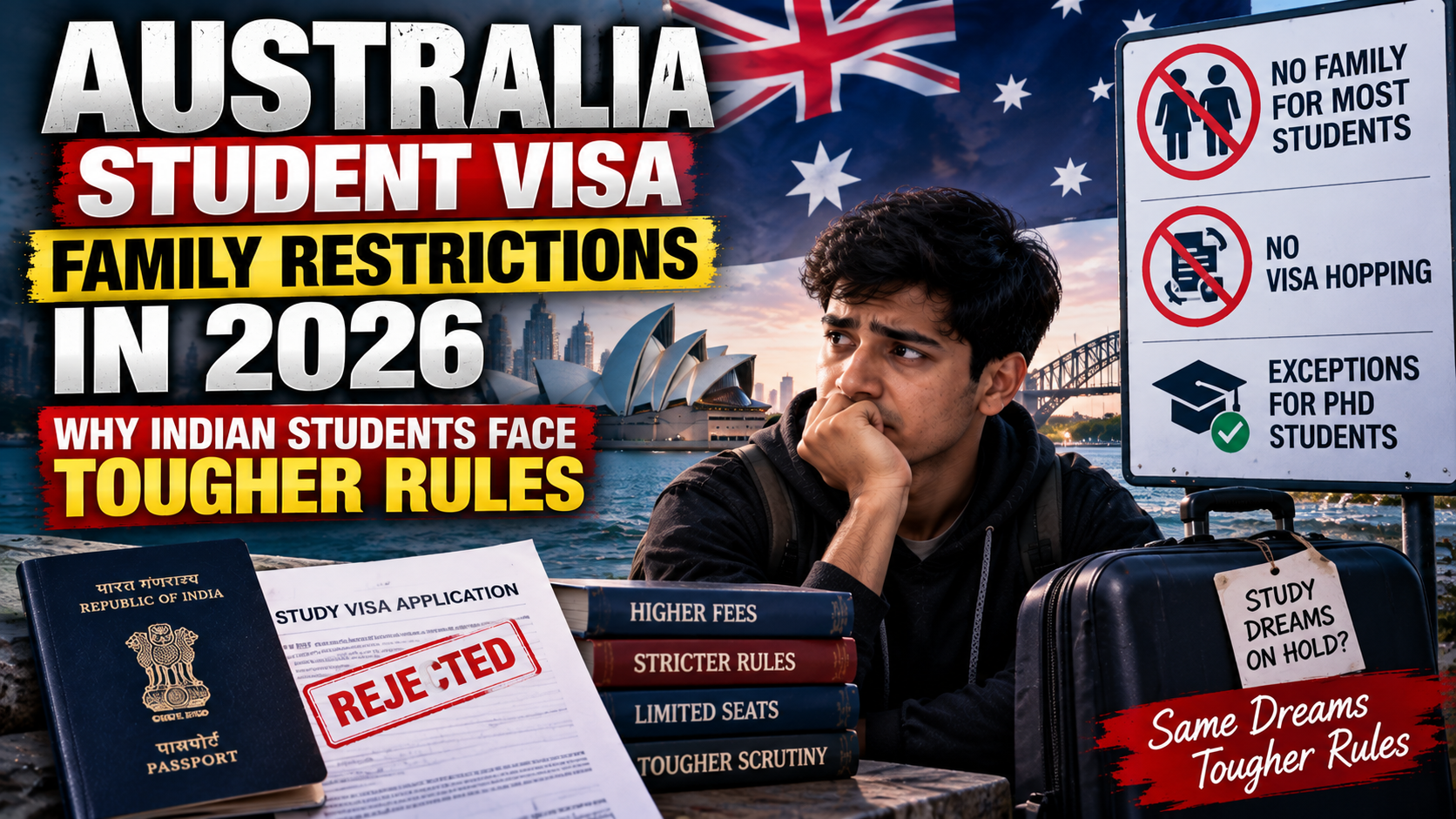
Australia has announced major changes to its temporary migration system, introducing tighter conditions for international students, graduate visa holders, visitors and working holiday makers.
The Australia student visa family restrictions 2026 reforms are particularly important for Indian students, who represent one of the largest international student groups in the country. Under the announced changes, most new international students will no longer be able to bring their partners or dependent children to Australia, although exemptions will apply to certain nationalities and study programs.
The government says the reforms are designed to improve migration management, reduce visa misuse and help bring net overseas migration down to 225,000 by 2027–28.
However, universities and education-sector representatives have warned that the changes could make Australia less attractive to international students who want to study with their families.
What Are the Australia Student Visa Family Restrictions 2026?
The central part of the Australia student visa family restrictions 2026 package is a proposed limitation on secondary applicants attached to most new student and graduate visas.
Under the announced approach, most new international students will not be able to bring their:
- Spouse or de facto partner
- Dependent children
- Other eligible family members currently permitted under student visa arrangements
There will be exceptions for students from certain Pacific and ASEAN countries, as well as students enrolled in PhD programs.
The government has also stated that families already in Australia will not be separated because of the new policy. Individuals whose family members are already attached to their visas are expected to remain protected under the transitional arrangements.
For Indian students planning to begin undergraduate, postgraduate or vocational studies, this could represent a significant change in how they plan their education and relocation.
Can Indian Students Still Bring Their Spouse or Children?
For most new Indian students, the announced policy means that bringing a spouse or dependent children may no longer be available through the usual student visa pathway.
Under the existing framework, eligible student visa holders can generally include a partner or dependent children in their application or bring them later as subsequent entrants, provided family members were declared in the original application.
However, the Australia student visa family restrictions 2026 proposal would narrow these options for most new students.
The precise implementation details, including the effective date, transitional rules and the full list of exemptions, will be important. Students should not assume that existing family arrangements will automatically apply to new applications after the changes take effect.
Those considering Australia should verify the latest requirements through the Department of Home Affairs before making tuition payments or finalising family relocation plans.
PhD Students and Certain Countries May Be Exempt
The reforms are not expected to apply equally to every international student.
According to the government’s announcement, exemptions will apply to:
- Certain students from Pacific countries
- Certain students from ASEAN or Southeast Asian countries
- Students enrolled in PhD programs
The government has not suggested that all students from every ASEAN or Pacific country will automatically receive identical treatment. The final rules and visa conditions will determine which applicants qualify for special arrangements.
For Indian students, the PhD exemption could be especially relevant for those pursuing research-based doctoral programs. However, students should wait for the final legislative or regulatory guidance before relying on the exemption.
The Australia student visa family restrictions 2026 rules may therefore create different family-visa outcomes depending on the applicant’s nationality, qualification level and visa category.
Australia Targets “Visa Hopping” under Australia Student Visa Family Restrictions 2026
Another major part of the reforms is a crackdown on what the government calls “visa hopping.”
Visa hopping refers to repeatedly changing courses or visa categories to extend a person’s stay in Australia without clear academic or immigration progression.
Under the new approach, international students who want to renew their student visas will generally be expected to progress to a higher qualification rather than repeatedly enrolling in a course at the same or a lower level.
For example, a student may be expected to progress from:
- A diploma to a bachelor’s degree
- A bachelor’s degree to a master’s degree
- A master’s degree to a doctoral program
There may be exceptions where students have genuine reasons for needing additional time. These could include serious personal circumstances or situations where an education provider closes or can no longer deliver the course.
The policy could affect students who move between unrelated courses primarily to remain in Australia. Indian students who plan to use multiple courses as a long-term stay strategy will need to consider the new progression expectations carefully.
What Does the Change Mean for Indian Students?
The Australia student visa family restrictions 2026 announcement may influence Indian students in several ways.
1. Family relocation may become more difficult
Students with spouses or children may need to decide whether to study in Australia alone or consider alternative destinations that allow more flexible family arrangements.
2. Course selection will matter more
Students may need to demonstrate a genuine academic progression when applying for another student visa. Choosing short courses without a clear educational or professional purpose could attract greater scrutiny.
3. Long-term planning will become essential
Applicants should consider their entire study pathway before travelling. This includes the qualification level, future employment plans, graduate visa eligibility and whether family members can legally join them.
4. Existing families may receive protection
The government has indicated that family members already in Australia will not be separated under the new measures. However, the exact transitional arrangements will depend on the final rules.
Australia Also Introduces Stronger Overstay Enforcement
The migration package also focuses on people who remain in Australia after their visas expire.
The government plans to recruit 100 additional compliance officers to strengthen visa compliance and enforcement operations.
The stated objective is to ensure that people leave Australia when their visa expires unless they have obtained lawful permission to remain.
The government is also introducing a No Further Stay condition on visitor visas. This condition is intended to prevent visitors from using a visitor visa as a pathway to apply for another visa while remaining in Australia.
Protection-related applications will be treated separately under the announced framework.
These measures form part of a broader attempt to control temporary migration and reduce the use of visitor visas for purposes beyond tourism or short-term visits.
Working Holiday Visa Rules Will Also Change
The reforms extend beyond students.
Australia will introduce a ballot system for working holiday makers seeking second- and third-year visas.
To qualify for the second-year ballot, applicants will still need to complete the required regional work, currently 88 days.
The announced second-year arrangements include:
| Category | Previous qualifying figure | New announced limit |
|---|---|---|
| Second-year working holiday visas | Approximately 57,000 qualified last year | 45,000 ballot places |
| Third-year working holiday visas | Approximately 31,000 qualified last year | 5,000 ballot places |
Applicants seeking a third-year visa will still need to complete six months of eligible regional work before entering the ballot.
The United Kingdom is expected to receive different treatment because of arrangements under the Australia–UK Free Trade Agreement.
The changes have raised concerns in the agricultural sector, where farmers rely heavily on working holiday makers during planting, harvesting and packing seasons. Industry groups have warned that fewer backpackers could worsen labour shortages and increase pressure on regional businesses.
Why Is Australia Introducing These Australia Student Visa Family Restrictions 2026?
The Australian government says it wants to regain greater control over temporary migration while ensuring that the migration system supports national priorities.
Home Affairs Minister Tony Burke has linked the reforms to several objectives:
- Reducing net overseas migration
- Preventing visa misuse
- Improving compliance
- Managing temporary visa numbers
- Prioritising skills needed in Australia
- Reducing repeated course changes
- Ensuring visitors do not use visitor visas as backdoor migration pathways
The government is targeting net overseas migration of approximately 245,000 in the current financial year and 225,000 by 2027–28.
At the same time, international education remains a major contributor to the Australian economy. The sector contributed approximately A$53.6 billion in the year to June 2025, making it one of the country’s largest export industries.
Universities Warn of Impact on International Education
The Australia student visa family restrictions 2026 reforms have triggered concern across the higher education sector.
Universities and international education representatives have warned that students who want to relocate with their partners or children may choose other destinations instead.
Australia competes with countries such as Canada, the United Kingdom, Germany and France for international students. Family rights, post-study work opportunities and long-term migration pathways are important factors in that decision.
Education-sector representatives have also raised concerns that restricting family members could affect Australia’s reputation as a welcoming study destination, particularly among mature students, married applicants and postgraduate candidates.
The government, however, argues that the reforms are targeted at migration management rather than a complete reduction in international education.
What Should Indian Students Do Now?
Students planning to study in Australia should take the following steps:
- Check the final rules: The announcement may require further regulatory changes before all measures become operational.
- Confirm family eligibility: Do not assume that a spouse or child will be able to apply as a subsequent entrant.
- Choose a logical course pathway: Ensure that the selected program matches previous education and future career goals.
- Avoid relying on visa hopping: Repeated enrolment in unrelated or lower-level courses may become more difficult.
- Review graduate visa options: Check whether the intended qualification provides a realistic post-study pathway.
- Use official sources: Verify requirements through the Australian Department of Home Affairs and the official Study Australia website.
Final Takeaway On Australia Student Visa Family Restrictions 2026
The Australia student visa family restrictions 2026 reforms could significantly change how Indian students plan their education and relocation.
Most new international students may no longer be able to bring family members, while PhD students and certain nationals may qualify for exemptions. At the same time, Australia is targeting visa hopping, strengthening overstay enforcement and introducing ballots for second- and third-year working holiday visas.
Australia has not announced a complete closure to international students. However, the system is becoming more controlled, and applicants will need to plan their education, finances, family arrangements and long-term visa strategy more carefully.
For Indian students, the most important step is to confirm the final rules before committing to an Australian study program.
FAQs : Australia Student Visa Family Restrictions 2026
What are the Australia student visa family restrictions 2026?
The announced reforms would prevent most new international students from bringing partners or dependent children to Australia through their student or graduate visas. Exceptions are expected for certain Pacific and ASEAN nationals and PhD students.
Can Indian students bring their spouse after Australia Student Visa Family Restrictions 2026?
Under the proposed Australia student visa family restrictions 2026, most new Indian students may not be able to bring a spouse through the usual dependent visa pathway. Students should wait for the final rules and check official guidance before applying.
Are PhD students exempt from the new family restrictions?
The government has announced an exemption for PhD students. However, the final eligibility conditions and implementation details must be confirmed through official regulations.
What is visa hopping in Australia?
Visa hopping refers to repeatedly changing courses or visa categories to extend a stay in Australia. The government plans to require students seeking further student visas to generally progress to a higher qualification.
Will families already in Australia be affected?
The government has stated that families already in Australia will not be separated under the new measures. Transitional arrangements should be checked once the final rules are published.
Will working holiday visa rules also change?
Yes. Australia plans to introduce ballot systems for second- and third-year working holiday visas, with 45,000 places for the second year and 5,000 places for the third year, subject to eligibility requirements.
Source : The Times Of India
Read About : New Zealand Visa Overstayer Estimate 2026: 19,153 People Recorded as Remaining After Visa Expiry


2 thoughts on “Australia Student Visa Family Restrictions 2026: Indian Students Face Tougher Rules on Dependants and Visa Extensions”