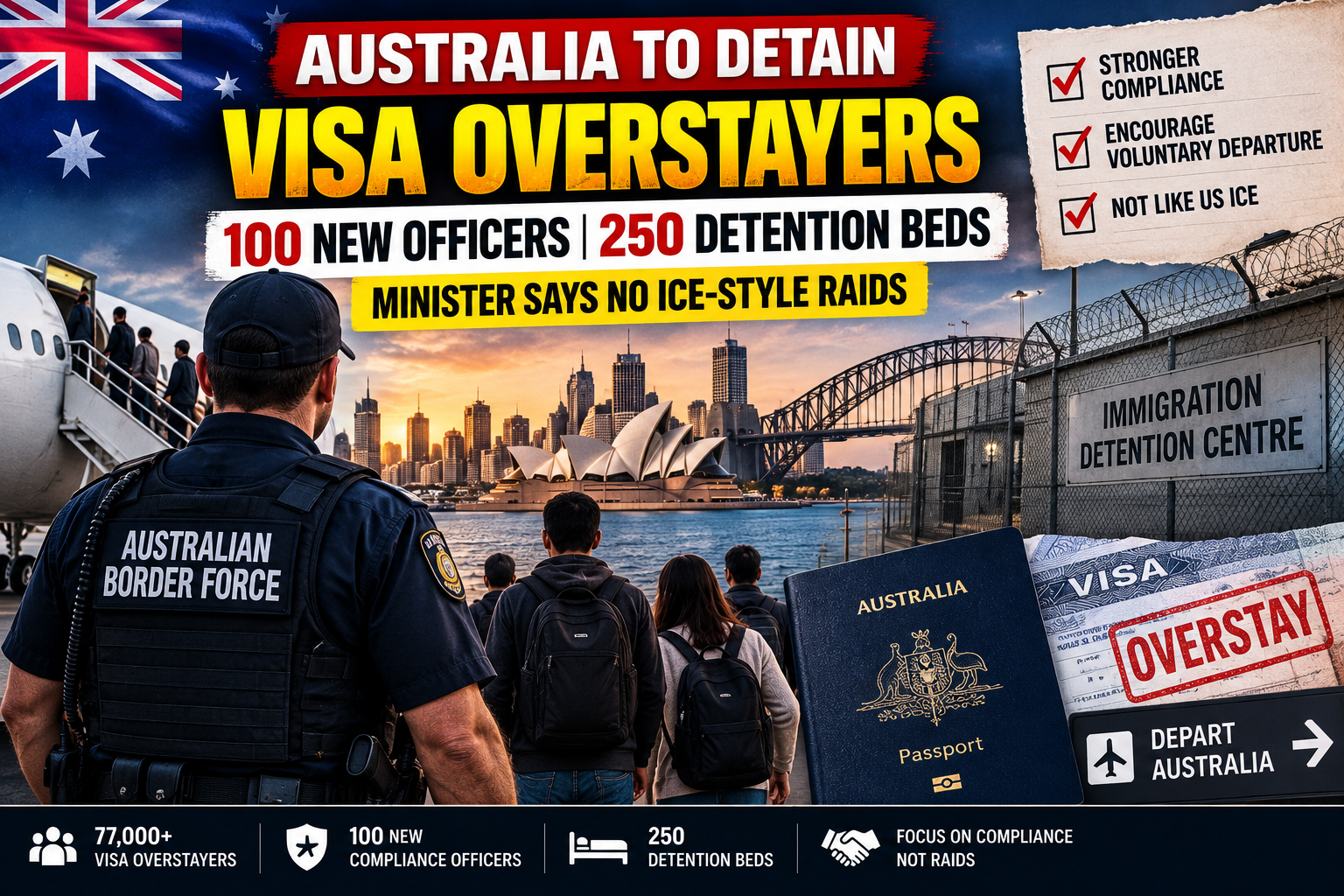
Australia is preparing to increase immigration compliance operations as the government responds to a growing number of people remaining in the country after their visas have expired. The federal government says the new approach will focus on encouraging people to leave voluntarily while restoring the capacity to detain and remove people who remain without a valid visa.
The government has announced 100 additional compliance officers and 250 additional detention beds, while also examining whether a former quarantine facility in Melbourne could be repurposed for immigration detention. Home Affairs Minister Tony Burke has stressed that the measures are not intended to replicate the immigration enforcement operations associated with US Immigration and Customs Enforcement (ICE).
The policy has nevertheless generated political and human-rights debate, particularly over how Australia will conduct enforcement and how the changes could affect vulnerable migrants.
Australia Visa Overstayers to Face Stronger Immigration Compliance
The government says there are now more than 77,000 people without a valid visa remaining in Australia, a figure that has increased from about 64,000 in 2016. The government wants to restore a level of immigration compliance that it says existed before 2015.
Under the announced measures, Australia will add 100 compliance officers and provide 250 additional detention beds. The government is also considering whether the former quarantine facility in Melbourne could be used as part of the detention network.
For Australia visa overstayers, the central message from the government is that remaining in the country after a visa expires should have consequences if there is no other lawful basis for staying.
Burke said the purpose of the additional capacity was not to conduct widespread raids but to make sure the government could act when people did not leave voluntarily.
The minister has described the policy as a return to a system Australia used before 2015, when people who overstayed could be placed in detention and subsequently make arrangements to leave.
Government Says Measures Will Not Copy US ICE Operations
The comparison with US immigration enforcement has become one of the most contentious aspects of the announcement.
Burke said the Australian approach would not resemble the operations seen in the United States and described the proposed system as a return to previous Australian practice. His National Press Club speech specifically referred to restoring the pre-2015 process rather than adopting enforcement methods used in other countries.
The distinction is important because US ICE operations have become a major political and human-rights issue under the Trump administration.
In Australia, the government says enforcement will be directed at people who have exhausted their lawful options to remain. The stated objective is to increase compliance capacity rather than introduce a US-style enforcement model.
Migration Institute of Australia chief executive Peter van Vliet also rejected the comparison, arguing that the measures resemble Australia’s previous compliance arrangements more closely than US ICE operations.
Former Immigration Department deputy secretary Abul Rizvi similarly said Australia’s pre-2015 compliance operations were conducted differently from current US enforcement practices. He described the earlier model as involving trained compliance officers and more targeted interventions.
Why Australia Is Increasing Detention Capacity
A major factor behind the government’s announcement is the limited capacity available to deal with people who have no valid visa.
According to Home Affairs data, there were 6,646 departures from Australia by status-resolution clients during 2024–25. These included 3,189 returns from the community and 3,457 removals from immigration detention.
The government believes that expanding detention capacity could increase the number of people who either leave voluntarily or are removed after being detained.
For Australia visa overstayers, the government argues that the existence of a functioning compliance mechanism can itself influence behaviour. Rather than every person being detained, the policy is designed partly around the expectation that some people will choose to leave once enforcement becomes more credible.
Burke said the 250 beds should not be viewed as a fixed annual limit because people may remain in detention for only a short period. The government expects the beds to turn over as people depart.
Who Are the Australia Visa Overstayers ?
The group of Australia visa overstayers is not made up of one single category of migrants.
The latest figures cited by ABC indicate that a little over one-third of people in this cohort originally arrived on visitor visas, while about 20 per cent arrived on student visas.
People can lose lawful status for different reasons, and the circumstances surrounding individual cases can vary significantly.
Some people may have exhausted their visa conditions without having another lawful pathway. Others may have been involved in unresolved immigration or protection processes.
This distinction is important because Australia’s broader population of people without a valid visa is different from the much larger population of people who remain lawfully in Australia on bridging visas.
Bridging Visa Numbers Are Much Larger
While there are more than 77,000 people without a valid visa, the government is also dealing with a much larger group of people who remain lawfully in Australia on bridging visas.
According to ABC, the number of people on bridging visas has increased from about 176,000 three years ago to more than 400,000. Bridging visas can allow people to remain lawfully in Australia while visa applications, reviews or other immigration processes are resolved.
This means the Australia visa overstayers issue represents only one part of the government’s broader migration-management strategy.
The government has separately announced measures targeting what it describes as “visa hopping”, including changes affecting visitors and international students.
New Focus on Visa Hopping
The government also wants to prevent temporary visa holders from repeatedly moving between visa categories to extend their stay.
One proposed change would see visitor visas generally carry a No Further Stay condition, preventing visitors from arriving in Australia and then lodging another visa application from inside the country in circumstances covered by the condition.
The government also wants international students to demonstrate progression when applying for another student visa, with the aim of preventing people from repeatedly moving between low-level or unrelated courses primarily to remain in Australia.
These measures are separate from the detention arrangements but form part of the government’s broader effort to improve migration compliance.
Human Rights Groups Raise Concerns
The proposed expansion of detention capacity has also attracted criticism from human-rights advocates.
The Human Rights Law Centre warned that stronger enforcement could create additional risks for undocumented workers who have experienced workplace exploitation. The organisation argued that migrants without lawful status may become less willing to report exploitation if they fear immigration enforcement.
The Greens have also criticised the government’s plans and compared the expansion of Australia’s immigration detention capacity with US enforcement practices. Those comparisons are political criticisms of the government’s policy rather than a description of the government’s stated operating model.
The government, meanwhile, maintains that the purpose of the measures is to restore immigration compliance and encourage people without a valid visa to leave Australia.
Australia Visa Overstayers and Net Overseas Migration
The enforcement announcement comes as Australia’s net overseas migration continues to decline.
The Australian Bureau of Statistics reported that net overseas migration was 292,100 in the year ending March 2026, down from 309,500 in the previous 12-month period. During the same period, Australia recorded 557,500 overseas migrant arrivals and 265,400 migrant departures.
The government has set migration targets for the coming years and says stronger compliance will help it have greater control over who remains in Australia and through which visa pathways.
However, the number of Australia visa overstayers is relatively small compared with the overall movement of people into and out of the country.
The government itself has acknowledged that visa overstayers are not the only factor affecting net overseas migration. A substantial number of people remain lawfully in Australia on bridging visas while their immigration matters are being resolved.
Could All 77,000 Overstayers Be Removed?
The government has not indicated that all people currently without valid visas will simply be detained and removed.
The policy is instead based on a combination of voluntary departure, compliance action, detention and removal where appropriate.
Former Immigration Department deputy secretary Abul Rizvi told ABC he did not expect the government to remove the entire cohort of more than 77,000 people through the newly announced measures. He estimated the changes could potentially contribute to another 5,000 to 10,000 departures or removals annually, although that is his assessment rather than an official government forecast.
For Australia visa overstayers, individual circumstances will therefore remain important, particularly where a person has an unresolved legal, protection or visa matter.
What the Changes Mean for Temporary Visa Holders
The announcement reinforces an important principle of Australia’s visa system: temporary visa holders are expected to leave when their visa expires unless they have obtained another lawful basis to remain.
For people currently in Australia, this means checking visa expiry dates and conditions remains particularly important.
People whose visa has expired should not assume that the government’s new enforcement measures automatically determine the outcome of their individual case. Immigration status can depend on the type of visa, cancellation decisions, review rights, protection claims and other circumstances.
Anyone facing a visa cancellation, unlawful-status issue or removal process should obtain advice from an appropriately qualified Australian immigration professional.
What Happens Next For Australia Visa Overstayers?
The government is expected to build the additional compliance capacity announced by Burke and determine how the extra detention beds will be provided.
It is also examining the possible use of the former Melbourne quarantine facility and pursuing separate changes involving visitor visas, international students, migration agents and protection claims.
The central question will be how the policy operates in practice.
For Australia visa overstayers, the government says the objective is stronger compliance without introducing the type of enforcement operation associated with US ICE.
At the same time, human-rights organisations and opposition parties are likely to continue scrutinising how officers use their powers and whether people in vulnerable circumstances receive appropriate protections.
FAQs : Australia Visa Overstayers
How many Australia Visa Overstayers are currently there?
The government has cited a cohort of more than 77,000 people without a valid visa in Australia. The figure has increased from approximately 64,000 in 2016.
Will Australia conduct ICE-style immigration raids?
Home Affairs Minister Tony Burke has said the government’s planned enforcement operations will not replicate US ICE-style raids. The government describes the approach as a return to Australia’s pre-2015 compliance model.
How many new detention beds will Australia provide?
The government has announced 250 additional detention beds and 100 additional compliance officers.
How many people departed Australia through status-resolution processes in 2024–25?
Home Affairs data records 6,646 departures during 2024–25, including community returns and removals from immigration detention.
Are bridging visa holders the same as Australia Visa Overstayers ?
No. Bridging visas can provide lawful temporary status while a person’s visa application, review or other immigration process is being resolved. The bridging-visa population is considerably larger than the cohort without a valid visa.
Final Takeaway On Australia Visa Overstayers
Australia is increasing its immigration compliance capacity as the government responds to a cohort of more than 77,000 people without valid visas. The plan includes 100 additional compliance officers, 250 detention beds and possible use of additional facilities.
The government says the policy is designed to encourage voluntary departure and restore a compliance process that operated before 2015, rather than introduce US-style ICE enforcement. Migration experts cited by ABC have also distinguished the proposed Australian model from current US practices.
At the same time, human-rights groups have raised concerns about detention, worker exploitation and the potential consequences for vulnerable migrants. The implementation of the policy will determine how the new enforcement powers operate in practice.
Source : ABC AU Net
Read About : Australia Student Visa Family Restrictions 2026 : Indian Students Face Tougher Rules