
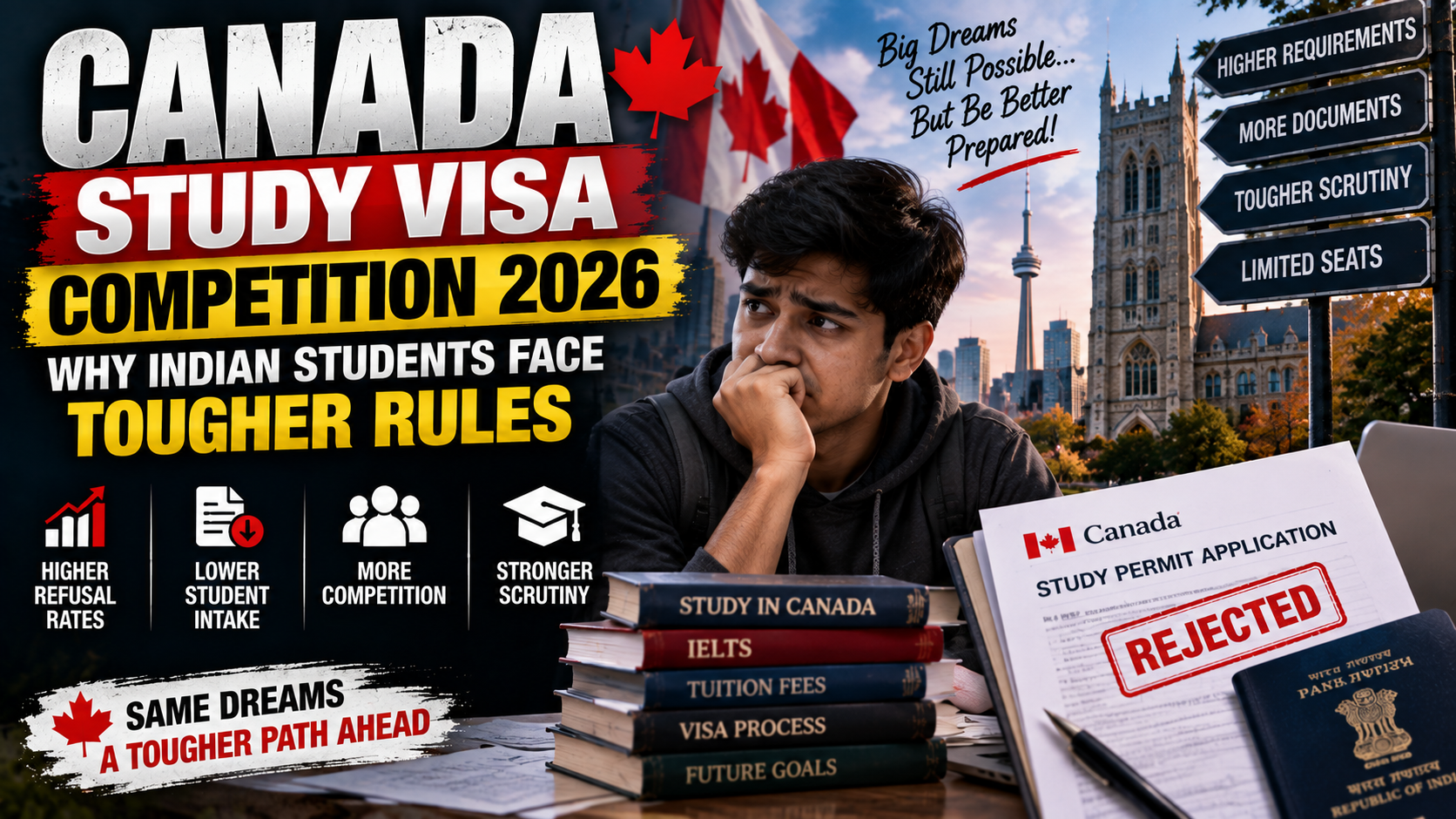
For years, Canada has remained one of the most popular destinations for Indian students seeking international education, professional opportunities and global exposure. Every year, students prepare for language tests, select courses, arrange finances and apply to Canadian colleges and universities with the expectation of building a better future.
However, the Canada study visa competition 2026 environment is considerably different from the system students experienced a few years ago.
Canada has reduced its expected intake of new international students, while interest in Canadian education remains strong among applicants worldwide. According to Immigration, Refugees and Citizenship Canada (IRCC), Canada’s 2026 target includes approximately 155,000 new international student arrivals. This figure is part of a broader plan to issue up to 408,000 study permits, including extensions for students already in Canada.
The 155,000 figure does not mean that only 155,000 applications can be submitted globally. It also does not create a simple first-come, first-served visa system. However, it reflects a significant reduction in the number of new students Canada expects to welcome.
As a result, the Canada study visa competition 2026 landscape is becoming more selective, making the quality, credibility and consistency of each application increasingly important.
Canada’s 2026 International Student Target
Under Canada’s 2026–2028 Immigration Levels Plan, the federal government expects to welcome:
| Category | 2026 Target |
|---|---|
| New international student arrivals | 155,000 |
| Total study permits, including extensions | Up to 408,000 |
| New temporary resident arrivals overall | 385,000 |
| New temporary worker arrivals | 230,000 |
The student-arrival target is approximately 49% lower than the previous year’s target. Canada has stated that these reductions are intended to manage temporary population growth and bring the share of temporary residents below 5% of the total population by the end of 2027.
This does not mean Canada has stopped accepting international students. Instead, the government is attempting to manage the volume of new arrivals while maintaining a more controlled international education system.
For applicants, this means the Canada study visa competition 2026 process must be approached with greater preparation rather than relying only on admission to a Canadian institution.
Why Indian Students Are Feeling the Pressure
India has historically been one of Canada’s largest international student source countries. Because of this high demand, Indian applicants are particularly exposed to changes in study permit policies, provincial allocations and application scrutiny.
Many Indian students apply for similar programs, including business administration, project management, information technology, healthcare, supply chain management and hospitality. When large numbers of applicants target the same destination and the number of new student arrivals is reduced, the overall environment becomes more competitive.
However, it is important to distinguish between competition and an official nationality-based ban.
Canada has not announced that Indian students are no longer eligible for study permits. Indian applicants can still apply, but their applications must demonstrate a credible educational purpose, sufficient financial capacity and compliance with all immigration requirements.
The Canada study visa competition 2026 situation is therefore better understood as a combination of reduced intake, increased scrutiny and stronger expectations regarding applicant credibility.
Admission Does Not Guarantee a Study Permit
One of the most important points for students to understand is that admission and immigration approval are two separate decisions.
A Canadian college or university decides whether an applicant meets its academic and admission requirements. IRCC separately decides whether the applicant qualifies for a study permit under Canadian immigration law.
A student may receive an admission letter but still face questions about:
- The relevance of the selected program
- Previous academic performance
- Gaps in education
- Financial resources
- The source of tuition and living funds
- The applicant’s intention to study
- The relationship between the proposed course and future plans
- The applicant’s overall immigration history
Therefore, receiving an offer letter should not be treated as a guarantee of approval in the Canada study visa competition 2026 environment.
Genuine Students Need a Clear Academic Story
The concept of a genuine study purpose is becoming increasingly important.
A strong application should explain why the applicant has selected a particular course and how it connects with their previous education, work experience or professional goals.
For example, a student with a background in commerce applying for accounting, finance, business analytics or supply chain management may be able to explain the academic progression clearly.
However, if an applicant with a technical background suddenly chooses an unrelated program without explaining the reason, the visa officer may seek additional clarification.
This does not mean that changing academic fields automatically leads to refusal. Students can change disciplines, but they should provide a reasonable explanation supported by their academic and career plans.
Applicants should avoid choosing a course simply because an agent claims it is “easy to get a visa for.” There is no Canadian program that guarantees study permit approval.
Education Background and Course Selection Matter
Course selection is an important part of the Canada study visa competition 2026 process.
Before applying, students should consider the following questions:
- Why have I selected this program?
- How does it relate to my previous education?
- Does it match my work experience?
- What specific skills will I gain?
- Why is Canada an appropriate destination for this course?
- What career opportunities could the qualification support?
- Is the program suitable for my academic level?
- Can I explain the course choice without relying on generic statements?
Students should also research the institution carefully. They should verify whether the institution is a designated learning institution (DLI), whether the program is eligible for the intended study pathway and whether the institution has communicated any specific requirements for international applicants.
English Proficiency Is More Than a Test Score
IELTS, PTE and other accepted language tests remain important for many Canadian study applications. However, language proficiency should be considered as part of the applicant’s overall profile rather than as an isolated number.
A student applying for an advanced academic program should be able to demonstrate that their language ability is consistent with the demands of the course.
Students should ensure that:
- Their test results meet the institution’s requirements
- Their language score is valid at the time of application
- Their written statement is clear and consistent
- Their academic history supports the selected level of study
- They understand the course they intend to pursue
A high language score cannot compensate for unexplained finances, an unsuitable course or an unclear academic purpose.
Financial Documents Must Tell a Credible Story
Financial capacity is another major part of the Canada study visa competition 2026 process.
Studying in Canada requires funds for tuition, accommodation, food, transportation, health insurance and other living expenses. Applicants must demonstrate that they can support themselves without depending on unauthorised employment.
The financial application should explain:
- Who is paying for the education
- The relationship between the sponsor and the student
- The source of the funds
- The sponsor’s income and employment
- Whether the funds are genuinely available
- Whether large deposits can be properly explained
- Whether the family can realistically afford the total cost
Showing a large balance shortly before applying without supporting evidence may raise questions. A credible financial profile is not necessarily the one with the highest bank balance. It is the one supported by consistent, verifiable documentation.
Canada’s financial requirements are also updated periodically. IRCC has stated that the cost-of-living financial threshold for a single student outside Quebec was $22,895 for applications under the September 2025 requirement framework, excluding tuition and transportation. Applicants should verify the latest official amount before submitting an application.
Study Permit Refusal Rates Have Increased
The wider Canadian study permit environment has become more restrictive.
IRCC reported that the refusal rate for new study permit applications increased to approximately 59% during 2025, compared with 52% in 2024. The figure applies to new study permit applications overall and should not be interpreted as an India-specific refusal rate.
The government has also reduced study permit targets, introduced provincial and territorial allocation mechanisms, and expanded the use of provincial attestation letters for many applicants.
These changes mean that students must prepare their applications more carefully. The Canada study visa competition 2026 environment is not based only on the number of applications received; it also reflects whether applications meet program requirements and demonstrate a credible purpose.
Is Canada Refusing Indian Students?
Canada is not officially refusing all Indian students. Indian applicants continue to receive study permits, and Canadian institutions continue to enrol students from India and other countries.
However, applicants should not assume that a previous approval trend will continue unchanged. Canada’s international student system is now being managed with stricter intake controls and greater attention to sustainability, housing pressure, labour-market needs and program integrity.
A refusal does not automatically prove that Canada has closed its doors to Indian students. At the same time, admission, IELTS results or financial documents alone do not guarantee approval.
The key issue in the Canada study visa competition 2026 process is whether the complete application is logical, genuine, financially credible and consistent with the applicant’s background.
What Indian Students Should Do Before Applying
Indian students planning to apply for a Canadian study permit in 2026 should consider the following checklist:
1. Choose a logical program
Select a course that connects with previous education, professional experience or a clearly explained career plan.
2. Research the institution
Confirm the institution’s DLI status, program details, tuition fees and any applicable provincial requirements.
3. Prepare genuine financial evidence
Document the source of tuition and living funds. Explain unusual transactions or recent deposits.
4. Write a clear study plan
Explain why the course, institution and Canadian education system are relevant to the applicant’s future.
5. Avoid false documents
Misrepresentation can lead to refusal and potentially serious immigration consequences.
6. Review provincial requirements
Many applicants need a provincial or territorial attestation letter, subject to applicable exemptions.
7. Do not rely on visa guarantees
No agent or consultant can guarantee study permit approval.
8. Apply with consistent information
The admission application, financial documents, study plan and immigration forms should not contradict one another.
Final Takeaway On Canada Study Visa Competition 2026
The Canada study visa competition 2026 environment is more controlled than it was during the period of rapid international student growth. Canada’s new-arrival target of approximately 155,000 students reflects a substantial reduction, but it does not represent a ban on Indian applicants.
For Indian students, the central lesson is to focus on the strength and credibility of the complete application rather than searching for a supposedly “easy visa course.”
A genuine academic progression, appropriate English proficiency, transparent finances, sensible course selection and realistic career planning can help applicants present a more convincing case.
Canada’s student pathway remains open, but the process now requires more preparation, more documentation and a clearer explanation of why the applicant wants to study in the country.
FAQs : Canada Study Visa Competition 2026
What is the Canada study visa competition 2026 situation for Indian students?
The Canada study visa competition 2026 environment is more competitive because Canada has reduced its target for new international student arrivals to approximately 155,000. Indian students can still apply, but applications are facing a more controlled intake system and greater scrutiny.
Is Canada accepting Indian students in 2026?
Yes. Canada continues to accept applications from Indian students. However, applicants must meet study permit requirements and demonstrate a genuine study purpose, sufficient funds and a credible academic plan.
Does the 155,000 target mean only 155,000 applications are allowed?
No. The 155,000 figure refers to expected new international student arrivals. Canada’s broader study permit target includes extensions for students already in Canada and returning students.
Can admission guarantee a Canadian study permit?
No. Admission is decided by the educational institution, while a study permit is decided by IRCC. An admission letter does not guarantee immigration approval.
What can improve an Indian student’s study permit application?
Applicants should choose a logical program, provide genuine financial documents, explain their study purpose clearly, demonstrate suitable language ability and maintain consistency across all submitted information.
Has Canada increased study permit refusals?
IRCC reported that the overall refusal rate for new study permit applications reached approximately 59% in 2025, up from 52% in 2024. This is an overall figure and should not be treated as a specific refusal rate for Indian applicants.
Source : Canada
Read About : Canada Deportations of Indian Nationals 2026: India Tops CBSA Removal List With 3,717 Removals


One thought on “Canada Study Visa Competition 2026: Why Indian Students Face Tougher Approval Conditions”