International applicants, including many from India, are finding that an admission offer from a UK university no longer guarantees a place. UK universities withdrawing offers have become a growing concern since the Home Office lowered the visa refusal threshold that sponsors must stay under to 5 per cent, down from 10 per cent.
The change leaves institutions with little room to absorb visa refusals without risking their ability to recruit overseas students. For applicants who hold an offer but haven’t yet secured a visa, that can mean uncertainty at the final stage of the process.
Quick Highlights : UK Universities Withdrawing Offers
- UK universities withdrawing offers are responding to a visa refusal threshold now set at 5 per cent, down from 10 per cent
- 10.5 per cent of UK study visa applications were withdrawn in the first half of 2026, against 2.3 per cent a year earlier and 0.4 per cent in 2023
- For Indians, the withdrawn share was 5.2 per cent, up from 1.2 per cent
- Pakistan recorded 40.9 per cent, Bangladesh 23.5 per cent, and Nigeria 22.7 per cent
- Around 15 universities are believed to have suspended recruitment from Pakistan entirely this year
- The figures cover withdrawn applications, not only outright visa refusals
- An offer does not guarantee a visa, so students should confirm their place is still secure
Why UK Universities Withdrawing Offers Is Happening
Under Home Office rules, a university that sponsors international students can lose the ability to recruit them if too many of the applicants it sponsors are refused visas. That limit is now 5 per cent. It was 10 per cent before the tightening.
Universities must also meet other compliance targets, including enrolling at least 95 per cent of the students they sponsor and keeping a course-completion rate of at least 85 per cent. Because a refused visa counts against the sponsoring university whether or not the institution did anything wrong, some universities are withdrawing offers or reducing recruitment in markets where they fear refusals. The aim is to stay below the line before sanctions are triggered.
The 5 Per Cent Threshold Explained
The tighter limit changes the arithmetic for every institution. A university that sponsors 1,000 applicants can now absorb fewer than 50 refusals before it reaches the limit, where the old rule allowed up to 100. For a smaller university, a handful of unexpected refusals in one cycle can push the rate up quickly.
This is why institutions describe the situation as one where sudden changes matter more than averages. Sir David Bell, vice-chancellor of the University of Sunderland, told the Financial Times that an unexpected rise in refusals prompted universities to act ahead of any formal threshold being crossed. Enroly data cited in earlier reporting suggested almost half of universities were above the 5 per cent line at some point this year, though that figure should be read as an estimate.
What the Withdrawal Data Shows
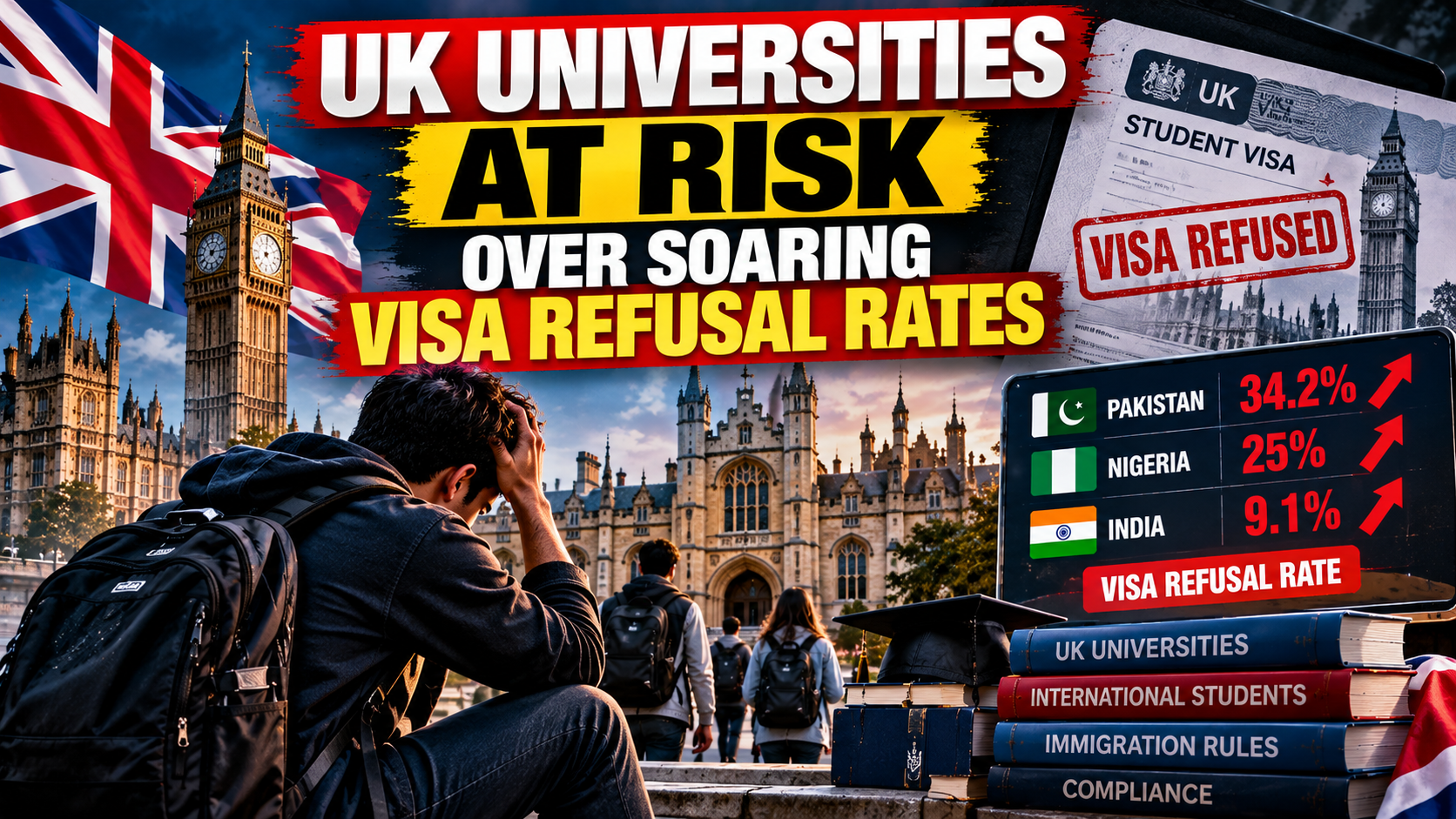
The Financial Times analysis of Home Office data found that 10.5 per cent of UK study visa applications in the first half of 2026 were withdrawn. That compares with 2.3 per cent in the same period of 2025 and 0.4 per cent in 2023.
| Nationality | Withdrawn, H1 2026 | Withdrawn, H1 2025 |
|---|---|---|
| Pakistan | 40.9% | 3.0% |
| Bangladesh | 23.5% | 7.1% |
| Nigeria | 22.7% | 4.5% |
| India | 5.2% | 1.2% |
These figures cover withdrawn applications, not necessarily outright refusals. A withdrawal can happen because an applicant decides not to proceed, because a university withdraws its sponsorship, or because the applicant expects a refusal. Even so, the sharp rise shows how much uncertainty prospective students now face.
Which Countries Are Most Affected
Pakistan, Bangladesh, and Nigeria show the steepest increases. The report cited sector figures suggesting around 15 universities are believed to have suspended recruitment from Pakistan entirely this year. Others, including Oxford Brookes, have paused sponsorship for particular countries or added extra checks.
Many of these decisions are pre-emptive, which means an applicant can be affected by a university’s risk assessment of their country rather than anything in their own file. That makes it important to ask a university directly about its current policy rather than assuming earlier information still applies.
Will Indian Students Face Greater Scrutiny?
The figures do not point to a blanket restriction on Indian applicants. At 5.2 per cent, India’s withdrawn share is far below that of Pakistan, Bangladesh, or Nigeria, although it is more than four times what it was a year earlier.
Professor Steven McGuire, deputy vice-chancellor of the University of East Anglia, said the policy could push UK universities to focus more on China and India, where refusal rates are lower, according to the report cited by PTI. Even so, universities may become more cautious with any overseas applicant if refusals threaten their own recruitment rights. The effect on an individual will depend on their circumstances and on the university’s recruitment decisions.
What Universities and Sector Bodies Say
Jamie Arrowsmith, director of Universities UK International, said many refusals appeared to rely on flawed, inconsistent, and highly subjective reasoning. He said this was forcing universities to withdraw offers on a large scale to avoid breaching compliance thresholds. He acknowledged the need to keep confidence in the immigration system but said visa processing had become markedly less predictable.
For applicants, the concern is the same: a genuine student with a valid offer can still lose a place because of the institution’s exposure rather than their own application.
What the Home Office Says
The Home Office said international students make a positive contribution to Britain, but that this should not come at the expense of responsible recruitment or the integrity of the immigration system. It said it offers universities support to improve their recruitment practices.
Migration and Citizenship Minister Mike Tapp has said the aim of the tighter rules is to stop the student route being used as a backdoor to asylum and illegal working.
The Financial Stakes for Universities
The pressure on universities is not only about compliance. International students generated £12.4 billion in tuition revenue in 2024/25, accounting for 23 per cent of total income across UK higher education, and 48 publicly funded universities in England, or 40 per cent, were running at a deficit that year.
That helps explain why UK universities withdrawing offers is a difficult choice. Institutions that rely on overseas fees have a strong incentive to recruit, but the sanction for exceeding the refusal threshold could be more costly than the lost fees from any single market.
What Prospective Students Should Do Now
Students with an offer should act early rather than wait for a problem to appear. These steps are worth taking:
- Confirm your admission status: Contact the university to check whether your offer remains valid and whether its recruitment policy has changed
- Check visa requirements: Review the latest UK government guidance and make sure every document is complete and consistent
- Clarify deadlines: Ask about enrolment dates and whether the university can extend them if visa processing is delayed
- Check refund policies: Before paying non-refundable accommodation deposits or other costs, understand what happens if a visa is refused or an offer is withdrawn
Keep copies of all emails with the university, since written confirmation of your offer status is useful if anything changes.
Questions to Ask Your University
A short list of direct questions can reduce risk:
- Is my offer still valid, and has the university changed recruitment for my country?
- What is the deadline for receiving my confirmation documents, and can it be extended?
- What is the refund policy for tuition deposits if my visa is refused?
- Does the university assess applicants before issuing confirmation documents, and what does that involve?
Ask for the answers in writing. If a university is slow to reply, treat that as a signal to line up alternatives.
If Your Offer Is Withdrawn
If a university withdraws your offer, ask for the reason in writing and whether any fees are refundable. Check whether the withdrawal is permanent or whether you can reapply in a later intake. Apply to other institutions while intakes are still open, and consider a mix of universities so one policy change doesn’t leave you without options.
Students should also be careful with agents. Use only licensed advisers, and avoid anyone who promises a visa outcome, since a refusal linked to inaccurate documents can affect future applications.
Key Takeaways On UK Universities Withdrawing Offers
UK universities withdrawing offers reflects a 5 per cent visa refusal threshold that leaves institutions with little margin, combined with a sharp rise in withdrawn applications. India’s withdrawn share of 5.2 per cent is far lower than Pakistan’s 40.9 per cent, and there is no blanket restriction on Indian applicants, but universities may still turn cautious. Students should confirm that their offer remains valid, prepare documents carefully, and understand refund terms before paying deposits.
FAQs : UK Universities Withdrawing Offers
Why are UK universities withdrawing offers?
Because a refusal rate above 5 per cent can threaten a university’s ability to recruit international students, so some institutions withdraw offers or reduce recruitment in higher-risk markets.
Does this mean Indian students will be refused?
No. There is no blanket restriction on Indian applicants. The withdrawn share for India was 5.2 per cent in the first half of 2026, but an offer does not guarantee a visa.
Are the withdrawal figures the same as refusal rates?
No. They cover withdrawn applications, which may include applicants who chose not to proceed, as well as cases where an offer or sponsorship was withdrawn.
What should I do if I hold an offer but have no visa yet?
Confirm your offer is still valid, check the latest visa guidance, clarify deadlines, and understand refund policies before paying non-refundable costs.
Which universities have changed their recruitment?
Several, including Sunderland, Oxford Brookes, and others, have restricted or paused recruitment from some countries, and around 15 are believed to have suspended recruitment from Pakistan entirely.
Source : Business Standard
Read About : UK Skilled Worker Visa Abuse Protection: New Rules Let Recognised Victims Leave Exploitative Employers