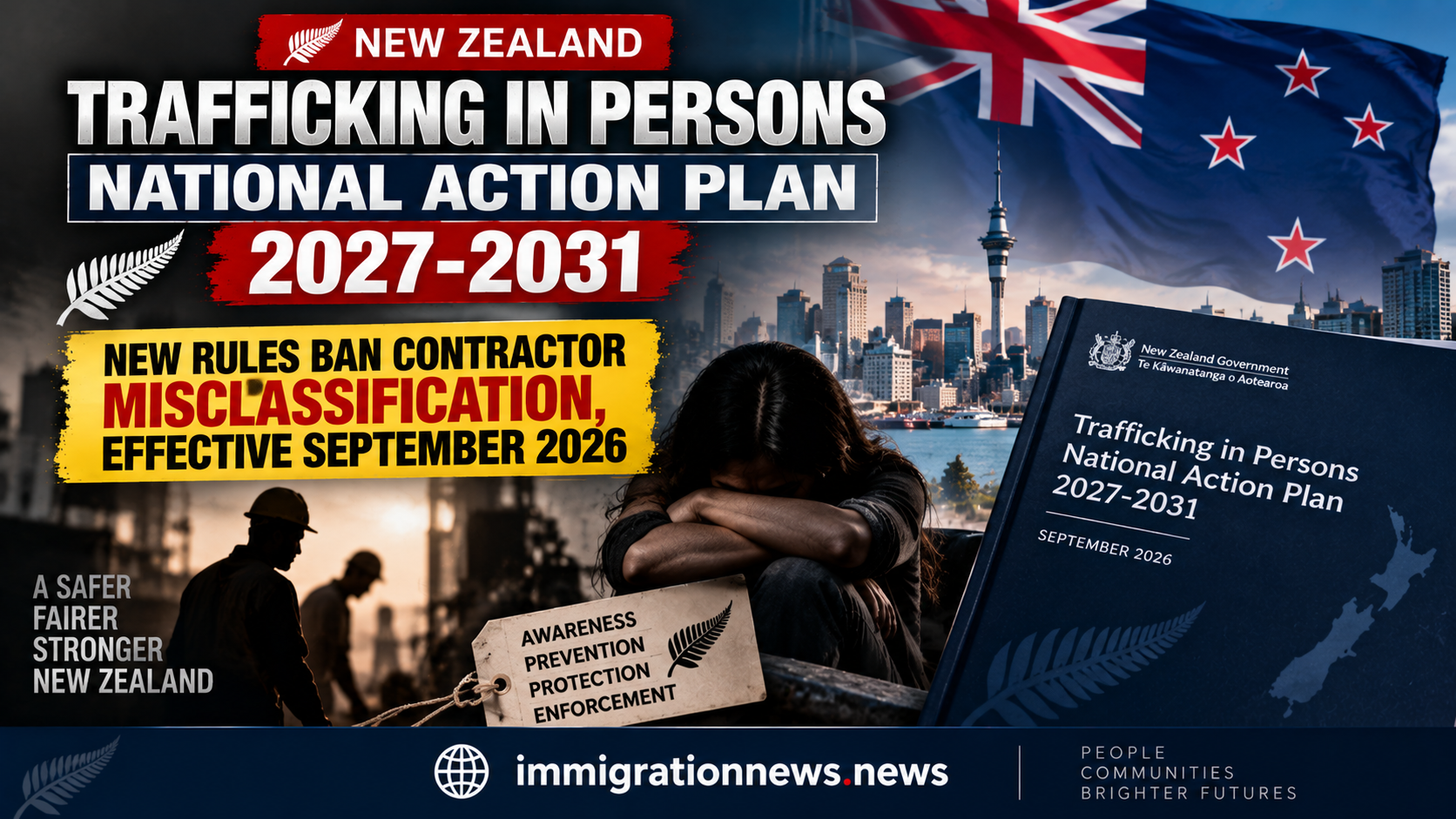
New Zealand has released the New Zealand Trafficking in Persons National Action Plan 2027-2031, setting out a five-year framework to strengthen prevention, victim identification, protection, enforcement and coordination against trafficking.
The plan forms part of New Zealand’s Transnational, Serious and Organised Crime (TSOC) Strategy 2026-2030 and is designed to strengthen the existing system rather than replace ongoing law-enforcement and regulatory operations.
The Ministry of Business, Innovation and Employment (MBIE) is responsible for coordinating implementation with government agencies, civil society, businesses and international partners. The official plan was published in September 2026.
What Is Trafficking in Persons?
The New Zealand Trafficking in Persons National Action Plan 2027-2031 defines trafficking in persons as a serious crime and human rights violation involving the recruitment, transportation, transfer, harbouring or receipt of a person for exploitation.
The plan identifies several forms of exploitation, including:
- Forced labour
- Forced criminality
- Sexual exploitation
- Forced marriage
- Domestic servitude
Trafficking can happen entirely within New Zealand or involve movement across international borders. Victims can be New Zealand citizens, residents or migrants and may be of any age.
New Zealand law provides serious penalties for trafficking offences, including imprisonment of up to 20 years and fines of up to NZ$500,000.
Why Has New Zealand Introduced a New Plan?
New Zealand previously operated under the Plan of Action against Forced Labour, People Trafficking and Slavery 2020-2025. That programme improved training, victim identification and cooperation between agencies, but the government identified several remaining weaknesses.
These include:
- Fragmented reporting pathways
- Different approaches to identifying potential victims
- Unclear agency responsibilities
- Data-sharing barriers
- Uneven frontline capability
- Limited public awareness
- Constrained investigative capacity
The New Zealand Trafficking in Persons National Action Plan 2027-2031 is therefore intended to deliver targeted improvements through better governance, stronger coordination and improved alignment across the existing system.
MBIE describes the new framework as a five-year approach to preventing trafficking, protecting victims and strengthening New Zealand’s overall response.
Four Strategic Pillars of the Plan
The New Zealand Trafficking in Persons National Action Plan 2027-2031 is built around four strategic pillars.
1. Partnership
The partnership pillar focuses on collaboration between government agencies, businesses, community organisations, international partners and other groups involved in preventing and responding to trafficking.
2. Protection
Protection focuses on identifying victims earlier and providing timely, trauma-informed, culturally appropriate and age-appropriate support.
The objective is also to reduce the risk of victims being re-victimised.
3. Prevention
The prevention pillar seeks to identify vulnerabilities and conditions that allow trafficking to occur and address those risks before exploitation happens.
4. Prosecution and Enforcement
This pillar focuses on coordinated criminal justice, law-enforcement and regulatory responses to detect, investigate and disrupt trafficking and hold offenders accountable.
The four-pillar structure follows the internationally recognised 4Ps approach associated with the Palermo Protocol, while New Zealand expands the traditional prosecution pillar to include enforcement.
Five Major Goals
The New Zealand Trafficking in Persons National Action Plan 2027-2031 sets out five broad goals:
- Improve public awareness and understanding of trafficking and exploitation risks.
- Enable earlier and more consistent identification of victims and improve access to support.
- Strengthen coordination between government, the private sector, civil society and international partners.
- Strengthen enforcement responses to detect and disrupt trafficking.
- Improve responses to trafficking risks affecting vulnerable populations, including women and children.
The plan says these goals are intended to produce measurable improvements in awareness, victim support, coordination, prevention and enforcement.
Eight Priority Activities Across Two Phases
The New Zealand Trafficking in Persons National Action Plan 2027-2031 includes eight initial priority activities divided into two phases.
Phase One: Building the Foundation
The first phase focuses on establishing the structures needed for a stronger national response.
Four activities include:
- Mapping New Zealand’s end-to-end trafficking response.
- Establishing a coordinated governance and engagement framework.
- Creating an interim process for timely victim support.
- Strengthening information sharing, data governance and intelligence.
The plan gives specific milestones for these activities, including 12-, 18- and 36-month delivery periods depending on the activity.
Phase Two: Expanding the Response
The second phase includes:
- Standardised victim identification and screening.
- Coordinated cross-sector training.
- Protection frameworks and support services for child victims.
- Stronger partnerships with Pacific countries to prevent child trafficking.
The plan says some activities may begin earlier where resources, capacity or existing initiatives allow.
Real Cases Highlight the Risks
One important feature of the plan is its inclusion of real case studies.
One case involved children who were brought to New Zealand after promises of education, employment and a better life. Instead, they experienced domestic servitude, financial exploitation, coercive control and sexual offending. The offender was ultimately convicted of slavery, rape, indecent assault and related offences and received a 16-year-and-four-month prison sentence.
Another case involved workers recruited through advertisements promising jobs, work visas, flights, accommodation and living expenses. Applicants paid approximately NZ$4,000 upfront.
After arriving in New Zealand, they discovered that they had visitor visas rather than work visas. They were subsequently placed in construction and horticulture jobs where the plan describes long working hours, below-minimum wages, deductions and overcrowded accommodation.
The principal offender was convicted of 15 trafficking charges and 15 charges of aiding and abetting unlawful migrant entry and sentenced to nine years and six months in prison.
These examples demonstrate why recruitment practices, immigration status and workplace exploitation are important parts of the government’s trafficking-prevention strategy.
What Does the Plan Mean for Migrants?
The New Zealand Trafficking in Persons National Action Plan 2027-2031 makes clear that trafficking is not exclusively an international-border issue.
A person does not necessarily have to cross a border to become a trafficking victim. Exploitation can occur in workplaces, businesses and private homes within New Zealand.
The plan also distinguishes trafficking from broader migrant exploitation. Wage underpayment, denial of employment entitlements and other workplace violations can represent exploitation, while trafficking involves more serious circumstances involving coercion, control or abuse for the purpose of exploitation.
For migrants and overseas workers, this distinction is important. A job offer involving substantial recruitment payments, misleading visa promises, unlawful working conditions or restrictions on freedom can create serious vulnerabilities.
Earlier Victim Identification Becomes a Major Focus
Another major component of the New Zealand Trafficking in Persons National Action Plan 2027-2031 is improving how potential victims are identified.
The government plans to develop standardised victim identification and screening processes and improve frontline capability through coordinated training.
The plan also proposes protection frameworks and support services specifically for child victims.
One foundational activity is the creation of an interim process allowing victims to access support more quickly, alongside work to examine a formal single-entry referral pathway and stronger access to legal support.
MBIE Will Coordinate Implementation
Implementation of the New Zealand Trafficking in Persons National Action Plan 2027-2031 will be coordinated by MBIE through cross-agency governance arrangements.
The framework involves organisations including New Zealand Police, Immigration New Zealand, Oranga Tamariki, New Zealand Customs Service, the Department of Internal Affairs, the Ministry of Justice and several other government agencies.
The government also plans to use monitoring, evaluation and learning mechanisms to measure progress, identify gaps and support evidence-based improvements.
What Happens Next?
The plan is designed to operate over five years and will evolve as activities are completed and new priorities emerge.
Interestingly, the initial eight activities do not include dedicated new actions under the Prosecution and Enforcement pillar. Instead, the government says the initial activities will strengthen enforcement indirectly through better information sharing, victim identification and cooperation between agencies. Additional enforcement activities can be incorporated later as priorities emerge.
The New Zealand Trafficking in Persons National Action Plan 2027-2031 therefore represents a coordinated national effort rather than a new immigration or visa programme. Its focus is on preventing exploitation, identifying victims earlier, improving support, strengthening cooperation and ensuring trafficking offences can be detected and disrupted.
FAQs : New Zealand Trafficking in Persons National Action Plan 2027-2031
What is the New Zealand Trafficking in Persons National Action Plan 2027-2031?
It is a five-year framework for strengthening New Zealand’s response to trafficking in persons, covering prevention, protection, partnership, prosecution and enforcement.
Who is responsible for implementing the plan?
MBIE is the lead coordinating agency, working with government agencies, civil society, private-sector organisations and international partners.
What are the four pillars?
The four pillars are Partnership, Protection, Prevention, and Prosecution & Enforcement.
Can trafficking happen without crossing an international border?
Yes. The plan specifically states that trafficking can occur entirely within New Zealand as well as across international borders.
What forms of exploitation are covered?
The plan identifies forced labour, forced criminality, sexual exploitation, forced marriage and domestic servitude among the forms of trafficking.
Is this a new visa programme?
No. The New Zealand Trafficking in Persons National Action Plan 2027-2031 is a national policy and coordination framework. It is not a new visa category or immigration pathway.
What should migrants know?
Migrants should be alert to recruitment arrangements involving misleading job promises, large upfront payments, inappropriate visa arrangements, unlawful employment conditions or coercive control. The plan specifically highlights recruitment and employment-related vulnerabilities in its case studies.
Source : Official Immigration NZ
Read About : Australia Student Visa Family Restrictions 2026: Indian Students Face Tougher Rules