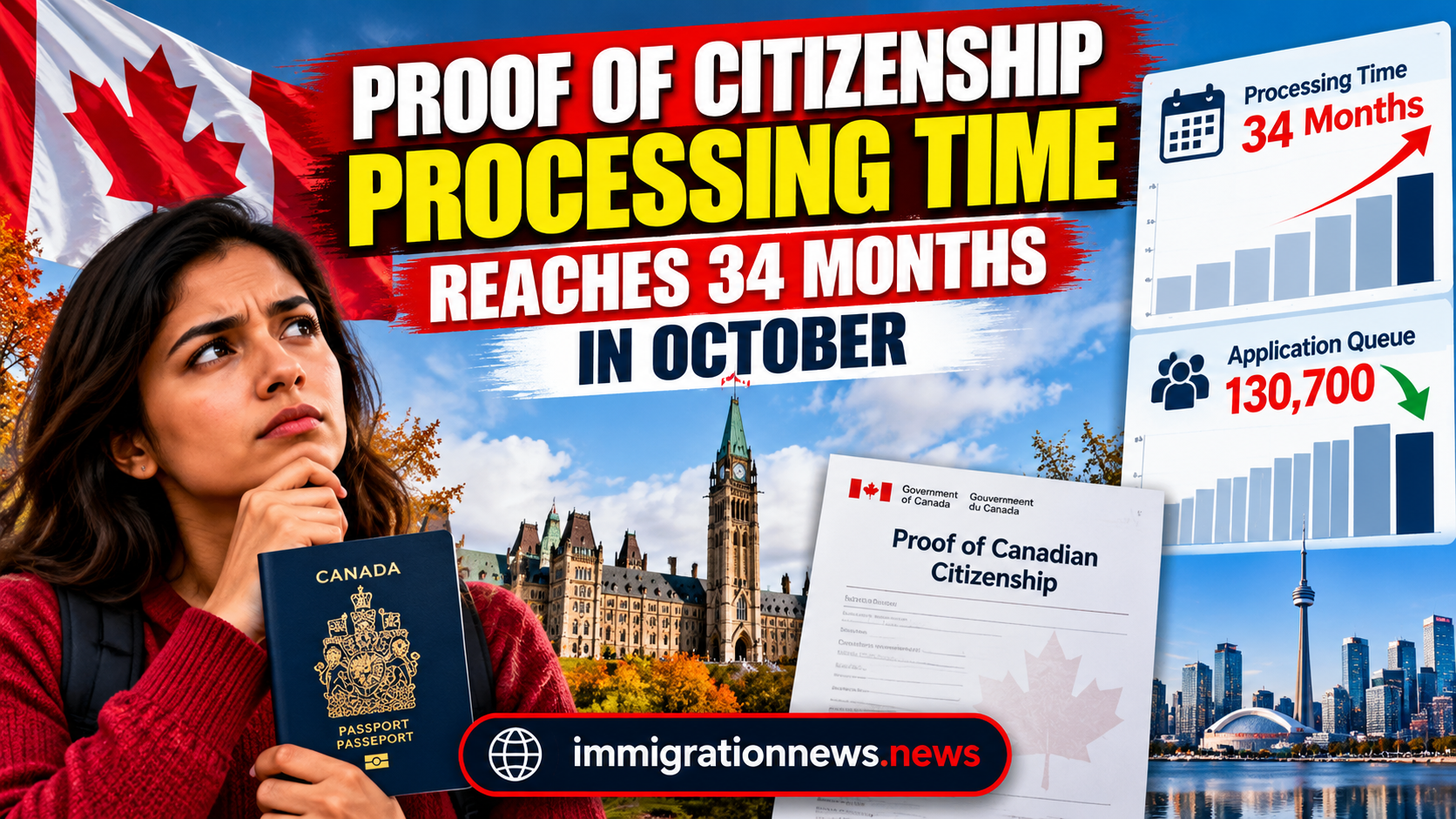
Canada’s proof of citizenship processing time has climbed to 34 months, according to Immigration, Refugees and Citizenship Canada’s (IRCC) October 2026 update. The figure, updated on October 9, represents a one-month increase from September’s 33-month estimate, but it also marks a sharp slowdown in the rate at which the quoted waiting time has been rising.
At the same time, the number of applicants waiting for a decision fell for the first time since Canada expanded citizenship-by-descent eligibility under Bill C-3 in December 2025. IRCC’s reported queue declined from 136,000 applicants in September to 130,700 in October, a reduction of 5,300 people.
These two developments offer a possible sign of a change in the backlog’s trajectory, although one monthly decline does not establish a lasting trend. For applicants seeking a Canadian citizenship certificate through descent, the immediate reality remains a lengthy wait and the need to submit complete, well-supported applications.
The latest Canada proof of citizenship processing time is especially important for people who may have become Canadian citizens automatically under the expanded citizenship rules but still need official documentation to confirm their status.
Canada Proof of Citizenship Processing Time: October 2026 Update
The latest figures show that the Canada proof of citizenship processing time increased from 33 months in September to 34 months in October 2026. IRCC updated its processing-time tool on October 9, making the latest estimate relevant to people preparing new citizenship certificate applications.
The increase is much smaller than those recorded over the preceding months. From May to September, the quoted processing time rose progressively faster, reaching an eight-month increase in September alone. October’s one-month rise represents a notable slowdown in that pattern.
The figures below show how the estimate has changed since May.
| IRCC reading | Quoted processing time | Increase from previous reading | Percentage increase |
|---|---|---|---|
| May 2026 | 12 months | +2 months | 20.0% |
| June 2026 | 15 months | +3 months | 25.0% |
| July 2026 | 19 months | +4 months | 26.7% |
| August 2026 | 25 months | +6 months | 31.6% |
| September 2026 | 33 months | +8 months | 32.0% |
| October 2026 | 34 months | +1 month | 3.0% |
The percentage increases compare the change in the quoted processing time with the previous month’s estimate. They are not a measure of how many additional applications IRCC received.
The department had previously reduced its estimate from 11 months to 10 months in March 2026. Since that point, the waiting time has increased substantially, with the October figure more than three times the March estimate.
Although the latest increase is comparatively small, applicants should not interpret it as a return to normal processing. A quoted wait of 34 months still represents a substantial period for people who need official proof of Canadian citizenship.
Citizenship Application Queue Falls for the First Time Since Bill C-3
The second major development in October is the reduction in the number of applicants waiting for a decision.
IRCC’s reported queue fell from 136,000 people in September to 130,700 in October. That is a decrease of 5,300 applicants, or approximately 3.9%.
The decline breaks the pattern of consecutive monthly increases following the expansion of citizenship-by-descent eligibility in December 2025.
Previous months had brought substantial additions to the queue. August recorded an increase of 22,300 applicants, while September added another 14,200. The October decline is therefore a notable departure from the figures reported during the preceding months.
A smaller queue may indicate that IRCC finalized more applications than it received during the period, although the department’s reported figures alone do not establish the precise reasons for the reduction.
It is also important to distinguish the number of people waiting from the quoted processing time. These are related but different measures. A decline in the queue does not automatically mean that new applications will be processed quickly, particularly if the department continues to receive a high volume of applications or must spend additional time reviewing complex cases.
For anyone following the Canada proof of citizenship processing time, the October figures provide a reason to watch the next update carefully. A further reduction in the queue could suggest that the backlog is beginning to stabilise, but one month of data is not enough to establish a sustained improvement.
Why Is Proof of Canadian Citizenship Taking So Long?
The large backlog is closely connected to changes in Canada’s citizenship-by-descent rules.
On December 15, 2025, Bill C-3 came into effect, changing the first-generation limit on citizenship by descent in certain circumstances. Before the change, Canadian citizenship generally could not be passed automatically to children born abroad beyond the first generation, subject to specific exceptions and historical rules.
The new legislation expanded eligibility for some people born outside Canada in the second generation or later before the law took effect. This means some individuals who previously could not obtain citizenship under the former rules may now qualify.
The change opened the possibility of Canadian citizenship to more people with family connections to Canada, including individuals living in the United States and other countries. However, eligibility depends on the applicant’s circumstances and the relevant citizenship rules; having a Canadian ancestor alone does not automatically establish that someone is a Canadian citizen.
People who believe they became citizens under the revised law can apply for a citizenship certificate. IRCC then reviews their records to determine whether they qualify and, if they do, issues proof of citizenship.
The expansion created additional demand for certificates at a time when the department was already managing existing applications. As more people sought to establish their status, the number of applications awaiting decisions increased.
The rise in the Canada proof of citizenship processing time therefore needs to be understood in the context of both the legal change and the volume of applications that followed it.
What Does the 34-Month Processing Time Actually Mean?
A quoted processing time is an estimate of how long an application may take, not a guaranteed deadline for every applicant.
The 34-month figure is particularly relevant to people submitting a new proof of citizenship application. It should not automatically be interpreted as a promise that every application will be completed in exactly 34 months.
Some cases may be more straightforward than others. Applicants with clear, consistent records demonstrating the relevant family relationships may avoid some of the additional review that can arise when documents are missing or information conflicts.
Other applications may require further examination, additional records or clarification of family relationships. These issues can make individual processing times differ from the general estimate.
Applicants should also distinguish a proof of citizenship application from an application to become a Canadian citizen through naturalisation. A citizenship certificate is used to establish or document citizenship status; it is not the same process as applying for citizenship after meeting permanent-residence and other eligibility requirements.
For applicants whose citizenship status arises through descent, the certificate can be an essential document for obtaining a Canadian passport and demonstrating citizenship when required.
The current Canada proof of citizenship processing time makes it especially important to plan ahead if the certificate is needed for employment, education, travel or another time-sensitive purpose.
Can You Get a Canadian Citizenship Certificate Faster?
IRCC may consider requests for urgent processing in specific circumstances. However, urgent processing is not available simply because an applicant is unhappy with the normal waiting time or would prefer a quicker decision.
The department assesses each request on its individual facts. Applicants need to explain why they require the certificate sooner and provide documents supporting their circumstances.
IRCC identifies several situations in which urgent processing may be considered, including:
- Avoiding certain situations involving harm or hardship.
- Moving a minor child to Canada when the child has a Canadian parent.
- Addressing a case involving statelessness.
- Travelling because of a death or serious illness in the family when the applicant cannot obtain a passport in their other nationality.
- Giving up foreign citizenship by a particular deadline.
- Applying for a job, avoiding the loss of a current job or attending an educational institution.
- Accessing certain social benefits, such as a pension, healthcare or a social insurance number.
These are examples of qualifying circumstances, and applicants should review IRCC’s current instructions to determine whether their specific situation meets the requirements.
A request for urgent processing should include a clear explanation letter and supporting evidence. Depending on the circumstances, this could include a paid flight itinerary, an employer’s letter, a letter from an educational institution, a doctor’s note or a death certificate.
IRCC does not guarantee that an urgent request will be approved or that the certificate will arrive before a particular deadline. Incomplete applications will not be processed, even where the applicant has a pressing need.
People who have already submitted an application should follow IRCC’s instructions for requesting urgent processing rather than submitting a duplicate application.
How to Avoid Delays in a Citizenship-by-Descent Application
Although applicants cannot control the overall backlog, they can reduce the risk of avoidable delays by preparing their applications carefully.
The most important step is to establish the family relationship through which citizenship may have been acquired. Depending on the case, this may involve records connecting the applicant to a Canadian parent, grandparent or more distant ancestor, along with evidence showing that the relevant citizenship rules apply.
Applicants should ensure that names, dates and places of birth are consistent across the documents they submit. Differences in spelling, changes of surname, inconsistent dates or other discrepancies may require further explanation.
Where records are missing, applicants should investigate whether alternative evidence is available and follow IRCC’s document instructions. Depending on the circumstances, historical records from another country may help establish a family relationship or clarify an important detail.
A useful preparation checklist includes:
- Confirming the basis on which Canadian citizenship may have been acquired.
- Collecting the required birth, marriage and other relevant civil records.
- Checking names, dates and family relationships across generations.
- Reviewing the application instructions for the applicant’s particular circumstances.
- Providing explanations and supporting evidence for discrepancies.
- Following IRCC’s instructions where a required record cannot be obtained.
- Checking that the application is complete before submitting it.
A complete application does not guarantee faster processing than the published estimate. However, careful preparation can reduce the risk of avoidable requests for additional information.
With the Canada proof of citizenship processing time reaching 34 months, resolving documentary issues before submission is particularly important.
Should You Wait Before Applying for Proof of Citizenship?
For someone who appears to qualify, waiting solely in the hope that processing times will improve may not be beneficial.
The reported queue has grown substantially since the citizenship rules changed, and applicants who delay may ultimately join the queue later than they otherwise would have. At the same time, the October decline shows why it is not possible to assume that the backlog will continue growing at the same rate indefinitely.
There is no guarantee that waiting a few months will produce a shorter processing time for a new application. Equally, the latest figures do not prove that the queue has entered a sustained period of decline.
The more important first step is to establish whether the person is eligible and determine which application process applies to their situation.
Anyone considering applying should review the official citizenship-by-descent rules, identify the necessary supporting documents and avoid relying on ancestry alone as proof of eligibility.
People who may have become Canadian citizens automatically under Bill C-3 should also understand that applying for a certificate is the process through which IRCC reviews their circumstances and provides official proof of citizenship where eligibility is established.
Who May Qualify Under Canada’s Expanded Citizenship-by-Descent Rules?
Bill C-3 changed the rules governing the transmission of Canadian citizenship by descent. It may benefit some people born outside Canada in the second generation or later before December 15, 2025, who were excluded under the former first-generation limit or certain earlier rules.
The law also introduced a framework for certain children born or adopted abroad on or after December 15, 2025, whose Canadian parent was also born or adopted abroad. In these cases, the Canadian parent generally needs to demonstrate at least 1,095 days of physical presence in Canada before the child’s birth or adoption.
The requirements differ depending on when the person was born or adopted and the family’s citizenship history. Adoption cases may also follow distinct rules.
A person with a Canadian grandparent or more distant Canadian ancestor should therefore not assume that they automatically qualify without reviewing the legal requirements. The relevant family relationships, dates and circumstances matter.
If an individual believes the law made them a Canadian citizen, they can apply for a citizenship certificate so that IRCC can assess the case. The certificate can then serve as official proof of citizenship and support an application for a Canadian passport.
The expanded rules have made citizenship-by-descent eligibility relevant to more families, but the growing number of applicants has also contributed to demand for certificate processing.
What Should Applicants Expect in the Coming Months?
The October 2026 figures present two developments worth monitoring: the quoted wait increased by only one month, and the reported queue decreased for the first time since the citizenship rules were expanded.
Neither development alone establishes that processing conditions are improving sustainably. The next monthly update will help show whether the backlog continues to decline or whether the queue begins growing again.
Applicants should pay attention to both measures rather than focusing exclusively on the published wait. The processing-time estimate indicates how long a new application may take, while the queue offers a separate indication of how many people are awaiting decisions.
Changes in application volumes, staffing, case complexity and the number of applications finalised can all affect how the backlog develops. Without more information from IRCC, it would be premature to attribute the October decline to a particular operational change.
For people preparing new applications, the most practical approach remains to verify eligibility, follow the current document checklist and submit a complete application. Anyone with a qualifying urgent need should review the department’s urgent-processing criteria and provide evidence supporting the request.
FAQs : Canada Proof of Citizenship Processing Time
1. What is the Canada proof of citizenship processing time in October 2026?
IRCC’s October 9, 2026 update lists a processing time of 34 months for proof of Canadian citizenship. This is one month longer than September’s estimate of 33 months.
2. Why has the Canada Proof of Citizenship Processing Time increased?
The increase follows the expansion of citizenship-by-descent eligibility under Bill C-3, which took effect on December 15, 2025. The change made more people potentially eligible to apply for proof of citizenship, contributing to higher demand for certificates.
3. Is the citizenship application backlog getting smaller?
The reported queue fell from 136,000 applicants in September to 130,700 in October. This is the first decline reported in the figures provided since the rules changed, but one month does not establish a lasting trend.
4. Can I request urgent processing for my citizenship certificate?
Yes, IRCC considers urgent-processing requests in specified circumstances. Applicants must provide an explanation and supporting documents, and approval is not guaranteed.
5. Does having a Canadian ancestor automatically make me a citizen?
No. Eligibility depends on the applicable citizenship law and the person’s family history and circumstances. Bill C-3 expanded eligibility in certain cases, but having a Canadian ancestor alone does not prove citizenship.
6. Should I delay my application until processing times fall?
There is no guarantee that waiting will result in a shorter processing time. If you believe you qualify, review the eligibility rules and required documents before deciding when to apply.
7. What documents can help prevent delays?
Depending on the case, applicants may need birth certificates, marriage records and other documents establishing the relevant family relationships. Names, dates and other details should be consistent, and discrepancies should be explained with supporting evidence.
8. Does a citizenship certificate let me apply for a Canadian passport?
If IRCC confirms that you are a Canadian citizen and issues a certificate, that certificate can be used as proof of citizenship when applying for a Canadian passport, subject to the passport application requirements.
Final Takeaway On Canada Proof of Citizenship Processing Time
The Canada proof of citizenship processing time reached 34 months in October 2026, extending a period of substantial increases since the beginning of the year. However, the latest update also brought a notable change: the reported queue fell by 5,300 applicants, from 136,000 to 130,700.
The decline may indicate that the backlog is beginning to stabilise, but further updates are needed before drawing that conclusion. Applicants should continue to plan around the published processing estimate and avoid assuming that a recent reduction in the queue guarantees faster decisions.
For people who may qualify for citizenship by descent under Bill C-3, careful eligibility checks and complete supporting documentation remain essential. Those with a qualifying urgent need can request expedited processing, although IRCC does not guarantee approval or completion by a specific date.
Source : CIC News
Read About : Express Entry Draw October 13 Issues 752 PNP Invitations At CRS 772