The United Kingdom is tightening scrutiny of international student visa applications, with new figures revealing that nearly eight out of every 10 students called for a UKVI credibility interview were deemed non-credible and subsequently faced visa rejection.
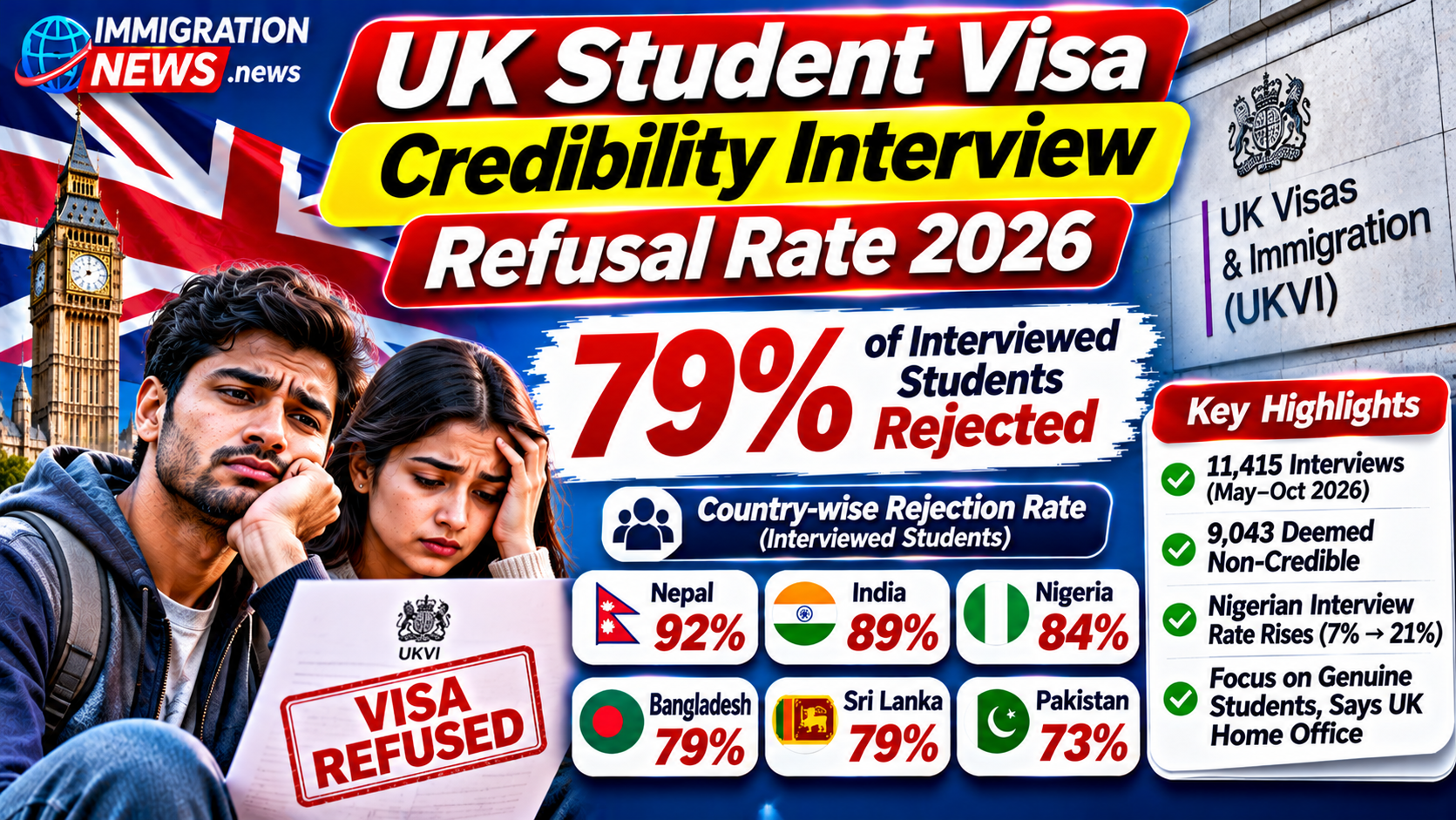
According to a UK Visas and Immigration (UKVI) sector briefing paper obtained by The PIE News, 9,043 out of 11,415 prospective international students interviewed between May and October 2026 were considered non-credible by UK immigration caseworkers.
This represents a rejection rate of approximately 79.2% among students who underwent credibility interviews.
The figures are particularly concerning for students from major international recruitment markets, including India, Nepal, Nigeria, Bangladesh, Sri Lanka and Pakistan.
Indian students recorded an 89% rejection rate among those interviewed, while the figure for Nepalese students reached 92%.
The findings raise fresh concerns for international students planning to pursue higher education in the UK, particularly those preparing applications for the next university intake.
The latest UK student visa credibility interview refusal rate 2026 figures also reveal that UKVI has increased interview scrutiny for certain nationalities. The proportion of Nigerian applicants invited for credibility interviews, for example, increased from 7% in 2025 to 21% in 2026.
However, the UK Home Office insists that stricter compliance measures are intended to identify genuine students rather than restrict international student recruitment.
Here is a detailed breakdown of the latest figures, country-wise rejection rates, reasons for visa refusals, the Home Office’s position and what prospective international students should do before attending a UKVI credibility interview.
UKVI Rejects 79% of Students Called for Credibility Interviews
The most significant finding from the latest UKVI briefing is the exceptionally high proportion of interviewed students who were considered non-credible.
Between May and October 2026, UKVI conducted 11,415 credibility interviews with prospective international students.
Of these, 9,043 were classified as non-credible.
<text weight=”medium” color=”secondary” size=”xs”>UKVI CREDIBILITY INTERVIEW DATA — MAY TO OCTOBER 2026</text>
| Indicator | Figures |
|---|---|
| Total interviews conducted | 11,415 |
| Students considered non-credible | 9,043 |
| Non-credible share | 79.2% |
| Remaining interviews | 2,372 |
| Remaining share | 20.8% |
The findings suggest that students selected for credibility interviews face a particularly challenging assessment process.
However, the distinction between interview rejection rates and overall visa refusal rates is important.
The 79% figure does not mean that 79% of all international students applying for UK visas were rejected.
It applies specifically to the group selected for credibility interviews during the six-month reporting period.
UKVI also cautioned that the figures covered only six months and should not necessarily be treated as representative of an entire year.
Nevertheless, the data highlights the importance of preparing for credibility assessments before submitting a UK student visa application.
Indian Students Face 89% Rejection Rate After UKVI Interviews
Indian students are among the largest international student groups in British universities.
However, the latest UKVI briefing reveals that Indian applicants who were called for credibility interviews experienced a particularly high rejection rate.
Approximately 89% of interviewed Indian students were deemed non-credible by UKVI caseworkers between May and October 2026.
This is a significant development for Indian students planning to study in the UK.
The figures suggest that applicants need to be prepared to explain their educational choices, university selection, financial circumstances and future career plans clearly.
Importantly, the 89% figure applies only to interviewed Indian applicants, not every Indian student visa applicant.
Students who are not selected for an interview are not represented in this particular statistic.
The findings also do not establish that nationality alone determines an individual’s visa outcome.
UKVI says student applications are assessed on their individual circumstances and available evidence.
For Indian applicants, the practical message is clear: choosing a university and obtaining an admission offer may not be enough. Students should also understand their course, their institution and how their education connects with their longer-term plans.
Country-Wise UK Student Visa Credibility Interview Rejection Rates
The UKVI briefing revealed substantial differences in the proportion of interviewed applicants considered non-credible across major international recruitment markets.
The highest reported figure was among Nepalese students, followed by Indian and Nigerian applicants.
Latest Country-Wise Rejection Figures
| Country | Interviewed students deemed non-credible |
|---|---|
| Nepal | 92% |
| India | 89% |
| Nigeria | 84% |
| Bangladesh | 79% |
| Sri Lanka | 79% |
| Pakistan | 73% |
<text color=”secondary” size=”xs”>Source: UKVI sector briefing paper reported by The PIE News. May–October 2026. Figures relate to interviewed applicants, not all student visa applications.</text>
The figures show that students from several important recruitment markets are facing increased scrutiny.
Nepal: Highest Interview Rejection Rate at 92%
Nepalese students recorded the highest rejection rate among the nationalities highlighted in the briefing.
Approximately 92% of interviewed Nepalese applicants were considered non-credible.
This means that only a relatively small proportion of the interviewed group avoided an adverse credibility assessment.
The figure is particularly significant for education consultants and institutions recruiting students from Nepal.
India: 89% of Interviewed Applicants Deemed Non-Credible
India recorded the second-highest reported rejection rate.
With 89% of interviewed Indian applicants deemed non-credible, the figures highlight the need for careful preparation among students planning to study in Britain.
Students should be able to explain their choice of course, university, academic progression and career objectives without relying on memorised answers.
Nigeria: 84% Rejection Rate
Nigerian students recorded an 84% rejection rate among those interviewed.
Nigeria also experienced a substantial increase in the proportion of applicants being invited for interviews.
UKVI specifically identified changing application patterns and additional scrutiny as reasons behind the increase.
Bangladesh: 79% Rejection Rate
Approximately 79% of interviewed Bangladeshi students were considered non-credible.
This places Bangladesh among the recruitment markets facing considerable scrutiny during the reporting period.
Sri Lanka: 79% Rejection Rate
Sri Lankan applicants also recorded a 79% rejection rate following credibility interviews.
The figures underline the importance of understanding the UK university and course selection process before applying.
Pakistan: 73% Rejection Rate
Pakistani students recorded the lowest rejection rate among the six nationalities listed in the briefing, at 73%.
However, this remains a substantial proportion of interviewed applicants.
It should also be noted that these percentages do not establish the overall student visa refusal rate for any of these nationalities.
UKVI Interviews for Nigerian Students Increased From 7% to 21%
Another important finding in the briefing concerns the increasing likelihood of Nigerian students being invited for credibility interviews.
Between 2025 and 2026, the proportion of Nigerian applicants invited to attend an interview increased from 7% to 21%.
<text weight=”medium” color=”secondary” size=”xs”>NIGERIAN STUDENT INTERVIEW SELECTION</text>
<box border radius=”lg” padding={3} gap={3}> <box gap={1}> <row align=”center” justify=”between”> **2025** <title size=”xl” color=”secondary” tabularNums>7%</title> </row> <box background=”surface-tertiary” radius=”full” height=”12px” clip> <box background=”#64748b” width=”7%” height=”12px” radius=”full”/> </box> </box> <box gap={1}> <row align=”center” justify=”between”> **2026** <title size=”xl” color=”danger” tabularNums>21%</title> </row> <box background=”surface-tertiary” radius=”full” height=”12px” clip> <box background=”#DC5555″ width=”21%” height=”12px” radius=”full”/> </box> </box> <badge color=”danger”>Three times the previous proportion</badge> <caption>Source: UKVI briefing paper reported by The PIE News.</caption> </box>
The increase means that Nigerian applicants were three times as likely to be invited for a credibility interview in 2026 compared with the previous year, based on the reported proportions.
UKVI explained that the change reflected evolving patterns and its understanding of risk within the Student route.
The department stated that it had seen an increase in Nigerian applications requiring additional scrutiny.
As a result, a greater proportion of applicants were being invited to attend credibility interviews.
This development is particularly important for Nigerian students preparing for future UK university intakes.
Applicants should ensure that their educational history, financial information and course choices are consistent and properly supported.
Why Is UKVI Rejecting So Many International Students After Interviews?
The briefing identified several recurring reasons why caseworkers considered applicants non-credible.
These reasons largely relate to the student’s understanding of their proposed education, financial circumstances and future plans.
1. Insufficient Research About the University
One of the most common concerns involved students who appeared to have limited knowledge of their chosen educational institution.
Applicants are expected to understand why they selected a particular university and what makes it suitable for their academic objectives.
Students should research:
- The university’s location.
- Its academic reputation and relevant facilities.
- The course structure.
- Available academic support.
- Relevant teaching and research facilities.
- The learning environment.
- Any specific course features that influenced their decision.
Simply knowing the university’s name is unlikely to demonstrate a well-informed decision.
2. Inability to Explain Why They Chose the UK
Applicants may also face credibility concerns if they cannot clearly explain why they want to study in the United Kingdom.
Students should be able to discuss why a UK qualification is relevant to their educational and professional objectives.
Their explanation should reflect their actual circumstances rather than generic statements about the UK being a popular study destination.
3. Weak Understanding of the Chosen Course
Another major concern involves applicants who cannot explain their proposed programme.
Students should understand:
- The main subjects or modules.
- The duration of the programme.
- The qualification they will receive.
- The academic level.
- How the programme builds on previous education.
- The knowledge and skills they expect to gain.
A student who cannot explain what they intend to study may struggle to convince a caseworker that their primary purpose is education.
4. Unclear Career Plans
UKVI also identified difficulties explaining how the selected university and programme align with an applicant’s future plans.
Students should be able to describe how the qualification relates to their intended career.
For example, someone applying for a postgraduate degree in computer science should understand how the programme’s subjects connect with their professional interests.
Applicants do not necessarily need to have a fixed job offer after graduation.
However, they should have a credible explanation of why the qualification is relevant to their ambitions.
5. Concerns About English Language Ability
English language ability can also influence the credibility assessment.
Students should be able to communicate effectively during the interview and demonstrate that they understand their intended course.
A caseworker may consider English language ability as part of the overall assessment.
However, the Home Office’s published guidance requires any refusal based on this factor to be properly justified.
6. Questions About the Credibility of Funds
Financial circumstances are another important area of scrutiny.
Applicants must satisfy the applicable financial requirements of the Student route.
They should understand who is funding their education, where the money comes from and how their tuition fees and living costs will be covered.
Any financial information provided in the visa application should be consistent with the applicant’s interview responses and supporting evidence.
Students Report Being Asked Unusual Questions During UKVI Credibility Interviews
Some of the most unusual examples reported by The PIE involved applicants being questioned about details that appeared to have little connection with their academic suitability.
These included students reportedly being unable to answer questions about:
- The number of trees on their university campus.
- The location of the nearest bus stop.
Such examples have raised concerns within the international education sector about the relevance and consistency of some interview questions.
Knowing every minor geographical detail about a university should not be confused with demonstrating genuine academic intentions.
The central question should be whether an applicant has made an informed decision about their education and can credibly explain their plans.
The published Home Office guidance requires caseworkers to consider the overall circumstances and evidence rather than treating any single factor as an automatic reason for refusal.
UK Home Office Says There Is No Cap on Genuine International Students
Despite the increase in scrutiny, the UK Home Office has rejected suggestions that the credibility interview process is being used to restrict international student numbers.
Speaking at the Universities UK International Student Recruitment Conference, Oliver Rae, head of work, study, family and Ukraine services at the Home Office, said the government did not have a cap on the number of international students it wanted to attract.
He emphasised that the focus was on ensuring that applicants were genuine students.
Rae also acknowledged that immigration decisions were not always correct.
He said that the number of credibility interviews had decreased year on year.
According to him, UKVI had become better at identifying specific risks and training caseworkers to assess individual applications more carefully.
The department’s position is that the objective is not to discourage genuine international students but to improve compliance and protect the integrity of the Student route.
However, the high rejection figures among interviewed applicants have raised questions about how consistently credibility assessments are being conducted.
Asylum Claims Continue to Influence UK Student Visa Scrutiny
Another sensitive issue highlighted in the UKVI briefing concerns asylum claims made by international students.
The document identified Pakistani students as the cohort most likely to claim asylum, followed by applicants from India, Bangladesh and Nigeria.
Concerns about asylum claims have become part of the wider debate surrounding international student recruitment and immigration compliance.
The UK government has previously introduced additional restrictions affecting student visa applications from certain nationalities over concerns about asylum claims.
These measures have included a student visa brake affecting nationals of:
- Afghanistan.
- Cameroon.
- Sudan.
- Myanmar.
The issue has created challenges for universities that depend on international recruitment while also needing to comply with Home Office sponsorship requirements.
However, an asylum claim made by another person of the same nationality does not automatically make an individual student application non-genuine.
UKVI must assess applications individually under the applicable Immigration Rules.
Students should therefore avoid assuming that their nationality alone determines the outcome of their application.
What Does UKVI Official Guidance Say About Genuine Student Assessments?
The Home Office’s published Student and Child Student caseworker guidance explains how immigration officers assess whether an applicant is a genuine student.
Under paragraph ST 5.1 of Appendix Student, applicants must satisfy the genuine student requirement.
Caseworkers consider the application as a whole, including information obtained during a credibility interview where applicable.
Factors can include:
- Immigration history.
- Previous visa refusals.
- Previous compliance with visa conditions.
- Educational background.
- Reasons for choosing the proposed course.
- Knowledge of the sponsoring institution.
- Academic progression.
- Future study and career plans.
- English language ability.
- Financial circumstances.
Importantly, the guidance states that caseworkers must not refuse an applicant on genuineness grounds without an interview, except in specified circumstances.
Where a refusal is made on credibility grounds, the decision letter must clearly explain the allegations, reasoning and evidence supporting the conclusion.
The decision must be based on the balance of probabilities.
This means that the caseworker must decide whether it is more likely than not that the applicant is a genuine student.
Official guidance:
UK Government – Student and Child Student Caseworker Guidance
How Can Indian Students Prepare for a UKVI Credibility Interview?
Given the latest UK student visa credibility interview refusal rate 2026 figures, prospective applicants should take interview preparation seriously.
The objective should not be to memorise scripted answers.
Instead, students should understand their own applications and be able to explain their decisions naturally.
Research Your University Properly
Before attending an interview, understand the institution you have selected.
Research its location, course structure, teaching facilities and the academic features that influenced your decision.
You should be able to explain why you chose that university over other institutions.
Understand Every Part of Your Course
Read the official course information provided by your university.
Understand the main modules, assessment methods, duration and qualification.
Be prepared to explain why the programme is suitable for your educational background.
Prepare a Clear Explanation of Why You Chose the UK
Think about why studying in Britain makes sense for your circumstances.
Your answer should relate to the actual course, institution and academic objectives rather than simply referring to the UK’s reputation.
Explain Your Career Plans
Be prepared to discuss how your qualification connects with your future professional goals.
Your plans should be realistic and consistent with your previous education and chosen programme.
Understand Your Financial Arrangements
Know who is paying for your education and how tuition fees and living costs will be covered.
If your parents or another sponsor are funding your studies, understand their financial circumstances and the source of the funds.
Ensure Your Application and Interview Answers Match
Inconsistencies between the application, financial documents and interview responses can create credibility concerns.
Review your submitted application before attending the interview.
If there is an error or an important change in your circumstances, address it honestly.
Speak Naturally Rather Than Memorising Answers
Memorised answers can sound artificial, particularly when an applicant struggles to explain follow-up questions.
Students should understand the subject well enough to answer questions in their own words.
The strongest preparation is based on genuine knowledge rather than rehearsed scripts.
What Can Students Do If UKVI Rejects Their Student Visa Application?
A UK student visa refusal can be particularly difficult for applicants who have already paid university deposits, arranged accommodation or made plans to travel.
However, a refusal does not necessarily mean that the applicant has no further options.
The appropriate next step depends on the refusal grounds and the applicant’s circumstances.
Read the Refusal Letter Carefully
The first step is to understand exactly why the application was refused.
The refusal letter should explain the decision and the reasons behind it.
If the refusal relates to credibility, applicants should identify which statements or parts of their application were considered insufficient or inconsistent.
Consider Administrative Review
Where an applicant believes that UKVI made a caseworking error, an administrative review may be available.
Administrative review is not a general appeal or an opportunity simply to submit a stronger new application.
It is intended to examine whether the original decision contained a caseworking error.
Eligibility, deadlines and the applicable procedure depend on the type of application and refusal.
Consider a Fresh Application
Some students may decide to submit a new application after addressing the problems identified in the refusal.
This may involve improving supporting evidence, correcting inconsistencies or providing a clearer explanation of their educational and financial circumstances.
A new application should not simply repeat the previous submission without addressing the reasons for refusal.
Seek Professional Immigration Advice
Applicants facing complicated credibility refusals may benefit from advice from an appropriately regulated UK immigration adviser or solicitor.
This can be particularly important when the refusal involves allegations of deception, inconsistent financial evidence or questions about the genuineness of the student’s intentions.
Does a UK Student Visa Refusal Mean All Indian Applicants Are at Risk?
No.
The 89% rejection figure applies specifically to Indian applicants who attended credibility interviews during the six-month period.
It does not mean that 89% of all Indian student visa applications were refused.
Separate Home Office statistics provide a different picture.
For the year ending June 2026, the overall refusal rate for main-applicant Student route decisions was approximately 4.6%, calculated using refusals as a share of grants and refusals.
The same dataset shows an estimated 4.2% refusal rate for Indian main applicants.
These figures are based on a different reporting period and methodology from the UKVI credibility interview briefing.
The distinction is essential:
| Measure | What it represents |
|---|---|
| 79% overall interview rejection | Interviewed applicants considered non-credible |
| 89% Indian interview rejection | Interviewed Indian applicants considered non-credible |
| 4.6% overall Student route refusal | Refused applications as a share of grants and refusals |
| 4.2% Indian Student route refusal | Refused Indian main-applicant applications as a share of grants and refusals |
The two sets of figures cannot be directly compared as if they measure the same population.
The interview data identifies a selected group of applicants facing additional scrutiny, while the overall refusal figures cover the wider student visa route.
This means genuine Indian students can still obtain UK student visas if they meet the applicable requirements.
What Does the Latest UK Student Visa Rejection Data Mean for Universities?
The latest figures also have important implications for British universities and international recruitment agencies.
International students contribute significantly to university finances, research activity and the UK’s wider education economy.
Higher rejection rates among interviewed applicants can create several challenges.
Uncertainty in recruitment: Universities may find it more difficult to predict how many international applicants will successfully obtain visas.
Financial pressure: Students who receive refusals may withdraw from their intended courses, potentially affecting university income.
Increased compliance responsibilities: Education providers may need to strengthen their admissions checks and ensure that applicants understand their chosen programmes.
Market diversification: Universities may reconsider recruitment strategies to reduce dependence on a small number of international markets.
Greater student support: Institutions may need to provide more detailed pre-visa guidance to help applicants understand their academic choices and visa responsibilities.
The Home Office maintains that it does not intend to restrict genuine international student recruitment.
However, the latest figures demonstrate how important visa compliance has become for universities recruiting overseas.
Conclusion: UKVI Credibility Interviews Are Becoming a Major Challenge for International Students
The latest UK student visa credibility interview refusal rate 2026 figures reveal a challenging situation for international students selected for additional scrutiny.
UKVI considered 79% of interviewed applicants non-credible between May and October 2026, with the rejection rate reaching 89% among interviewed Indian students and 92% among Nepalese applicants.
The increase in interview selection among Nigerian students further highlights how UKVI is adjusting its scrutiny based on changing risk assessments.
For prospective students, the message is clear: securing admission to a British university is only one part of the visa process.
Applicants must also demonstrate that they understand their course, have genuine academic intentions, can explain their university selection and meet the applicable financial and immigration requirements.
At the same time, the high interview rejection figures should not be interpreted as the overall UK student visa refusal rate.
The Home Office says it remains interested in attracting genuine international students and insists that applications are assessed individually.
For students from India, Nepal, Nigeria, Pakistan, Bangladesh and other major recruitment markets, careful preparation and accurate documentation will remain essential when applying to study in the United Kingdom.
FAQs : UK Student Visa Credibility Interview Refusal Rate 2026
1. What is the UK student visa credibility interview rejection rate in 2026?
According to the UKVI briefing covering May to October 2026, approximately 79% of prospective international students selected for credibility interviews were considered non-credible.
2. How many students were rejected after UKVI credibility interviews?
Of 11,415 interviews conducted between May and October 2026, 9,043 applicants were considered non-credible by UKVI caseworkers.
3. What is the UK student visa interview rejection rate for Indian students?
Approximately 89% of Indian students interviewed during the May–October 2026 period were considered non-credible. This figure applies only to interviewed applicants, not all Indian student visa applications.
4. Which country has the highest UKVI student interview rejection rate?
Nepal recorded the highest rejection rate among the nationalities highlighted in the briefing, with 92% of interviewed applicants considered non-credible.
5. What is the UK student visa interview rejection rate for Nigerian students?
Approximately 84% of Nigerian students interviewed between May and October 2026 were considered non-credible.
6. Why are UK student visas being rejected after credibility interviews?
Common reasons include insufficient knowledge of the chosen university, inability to explain course selection, unclear career plans, limited understanding of the programme, English language concerns and questions about the credibility of financial arrangements.
7. Are all Indian students facing an 89% UK student visa rejection rate?
No. The 89% figure applies only to Indian applicants selected for credibility interviews. It does not represent the refusal rate for all Indian student visa applicants.
8. Can UKVI reject a student visa because the applicant does not know enough about their university?
Yes, insufficient knowledge of the university and course can contribute to a finding that an applicant is not a genuine student. However, caseworkers must assess the overall application and explain the reasons for a credibility refusal.
9. What questions are asked in a UKVI credibility interview?
Questions may cover university selection, course modules, academic history, reasons for studying in the UK, future career plans, English language ability and financial arrangements.
10. Do all UK student visa applicants have to attend a credibility interview?
No. UKVI may invite applicants for an interview when further assessment of their genuine student intentions is required. The department does not interview every student visa applicant.
11. Why are more Nigerian students being called for UKVI interviews?
UKVI reported that the proportion of Nigerian applicants invited for interviews increased from 7% in 2025 to 21% in 2026. The department attributed this to changing application patterns and the need for additional scrutiny.
12. Can a UK student visa be rejected because of poor English communication?
English language ability can be considered when assessing whether an applicant is a genuine student. However, any refusal relying on this factor must be properly justified under Home Office guidance.
13. Can I apply again after a UK student visa refusal?
Depending on the circumstances, an applicant may submit a fresh application after addressing the refusal reasons. An administrative review may also be available where the applicant believes that UKVI made a caseworking error.
14. Does a UKVI credibility interview refusal mean I can never study in the UK?
No. A refusal does not automatically prevent future applications. However, applicants should carefully address the reasons for the original decision before applying again.
15. Is the UK government planning to stop international student recruitment?
The Home Office has stated that there is no cap on the number of genuine international students it wants to attract. Its stated focus is on immigration compliance and ensuring applicants meet the genuine student requirement.
16. What is the overall UK student visa refusal rate in 2026?
Separate Home Office statistics indicate an approximately 4.6% refusal rate for main-applicant Student route decisions in the year ending June 2026, calculated as refusals divided by grants plus refusals. This is different from the 79% interview rejection figure.
17. What is the best way to prepare for a UKVI credibility interview?
Applicants should thoroughly research their university and course, understand their academic history, prepare realistic career plans, know their financial arrangements and answer questions naturally and honestly.
18. Where can I find official UK student visa requirements?
Applicants can consult the official UK Government Student visa guidance at https://www.gov.uk/student-visa and the Home Office’s Student route caseworker guidance.
Source : The Pie News
Read About : UK Care Worker Settlement Rules: 5-Year Route Kept While Most Migrants Face A 10-Year Wait