
India is stepping up efforts to attract international universities as it seeks to strengthen higher education, expand research opportunities and establish itself as a global education destination.
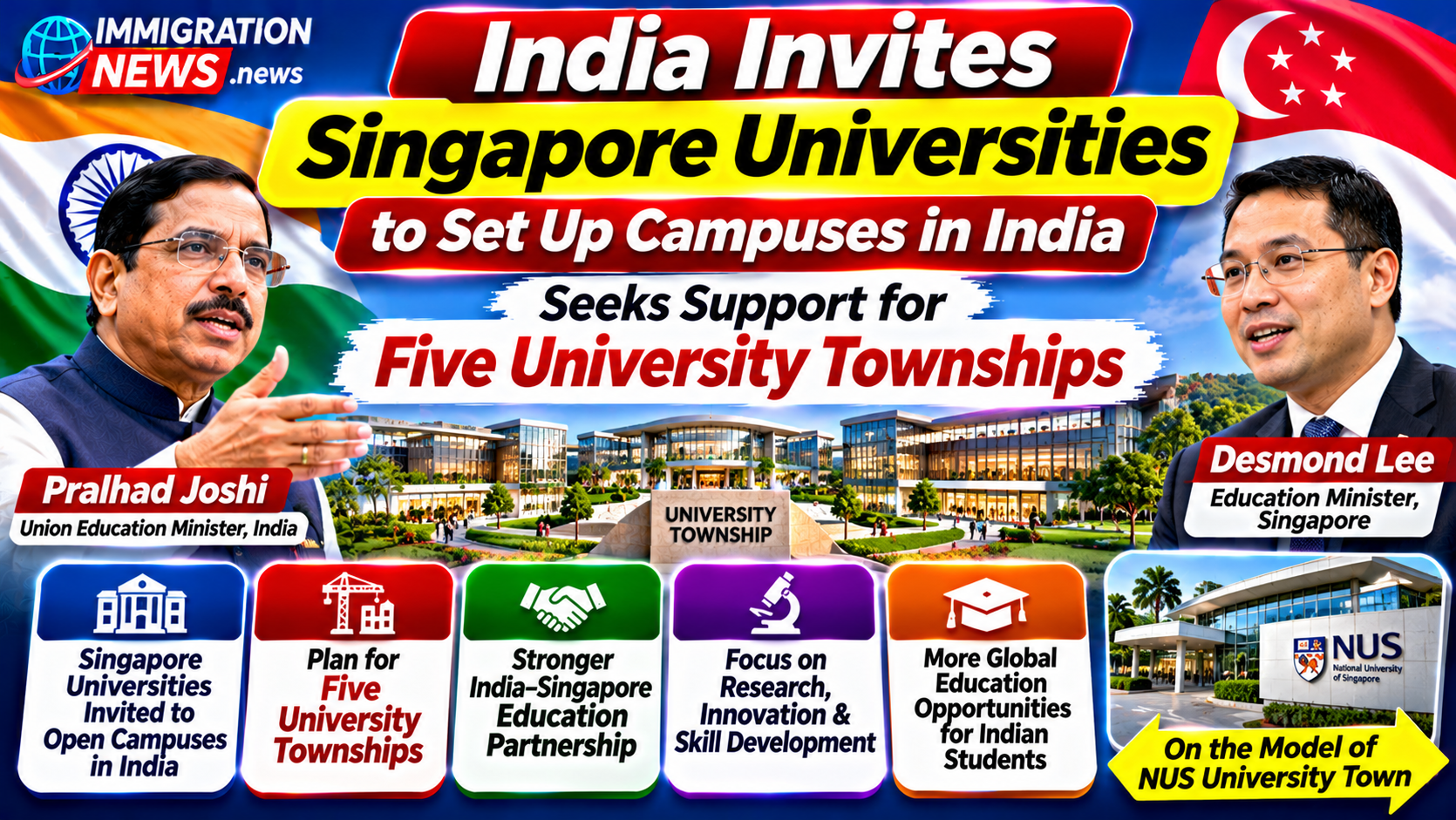
Union Education Minister Pralhad Joshi has invited Singaporean universities to establish campuses in India and sought Singapore’s expertise in developing five proposed university townships across the country.
The proposals were discussed during a bilateral meeting with Singapore’s Education Minister Desmond Lee at Singapore Management University (SMU). The discussions covered higher education, research, innovation, skill development and international academic cooperation.
A major highlight is India’s plan to develop five integrated university townships near major industrial and logistics corridors. The government is exploring Singapore’s experience, particularly the National University of Singapore’s University Town model, to help shape these proposed academic hubs.
The initiative could create new opportunities for Indian students, researchers, universities and international education providers. However, the invitation does not mean that any Singaporean university has formally agreed to establish a campus in India.
Singapore Universities in India: What Has the Government Proposed?
The Indian government wants to attract more foreign universities and encourage international institutions to establish a presence in the country.
During his meeting with Desmond Lee, Pralhad Joshi invited Singaporean universities to explore opportunities to establish campuses in India.
The proposal forms part of India’s broader ambition to improve higher education quality, increase international academic collaboration and provide students with access to globally recognised educational institutions.
Singapore has several internationally recognised universities, including:
- National University of Singapore (NUS).
- Nanyang Technological University (NTU).
- Singapore Management University (SMU).
These institutions represent potential areas for future academic cooperation. However, none has been confirmed as a campus partner under the latest announcement.
India already has a regulatory framework allowing eligible foreign higher education institutions to establish campuses in the country, subject to applicable conditions and approvals.
Attracting Singaporean universities could benefit both countries. Singaporean institutions could reach a larger student population, while Indian students could gain additional access to international academic programmes without necessarily relocating overseas.
India Plans Five University Townships Near Industrial and Logistics Corridors
One of the most important aspects of the India-Singapore education discussions is India’s proposal to develop five university townships.
The Union Budget 2026–27 proposed establishing five such townships near major industrial and logistics corridors.
The proposed academic hubs are intended to bring together universities, colleges, research institutions, skill development centres and residential facilities within integrated educational ecosystems.
The initiative aims to strengthen connections between education, research and industry rather than treating them as separate activities.
The proposed townships are expected to include:
- Universities and higher education institutions.
- Research and innovation centres.
- Skill development and vocational training facilities.
- Student accommodation and residential infrastructure.
- Industry-linked educational facilities.
- Shared academic and collaborative learning spaces.
The Ministry of Education has initiated consultations with state governments, academic institutions and industry representatives to advance the proposal.
Seeking Singapore’s expertise is intended to help India draw on international experience in planning and developing integrated university environments.
However, the government has not yet confirmed the final locations, development schedules or institutional partners for all five townships.
Why India Wants to Follow the NUS University Town Model
India is particularly interested in the University Town model developed by the National University of Singapore.
The NUS University Town, commonly known as UTown, is an integrated academic and residential environment designed to encourage collaboration among students, faculty members and researchers.
Unlike conventional university campuses that separate academic buildings from residential facilities, this model brings several educational and community facilities together.
Its main features include:
- Academic and learning spaces.
- Residential colleges and student accommodation.
- Research and collaboration facilities.
- Shared study environments.
- Community and recreational infrastructure.
- Opportunities for interdisciplinary interaction.
The model encourages students from different academic backgrounds to interact, exchange ideas and participate in collaborative activities.
India’s interest in this approach reflects a growing focus on developing universities as complete educational ecosystems rather than simply expanding the number of colleges and classrooms.
If successfully implemented, the five proposed university townships could provide students with improved research facilities, industry exposure and multidisciplinary learning opportunities.
India-Singapore Education Partnership to Expand in Research and Innovation
The discussions between the two education ministers extended beyond university campuses and township development.
Both countries explored opportunities to strengthen cooperation across school education, higher education, skill development, research and innovation.
Several areas were identified for deeper academic collaboration.
Mutual Recognition of Academic Qualifications
India and Singapore discussed mutual recognition of academic qualifications.
This could help strengthen academic mobility and make it easier for students and professionals to pursue educational and career opportunities across the two countries.
However, the discussions do not amount to a final agreement covering automatic recognition of every qualification.
Student and Faculty Exchange Programmes
Both sides explored opportunities to expand student and faculty exchanges.
Such programmes could allow Indian and Singaporean students to gain international academic exposure, participate in collaborative projects and experience different education systems.
Faculty exchanges could also help universities share teaching practices, research expertise and institutional knowledge.
Joint Research and Capacity Building
The two countries also discussed joint capacity-building programmes and stronger partnerships between universities and industry.
These initiatives could help academic institutions improve research capabilities while ensuring that students develop skills relevant to emerging employment opportunities.
Stronger Industry-Academia Partnerships
An important objective is to connect universities more closely with businesses and industries.
This could provide students with access to practical training, research projects, internships and employment-oriented learning.
Such collaboration is particularly important in technology-intensive sectors where industry requirements continue to evolve.
AI, Semiconductors and Clean Energy Among Key Areas of Cooperation
India and Singapore also discussed expanding cooperation in emerging technology sectors.
The areas identified include artificial intelligence, advanced materials, clean energy, financial technology and semiconductors.
These sectors are increasingly important for economic growth, industrial development and future employment.
| Sector | Potential cooperation |
|---|---|
| Artificial Intelligence | AI research, education and innovation |
| Advanced Materials | Research and development |
| Clean Energy | Sustainable technologies |
| Financial Technology | FinTech research and innovation |
| Semiconductors | Advanced technology and industry-linked research |
| Deep Technology | Startup development and commercialisation |
Artificial intelligence is becoming increasingly important in education, employment and industrial development.
Collaboration in this area could help universities develop relevant academic programmes while supporting research into emerging technologies.
The discussions also included cooperation through India’s Bharat Innovates initiative to support deep-tech startups and entrepreneurs.
The broader objective is to create stronger connections between academic research, technological innovation and commercial applications.
Fifth India-Singapore Hackathon Proposed for 2027
Another important development was Joshi’s proposal to host the fifth India-Singapore Hackathon in India in 2027.
The hackathon provides students from both countries with an opportunity to work together on practical challenges involving technology, innovation and sustainability.
The fourth Singapore-India Hackathon 2026 was held at Singapore Management University from November 15 to 17.
The event brought together approximately 120 students from Indian and Singaporean educational institutions.
Participants worked on developing solutions to challenges involving technology, financial services and sustainability.
Hosting the fifth edition in India could provide another opportunity for students, researchers and young entrepreneurs to collaborate internationally.
Proposal for a Regular Higher Education Conference
Joshi also proposed organising a regular conference involving higher education institutions from both countries.
The proposed conference could provide universities with a platform to:
- Share research findings and academic developments.
- Explore joint research opportunities.
- Discuss student and faculty exchange programmes.
- Develop institutional partnerships.
- Strengthen international academic cooperation.
The proposal is intended to create a more consistent channel for collaboration beyond individual meetings and events.
How the Initiative Fits India’s National Education Policy 2020
India’s efforts to attract Singaporean universities are closely linked to the objectives of the National Education Policy (NEP) 2020.
The policy aims to transform India’s education system through multidisciplinary learning, internationalisation, research, innovation and improved academic quality.
One of its broader objectives is to strengthen India’s position as a global destination for higher education.
The government has taken several steps towards this goal, including allowing eligible foreign universities to establish campuses in India under a dedicated regulatory framework.
The University Grants Commission’s 2023 regulations provide a framework for foreign higher education institutions to establish campuses in India, subject to eligibility requirements and regulatory approval.
The invitation to Singaporean universities could therefore support India’s efforts to expand international academic partnerships.
It may also encourage greater competition, institutional collaboration and new opportunities for Indian students.
How Could Singapore Universities in India Benefit Indian Students?
If Singaporean universities decide to establish campuses in India, the development could have several implications for students.
More International Education Options
Students could potentially access programmes offered by Singaporean institutions without having to relocate overseas.
This may provide additional choices for students interested in international qualifications and academic exposure.
Greater Research Opportunities
Partnerships between Indian and Singaporean institutions could create opportunities for joint research, collaborative projects and access to advanced research facilities.
Industry-Relevant Skills
Cooperation in artificial intelligence, semiconductors, clean energy and financial technology could support programmes designed around emerging employment requirements.
International Academic Exposure
Student exchanges, visiting faculty programmes and joint research initiatives could help students develop international experience and professional networks.
Potential Accessibility Benefits
Having more international institutions operating in India could provide additional options for students seeking an international academic environment without necessarily moving abroad.
However, tuition fees, admission requirements, scholarship availability and programme recognition would depend on individual institutions and their eventual campus arrangements.
Have Any Singapore Universities Confirmed Campuses in India?
The latest announcement concerns an invitation and discussions about future cooperation.
There has been no formal confirmation in the cited announcements that a Singaporean university has committed to opening a campus in India under this initiative.
Similarly, Singapore’s participation in developing the five university townships remains at the discussion and expertise-sharing stage.
The next steps will likely involve institutional consultations, regulatory considerations, potential partnerships and decisions about the development model.
Students should therefore avoid treating the announcement as confirmation that admissions to new Singaporean university campuses in India are about to begin.
What Happens Next?
The next stage will involve taking the proposals from bilateral discussions towards practical implementation.
Several developments will be important to watch:
- Whether Singaporean universities formally express interest in establishing Indian campuses.
- Whether Singapore provides technical or institutional expertise for the proposed university townships.
- Which states and industrial corridors are selected for the five townships.
- Whether joint research and academic exchange programmes are announced.
- Whether India confirms arrangements for hosting the fifth Singapore-India Hackathon in 2027.
- Whether a regular India-Singapore higher education conference is established.
The success of the initiative will depend on how quickly the two countries move from discussions to formal partnerships and implementation.
Conclusion: Singapore Universities in India Could Transform Higher Education Opportunities
India’s invitation to Singaporean universities marks an important development in the country’s efforts to internationalise higher education.
The proposal to establish more foreign university campuses, combined with Singapore’s potential support for five university townships, reflects India’s ambition to create stronger academic, research and industry-linked educational ecosystems.
The discussions also cover student exchanges, mutual recognition of qualifications, advanced technology research, deep-tech startups and international innovation programmes.
For Indian students, the potential benefits could include more international academic opportunities, stronger research infrastructure and closer connections with global industries.
However, the proposals are still at an early stage. Formal commitments from Singaporean universities, regulatory approvals and implementation plans will determine how quickly these ambitions translate into opportunities on the ground.
For now, the initiative signals a growing India-Singapore education partnership and another step towards positioning India as a major international higher education destination.
FAQs : Singapore Universities in India
1. Has India invited Singapore universities to open campuses in India?
Yes. Union Education Minister Pralhad Joshi invited Singaporean universities to explore establishing campuses in India during a bilateral meeting with Singapore’s Education Minister Desmond Lee in November 2026.
2. Which Singapore universities could establish campuses in India?
The National University of Singapore, Nanyang Technological University and Singapore Management University are prominent Singaporean institutions. However, none has been confirmed as a campus partner under the latest announcement.
3. How many university townships is India planning?
India is planning five university townships near major industrial and logistics corridors under the Union Budget 2026–27.
4. What is the NUS University Town model?
The NUS University Town model is an integrated academic and residential environment that brings together educational facilities, student accommodation, research spaces and collaborative learning infrastructure.
5. Will Singapore universities offer admission in India soon?
No admission timeline has been announced. The government has invited Singaporean institutions to explore campus opportunities, but formal participation and implementation details are still awaited.
6. What is the India-Singapore education partnership focusing on?
The discussions cover higher education, student and faculty exchanges, mutual recognition of qualifications, research, skill development, artificial intelligence, semiconductors, clean energy, FinTech and deep technology.
7. When will the fifth India-Singapore Hackathon take place?
Pralhad Joshi has proposed hosting the fifth India-Singapore Hackathon in India in 2027. Formal arrangements are yet to be announced.
8. How could Indian students benefit from Singapore university campuses?
Potential benefits include access to international academic programmes, research opportunities, student exchanges, industry collaboration and exposure to global education practices.
9. Are the five university townships already under construction?
The government has initiated consultations with relevant stakeholders. Specific locations, development schedules and implementation arrangements have not yet been confirmed in the cited announcement.
10. Which policy supports foreign universities establishing campuses in India?
The National Education Policy 2020 supports internationalisation of Indian higher education. The UGC’s 2023 regulations provide the regulatory framework for eligible foreign universities to establish campuses in India.
Source : Entrepreneur India
Read About : India New Visa Rules 2026: Tourist Visa Replaced by Visitor Visa, Application Paperwork Cut by 70%