
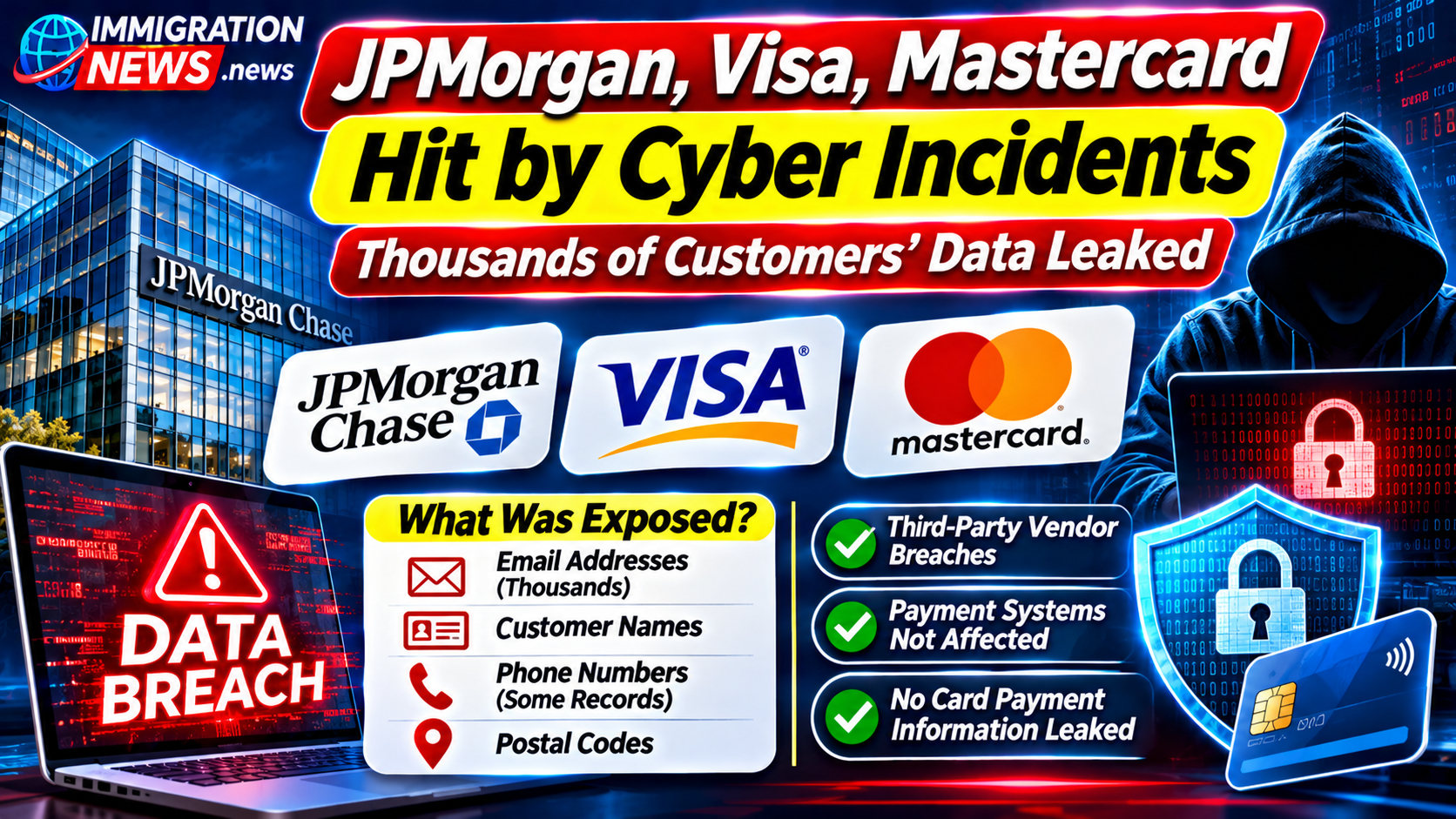
JPMorgan Chase, Visa and Mastercard have disclosed separate cybersecurity incidents involving third-party service providers, raising concerns about the security of customer information shared with external companies. The incidents may have exposed thousands of customer email addresses, names and other personal details, although the companies have stressed that their payment networks and core systems were not affected.
The disclosures came on November 19, 2026, after a cyber extortion group known as n0n claimed to have obtained customer engagement and marketing records associated with the three financial services companies.
JPMorgan Chase, the largest bank in the United States, said attackers targeted external vendors providing services to the bank and accessed certain marketing information. The exposed records may include customer names and email addresses, with some records reportedly containing phone numbers and postal codes.
Visa confirmed that claims involving its data were associated with an incident at a third-party service provider in the Asia-Pacific region. Mastercard also acknowledged a separate incident involving a service provider, which exposed a limited number of email addresses belonging to customers enrolled in a specific benefits programme.
All three companies said their own payment systems were not affected. They also indicated that sensitive payment information, including card numbers, was not exposed.
The JPMorgan Visa Mastercard data breach developments have raised fresh questions about the risks financial institutions face when sharing customer information with external vendors. They also highlight how a security incident involving a relatively small service provider can create reputational and privacy concerns for some of the world’s largest financial companies.
JPMorgan, Visa and Mastercard Data Breach: What Happened?
The incidents became public after the hacking group n0n claimed on November 16 that it had obtained customer engagement records connected to JPMorgan, Visa and Mastercard.
The group subsequently posted data that it claimed was evidence of the intrusions.
On November 19, JPMorgan confirmed that third-party service providers had been targeted by a cyberattack and that attackers may have accessed marketing data held by those vendors.
A JPMorgan spokesperson said the bank was investigating the incident and would contact affected customers directly where appropriate.
Visa and Mastercard also acknowledged incidents involving external service providers, although the companies described different circumstances and types of information potentially exposed.
The incidents have several important distinctions:
- JPMorgan said attackers accessed marketing data held by external vendors.
- Visa linked the reported claims to an incident involving a third-party provider in the Asia-Pacific region.
- Mastercard confirmed that a limited number of customer email addresses from a specific benefits programme were exposed.
- None of the companies reported an impact on their payment networks.
- The authenticity of the data published by the hacking group has not been independently verified by Reuters.
It is also important to note that the available information does not establish that all three companies were attacked through the same vendor or a single confirmed intrusion.
The disclosures instead point to separate third-party security incidents and claims involving the same cyber extortion group.
JPMorgan Cyberattack: More Than 16,000 Customer Email Addresses Reportedly Exposed
JPMorgan Chase’s disclosure has attracted particular attention because of the potential scale of the customer information involved.
The bank said attackers targeted third-party companies providing services to the financial institution and accessed certain marketing data held by those vendors.
According to the bank’s initial investigation, the information may include customer names and email addresses.
A Reuters review of data posted by the n0n group identified more than 16,000 customer email addresses, along with some phone numbers and postal codes.
The material also appeared to contain approximately 124 bank employee email addresses.
However, Reuters could not independently verify the authenticity of the published records, and JPMorgan did not confirm that the figures represented genuine compromised customer records.
The bank has also not publicly disclosed the total number of customers potentially affected.
JPMorgan has millions of customers across its banking and credit card businesses, meaning the reported records would represent only a small proportion of its overall customer base if their authenticity and attribution were established.
What Did JPMorgan Say About the Incident?
JPMorgan confirmed that external service providers had been targeted and that marketing information held by those vendors may have been accessed.
The bank also said it would contact affected customers directly and provide support where appropriate, including complimentary credit monitoring.
Importantly, JPMorgan stated that its own services had not been disrupted by this incident.
The bank has not publicly identified the affected vendors or provided a complete breakdown of the information involved.
The investigation is therefore still important in determining the precise number of affected customers and the extent of the information exposure.
Visa Data Breach: Asia-Pacific Customers Among Those Potentially Affected
Visa also addressed claims involving its customer information after the n0n group published material allegedly associated with the payment network.
The company said the reported incident was connected to a third-party service provider operating in the Asia-Pacific region.
Visa emphasised that its own systems were not involved or affected.
It also confirmed that payment information, including card numbers, had not been compromised.
According to Reuters’ review of the material posted by the hacking group, the purported Visa records covered several Asia-Pacific markets.
These included:
- Hong Kong
- Taiwan
- South Korea
- Japan
- Singapore
- Malaysia
- Australia
- The Philippines
- Macau
The spreadsheets reportedly contained thousands of customer email addresses, phone numbers and marketing campaign information.
However, Reuters has not independently verified the authenticity of the published records.
Visa has not announced a confirmed number of affected customers or provided a detailed breakdown of the information potentially exposed.
Were Visa Card Numbers Compromised?
Visa said no payment data, including card numbers, was affected.
The company also stated that its payment systems were not involved in the incident.
This distinction is important because the exposure of marketing information is different from the compromise of payment credentials.
Nevertheless, customer email addresses and phone numbers can still be valuable to cybercriminals, particularly when used to create convincing phishing messages or impersonate financial institutions.
Customers should therefore remain cautious about unexpected communications claiming to come from Visa or their banks.
Mastercard Data Breach: Limited Email Addresses Exposed
Mastercard has also confirmed a cybersecurity incident involving one of its third-party service providers.
The company said the incident exposed a limited number of email addresses belonging to cardholders enrolled in a specific benefits programme.
Unlike the broader claims made by the hacking group, Mastercard described the exposed information as non-payment data.
The company confirmed that its payment network was not affected and customers could continue using their cards normally.
Mastercard also said the exposure had been contained and that its teams were working with the service provider to support affected cardholders where necessary.
Which Mastercard Customers Were Affected?
The company has not publicly disclosed the precise number of affected cardholders or identified the benefits programme involved.
Data published by the n0n group appeared to include marketing information associated with customers in North America, the Middle East and Africa.
The material also reportedly contained a small number of Mastercard employee email addresses.
However, these records have not been independently authenticated.
Mastercard’s statement indicates that the confirmed exposure involved a limited group of customers rather than a widespread compromise of its entire cardholder database.
The company has not reported any impact on card numbers, payment credentials or the ability of customers to complete transactions.
Who Is the n0n Cyber Extortion Group?
The cyber extortion group known as n0n claimed responsibility for obtaining information associated with JPMorgan, Visa and Mastercard.
On November 16, the group reportedly published claims involving customer engagement and marketing records from the three companies.
It subsequently shared sample data that it presented as evidence of the alleged intrusions.
The group’s claims attracted attention because of the financial institutions involved and the reported volume of customer information.
According to reporting citing cybercrime monitoring platform eCrime.ch, the group had claimed approximately 200 incidents since emerging in September 2026.
However, a cybercriminal group’s claim of responsibility should not automatically be treated as proof that every published record is genuine or that the claimed company systems were directly compromised.
Reuters was unable to independently verify the authenticity of the material attributed to JPMorgan, Visa and Mastercard.
The companies’ disclosures confirm incidents involving third-party providers, but they do not establish that every claim made by n0n is accurate.
This distinction is particularly important when assessing the actual scale of the data exposure.
Why Were Third-Party Vendors Targeted Instead of the Companies’ Main Systems?
One of the most important aspects of the JPMorgan Visa Mastercard data breach incidents is the role played by external service providers.
Large financial institutions regularly work with outside companies to manage marketing campaigns, customer communications, loyalty programmes, analytics and other business functions.
These vendors may receive access to customer information to perform specific services.
While this arrangement can improve operational efficiency, it also creates additional cybersecurity risks.
A financial institution may maintain sophisticated security systems across its own infrastructure, but information shared with an external provider may be subject to different security controls.
If attackers compromise that provider, customer information belonging to the financial institution could be exposed without directly breaching the bank or payment network itself.
How Third-Party Vendor Attacks Work
A typical third-party data breach can involve several stages.
1. Access to a vendor’s systems
Attackers identify an external service provider that stores or processes information for a larger organisation.
2. Exploitation of a security weakness
Cybercriminals may exploit vulnerabilities, compromised credentials or insufficient access controls to enter the provider’s systems.
3. Access to stored information
Once inside, attackers may access customer records, marketing databases, employee information or other business data.
4. Data theft and extortion
The stolen information may be used for extortion, sold through criminal networks or published to pressure the affected organisation.
5. Investigation and customer notification
The affected company and its service provider investigate the incident, assess the information involved and determine whether customers need to be notified.
The recent disclosures demonstrate why financial institutions must assess the security of their entire supplier ecosystem rather than concentrating only on their internal networks.
What Information Was Exposed in the JPMorgan Visa Mastercard Data Breach?
Based on the companies’ statements and reporting about the material published by n0n, the potentially exposed information primarily involves customer marketing and contact records.
The following table summarises the available information.
| Company | Potentially exposed information | Payment systems affected? |
|---|---|---|
| JPMorgan Chase | Names, email addresses and reportedly some phone numbers and postal codes | No reported impact |
| Visa | Purported email addresses, phone numbers and marketing records | No |
| Mastercard | Limited customer email addresses from a benefits programme | No |
The distinction between confirmed company disclosures and unverified leaked material is important.
JPMorgan confirmed potential access to vendor-held marketing data but did not verify the number of affected customers.
Visa linked the claims to a third-party provider incident but did not independently confirm the authenticity of the published records.
Mastercard confirmed a limited email exposure involving a specific benefits programme.
None of the three companies reported that customer card numbers or payment credentials had been compromised.
Are Customers’ Bank Accounts and Credit Cards Safe?
Based on the companies’ statements, the incidents have not affected their payment networks or customers’ ability to use their cards.
JPMorgan said its services were not disrupted by the cyber incident.
Visa confirmed that its systems were not involved or affected and that payment data, including card numbers, was not exposed.
Mastercard similarly stated that its payment network continued operating normally.
This means the reported exposure should not be confused with a confirmed theft of card credentials or direct access to customers’ bank accounts.
However, the absence of reported payment data exposure does not mean customers should ignore the incident.
Names, email addresses and phone numbers can be used in targeted scams.
Cybercriminals may combine leaked contact information with publicly available details to create convincing messages that appear to come from a bank, card provider or financial service.
The biggest immediate concern for many affected customers may therefore be phishing and identity-based fraud rather than direct card payment theft.
What Should JPMorgan, Visa and Mastercard Customers Do Now?
Customers should take reasonable precautions even if their card details have not been reported as compromised.
The following steps can help reduce the risk of fraud following a customer information exposure.
1. Be Careful With Unexpected Emails and Messages
Do not automatically trust emails claiming to come from JPMorgan, Visa or Mastercard.
Be particularly cautious about messages that create urgency, threaten account suspension or ask you to verify personal information.
2. Avoid Clicking Suspicious Links
Cybercriminals may use exposed email addresses to send targeted phishing messages.
Avoid clicking unexpected links or opening attachments from unknown senders.
If a message claims that your account requires immediate attention, visit the company’s official website independently instead.
3. Never Share OTPs or Banking Passwords
Do not disclose one-time passwords, PINs, passwords or card verification codes in response to unexpected calls, emails or messages.
Legitimate security procedures should not require customers to disclose sensitive authentication information to an unsolicited caller.
4. Monitor Bank and Card Transactions
Review recent transactions and account activity regularly.
Contact your bank immediately if you notice unfamiliar purchases, transfers or other suspicious activity.
Although no card payment data has been reported exposed in these incidents, monitoring transactions remains a sensible precaution.
5. Use Multi-Factor Authentication
Enable multi-factor authentication wherever available.
This provides an additional layer of protection if an attacker obtains an email address or password.
6. Contact the Company Through Official Channels
If you receive a notification claiming that your information was involved, verify it directly through the official banking application, website or customer support number.
Do not use contact details supplied in suspicious messages.
7. Follow Official Breach Notifications
JPMorgan has said it will contact affected customers directly and provide support where appropriate, including complimentary credit monitoring.
Customers who receive an official notification should carefully review the information provided and follow the company’s recommended protective measures.
JPMorgan Banking Outage Was Not Connected to the Cyberattack
The JPMorgan disclosure came shortly after a separate technology disruption affected some customers’ banking services.
Earlier in the week, JPMorgan and other banks experienced transaction-processing problems linked to a software bug.
The disruption raised questions about whether the financial sector was facing a wider cybersecurity problem.
However, JPMorgan specifically clarified that the third-party vendor incident was unrelated to the earlier service disruption.
The bank attributed the transaction-processing problems to a software issue involving its systems rather than the newly disclosed cyberattack.
The distinction is important because a technical outage and a data breach are different types of incidents.
A software malfunction can temporarily interrupt banking services without exposing customer information.
A vendor-related cyber incident, on the other hand, can expose information even when the bank’s main services continue operating normally.
JPMorgan said there was no disruption to its services resulting from the vendor incident.
The earlier technology disruptions also prompted inquiries from US banking regulators seeking to understand their impact and determine whether any cybersecurity risks were involved.
Why the Incidents Raise Concerns for the Global Banking Industry
The JPMorgan Visa Mastercard data breach developments highlight a wider challenge facing financial institutions: protecting customer information across increasingly complex technology networks.
Banks and payment companies rely on numerous external providers to manage different aspects of their operations.
These relationships create potential vulnerabilities that can be difficult to monitor.
Even when a financial institution has strong internal cybersecurity controls, an external service provider may have access to sensitive customer records.
The recent incidents raise several important questions.
Are Companies Sharing More Customer Data Than Necessary?
Financial institutions should regularly review what information they share with outside vendors.
If a service provider only needs an email address to deliver a marketing communication, sharing additional personal information may create unnecessary exposure.
Limiting the amount of information transferred can reduce the potential impact of a breach.
Are Vendor Security Checks Strong Enough?
Companies need to assess the cybersecurity standards of external service providers before granting access to customer information.
These checks should not end when a contract is signed.
Regular security reviews, access monitoring and incident-response testing are important throughout the relationship.
Who Is Responsible When a Vendor Is Breached?
Customers generally view their relationship as being with the bank or payment company, not the external service provider.
As a result, a vendor’s security failure can create reputational damage for the financial institution whose customer information was exposed.
Financial companies must therefore take responsibility for understanding how their partners collect, store and protect customer information.
Will the JPMorgan Visa Mastercard Data Breach Lead to More Regulatory Scrutiny?
The incidents could increase attention on third-party cybersecurity practices across the financial services sector.
Financial institutions operate under extensive regulatory and security requirements, but managing external technology risks remains a significant challenge.
Regulators may examine whether companies have appropriate vendor risk-management procedures, data-sharing controls and incident-reporting systems.
The recent incidents also come amid wider concerns about technology disruptions affecting banks and critical infrastructure providers.
The earlier transaction-processing problems involving JPMorgan and other banks have already attracted regulatory attention.
However, there has been no confirmation that the latest vendor incidents have resulted in a new regulatory enforcement action against the three companies.
Any additional regulatory response will depend on the findings of ongoing investigations and the applicable legal requirements.
What Happens Next?
The investigations into the three incidents are ongoing, and several important questions remain unanswered.
These include:
- The exact number of JPMorgan customers whose information may have been exposed.
- The identities of the third-party service providers involved.
- Whether the published records attributed to the companies are authentic.
- The full categories of customer information accessed.
- Whether additional customers will receive breach notifications.
- Whether further security measures will be introduced by the affected companies.
JPMorgan has indicated that it will contact affected customers directly and offer support where appropriate.
Mastercard has said the exposure has been contained and that it is working with its provider to support affected cardholders.
Visa has maintained that its own systems and payment data were not affected.
Further details may emerge as the companies complete their investigations and determine the full extent of the incidents.
Conclusion: Third-Party Cybersecurity Risks Put Financial Customer Data Under Spotlight
The cyber incidents involving JPMorgan Chase, Visa and Mastercard have highlighted the growing risks associated with sharing customer information with external service providers.
Although the companies have said their payment networks and core systems were not affected, the potential exposure of customer names, email addresses, phone numbers and other marketing information remains a serious privacy concern.
The hacking group n0n has claimed responsibility for obtaining records associated with the three companies, but the authenticity of the published material has not been independently established.
For customers, the most important immediate precaution is to remain alert to suspicious emails, phone calls and messages that attempt to exploit personal information.
For financial institutions, the incidents reinforce the need for stronger vendor security assessments, tighter data-sharing controls and continuous monitoring of external service providers.
As investigations continue, the broader lesson is clear: protecting financial customer information requires more than securing a company’s own systems. Every external organisation handling that information must also maintain effective cybersecurity safeguards.
FAQs : JPMorgan Visa Mastercard Data Breach
1. What happened in the JPMorgan Visa Mastercard data breach incidents?
JPMorgan Chase, Visa and Mastercard disclosed separate cybersecurity incidents involving third-party service providers. The incidents potentially exposed customer marketing information, including names and email addresses. All three companies said their payment systems were not affected.
2. Were JPMorgan customer email addresses leaked?
A Reuters review of data published by the n0n group identified more than 16,000 email addresses reportedly associated with JPMorgan customers. Some records also contained phone numbers and postal codes. However, Reuters could not independently verify the authenticity of the data.
3. Were Visa credit card numbers exposed?
Visa said no payment information, including card numbers, was affected. The incident was associated with a third-party service provider in the Asia-Pacific region.
4. What information was exposed in the Mastercard incident?
Mastercard confirmed that a limited number of email addresses belonging to cardholders enrolled in a specific benefits programme were exposed. The company described the information as non-payment data.
5. Who is behind the JPMorgan, Visa and Mastercard cyber incidents?
A cyber extortion group known as n0n claimed responsibility for obtaining records associated with the three companies. However, the authenticity of the published data has not been independently verified.
6. Can customers continue using their JPMorgan, Visa and Mastercard cards?
Yes. The companies have stated that their payment networks were not affected and customers’ ability to use their cards remained intact.
7. Was the JPMorgan banking outage connected to the cyberattack?
No. JPMorgan said the vendor-related cyber incident was unrelated to the earlier transaction-processing disruption, which the bank attributed to a software bug.
8. How can customers protect themselves after the data exposure?
Customers should avoid suspicious links, never share OTPs or banking passwords, monitor account transactions, enable multi-factor authentication and verify unexpected communications through official company channels.
9. Will affected JPMorgan customers receive compensation or support?
JPMorgan said it would contact affected customers directly and offer support where appropriate, including complimentary credit monitoring. The bank has not publicly announced a general compensation programme.
10. Have the companies confirmed how many customers were affected?
No. JPMorgan, Visa and Mastercard have not published comprehensive confirmed figures covering all potentially affected customers. The numbers identified in publicly circulated material have not been independently authenticated.
11. Does a third-party vendor breach mean a bank’s main systems were hacked?
Not necessarily. A third-party breach occurs when an external service provider’s systems are compromised. Customer information stored by that provider may be exposed even if the bank’s own infrastructure remains secure.
12. Are these incidents part of one confirmed cyberattack?
The companies have acknowledged separate incidents involving third-party providers. The available information does not establish that all three incidents originated from the same vendor or a single confirmed intrusion.
Source : The Times Of India
Read About : Xi Putin Trump Trilateral Meeting 2026: China Calls Shenzhen Summit Groundbreaking



One thought on “JPMorgan Visa Mastercard Data Breach 2026 : Hit by Cyberattacks as Thousands of Customer Records Are Exposed”