
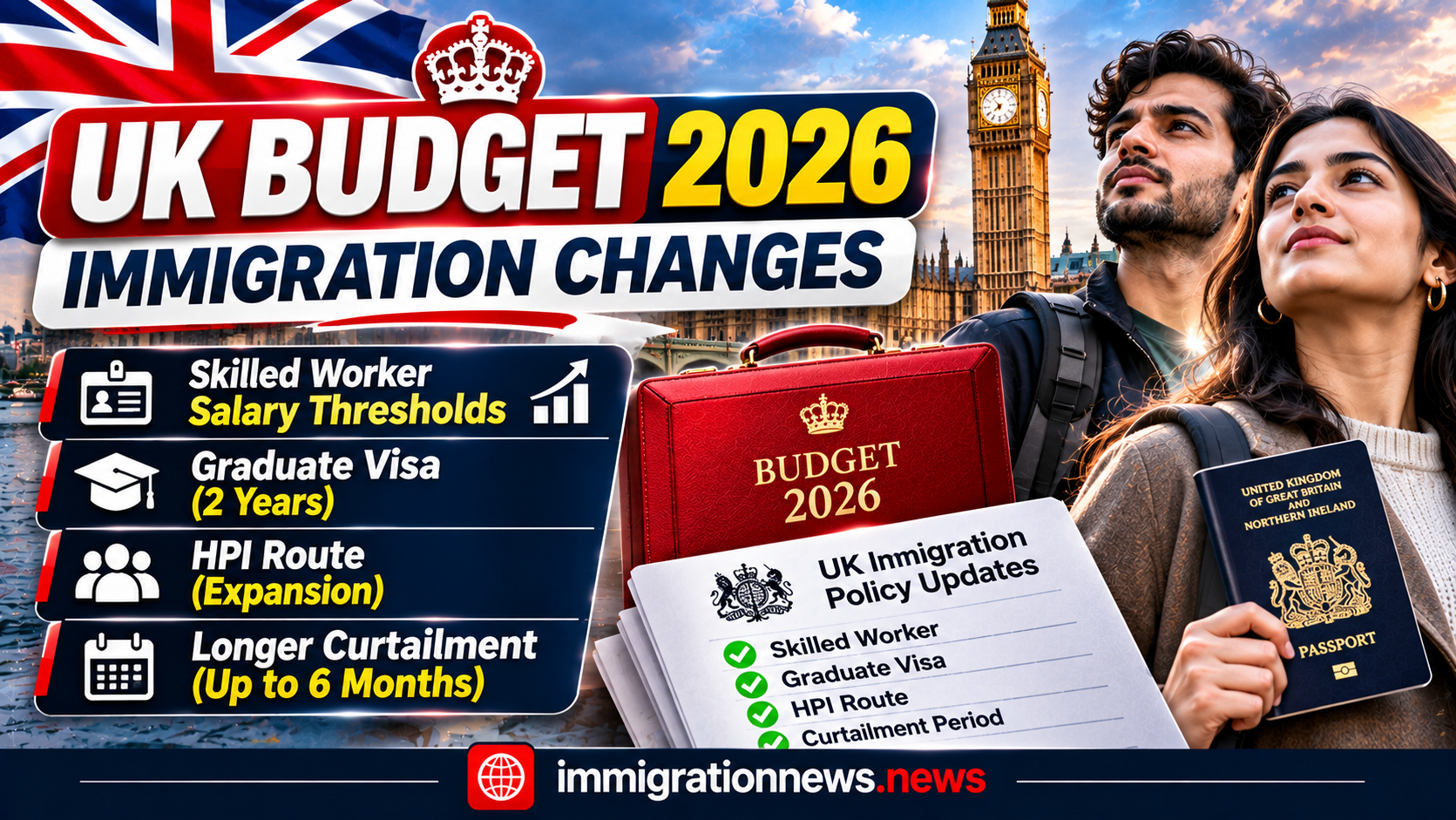

The UK Government has announced a new direction for its immigration system through the 2026 Budget, introducing plans to make the country more attractive to highly skilled international professionals while maintaining restrictions on lower- and medium-skilled migration.
Published on 28 October 2026, the Budget outlines significant changes that could affect overseas workers, international graduates, employers and businesses recruiting talent from abroad. The proposals focus on four major areas: Skilled Worker visa salary thresholds, the High Potential Individual (HPI) route, the Graduate visa and the time highly skilled sponsored workers may receive to find another job after losing their employment.
For Indian professionals and students considering the UK, these announcements could create new opportunities. However, the benefits will depend on eligibility requirements, university status, occupation-specific salary rules and the implementation timetable.
The UK Budget 2026 immigration changes also reflect a broader economic strategy. The Government wants to attract international talent that can contribute to innovation, investment, productivity and regional development without returning to a more open approach to lower-skilled migration.
Here is a detailed breakdown of the announced reforms and what they could mean for people planning to move to the UK.
Key UK Budget 2026 Immigration Changes at a Glance
The Budget outlines several important reforms to the UK’s skilled migration framework.
| Immigration area | Government announcement | Expected implementation |
|---|---|---|
| Skilled Worker salary thresholds | Occupation-specific thresholds to return from the median to the 25th percentile | Spring 2027 |
| General salary threshold | To be updated using 2026 wage data | Spring 2027 |
| High Potential Individual visa | Eligibility to expand to graduates from the world’s top 150 institutions | Further details to follow |
| Graduate visa | Two-year duration for graduates from qualifying high-compliance universities with strong employment outcomes | Further details to follow |
| Skilled Worker curtailment | Up to six months for the highest-skilled sponsored workers to find another job | 2027 |
These are announced policy measures and implementation plans, not a confirmation that every change is already operational. Applicants and employers should continue following the existing Immigration Rules until the relevant changes take effect.
1. Skilled Worker Visa Salary Thresholds to Return to the 25th Percentile
One of the most significant announcements concerns the salary requirements for the UK Skilled Worker visa.
The Government plans to reduce occupation-specific minimum salary thresholds from the 50th percentile (median) of wages to the 25th percentile.
This is particularly important because salary requirements increased substantially in April 2024, when occupation-specific going rates were moved from the 25th percentile to the median of full-time earnings.
The proposed adjustment would reverse that part of the earlier increase.
What does the 25th percentile mean?
The 25th percentile represents the point below which 25% of workers in a particular occupation earn and above which 75% earn.
By using this benchmark, the Government intends to make occupation-specific salary requirements more reflective of the wages paid across different parts of the UK.
For example, employers in regions where salaries are generally lower may find it easier to meet the relevant occupation-specific requirement than under a median-based system.
However, returning to the 25th percentile does not mean that every employer can sponsor a worker at any salary. The applicable general threshold and other Skilled Worker requirements will still matter.
The general salary threshold will also increase
The Government has confirmed that the general salary threshold will be uprated using 2026 wage data.
This means applicants will need to consider two separate requirements:
- The general minimum salary threshold.
- The occupation-specific going rate.
The applicable salary requirement will depend on the relevant Immigration Rules and any permitted salary discounts.
The Government also plans to update salary thresholds annually using the latest Office for National Statistics (ONS) wage-inflation data, including Annual Survey of Hours and Earnings (ASHE) information.
The UK Budget 2026 immigration changes therefore introduce a more flexible occupation-specific benchmark while retaining a general minimum salary requirement.
Changes to new entrant discounts
The Budget also proposes simplifying new entrant salary discounts into a single figure for people who are studying, recently graduated or undertaking professional training.
At the same time, the Government plans to remove the PhD salary discount.
These adjustments could change how salary requirements are calculated for certain applicants, particularly recent graduates moving from education into sponsored employment.
The final rules will determine the precise salary figures and how the revised discounts apply.
2. High Potential Individual Visa to Expand to the World’s Top 150 Universities
The High Potential Individual visa is another major focus of the Budget.
The Government plans to expand the route to include eligible graduates from the world’s top 150 institutions, compared with the narrower university eligibility framework currently used.
The HPI route is designed for talented international graduates who want to work or look for employment in the UK without first securing a sponsored job offer.
This makes it different from the Skilled Worker route, which generally requires an eligible job offer from an approved sponsor.
What is the HPI visa?
The High Potential Individual route allows eligible graduates of selected overseas universities to move to the UK and work in most jobs without employer sponsorship.
Under the existing route:
- Applicants generally need an eligible overseas qualification awarded within the previous five years.
- The qualification must meet the required UK degree-equivalence standard.
- Applicants must meet the English-language requirement.
- Applicants must satisfy the financial requirement, where applicable.
- The route does not require a job offer from a UK employer.
The existing visa normally lasts two years for bachelor’s or master’s degree holders and three years for doctoral graduates.
It does not provide a direct route to settlement, although eligible individuals may be able to switch into another immigration category, such as the Skilled Worker route.
What will change under the Budget?
The Government plans to expand eligibility to graduates with qualifying degrees from the top 150 global institutions.
It will also proportionately increase the annual application cap to accommodate the wider university list.
This could benefit graduates from additional international universities, including potentially more institutions in countries such as India, depending on the final eligibility list and ranking methodology.
However, the announcement does not mean that every graduate from a university ranked within the top 150 will automatically qualify. The Government will need to publish the detailed criteria, eligible institutions and application arrangements.
For highly educated professionals who want to explore the UK job market before securing sponsorship, this could become an important alternative.
3. Graduate Visa: Two Years to Be Retained for Eligible University Graduates
The Graduate visa announcement is particularly important for international students already studying or planning to study in the UK.
The Government has announced plans to provide a two-year Graduate visa for people graduating from universities that meet high-compliance standards and demonstrate strong employment outcomes.
However, this is a targeted measure rather than a universal restoration of the two-year period for all graduates.
What is the current Graduate visa position?
Under the rules currently published by the UK Government:
- Applications made on or before 31 December 2026 generally receive two years of permission.
- Applications made on or after 1 January 2027 generally receive 18 months.
- Applicants with a PhD or other doctoral qualification can receive three years.
The visa allows eligible international graduates to remain in the UK after completing an eligible course and work or look for employment without requiring Skilled Worker sponsorship during the Graduate visa period.
What has the Budget announced?
The Government intends to set the Graduate visa duration at two years for graduates from:
- High-compliance universities.
- Institutions demonstrating strong labour-market outcomes.
The aim is to retain international graduates who are more likely to contribute to the UK economy through employment and skilled work.
The announcement is significant because it creates a distinction between universities based on compliance and employment performance.
Students choosing a UK university may therefore need to consider more than tuition fees, course rankings and location. The institution’s compliance record and graduate employment outcomes could also become important factors.
Will every international student receive a two-year Graduate visa?
No. The Budget announcement specifically refers to graduates from qualifying universities.
Until the Government publishes the detailed criteria and implements the relevant changes, students should not assume that all universities will qualify for the extended duration.
The UK Budget 2026 immigration changes could therefore make university selection an even more important part of long-term immigration planning.
4. Highly Skilled Workers Could Get Up to Six Months to Find a New Job
Another important proposal concerns sponsored workers who lose their employment or have their sponsorship withdrawn.
Under the current system, when an employer withdraws sponsorship, the Home Office may curtail the worker’s permission. The individual may be given a limited period to find another sponsor, switch immigration categories or make alternative arrangements.
The Budget proposes allowing the highest-skilled workers to access a curtailment period of up to six months.
How could the six-month period work?
The Government says the duration will vary depending on how long the individual has worked in their previous highly paid job.
This suggests that the proposed protection will not automatically apply to every Skilled Worker visa holder.
The objective is to give highly skilled professionals more time to secure another position and allow employers to recruit experienced international workers without an unnecessarily short transition period.
The proposal could be particularly relevant to senior professionals, specialist engineers, researchers, technology workers and other highly paid employees.
When will the UK Budget 2026 Immigration Changes take effect?
The Government has indicated that implementation is planned for 2027.
The final rules will need to clarify:
- Which occupations or salary levels qualify.
- How previous employment duration will be assessed.
- When the six-month period applies.
- Whether different curtailment periods will apply to different groups.
Until those details are published, sponsored workers should continue to follow the existing rules and seek appropriate immigration advice if their employment ends.
5. UK Immigration Policy Places Greater Emphasis on Regional Economic Growth
The Budget also links immigration reforms with the Government’s wider plans to support regional development.
Historically, salary requirements have created challenges for some employers outside London and other high-wage areas.
The return to occupation-specific thresholds based on the 25th percentile could make the Skilled Worker route more accessible to certain employers in regions where prevailing wages are lower.
This does not mean that regional employers will receive an automatic exemption from salary rules. They will still need to meet the applicable general threshold, occupation-specific requirements and sponsorship conditions.
The Government’s intention is to make immigration criteria more reflective of labour-market conditions across the UK.
This could be relevant to businesses in sectors such as:
- Engineering and manufacturing.
- Technology and digital services.
- Scientific research.
- Professional and specialist services.
- Other eligible skilled occupations.
The wider policy direction suggests that the Government wants to attract international workers who can support regional investment and productivity, rather than relying only on migration numbers as a measure of success.
6. Employers May Face Greater Pressure to Demonstrate Economic Value
The Budget signals a more targeted approach to international recruitment.
Businesses may increasingly be expected to demonstrate how overseas recruitment supports wider economic objectives, including:
- Business investment.
- Productivity improvements.
- Innovation and research.
- Regional economic development.
- Long-term workforce planning.
- Domestic skills development.
This direction is consistent with the Government’s broader approach to the Temporary Shortage List, which links access to certain overseas recruitment opportunities with evidence about labour-market needs and domestic workforce investment.
The Government has not abandoned its objective of reducing lower- and medium-skilled migration.
Instead, it is attempting to make the immigration system more attractive to selected high-skilled professionals while maintaining tighter controls elsewhere.
For employers, this means that understanding sponsorship compliance and salary requirements will remain essential even as some thresholds become more flexible.
7. What the UK Budget 2026 Immigration Changes Mean for Indian Applicants
India is an important source of international students and skilled professionals for the UK. The announced reforms could create opportunities across several immigration pathways.
For Indian skilled professionals
The proposed return to the 25th percentile for occupation-specific salary thresholds could make sponsorship more accessible in certain eligible occupations.
However, applicants must still meet the general salary threshold, occupation-specific going rate and other visa requirements.
For Indian graduates
The expansion of the HPI route could benefit graduates from Indian universities if those institutions appear on the final eligible list.
The Graduate visa announcement may also benefit Indian students graduating from qualifying UK universities that meet the Government’s compliance and employment-outcome criteria.
For experienced professionals
The proposed six-month curtailment period could offer additional time to highly skilled sponsored workers who lose their jobs.
This may reduce the pressure to secure a new sponsor immediately, although eligibility will depend on the final rules.
For students planning to study in Britain
University selection could become even more important.
Students should consider the institution’s academic reputation, graduate employment outcomes, compliance standards and course quality before making a financial commitment.
The Budget does not guarantee a two-year Graduate visa for every international student.
8. When Will the New UK Immigration Rules Take Effect?
Not all the announced reforms in UK Budget 2026 Immigration Changes will begin at the same time.
The Government has provided an implementation timetable for several measures, but some details are still pending.
| Proposed reform | Government timeline |
|---|---|
| Skilled Worker occupation-specific salary thresholds | Spring 2027 |
| Updated general salary threshold | Spring 2027 |
| Annual salary threshold updates using ONS wage data | Under the planned revised system |
| HPI route expansion | Further implementation details to follow |
| Graduate visa extension for qualifying universities | Further implementation details to follow |
| Up to six months’ curtailment for highest-skilled workers | 2027 |
Applicants should check the official UK Government immigration guidance before applying or making decisions based on the proposed changes.
The UK Budget 2026 immigration changes should not be treated as immediate changes to every visa category. The applicable rules will depend on the date of application and the specific implementation arrangements.
FAQs : UK Budget 2026 Immigration Changes
1. What are the major UK Budget 2026 immigration changes?
The major announcements include returning occupation-specific Skilled Worker salary thresholds to the 25th percentile, expanding the High Potential Individual visa to graduates from the top 150 global institutions, providing a two-year Graduate visa for eligible university graduates and allowing up to six months for certain highly skilled sponsored workers to find new employment.
2. Will the UK reduce Skilled Worker visa salary requirements in UK Budget 2026 Immigration Changes?
The Government plans to reduce occupation-specific salary thresholds from the median to the 25th percentile of wages from spring 2027. However, the general salary threshold will also be updated using 2026 wage data, so the overall salary requirement will depend on the final rules.
3. Will the HPI visa expand to 150 universities in UK Budget 2026 Immigration Changes?
Yes. The Budget announces plans to expand the High Potential Individual route to eligible qualifications from the world’s top 150 institutions. The annual application cap will also increase proportionately. The detailed eligibility list and implementation arrangements are still to follow.
4. Will the UK Graduate visa return to two years in UK Budget 2026 Immigration Changes?
The Government plans to provide a two-year Graduate visa for graduates from high-compliance universities with strong labour-market outcomes. This is a targeted measure, not a guarantee of two years for every international graduate.
5. Can Skilled Worker visa holders get six months to find another job?
The Government plans to allow the highest-skilled sponsored workers to access a curtailment period of up to six months. The duration will depend on how long they worked in their previous highly paid job. Implementation is planned for 2027.
6. When will the new UK Skilled Worker salary thresholds start?
The Government has announced plans to implement the salary changes from spring 2027. The final figures and detailed rules will need to be published before applicants can determine the exact requirements.
7. Will Indian graduates benefit from the expanded HPI visa?
Potentially. Indian graduates could benefit if their university and qualification meet the final eligibility requirements. The expansion does not automatically make every Indian university eligible.
Final Takeaway On UK Budget 2026 Immigration Changes
The UK’s 2026 Budget signals a shift towards a more selective but potentially more attractive immigration system for highly skilled international professionals.
The proposed return to the 25th percentile for occupation-specific salary thresholds could help some employers recruit overseas talent, while the expansion of the HPI route may create additional opportunities for graduates from leading universities.
The Graduate visa announcement is also important, but its benefits will be limited to graduates from qualifying universities with strong compliance and employment outcomes. Meanwhile, the proposed six-month curtailment period could give certain highly skilled sponsored workers more time to find another job.
For Indian students and professionals, these developments may create new opportunities to study, work and build careers in Britain. However, the final eligibility rules, salary figures and implementation dates will determine how much applicants can benefit.
The UK Budget 2026 immigration changes represent a shift towards attracting talent that contributes to innovation, investment and regional growth while retaining tighter controls on other forms of migration.
Source : The Economic Times
Read About : UK Universities Withdrawing Offers: What Prospective Students Must Know in 2026




One thought on “UK Budget 2026 Immigration Changes: Skilled Worker Salary Thresholds, Graduate Visa and HPI Route Reforms”