
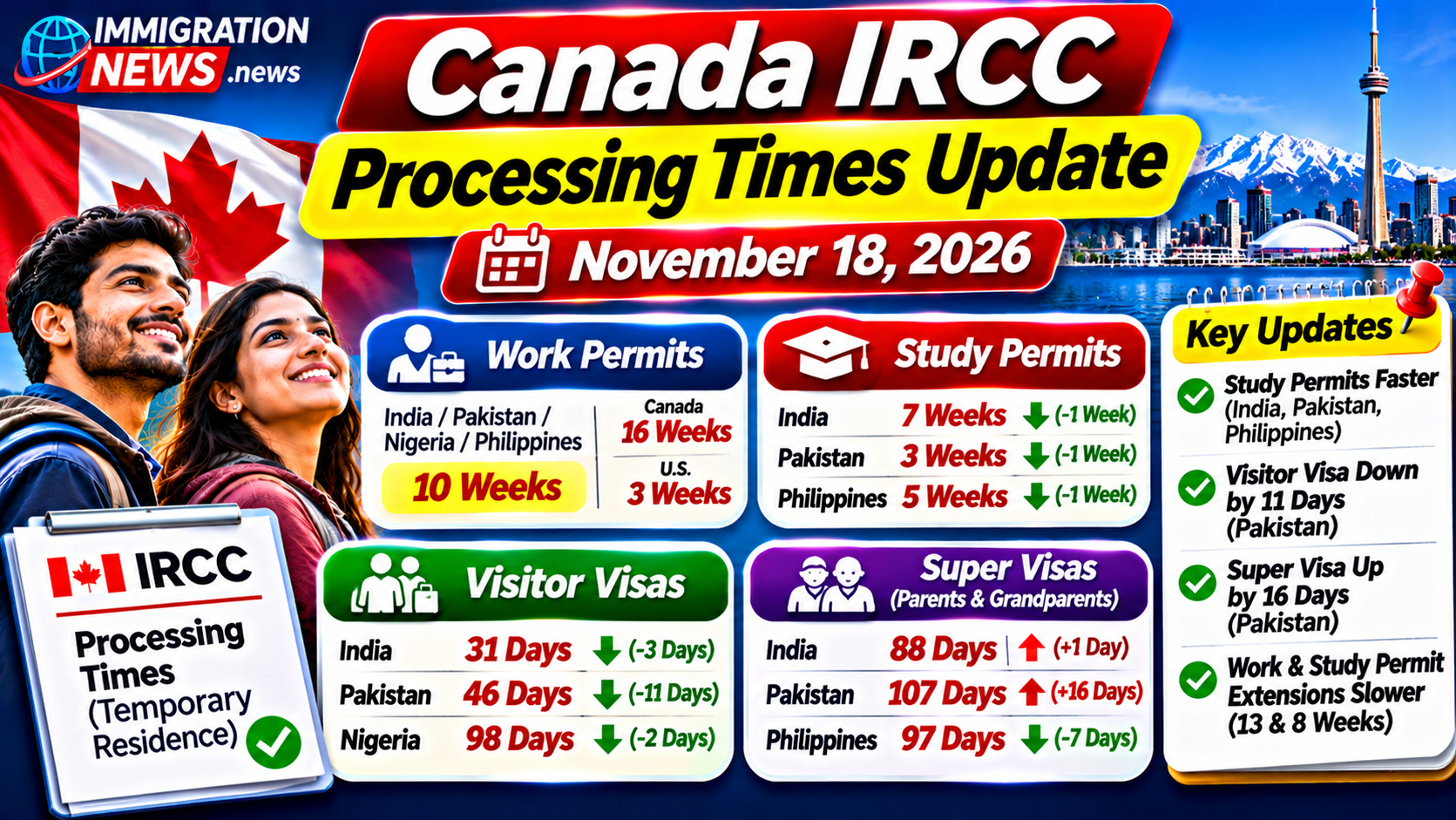

Canada has released its latest immigration application processing estimates, bringing mixed news for international students, temporary foreign workers, visitors and parents planning to reunite with family members in the country.
Immigration, Refugees and Citizenship Canada (IRCC) updated its temporary residence processing times on November 18, 2026, with several application categories recording shorter waiting periods while others experienced delays.
The latest Canada IRCC processing times November 2026 update brings some relief for international students from India, Pakistan and the Philippines, whose study permit processing estimates have each decreased by one week.
Visitor visa applicants from Pakistan also received positive news, with the estimated waiting period falling by 11 days. However, parents and grandparents applying for Canadian Super Visas from Pakistan are facing a longer wait, while work and study permit extension applicants already in Canada are also experiencing slower processing.
For Indian applicants, the latest figures show a seven-week estimated wait for study permits, 31 days for visitor visas and 88 days for Super Visas.
IRCC is expected to publish its next temporary residence processing time update around November 25, 2026.
Here is a complete breakdown of the latest Canadian visa processing estimates, including country-wise comparisons, extension delays, service standards and what applicants should know before planning their travel or studies.
Canada Visa Processing Times November 2026: Latest Overview
The November 18 update shows that processing times are moving in different directions depending on the application category and country of residence.
The biggest improvements were recorded in study permit applications from India, Pakistan and the Philippines. Visitor visa applicants from Pakistan also experienced a noticeable reduction.
However, applicants extending their work or study permits from within Canada are facing longer estimated waiting periods.
The following table summarises the most important developments.
| Application category | Latest development |
|---|---|
| Work permits | No change across six tracked locations |
| Study permits | Down one week in India, Pakistan and Philippines |
| Visitor visas | Down 11 days in Pakistan |
| Super Visas | Up 16 days in Pakistan |
| Work permit extensions | Increased from 10 to 13 weeks |
| Study permit extensions | Increased from 6 to 8 weeks |
| Visitor records | Decreased from 304 to 296 days |
The figures reflect IRCC’s published estimates and are not guaranteed decision dates. Applicants can check the official IRCC processing time tool for their specific application category and country.
Canada Work Permit Processing Times: No Change in November
Foreign workers planning to move to Canada will find that work permit processing estimates remained unchanged between November 12 and November 18.
The latest figures cover applications submitted from Canada and several major international recruitment markets.
Work Permit Processing Times by Country
| Applying from | November 18, 2026 | November 12, 2026 |
|---|---|---|
| Canada | 16 weeks | 16 weeks |
| India | 10 weeks | 10 weeks |
| Pakistan | 10 weeks | 10 weeks |
| Nigeria | 10 weeks | 10 weeks |
| United States | 3 weeks | 3 weeks |
| Philippines | 10 weeks | 10 weeks |
For Indian applicants, the estimated processing time remains 10 weeks.
Applicants from Pakistan, Nigeria and the Philippines also face an estimated 10-week wait, while applications from the United States have a considerably shorter estimate of three weeks.
Applications submitted from within Canada currently have an estimated processing time of 16 weeks in the category covered by the update.
Work Permit Service Standards
IRCC’s stated service standards are:
- Initial work permit applications submitted outside Canada: 60 days.
- Work permit extensions submitted from within Canada: 120 days.
These standards represent departmental processing objectives rather than guaranteed deadlines.
The absence of a change in the latest work permit estimates suggests that applicants in the listed locations should not expect an immediate improvement based solely on this update.
Canada Study Permit Processing Times: India, Pakistan and Philippines See One-Week Reduction
International students have received some positive news from the latest IRCC update.
Study permit processing estimates decreased by one week for applicants from India, Pakistan and the Philippines.
This is particularly relevant for students preparing to begin their studies at Canadian colleges and universities.
Study Permit Processing Times by Country
| Applying from | November 18, 2026 | November 12, 2026 |
|---|---|---|
| Canada | 6 weeks | 6 weeks |
| India | 7 weeks | 8 weeks |
| Pakistan | 3 weeks | 4 weeks |
| Nigeria | 11 weeks | 11 weeks |
| United States | 4 weeks | 4 weeks |
| Philippines | 5 weeks | 6 weeks |
Indian students now have an estimated study permit processing time of seven weeks, compared with eight weeks in the previous update.
Pakistan recorded a reduction from four weeks to three weeks, while applicants from the Philippines saw their estimate fall from six weeks to five weeks.
Meanwhile, processing estimates remained unchanged for applicants from Canada, Nigeria and the United States.
What This Means for Indian Students
The reduction to seven weeks is encouraging for Indian students planning to study in Canada.
However, students should not assume that every application will receive a decision within this period.
Actual processing can vary depending on application completeness, verification requirements, background checks and individual circumstances.
Students should ideally submit their applications well before their programme begins, allowing additional time for biometrics, medical examinations where required and other immigration formalities.
Study Permit Service Standards
IRCC’s service standards for study permits are:
- Applications submitted from outside Canada: 60 days.
- Initial applications and extensions submitted from within Canada: 120 days.
The latest reduction is a positive development, but applicants should continue checking the official processing tool before making travel arrangements.
Canada Visitor Visa Processing Times: Pakistan Records an 11-Day Drop
Visitor visa applicants have also received some positive news.
The November 18 update shows shorter estimated processing times for applicants from India, Pakistan, Nigeria and the Philippines.
Pakistan recorded the largest reduction, with the estimated waiting period falling from 57 days to 46 days.
Visitor Visa Processing Times by Country
| Applying from | November 18, 2026 | November 12, 2026 |
|---|---|---|
| Canada | 12 days | 12 days |
| India | 31 days | 34 days |
| Pakistan | 46 days | 57 days |
| Nigeria | 98 days | 100 days |
| United States | 18 days | 18 days |
| Philippines | 23 days | 24 days |
Visitor Visa Processing Time for India
Indian applicants now face an estimated waiting period of 31 days, compared with 34 days in the previous update.
This represents a three-day improvement.
Visitor Visa Processing Time for Pakistan
Pakistan recorded the biggest improvement among the listed countries.
The estimated processing time decreased by 11 days, from 57 days to 46 days.
Visitor Visa Processing Time for Nigeria
Nigerian applicants saw a smaller improvement, with the estimated wait falling from 100 days to 98 days.
However, Nigeria continues to have the longest visitor visa estimate among the six locations listed.
Visitor Visa Processing Time for the Philippines
Applicants from the Philippines experienced a one-day reduction, bringing the estimate to 23 days.
The United States and Canada recorded no changes.
Visitor Visa Service Standard
IRCC’s service standard for initial visitor visa applications submitted from outside Canada is 14 days.
There is no corresponding in-Canada service standard listed for visitor visa applications in this update.
Importantly, the 14-day service standard should not be confused with the actual country-specific processing estimates. Applicants from India, Pakistan and other countries may face substantially longer waits.
Canada Super Visa Processing Times: Pakistan Faces a 16-Day Increase
Parents and grandparents hoping to visit family members in Canada through the Super Visa programme are facing mixed processing results.
The latest figures show that Pakistan recorded the largest increase, while applicants from the Philippines experienced the biggest reduction.
Super Visa Processing Times by Country
| Applying from | November 18, 2026 | November 12, 2026 |
|---|---|---|
| India | 88 days | 87 days |
| Pakistan | 107 days | 91 days |
| Nigeria | 27 days | 28 days |
| United States | 75 days | 78 days |
| Philippines | 97 days | 104 days |
The most significant changes include:
- Pakistan: Increased by 16 days, from 91 to 107 days.
- India: Increased by one day, from 87 to 88 days.
- Philippines: Decreased by seven days, from 104 to 97 days.
- United States: Decreased by three days, from 78 to 75 days.
- Nigeria: Decreased by one day, from 28 to 27 days.
The estimated waiting period for Indian Super Visa applicants now stands at 88 days.
For Pakistani applicants, the increase to 107 days makes the wait considerably longer than in the previous update.
Super Visa Service Standard
IRCC’s service standard for Super Visa applications is 112 days.
Super Visa applications must be submitted from outside Canada.
Although Pakistan’s latest estimate of 107 days remains below the 112-day service standard, this does not guarantee that every application will be finalised within that period.
The Super Visa allows eligible parents and grandparents of Canadian citizens and permanent residents to visit their family members in Canada for extended periods, subject to the applicable immigration requirements.
Work and Study Permit Extensions Face Longer Processing Delays Inside Canada
While some overseas applicants have benefited from shorter processing estimates, people already living in Canada are experiencing longer waits for certain permit extensions.
The latest extension figures show increases for both work permits and study permits.
Updated Extension Processing Times
| Application type | Previous estimate | Latest estimate |
|---|---|---|
| Work permit extensions | 10 weeks | 13 weeks |
| Study permit extensions | 6 weeks | 8 weeks |
| Visitor records | 304 days | 296 days |
The work permit extension estimate increased by three weeks between October 31 and November 14.
Study permit extensions increased by two weeks over the same period.
Visitor record processing, however, improved by eight days between November 14 and November 18.
Work Permit Extensions
The work permit extension estimate increased from 10 weeks to 13 weeks.
The category includes applications for:
- Post-Graduation Work Permits (PGWP).
- Bridging Open Work Permits (BOWP).
- Changes to work permit conditions.
This increase is important for temporary foreign workers and international graduates who need to maintain valid immigration status while applying for an extension or a change in work permit conditions.
Study Permit Extensions
Study permit extension processing increased from six weeks to eight weeks.
International students who need additional time to complete their studies should plan ahead and avoid leaving their applications until the last moment.
Students should also understand the rules governing their status while an extension application is being processed.
Visitor Records
The visitor record processing estimate decreased from 304 days to 296 days.
Although this represents an improvement, the waiting period remains substantial.
A visitor record is used by someone already in Canada who wants to extend their authorised stay as a visitor.
It is not the same as a visitor visa, which is generally used as a travel document to seek entry into Canada.
IRCC Permit Extension Application Inventory
As of November 14, IRCC reported the following inventories:
| Application category | Pending inventory | Change |
|---|---|---|
| Work permit extensions | 187,900 | -3,200 |
| Study permit extensions | 24,900 | -600 |
The work permit extension inventory decreased by 3,200 applications, while the study permit extension inventory declined by 600.
Despite these reductions, the latest processing estimates increased for both categories.
This illustrates why a smaller inventory does not automatically translate into shorter processing times in every reporting period.
IRCC Processing Times vs Service Standards: What Is the Difference?
One of the most important things applicants need to understand is that IRCC processing times and service standards are not the same.
Both provide information about immigration application timelines, but they measure different things.
What Are IRCC Processing Times?
Processing times indicate approximately how long IRCC may take to finalise an application.
Depending on the application category, the department uses two calculation methods.
1. Historical Processing Times
Historical processing estimates are based on how long it took IRCC to finalise 80% of previously processed applications.
For temporary residence applications, the department generally uses a historical period of eight to 16 weeks.
2. Forward-Looking Processing Times
Forward-looking estimates are based on current application inventories, available processing resources and the number of applications IRCC expects to receive.
These estimates aim to indicate how long applicants submitting applications now may have to wait.
What Are IRCC Service Standards?
Service standards represent the department’s processing objectives.
They generally specify the time within which IRCC aims to complete 80% of applications under normal operating circumstances.
For example, the service standard for an initial work permit application submitted outside Canada is 60 days.
However, the latest processing estimate for applicants from India is 10 weeks.
This does not automatically mean IRCC has violated its service standard because the estimates and standards can be based on different measurement approaches and application circumstances.
Why Can Actual Processing Take Longer?
Several factors can influence how quickly an application receives a decision.
These include:
- Missing or incomplete documents.
- Complex application circumstances.
- Additional background or security checks.
- Requests for further information.
- Verification of supporting documents.
- High application volumes.
- Delays in completing biometrics or medical requirements.
Applicants should therefore treat published processing times as planning estimates rather than guaranteed deadlines.
How Many Temporary Residence Applications Has IRCC Processed in 2026?
The latest processing update also provides important context about the department’s overall workload.
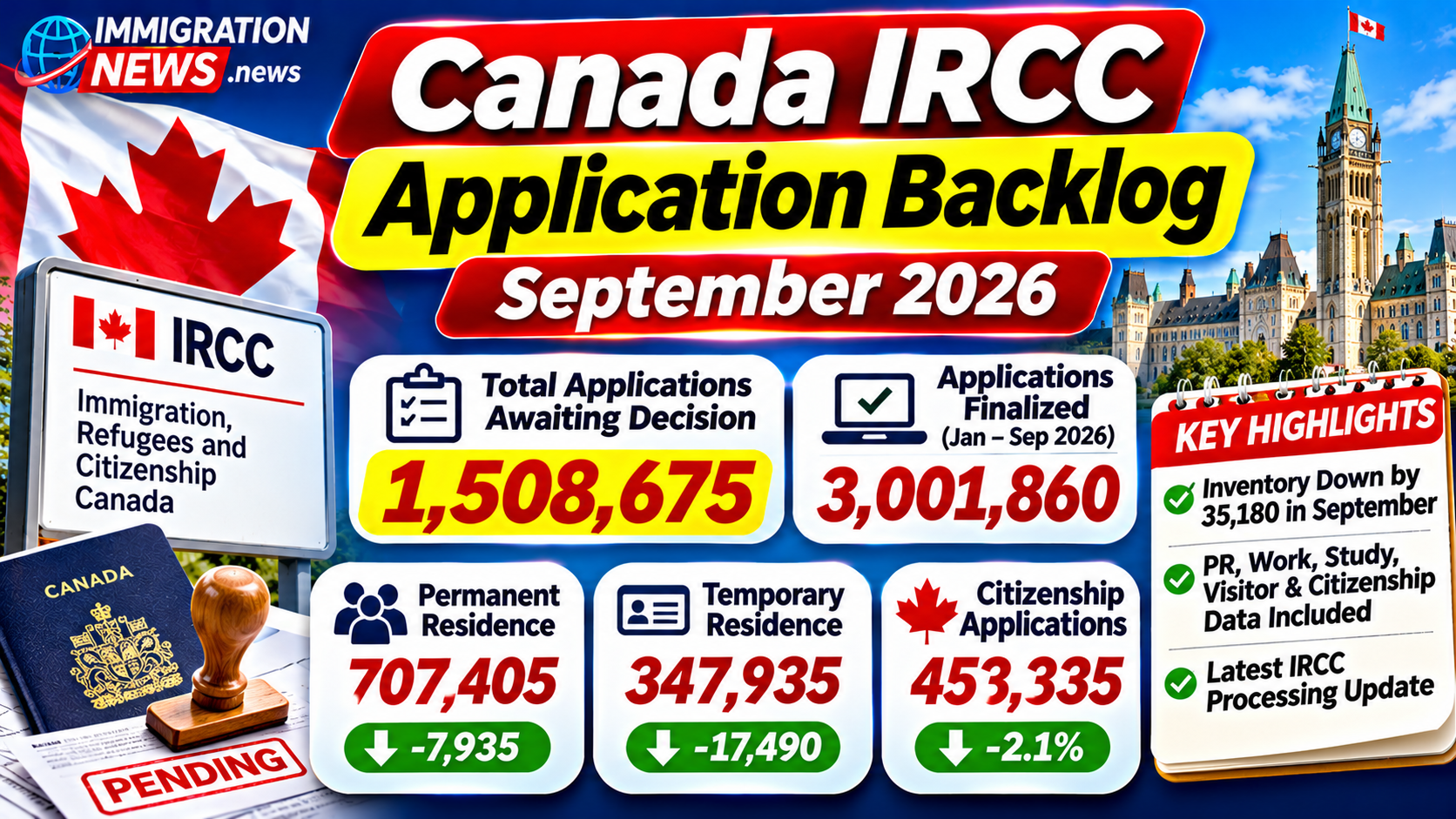
Between January 1 and September 30, 2026, IRCC finalised 2,292,410 temporary residence applications.
As of September 30, the department had another 347,935 temporary residence applications in its processing inventory.
These figures exclude extension applications.
The numbers demonstrate the scale of Canada’s temporary immigration system and the volume of applications handled by the department.
Temporary residence applications include major categories such as:
- Visitor visas.
- Work permits.
- Study permits.
The processing inventory represents applications awaiting finalisation, rather than the total number of applications received during the year.
The latest figures also help explain why processing estimates can change from one weekly update to another.
What Should Canada Visa Applicants Do While Waiting for IRCC Decisions?
With processing estimates changing regularly, applicants should take practical steps to avoid unnecessary delays.
1. Submit a Complete Application
Before submitting an application, review all required documents and ensure that the information is accurate.
Missing documents can lead to additional requests, delays or a returned application.
2. Complete Biometrics Promptly
Applicants who receive a biometrics instruction letter should arrange their appointment as soon as possible.
Delays in completing biometrics can affect the overall processing timeline.
3. Monitor IRCC Account Updates
Applicants should regularly check their online IRCC accounts and email notifications.
If IRCC requests additional information, responding within the specified deadline is important.
4. Avoid Making Non-Refundable Travel Plans Too Early
A published processing estimate does not guarantee a decision by a particular date.
Applicants should be cautious about booking non-refundable flights or making commitments that depend on receiving a visa.
5. Apply for Extensions Before Status Expires
People already in Canada should understand the deadlines for extending their immigration status.
Eligible applicants who submit an extension application before their current status expires may benefit from maintained status under the applicable immigration rules, provided they meet the relevant conditions.
6. Check Processing Times Regularly
IRCC generally updates temporary residence processing estimates weekly.
The next update is expected around November 25, 2026.
Applicants should use the official government tool rather than relying exclusively on older processing time reports.
Official tool: https://www.canada.ca/en/immigration-refugees-citizenship/services/application/check-processing-times.html
When Will IRCC Publish the Next Canada Visa Processing Time Update?
IRCC is expected to release its next temporary residence processing time update on or around November 25, 2026.
The next update may bring further changes to visitor visas, study permits, work permits and Super Visa applications.
Applicants from India, Pakistan, Nigeria, the Philippines and other major immigration markets should monitor the figures before making travel, education or employment decisions.
The November 18 figures provide the latest available comparison for the application categories covered in this report.
However, the estimates can change as IRCC processes existing applications and receives new submissions.
Conclusion: Canada IRCC Processing Times November 2026
The latest Canada IRCC processing times November 2026 update brings encouraging news for some international students and visitors, but challenges remain for applicants seeking permit extensions and family visits.
Indian students now face an estimated seven-week wait for study permits, while visitor visa applicants from India have an estimated waiting period of 31 days.
Pakistan recorded the biggest improvement in visitor visa processing, with the estimate falling by 11 days. However, Pakistani Super Visa applicants experienced a 16-day increase, bringing their estimated wait to 107 days.
Work permit estimates remained unchanged across all six locations covered in the comparison, while work and study permit extensions submitted from within Canada became slower.
For applicants, the most important takeaway is that IRCC processing times are estimates, not promises.
Keeping applications complete, responding promptly to document requests and checking the official processing tool regularly can help applicants plan more effectively.
With the next update expected around November 25, Canadian immigration applicants will be watching closely to see whether the latest improvements continue.
FAQs : Canada IRCC Processing Times November 2026
1. What are the latest Canada IRCC processing times November 2026?
According to the November 18 update, work permits take approximately 3–16 weeks depending on the application location, study permits take 3–11 weeks, visitor visas take 12–98 days and Super Visas take 27–107 days across the locations covered in this report.
2. What is the Canada study permit processing time for Indian students?
The estimated processing time for study permit applications from India is seven weeks as of November 18, 2026, down from eight weeks in the previous update.
3. What is the Canada visitor visa processing time for Indians?
Indian visitor visa applicants currently face an estimated processing time of 31 days, compared with 34 days in the previous update.
4. What is the Canada work permit processing time for Indian applicants?
The estimated work permit processing time for applicants from India is 10 weeks, unchanged from November 12.
5. What is the Canada Super Visa processing time for India?
The latest estimated Super Visa processing time for Indian applicants is 88 days, compared with 87 days previously.
6. What is the Canada visitor visa processing time for Pakistan?
The estimated processing time for Pakistani visitor visa applicants is 46 days, down from 57 days in the previous update.
7. What is the Canada Super Visa processing time for Pakistan?
Pakistani Super Visa applicants currently face an estimated waiting period of 107 days, an increase of 16 days from the previous estimate of 91 days.
8. Has Canada study permit processing become faster in November 2026?
Yes. Processing estimates decreased by one week for applicants from India, Pakistan and the Philippines.
9. What is the Canada work permit extension processing time?
The latest estimate for work permit extensions submitted from within Canada increased from 10 weeks to 13 weeks between October 31 and November 14.
10. What is the Canada study permit extension processing time?
The estimated waiting period increased from six weeks to eight weeks during the October 31–November 14 reporting period.
11. How long does it take to extend a visitor record in Canada?
The latest visitor record processing estimate is 296 days, down from 304 days in the previous reporting period.
12. What is the difference between IRCC processing times and service standards?
Processing times estimate how long an application may take to receive a decision. Service standards are the department’s targets for completing a specified proportion of applications under normal circumstances.
13. Are IRCC processing times guaranteed?
No. IRCC explicitly states that published processing times are not maximum waiting periods or guarantees. Actual timelines may vary depending on application completeness, complexity, background checks and other factors.
14. How often does IRCC update temporary residence processing times?
IRCC generally updates temporary residence processing estimates weekly. The next update following November 18, 2026, is expected around November 25.
15. Where can I check the latest official Canadian visa processing times?
Applicants can use the official IRCC processing time tool:
16. Can my Canada visa application take longer than the published processing time?
Yes. Applications may take longer if additional documents, verification, background checks or other assessments are required.
17. Does a shorter processing time mean my Canada visa will be approved faster?
Not necessarily. Processing times indicate the estimated time to receive a decision, not the likelihood of approval. The outcome depends on whether the applicant meets the applicable immigration requirements.
18. How many temporary residence applications did IRCC finalise in 2026?
IRCC finalised 2,292,410 temporary residence applications between January and September 2026. Its inventory contained another 347,935 applications awaiting finalisation as of September 30, excluding extensions.
Source : CIC News
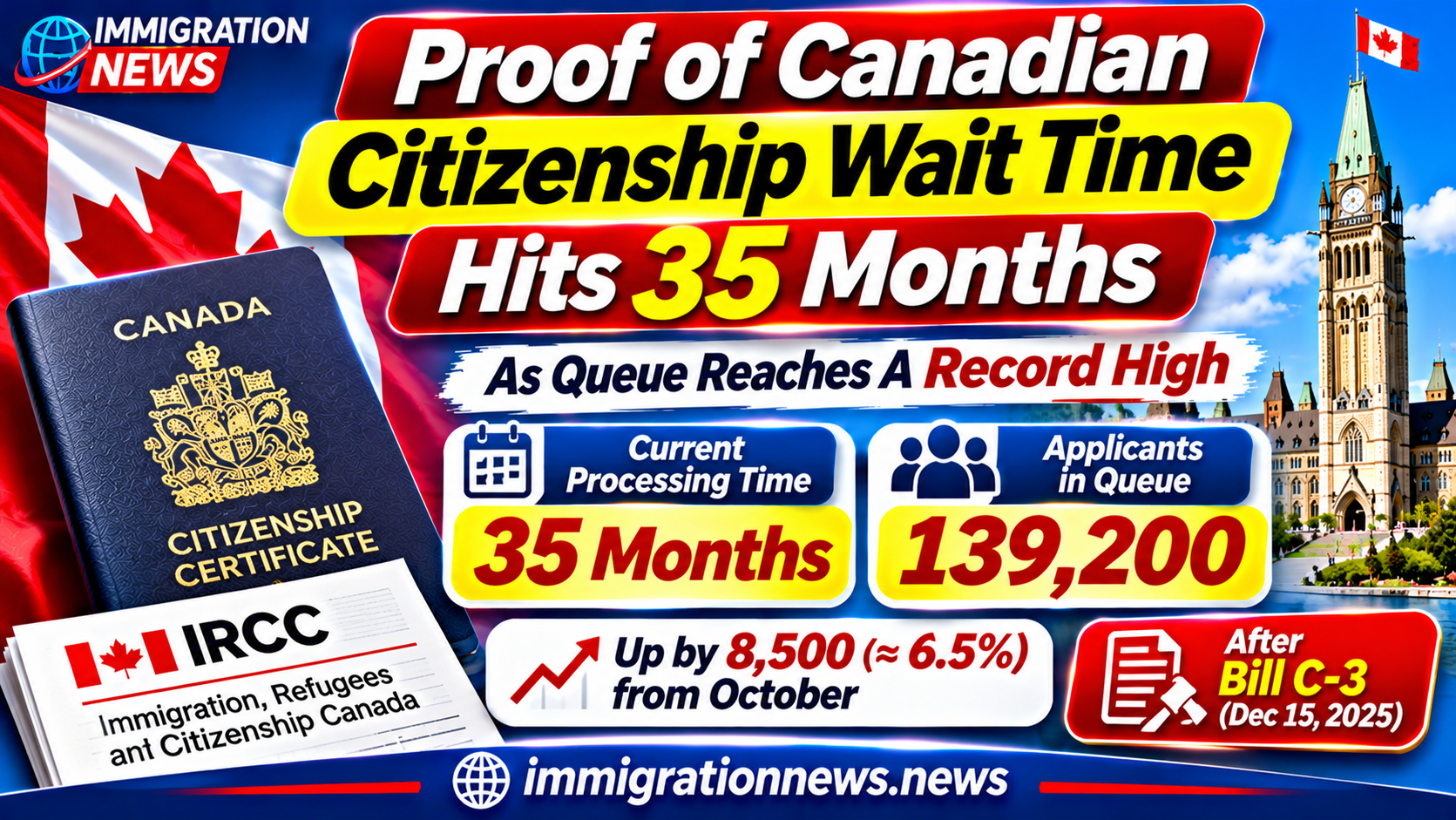
Read About : Canada Proof of Citizenship Processing Time 2026 : Hits 35 Months as Application Queue Reaches Record High
One thought on “Canada IRCC Processing Times November 2026: Study Permits Faster, Work Permit Extensions Slower”