
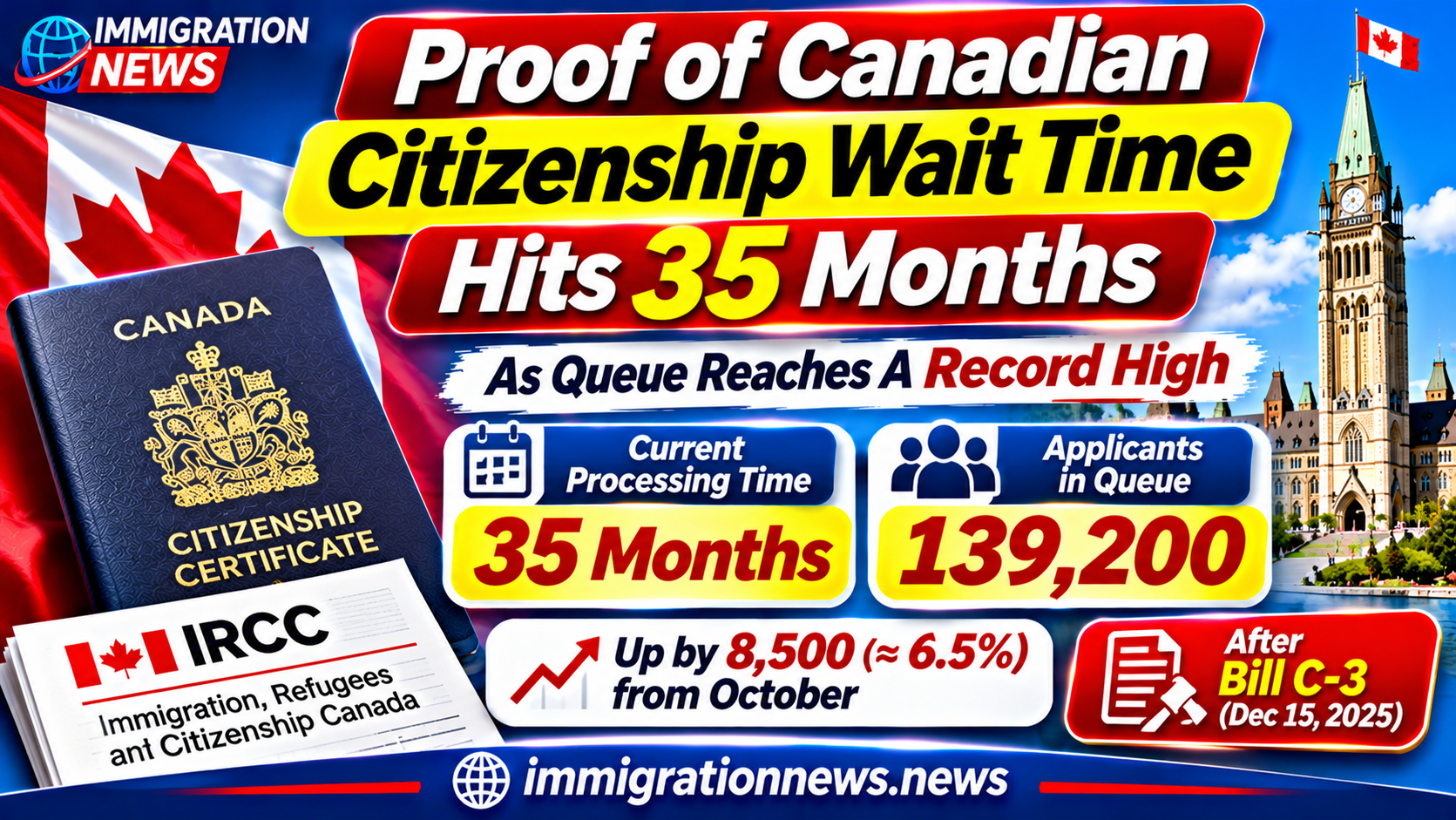
The wait for a Canadian citizenship certificate has reached 35 months, creating further uncertainty for thousands of people seeking official proof of their Canadian citizenship by descent.
Immigration, Refugees and Citizenship Canada (IRCC) updated its processing times on November 17, 2026, increasing the estimated waiting period from 34 months in October to 35 months in November.
The latest Canada Proof of Citizenship Processing Time 2026 update comes as the number of applicants waiting for a decision has climbed to approximately 139,200, an increase of 8,500 people compared with October.
This is the highest reported queue since Canada’s citizenship law changed in December 2025, when Bill C-3 removed the first-generation limit in certain circumstances and expanded eligibility for citizenship by descent.
The latest development is particularly significant for Americans and other foreign nationals with Canadian family roots who may have automatically acquired Canadian citizenship under the revised legislation.
At the current estimated processing time, someone submitting a new application in November 2026 could be waiting until approximately October 2029 for a decision.
Although IRCC has increased the number of applications it is finalising, the growing queue suggests that demand for Canadian citizenship certificates continues to exceed the department’s processing capacity.
Here is what the latest figures mean, who is affected, how Bill C-3 changed Canadian citizenship rules and whether applicants can obtain their citizenship certificates sooner.
Canada Proof of Citizenship Processing Time 2026: Latest IRCC Update
The November 17 update increased the estimated processing time for proof of Canadian citizenship applications by one month.
The waiting period has now reached 35 months, compared with 12 months in May 2026.
| Indicator | Latest figure |
|---|---|
| Proof of citizenship processing time | 35 months |
| Previous processing time | 34 months |
| Increase in November | 1 month |
| Applicants waiting | Approximately 139,200 |
| Increase in queue | Approximately 8,500 |
| Monthly queue growth | Approximately 6.5% |
| Previous October queue | Approximately 130,700 |
The figures show that the processing situation has continued to deteriorate, although the monthly increase in waiting time is now considerably smaller than the sharp rises recorded during the summer.
The 35-month estimate applies to applications submitted from Canada and the United States.
Applicants applying from other countries should expect additional time because of international mail and document delivery.
According to IRCC, applicants outside Canada and the United States should allow an additional three to four months for mail.
The published processing time is an estimate rather than a guaranteed decision date.
Canadian Citizenship Certificate Waiting Time Has Increased Every Month
The latest Canada Proof of Citizenship Processing Time 2026 figures show how dramatically the waiting period has increased over the past several months.
In May 2026, applicants were facing an estimated 12-month wait.
By November, the figure had almost tripled.
Month-by-Month IRCC Processing Time Changes
| Month | Estimated waiting time | Monthly increase |
|---|---|---|
| May 2026 | 12 months | +2 months |
| June 2026 | 15 months | +3 months |
| July 2026 | 19 months | +4 months |
| August 2026 | 25 months | +6 months |
| September 2026 | 33 months | +8 months |
| October 2026 | 34 months | +1 month |
| November 2026 | 35 months | +1 month |
The sharpest deterioration occurred between August and September, when the estimated processing time increased by eight months.
October and November brought smaller increases of one month each.
This suggests that the rate at which the estimated waiting time is increasing has slowed.
However, the overall processing situation remains challenging.
A 35-month waiting period means that applicants submitting new files in November 2026 could potentially remain in the system until October 2029.
For people planning to use their Canadian citizenship to obtain a passport, relocate to Canada or pursue employment and education opportunities, such delays can create significant uncertainty.
Canadian Citizenship Application Queue Reaches Approximately 139,200
The growing processing time is accompanied by an increase in the number of people waiting for their citizenship certificates.
IRCC’s processing-time tracker showed approximately 139,200 applicants awaiting decisions in November.
This was approximately 8,500 more than the 130,700 reported in October.
The increase represents approximately 6.5% in a single month.
It also exceeds the previous reported high of approximately 136,000 applicants in September.
How Much Has the Citizenship Certificate Queue Increased?
The scale of the increase becomes clearer when comparing the figures from December 2025 with the latest November 2026 update.
| Reporting period | Applicants waiting |
|---|---|
| December 2025 | Approximately 40,400 |
| September 2026 | Approximately 136,000 |
| October 2026 | Approximately 130,700 |
| November 2026 | Approximately 139,200 |
The queue has more than tripled since December 2025.
October briefly offered some relief when the number of pending applicants decreased by approximately 5,300.
However, the November update reversed that improvement.
The latest figures indicate that demand for citizenship certificates remains exceptionally high following the changes to Canada’s citizenship legislation.
Why Is Canada’s Citizenship Certificate Backlog Growing?
The major factor behind the growing demand is Canada’s decision to expand citizenship by descent eligibility through Bill C-3.
The legislation took effect on December 15, 2025, changing the rules that previously restricted how Canadian citizenship could be passed to children born or adopted outside Canada.
The previous first-generation limit prevented many Canadians born abroad from passing citizenship to their own children who were also born outside Canada.
This created situations in which people with Canadian parents or grandparents could not automatically obtain Canadian citizenship because of the generation in which they were born.
Bill C-3 changed this position for certain groups.
As a result, many people who were previously excluded became eligible for Canadian citizenship automatically.
These individuals can now apply for a citizenship certificate to obtain official proof of their status.
The sudden expansion of eligibility has brought a significant number of new applicants into IRCC’s processing system.
The First-Generation Limit Before Bill C-3
Before the legislative changes, Canadian citizenship by descent was generally limited to the first generation born abroad.
For example:
- A person born in Canada could pass citizenship to a child born outside Canada.
- That child, if born abroad, generally could not pass citizenship automatically to another child also born outside Canada.
This restriction created difficulties for Canadian families living internationally.
Even when families maintained strong connections with Canada, children born outside the country beyond the first generation could be excluded from automatic citizenship.
What Changed After December 15, 2025?
Bill C-3 removed the first-generation limit in certain circumstances.
People born outside Canada before December 15, 2025, who would have been Canadian citizens if not for the previous first-generation limit or other outdated rules, can now qualify for citizenship automatically.
This means that citizenship may extend beyond the first generation of people born abroad.
For example, someone born in the United States to a parent who was also born outside Canada may now qualify if their parent became a Canadian citizen under the revised rules.
The changes have created a significant new group of potential citizenship certificate applicants.
However, eligibility depends on the citizenship status of the relevant parent and the historical circumstances of the family.
Having a Canadian grandparent or great-grandparent alone is not sufficient in every case.
Who Can Claim Canadian Citizenship by Descent Under Bill C-3?
The revised legislation may benefit people born outside Canada who have a qualifying connection to a Canadian parent.
The most important distinction is whether the applicant was born before or on or after December 15, 2025.
People Born Before December 15, 2025
People born outside Canada before December 15, 2025, may automatically be Canadian citizens if they would have qualified under the previous rules except for the first-generation limit or certain outdated provisions.
This includes many individuals born abroad in the second generation or later.
For example:
Example 1: Canadian grandparent
A person was born in the United States to a parent who was also born in the United States. Their grandparent was born in Canada.
If the parent became a Canadian citizen under the revised law before the person’s birth, the person may qualify for Canadian citizenship by descent.
Example 2: Canadian great-grandparent
A person was born abroad to a parent who became Canadian through Bill C-3, with the parent’s Canadian connection originating through a grandparent born in Canada.
The person may also qualify, provided the legal citizenship chain is established.
Example 3: Multiple generations born abroad
A family may have several generations born outside Canada.
Under the revised legislation, people born before December 15, 2025, may qualify even when the previous first-generation limit would have prevented citizenship from passing through the family.
The important requirement is establishing an unbroken qualifying chain of citizenship through the relevant generations.
People Born On or After December 15, 2025
The rules are different for children born or adopted outside Canada on or after December 15, 2025.
If their Canadian parent was also born or adopted outside Canada, the parent generally must demonstrate at least 1,095 days of physical presence in Canada before the child’s birth or adoption.
This is known as the substantial connection requirement.
The requirement is designed to ensure that Canadians born abroad maintain a meaningful connection to Canada before passing citizenship to another generation born outside the country.
What About Adopted Children?
Bill C-3 also addresses citizenship for adopted children.
People adopted abroad before December 15, 2025, by eligible Canadian parents born or adopted abroad may qualify to apply for a direct grant of citizenship.
For eligible adoptions occurring on or after that date, the Canadian parent must generally demonstrate the required 1,095 days of physical presence in Canada.
Applicants should review the specific adoption rules because citizenship by descent and citizenship through adoption follow different legal procedures.
Official eligibility information is available through the Government of Canada’s citizenship rule changes.
Who Is Most Affected by the 35-Month Canadian Citizenship Processing Time?
The increase is particularly significant for people who need documentary proof of Canadian citizenship.
The application queue includes several types of applicants.
Americans With Canadian Family Roots
A substantial number of new applicants are Americans with Canadian parents, grandparents or more distant Canadian family connections.
Many may have automatically acquired Canadian citizenship under Bill C-3.
A Canadian citizenship certificate allows eligible individuals to obtain official proof of their status and subsequently apply for a Canadian passport.
For Americans planning to relocate to Canada, study there or access opportunities available to Canadian citizens, the certificate can be an important document.
Canadians Born Outside Canada
Some Canadians who were previously affected by the first-generation limit may now be able to establish their citizenship through the revised legislation.
They may have lived their entire lives outside Canada without knowing that they qualify.
The new rules provide an opportunity to obtain formal recognition of their Canadian citizenship.
People Replacing Lost Citizenship Certificates
Not every application in the queue is related to Bill C-3.
People who are already Canadian citizens may also apply for a replacement citizenship certificate if their original document has been lost, damaged or requires replacement.
These applications are also part of the proof-of-citizenship processing system.
People Who Need Canadian Citizenship Documents for Travel
Individuals who have acquired citizenship by descent may need a certificate before applying for a Canadian passport.
This can become particularly important for people planning to move to Canada or travel on a Canadian passport.
However, applicants should avoid making non-refundable travel arrangements based solely on an estimated processing time.
Can You Apply for a Canadian Passport Without a Citizenship Certificate?
A Canadian citizenship certificate is an official document confirming that a person is a Canadian citizen.
It is not the same as a Canadian passport.
For people who acquired citizenship by descent and need documentary proof, the certificate is generally an important document when applying for their first Canadian passport.
A Canadian passport provides travel documentation, while the citizenship certificate establishes citizenship status.
People who already have an existing Canadian citizenship certificate may not need to apply for another one unless they require a replacement or correction.
Applicants who have never received proof of citizenship should generally complete the appropriate IRCC process before applying for their first Canadian passport.
The government also advises people planning to travel soon to obtain proof of citizenship and a Canadian passport before travelling to avoid complications at the border.
Can You Get Your Canadian Citizenship Certificate Faster?
Yes. IRCC allows applicants to request urgent processing in certain circumstances.
However, urgent processing is not automatic.
The department reviews each request individually and requires evidence demonstrating why the citizenship certificate is needed sooner than the normal processing time.
According to IRCC, acceptable reasons can include:
1. Employment requirements
If an applicant needs a citizenship certificate to apply for a job or avoid losing an existing job, they may qualify for urgent consideration.
2. Education requirements
Applicants who need proof of citizenship to attend a school, college or university may request urgent processing.
3. Death or serious illness in the family
People who need to travel because of a death or serious illness in their family may qualify.
For travel-related requests, IRCC may require evidence showing why the applicant cannot obtain a passport using another nationality.
4. Access to government benefits
Urgent processing may be considered when an applicant needs proof of citizenship to access:
- A pension.
- Healthcare.
- A Social Insurance Number.
- Other eligible social benefits.
5. Avoiding harm or hardship
IRCC may also consider requests involving situations where applicants face harm or hardship related to factors such as nationality, religion, race, sexual orientation or membership in particular groups.
6. Relocating a minor child to Canada
Urgent processing may be considered when an applicant needs to move a minor child under 18 to Canada and the child was born outside Canada to a Canadian parent.
What Documents Are Required for Urgent Processing?
Applicants must provide an explanation letter outlining why the certificate is needed urgently.
They must also submit supporting evidence.
Examples include:
- A paid flight ticket or travel itinerary.
- A letter from an employer.
- A school or university admission letter.
- A doctor’s note.
- A death certificate.
- Other official documents establishing the urgency.
IRCC will assess the request and decide whether the circumstances justify faster processing.
Even when an application meets the urgent processing criteria, the department does not guarantee that the certificate will be issued by the required date.
Incomplete applications will not be processed.
Official guidance is available here:
IRCC – How to Apply for Urgent Processing of a Citizenship Certificate
How to Request Urgent Processing If You Have Already Applied
Applicants who have already submitted their proof-of-citizenship applications can still request urgent processing if their circumstances qualify.
The process depends on how the original application was submitted.
If you applied online: Use the IRCC web form to explain the urgent circumstances and attach supporting evidence.
If you applied on paper from Canada or the United States: Submit a request through the IRCC web form, beginning the message with the words “Request for urgent processing.”
If you applied on paper from outside Canada and the United States: Contact the Canadian embassy, consulate or high commission where the application was submitted.
Applicants should include their identifying information and supporting documents.
Importantly, IRCC advises applicants not to submit a duplicate urgent application if they have already made an urgent processing request.
Submitting another request for the same case may not speed up processing.
Should You Wait Before Applying for Canadian Citizenship Proof?
For people who are already eligible for Canadian citizenship, delaying an application simply because the current processing time is long may not be helpful.
New applications generally enter the existing queue.
The November figures show that approximately 8,500 additional applicants joined the waiting list compared with October.
Waiting does not reserve an earlier place in the queue.
However, submitting an application without checking eligibility or preparing the required documents can also create problems.
A complete and accurate application is particularly important for people claiming citizenship through multiple generations.
Why Family Documents Matter
Applicants relying on Canadian ancestry may need to establish the citizenship chain through several generations.
Depending on the family history, this may involve:
- Canadian birth certificates.
- Parents’ birth certificates.
- Grandparents’ birth certificates.
- Great-grandparents’ records.
- Marriage certificates.
- Legal name-change documents.
- Adoption records, where applicable.
- Death certificates, where relevant.
Names and dates must be consistent across the documents.
For example, differences in spelling between a birth certificate and a marriage certificate may require additional evidence.
If IRCC requests missing documents or clarification, the application may take longer.
Applicants should therefore establish their eligibility and prepare the complete documentary chain before submitting their applications.
What Is the Difference Between Canadian Citizenship by Descent and Proof of Citizenship?
These terms are closely connected but refer to different things.
Canadian citizenship by descent describes how a person acquires Canadian citizenship through a Canadian parent under the Citizenship Act.
Proof of Canadian citizenship is the application process used to obtain an official citizenship certificate confirming that status.
A person may already be a Canadian citizen even if they have never lived in Canada, held a Canadian passport or received a citizenship certificate.
This is especially important following the implementation of Bill C-3.
The legislation means that some people who previously believed they were ineligible may now already be Canadian citizens.
The citizenship certificate does not normally create citizenship for someone who has automatically acquired it under the law. It provides official documentary proof of that status.
This distinction explains why thousands of people are now applying for certificates despite having been Canadian citizens under the revised legislation.
How to Apply for a Canadian Citizenship Certificate in 2026
People who believe they qualify for Canadian citizenship by descent can apply to IRCC for proof of citizenship.
The process generally involves the following steps.
Step 1: Check your citizenship eligibility
Review your family history and determine whether a parent or another relevant generation acquired Canadian citizenship under the applicable rules.
Step 2: Establish your family connection
Collect the documents necessary to establish the relationship between you and the Canadian parent or ancestor.
Step 3: Prepare identity documents
Prepare your birth certificate, passport or other accepted identity documents.
Step 4: Collect supporting family records
Depending on your circumstances, you may need birth, marriage, adoption or name-change certificates for multiple generations.
Step 5: Complete the proof-of-citizenship application
Use the latest IRCC application instructions and provide accurate information.
Step 6: Submit the application and pay the applicable fee
Submit the application through the available official process and retain your confirmation and application details.
Step 7: Monitor your application
Check your IRCC account and respond promptly to any requests for additional information.
Applicants should use the official Government of Canada website for the latest forms and submission instructions:
Apply for Proof of Canadian Citizenship
What Does the 35-Month Wait Mean for Future Canadian Citizens?
The latest Canada Proof of Citizenship Processing Time 2026 update highlights the administrative challenges created by the expansion of citizenship eligibility.
Bill C-3 has opened a pathway for many people who previously could not acquire Canadian citizenship automatically through their families.
However, the increased demand has placed considerable pressure on IRCC’s citizenship certificate processing system.
The department’s output has also improved.
According to calculations based on IRCC data published on November 17, the department finalized 5,705 proof-of-citizenship applications in September, its highest monthly total since the monthly breakdown began in June.
Nevertheless, the number of applicants waiting has continued to increase.
This suggests that increased processing activity has not yet been sufficient to reduce the overall queue.
The situation will depend on several factors, including:
- The number of new applications submitted.
- IRCC’s monthly processing capacity.
- The complexity of family history assessments.
- The availability of historical citizenship and civil-status records.
- The department’s ability to allocate additional resources.
For applicants, the most practical approach is to verify eligibility carefully, prepare complete records and request urgent processing only when their circumstances meet IRCC’s criteria.
Conclusion: Canadian Citizenship Certificate Wait Reaches 35 Months
The latest Canada Proof of Citizenship Processing Time 2026 update is a significant warning for people planning to claim or document Canadian citizenship by descent.
IRCC has increased the estimated waiting time to 35 months, while the number of applicants awaiting decisions has climbed to approximately 139,200.
The growth follows the implementation of Bill C-3, which removed the first-generation limit in certain circumstances and made many additional people eligible for Canadian citizenship.
Although IRCC has increased the number of applications it is finalising, the growing queue means that new applicants could face lengthy delays.
People who believe they qualify through a Canadian parent or family connection should not assume they are ineligible simply because they were born outside Canada or because several generations of their family lived abroad.
At the same time, Canadian ancestry alone does not guarantee citizenship.
The relevant family relationships and citizenship status must be established under the applicable law.
Applicants should check their eligibility, prepare their supporting documents and submit complete applications rather than waiting unnecessarily.
For those facing genuine employment, education, travel or other qualifying urgent circumstances, IRCC provides a separate process for requesting expedited consideration.
The most important step is to establish whether you are already a Canadian citizen before making plans based on the current processing estimate.
FAQs : Canada Proof of Citizenship Processing Time 2026
1. What is the Canada proof of citizenship processing time in November 2026?
IRCC’s processing-time estimate reached 35 months on November 17, 2026, for proof of citizenship applications submitted from Canada and the United States.
2. How many people are waiting for Canadian citizenship certificates?
Approximately 139,200 people were waiting for decisions on proof of citizenship applications in November 2026, around 8,500 more than in October.
3. Why has the Canadian citizenship certificate backlog increased?
The increase is largely associated with higher demand following Bill C-3, which changed the first-generation limit for citizenship by descent and made additional people eligible for Canadian citizenship.
4. What is Bill C-3 in Canadian immigration?
Bill C-3 is legislation that amended Canada’s Citizenship Act and changed how Canadian citizenship can pass to children born or adopted outside the country. It took effect on December 15, 2025.
5. Can I claim Canadian citizenship through my grandparents?
You may qualify if your Canadian grandparent’s citizenship passed through your parent under the applicable citizenship rules. Your family’s complete citizenship chain must be established.
6. Can I get Canadian citizenship through my great-grandparents?
Potentially, yes. People born abroad before December 15, 2025, may qualify beyond the first generation under Bill C-3 if the relevant citizenship chain is established. Eligibility depends on the family’s specific circumstances.
7. Do I need to have lived in Canada to claim citizenship by descent?
Generally, people who automatically acquired citizenship by descent do not need to have lived in Canada. However, the rules for children born abroad on or after December 15, 2025, include a substantial connection requirement in certain circumstances.
8. Does Bill C-3 apply to people born before December 15, 2025?
Yes. The legislation provides citizenship to many people born abroad before December 15, 2025, who would have been Canadian citizens if not for the previous first-generation limit or certain outdated provisions.
9. What is the substantial connection test under Bill C-3?
For certain children born or adopted abroad on or after December 15, 2025, to a Canadian parent who was also born or adopted abroad, the parent must demonstrate at least 1,095 days of physical presence in Canada before the child’s birth or adoption.
10. Can I apply for a Canadian passport without a citizenship certificate?
People seeking their first Canadian passport generally need acceptable proof of Canadian citizenship. A citizenship certificate is an important document for people who acquired citizenship by descent and do not already have other acceptable proof.
11. Can IRCC process a citizenship certificate faster than 35 months?
Yes. IRCC may consider urgent processing for qualifying circumstances involving employment, education, serious family illness, death, access to social benefits and other recognised situations.
12. What documents are needed for urgent processing?
Applicants generally need an explanation letter and supporting evidence, such as a paid flight itinerary, employer letter, school admission letter, doctor’s note or death certificate.
13. Does urgent processing guarantee a faster citizenship certificate?
No. IRCC assesses requests individually. Even if an urgent request qualifies, the department cannot guarantee that the certificate will arrive by the applicant’s required date.
14. How long does Canadian citizenship proof take for applicants outside Canada?
The 35-month estimate applies to applications submitted from Canada and the United States. Applicants elsewhere should allow an additional three to four months for international mail, according to IRCC.
15. Should I wait before applying for Canadian citizenship proof?
If you are already eligible, delaying your application generally does not shorten the waiting period. New applications join the existing queue. However, you should first confirm eligibility and prepare complete supporting documents.
16. Can I apply for a citizenship certificate if my Canadian parent was also born outside Canada?
Yes, potentially. Bill C-3 removed the first-generation limit for certain people born before December 15, 2025. Your parent’s citizenship status and the applicable rules must be verified.
17. Does a Canadian citizenship certificate expire?
A Canadian citizenship certificate does not expire. However, you may need a replacement if it is lost, damaged or contains incorrect information.
Source : CIC News
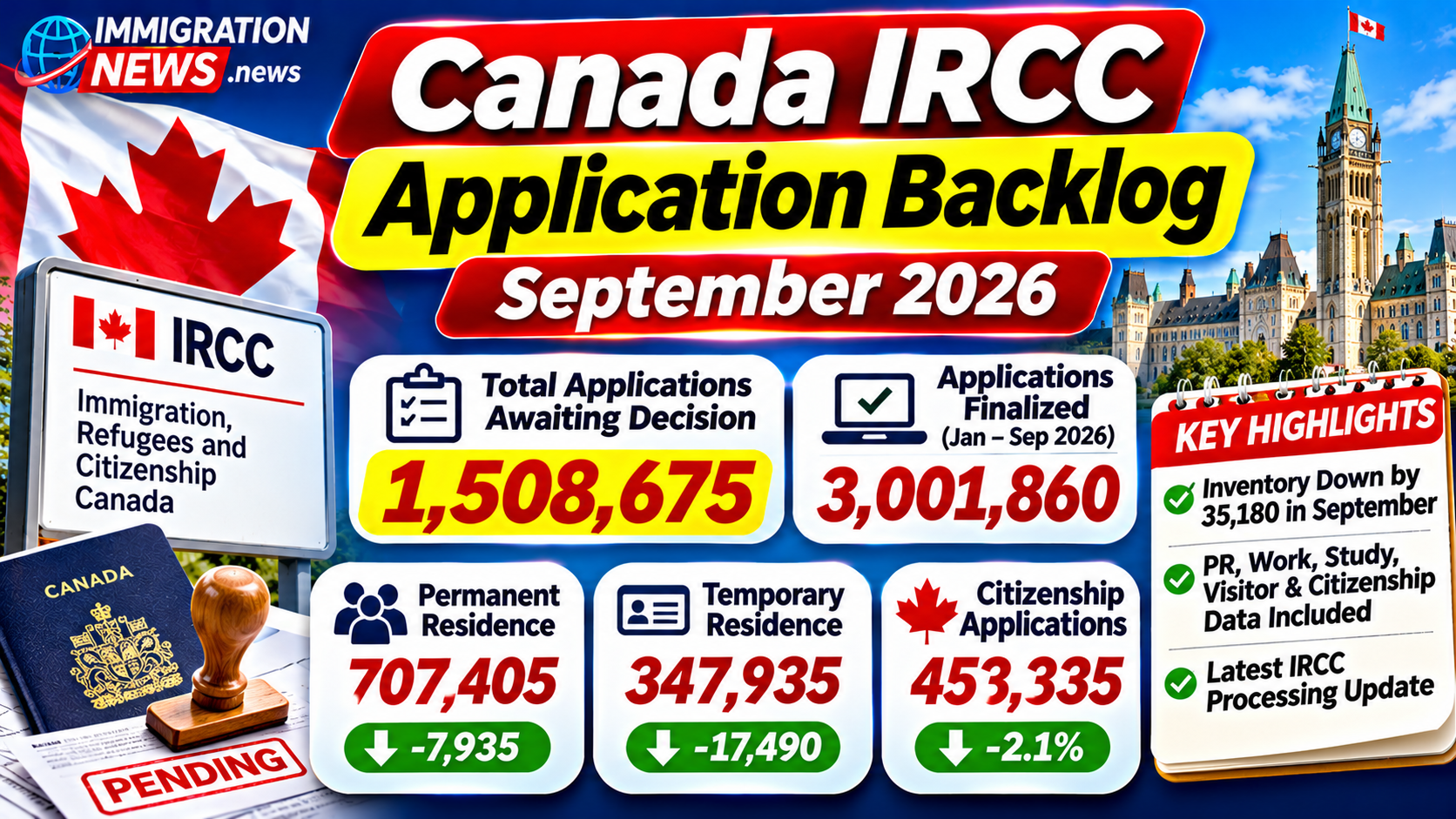
Read About : Canada IRCC Application Backlog September 2026: 1.5 Million Applications Awaiting Decisions After 3 Million Finalized

One thought on “Canada Proof of Citizenship Processing Time 2026 : Hits 35 Months as Application Queue Reaches Record High”