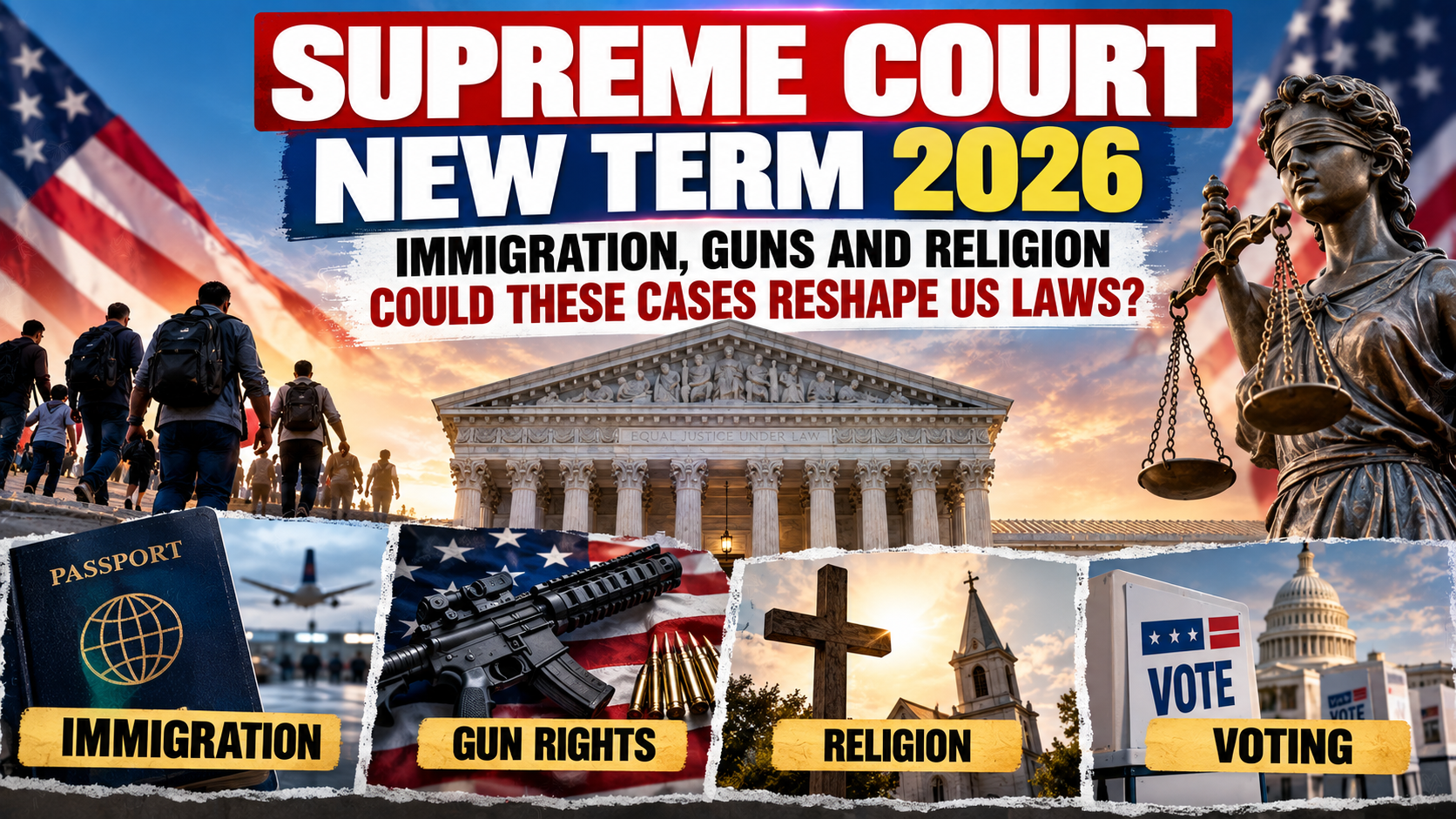
The Supreme Court new term 2026 has opened with a series of major cases that could reshape U.S. law on immigration, gun rights, religious freedom and voting.
The nine justices began the new term on October 5, 2026, with several disputes already scheduled for arguments and additional challenges to President Donald Trump’s policies potentially reaching the court in the months ahead.
Immigration is expected to be one of the most consequential areas. The justices are set to examine the Trump administration’s use of third-country deportations and its policy of mandatory detention for certain immigrants awaiting removal proceedings. The court has also allowed the administration’s third-country deportations to resume temporarily while it considers the underlying legal questions.
The Supreme Court new term 2026 also includes major Second Amendment cases involving state restrictions on AR-15-style rifles, a religious-freedom dispute involving a Catholic preschool in Colorado and potentially significant voting-law cases.
At the same time, November’s midterm elections could influence the political environment surrounding the court, including future Supreme Court appointments and proposals to change the institution itself.
Here are the major issues to watch.
1. Immigration cases could produce major consequences
Immigration is likely to be one of the biggest areas of focus during the Supreme Court new term 2026.
The justices are considering challenges involving two particularly controversial elements of the Trump administration’s immigration enforcement strategy.
The first concerns the government’s authority to deport noncitizens to countries where they are not citizens.
The second involves whether the administration can require certain immigrants living in the United States to remain in detention without access to a bond hearing while their removal cases proceed.
Both disputes could affect the government’s ability to carry out its broader immigration enforcement agenda.
Third-country deportations
The Supreme Court has agreed to consider whether the Trump administration can remove certain noncitizens to countries other than their countries of citizenship.
The policy has faced challenges over whether migrants receive adequate notice and a meaningful opportunity to object before being sent to another country.
In September, the Supreme Court temporarily allowed the administration to resume the deportations while the broader legal dispute proceeds.
The eventual ruling could establish important limits on the government’s authority to use third countries when direct removal to a person’s home country is difficult or unavailable.
That makes the issue one of the most important immigration cases in the Supreme Court new term 2026.
Mandatory immigration detention
Another major immigration case concerns the government’s interpretation of federal detention law.
The Trump administration has argued that certain noncitizens can be detained without a bond hearing while their removal proceedings continue.
Several lower federal courts have rejected broader interpretations of the government’s authority, creating a legal conflict that has now reached the Supreme Court.
The dispute could affect a large number of immigrants who are already living inside the United States rather than people detained at the border.
The outcome could determine when an immigrant is entitled to ask an immigration judge for release on bond and when federal law instead requires continued detention.
2. More Trump immigration policies could reach the justices
The immigration disputes already on the docket may not be the only Trump administration policies examined by the court during the Supreme Court new term 2026.
Additional legal challenges could involve:
- Birthright citizenship restrictions
- The administration’s transgender military policy
- Federal immigration enforcement
- Executive authority
- Federal appointments
- Tariffs
- Other immigration-related executive actions
The court’s handling of these disputes will help define the limits of presidential power during Trump’s second administration.
The justices have previously delivered a mixed record on Trump’s policies, sometimes allowing controversial measures to proceed while also blocking or limiting other administration actions.
That history makes the Supreme Court new term 2026 especially important for determining how far the executive branch can go without additional authorization from Congress.
3. AR-15-style rifle bans face a major Supreme Court test
Gun rights will also take centre stage during the Supreme Court new term 2026.
The justices have agreed to hear challenges involving restrictions on AR-15-style semiautomatic rifles in Illinois and Connecticut.
The cases could become among the most important Second Amendment disputes since the Supreme Court’s recent decisions expanding the constitutional protection of firearm possession and carrying.
The court will have to consider whether governments can prohibit certain semiautomatic rifles and related firearms under the Second Amendment.
Gun-rights groups argue that commonly owned firearms cannot be prohibited simply because they are politically controversial or because of their characteristics.
States and local governments defending the restrictions argue that they have authority to regulate particularly dangerous weapons.
The court’s decision could affect firearm laws across the country.
4. The cases build on major Second Amendment rulings
The gun cases in the Supreme Court new term 2026 follow several major Second Amendment decisions.
In 2022, the Supreme Court struck down a New York law that imposed strict requirements on people seeking to carry firearms in public.
The court also established a historical approach to evaluating modern firearm restrictions.
Under that framework, governments defending a gun regulation generally face questions about whether the restriction is consistent with the nation’s historical tradition of firearm regulation.
The new AR-15 cases could test how that methodology applies to modern semiautomatic rifles.
The justices could therefore establish a significant precedent for future challenges involving assault-weapons bans and similar firearm restrictions.
5. Religious freedom returns to the Supreme Court
Religious liberty is another major theme of the Supreme Court new term 2026.
One important case involves a Catholic preschool in Colorado that wants to participate in the state’s publicly funded universal preschool programme.
The religious school argues that it was excluded because of its faith-based admissions policies.
Colorado, meanwhile, maintains that schools receiving public benefits can be required to comply with nondiscrimination requirements.
The case raises a broader constitutional question:
Can a government exclude a religious institution from a public programme because the institution’s religious practices conflict with programme requirements?
The ruling could have consequences beyond preschool education, potentially affecting how governments structure public-benefit programmes involving religious organisations.
6. Texas Ten Commandments law could face a constitutional challenge
The Supreme Court new term 2026 could also bring the justices another major dispute over religion in public schools.
Texas has adopted legislation requiring the display of the Ten Commandments in public-school classrooms.
The law is expected to face a constitutional challenge concerning the Establishment Clause and the separation between government and religion.
The case could require the court to reconsider how constitutional rules governing religious displays in public institutions should be applied.
A ruling in favour of Texas could give states greater freedom to include religious material in government institutions.
A ruling against the law could reinforce existing restrictions on government-sponsored religious displays.
7. Voting disputes could put the court back in the election spotlight
The November 2026 midterm elections could create another major source of cases for the Supreme Court.
The Supreme Court new term 2026 coincides with an election cycle in which control of the House and Senate will be contested.
Several election-related disputes could reach the justices, particularly over voting eligibility, voter registration and election administration.
One important area involves Arizona voting laws.
The court is expected to consider challenges involving requirements for documentary proof of citizenship when registering to vote using certain state forms and procedures for removing voters from registration rolls when citizenship cannot be confirmed.
These cases could have consequences for election administration in states beyond Arizona.
8. Election disputes could become especially contentious
The court has already become involved in several election-related disputes involving the Trump administration.
The possibility of federal intervention at polling places or disputes over voter eligibility could produce emergency litigation during the midterms.
If those cases reach the Supreme Court shortly before or after Election Day, the justices could once again find themselves at the centre of a political controversy.
The role of federal agencies in elections could also become an important constitutional question.
For the Supreme Court new term 2026, that means the midterms could generate significant litigation even though the justices themselves are not running for office.
9. Could a Supreme Court justice retire?
The composition of the court is another issue attracting attention during the Supreme Court new term 2026.
Two older conservative justices in particular remain the focus of retirement speculation: Samuel Alito and Clarence Thomas.
Alito, who is 76, has previously dismissed speculation that he plans to retire.
Thomas, 78, is the oldest member of the court and has served since 1991.
A retirement could dramatically alter the political and ideological balance of the Supreme Court.
However, retirement speculation should not be treated as confirmation that either justice intends to leave the court.
No retirement has been announced simply because these questions are being discussed.
10. Why the 2026 midterms could matter for the Supreme Court
The midterm elections could influence the court’s future because Supreme Court nominees require Senate confirmation.
If Republicans retain control of the Senate, President Trump would have a potentially clearer path to confirming a nominee if a vacancy occurred.
If Democrats gain control, the confirmation process could become substantially more difficult.
That makes the period between the November election and the seating of the new Congress potentially important.
A vacancy occurring during that period could create a political battle over whether Trump should be allowed to fill it before the new Senate takes office.
Consequently, the Supreme Court new term 2026 is taking place against an unusually important political backdrop.
11. Democrats are proposing changes to the Supreme Court
The future of the court itself is also part of the political debate surrounding the Supreme Court new term 2026.
Some Democratic lawmakers have proposed structural changes that could include:
- Term limits for Supreme Court justices
- Expanding the court beyond nine seats
- A formal and enforceable ethics code
- Greater transparency surrounding judicial conduct
One proposal would increase the number of justices from nine to 13.
Supporters argue that structural reforms could improve accountability and reduce the influence of individual justices serving for decades.
Opponents argue that expanding the court would undermine judicial independence and could establish a precedent for future changes whenever political control of Congress changes.
12. Why court expansion would face major obstacles
Even if Democrats gain control of Congress, changing the Supreme Court’s structure would not necessarily be straightforward.
Legislation to expand the court or impose term limits would need to pass both chambers of Congress and be signed by the president.
The Senate filibuster presents another potential obstacle.
Unless Senate rules change, most major legislation effectively requires 60 votes to overcome a filibuster.
That makes a major restructuring of the Supreme Court difficult unless there is substantial bipartisan support or Senate rules are changed.
As a result, proposals to expand the court may generate significant political debate without necessarily becoming law.
13. The Supreme Court’s conservative majority remains important
The Supreme Court new term 2026 begins with a 6-3 conservative majority.
Chief Justice John Roberts and Justices Clarence Thomas, Samuel Alito, Neil Gorsuch, Brett Kavanaugh and Amy Coney Barrett form the court’s conservative bloc, while Justices Sonia Sotomayor, Elena Kagan and Ketanji Brown Jackson form the liberal wing.
That does not mean the conservative justices will always vote together.
Major cases involving presidential authority, administrative law, immigration and constitutional rights can produce different coalitions.
Justice Roberts in particular has sometimes taken positions that differ from the court’s more conservative members.
Justice Barrett has also occasionally provided a decisive vote in closely divided cases.
Therefore, the outcome of the Supreme Court new term 2026 cannot simply be predicted based on the court’s 6-3 ideological composition.
14. What the immigration cases could mean for migrants
For immigrants and immigration lawyers, the Supreme Court new term 2026 could produce some of the most consequential rulings of the year.
A decision supporting broader mandatory detention could make it significantly harder for some detained immigrants to obtain bond hearings.
A decision limiting third-country deportations could require the administration to provide additional procedural protections before sending people to countries where they are not citizens.
The decisions could also influence how lower federal courts handle future challenges to immigration enforcement policies.
Because immigration law frequently involves conflicts between executive authority, congressional statutes and constitutional protections, the Supreme Court’s interpretation could affect federal immigration policy for years.
15. What happens next in the Supreme Court term?
The Supreme Court new term 2026 officially began on October 5.
Several major cases are scheduled for arguments during the coming months.
The third-country deportation dispute is expected to receive arguments in December, while the AR-15 cases are scheduled for arguments in early December.
The mandatory detention dispute and other immigration cases will also move through the court’s argument calendar.
After oral arguments, the justices will deliberate privately before issuing written opinions.
Most major decisions are expected later in the term, with the court traditionally issuing a large number of its most consequential rulings toward the end of its term.
Key issues to watch in the Supreme Court new term 2026
| Issue | Main question |
|---|---|
| Third-country deportations | Can the U.S. deport noncitizens to countries where they are not citizens, and what process must they receive? |
| Mandatory detention | Can certain immigrants be detained without bond hearings during removal proceedings? |
| AR-15 bans | Can states prohibit certain semiautomatic rifles? |
| Religious preschool | Can religious schools be excluded from public programmes because of faith-based policies? |
| Ten Commandments | Can public schools be required to display the Ten Commandments? |
| Voting laws | How much authority do states have over voter registration and eligibility rules? |
| Supreme Court appointments | Could a retirement create another vacancy? |
| Court reform | Could term limits, ethics rules or expansion gain political momentum? |
FAQs : Supreme Court New Term 2026
What is the Supreme Court new term 2026?
The Supreme Court new term 2026 is the court’s October 2026–2027 term, which began on October 5, 2026. It includes major cases involving immigration, gun rights, religious freedom, voting and executive power.
What immigration cases will the Supreme Court hear?
The court is considering major disputes involving third-country deportations and mandatory detention of certain immigrants during removal proceedings.
Can Trump deport immigrants to third countries?
The Supreme Court has temporarily allowed the Trump administration to resume certain third-country deportations while the justices consider the underlying legal dispute. A final ruling is still expected.
Will the Supreme Court decide whether AR-15 bans are constitutional?
Yes. The court has agreed to hear challenges involving semiautomatic-rifle restrictions in Illinois and Connecticut.
Why is the Colorado Catholic preschool case important?
The case concerns whether Colorado can exclude a religious preschool from a publicly funded programme because its faith-based admissions policies conflict with state nondiscrimination requirements.
Could the Supreme Court consider the Texas Ten Commandments law?
The dispute could require the justices to address whether requiring Ten Commandments displays in public-school classrooms violates constitutional protections concerning government and religion.
Could a Supreme Court justice retire in 2026?
Retirement speculation has focused on older conservative justices, including Samuel Alito and Clarence Thomas. However, no retirement should be assumed unless a justice formally announces one.
Could Democrats expand the Supreme Court?
Democratic lawmakers have proposed court-expansion and term-limit ideas, but major structural changes would face substantial political and legislative obstacles.
Why are the 2026 midterms important for the Supreme Court?
The midterms could determine control of the Senate, which plays a central role in confirming Supreme Court nominees. The election could therefore affect the future composition of the court if a vacancy occurs.
Final Takeaway On Supreme Court New Term 2026
The Supreme Court new term 2026 could become one of the most consequential terms in recent years, particularly for immigration policy, gun rights, religious freedom and presidential power.
For immigrants, the biggest questions involve third-country deportations and mandatory detention. The rulings could determine how much authority the Trump administration has to detain and remove noncitizens and what procedural protections those individuals must receive.
Gun-rights cases involving AR-15-style rifles could establish an important new Second Amendment precedent, while the Colorado religious-preschool dispute and potential Texas Ten Commandments case could reshape the boundaries between religious freedom and government-funded programmes.
Meanwhile, the November midterm elections could create another layer of uncertainty. The results could affect congressional control, future Supreme Court confirmations and the political prospects of proposals to change the court’s size, ethics rules or term structure.
The Supreme Court new term 2026 will therefore be about more than individual cases. Its decisions could influence the balance between presidential power and the courts, the rights of immigrants and gun owners, the role of religion in public institutions and potentially the future structure of America’s highest court.
Source : Money Control
Read About : H-1B Visa Crackdown Intensifies as US Signals New Action on Foreign Workers