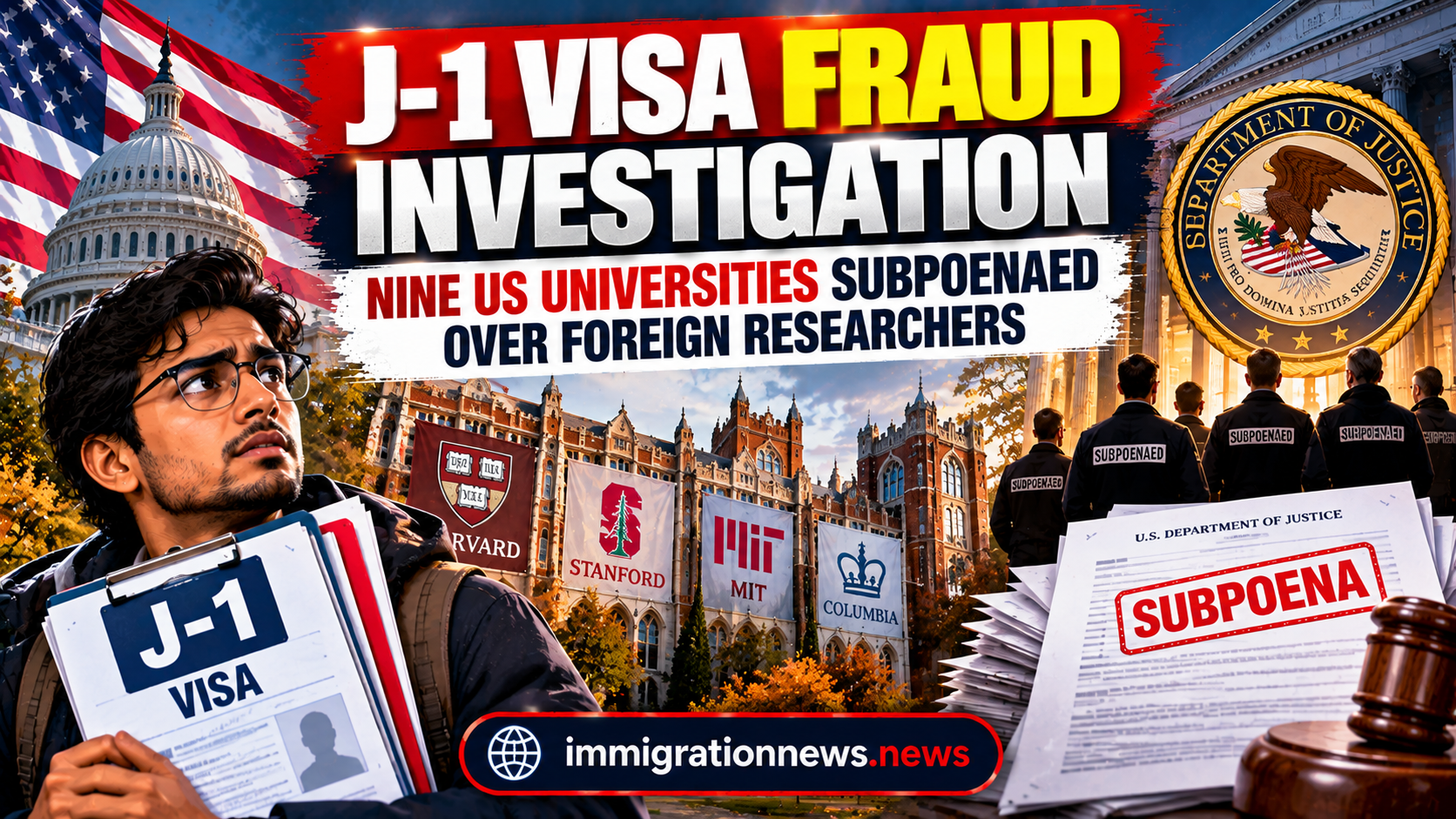
The Trump administration has opened a J-1 visa fraud investigation into nine of the country’s leading research universities, accusing them of using foreign researchers to undercut the wages of American graduate students and scholars. Vice President JD Vance and Labor Department Inspector General Anthony D’Esposito announced the probe on Thursday, October 8, 2026, at a White House event on fraud, and said subpoenas have already been served.
The allegations are serious, but they are allegations. Officials have not publicly identified specific fraudulent visa applications or individual researchers hired unlawfully, and the universities involved say they follow the law. What follows separates what was announced from what has been shown.
Quick Highlights : J-1 Visa Fraud Investigation
- Nine universities which are under the investigation: Harvard, Yale, Stanford, Brown, the University of Pittsburgh, UC Davis, Caltech, Arizona State, and MIT
- Officials say foreign nationals fill about 61% of federally funded postdoctoral and researcher roles at these schools, against 38% elsewhere
- The Labor Department’s Office of Inspector General says subpoenas have been served and investigations are underway
- The administration announced a new multi-agency Visa Fraud Strike Team
- The J-1 visa fraud investigation is part of a wider push that also includes suspending several technology companies from H-1B and green card sponsorship
- Vance’s claim that American researchers earn about $20,000 more was given without a stated source
- The universities say they comply with visa law and will cooperate or review the subpoenas
What Have Officials Announced
Vance said “something weird is going on at these universities” and accused them of using J-1 visas far too much to undercut American wages. D’Esposito said his office had issued subpoenas to all nine institutions and described the inquiry as a historic one. He said it would examine whether foreign influence, improper financial relationships, or visa abuse are compromising federally funded research.
The Labor Department’s inspector general release says the J-1 visa fraud investigation will look at alleged misuse and misclassification within J-1 programs at institutions that together receive billions of dollars in federal research support. D’Esposito also pointed to concerns about China, though he did not name specific cases.
The Nine Universities Named
The universities under investigation are:
- Harvard University
- Yale University
- Stanford University
- Brown University
- University of Pittsburgh
- University of California, Davis
- California Institute of Technology
- Arizona State University
- Massachusetts Institute of Technology
Several are private research universities with large endowments, while others are public institutions. The mix suggests the J-1 visa fraud investigation is built around research-funding patterns rather than any single type of school.
The Core Allegation: Wages and Visa Use
The central claim is about proportion and pay. According to the Labor Department’s inspector general, roughly 61% of postdoctoral workers and researchers supported by federal grants at the nine universities are foreign nationals, compared with 38% at other universities.
Vance went further, saying an American graduate student or researcher makes about $20,000 more than someone brought in on a J-1 visa. He did not say where the figure came from. A gap in who fills research jobs, or in pay, does not by itself show fraud, which is why the J-1 visa fraud investigation will turn on what records the subpoenas produce.
What the J-1 Visa Actually Is
The J-1 Exchange Visitor Program lets foreign nationals study, teach, lecture, conduct research, or receive graduate medical education in the United States on a temporary basis. The State Department designates the sponsors, and universities are among them.
Research scholars and postdoctoral researchers on J-1 visas are common at US universities, and many of them are paid through grants. The investigation’s focus on “misclassification” suggests officials are asking whether some people are being treated as exchange visitors when they function as regular employees, with the pay and obligations that would come with that status. Whether that is happening at these schools is the open question.
What Has Not Been Shown
At this stage, the public record is thin on detail. Reporting notes that the administration has not identified particular fraudulent applications or named researchers it says were hired unlawfully. Whether the nine institutions broke any law depends on evidence the investigation develops, and the subpoenas may reach employment records, sponsorship documents, pay arrangements, and the use of federal grants.
That distinction is worth keeping in view. An announcement at a press conference starts an investigation. It does not establish wrongdoing, and plenty of federal inquiries end with no charges.
How the Universities Responded
Several universities issued statements. Arizona State University said it educates more STEM majors than any other university and has hired talent in full compliance with existing US policy and law. MIT said it was reviewing what it called a very broad subpoena and that every J-1 holder there has been vetted and authorized by the US government. A Stanford spokesperson said the university abides by all applicable visa laws and will cooperate. Yale said it would review the documents once it receives them.
Brown acknowledged receiving a subpoena and defended its international scholars and employees as essential to teaching and research. Harvard, Pitt, and MIT acknowledged receiving subpoenas, according to Time.
The Visa Fraud Strike Team
Alongside the announcement, D’Esposito unveiled two initiatives: the Visa Fraud Strike Team and a Labor Inspector General Most Wanted List. The Strike Team is described as a multi-agency enforcement effort designed to investigate and prosecute visa fraud across the highest-risk visa programs.
The creation of a standing team signals that the J-1 visa fraud investigation is meant to be the first of several, not a one-off. Other visa categories that depend on employer sponsorship, including H-1B, could see similar scrutiny.
Part of a Wider Crackdown
At the same press conference, officials announced that several technology companies, including Microsoft, are being suspended from using H-1B visas and from sponsoring workers for permanent residence. Vance said those companies had abused the processes to replace American workers.
The universities’ probe also follows earlier action. In July 2025, the State Department launched a separate investigation into Harvard’s participation in the J-1 program, questioning whether its programming ran contrary to national interests. Taken together, the measures show an administration treating exchange and work visas as a labour-market and national-security matter at once.
What This Means for J-1 Researchers
Foreign researchers and postdocs on J-1 visas at any university should expect more questions about their status, pay, and role, and should keep copies of their DS-2019, appointment letter, and pay records. Researchers should not assume their own visa is at risk, since the investigation concerns institutional practices rather than individual scholars, but they should know who their sponsor is and what their program category allows.
Prospective J-1 applicants may see longer processing or extra documentation requests while enforcement attention is high. Researchers whose funding or sponsor is among the nine named schools may want to speak with their institution’s international office about any effect on their appointment.
What Universities Should Do
Universities that sponsor J-1 scholars should audit how they classify research staff, confirm that pay and duties match the visa category, and keep records that show compliance. Institutions outside the nine named schools may also want to review practices now, given the Strike Team’s wider mandate.
Legal counsel can help with subpoena responses and with communications to affected scholars, particularly where funding from federal grants is involved.
Key Takeaways On J-1 Visa Fraud Investigation
The J-1 visa fraud investigation targets nine major US universities over claims that they use foreign researchers to undercut American wages, with the Labor Department saying subpoenas have been served. The 61% versus 38% comparison and the $20,000 pay claim are the main figures behind the allegation, but no specific fraud has yet been publicly detailed and the universities say they comply with the law. The probe, the new Visa Fraud Strike Team, and the H-1B suspensions announced the same day indicate a broader enforcement push that J-1 scholars and sponsoring institutions should watch closely.
FAQs : J-1 Visa Fraud Investigation
Which universities are in the J-1 visa fraud investigation?
Harvard, Yale, Stanford, Brown, the University of Pittsburgh, UC Davis, Caltech, Arizona State University, and MIT.
What are the universities accused of in J-1 Visa Fraud Investigation?
Officials accuse them of misusing the J-1 program to bring in foreign researchers and undercut the wages of American graduate students and researchers. The accusations have not been proven.
Where does the 61% figure come from?
The Labor Department’s inspector general says about 61% of postdocs and researchers supported by federal grants at the nine schools are foreign nationals, compared with 38% at other universities.
Does this affect all J-1 visa holders?
The probe concerns institutional practices at nine universities, but J-1 holders elsewhere may see greater scrutiny. Researchers should keep their documents in order and speak with their sponsor’s international office.
What is the Visa Fraud Strike Team?
A new multi-agency enforcement initiative announced by the Labor inspector general to investigate and prosecute visa fraud across high-risk visa programs.
Source : Forbes
Read About : Indian American Voter Roll Claim: 200,000 Removals Alleged, But Unverified