
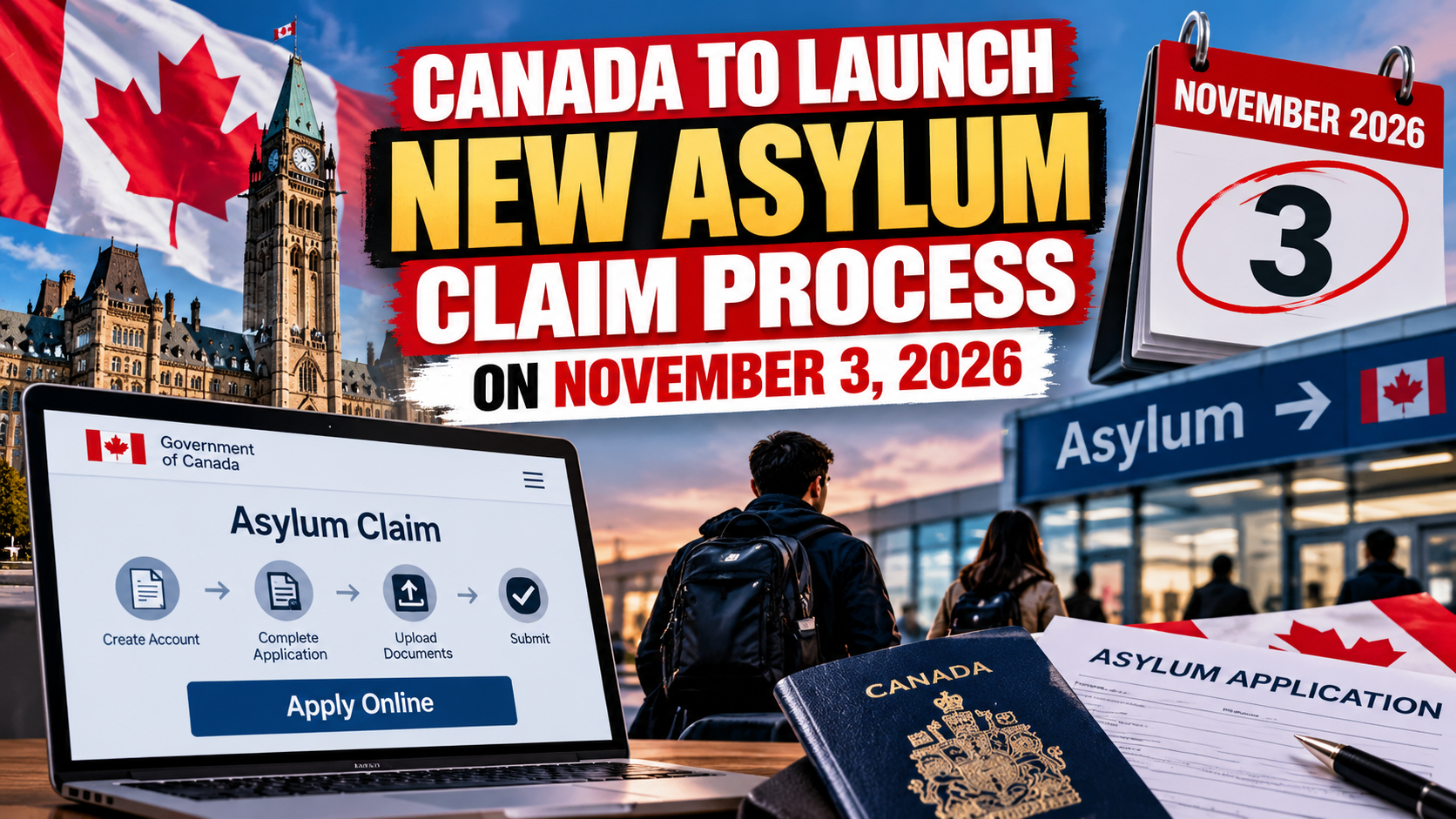
Canada is preparing to introduce important changes to how people submit asylum claims through the Immigration, Refugees and Citizenship Canada (IRCC) Portal. The Canada asylum claim process will move to a new online application format beginning November 3, 2026, affecting people who have started but not yet submitted their claims.
The change is part of IRCC’s efforts to modernize the asylum system and improve how applications are collected and processed online.
For people with unfinished claims, the timing is particularly important. IRCC has set a cutover deadline of 11:59 p.m. Eastern Time on November 2, 2026. Claims submitted before that deadline will generally not be affected by the new questions.
Canada Asylum Claim Process Changes From November 3
The new Canada asylum claim process will affect both asylum claims made from inside Canada and certain claims initiated at the Canadian border.
The most important distinction is whether a claimant has submitted the claim before the November 2 deadline.
If a claim has already been submitted through the IRCC Portal by 11:59 p.m. ET on November 2, IRCC says the claimant will not have to provide the new information unless the department specifically requests it.
However, people who have started a claim but have not submitted it will have to work through the updated process.
What happens to claims made inside Canada?
| Status at 11:59 p.m. ET on Nov. 2 | What happens |
|---|---|
| Claim started but not submitted | Claimant will need to answer new questions and review previous answers |
| Claim submitted | No impact from the change unless IRCC requests additional information |
Personal information already entered into an unfinished application will be saved.
This means applicants do not necessarily have to start the entire application from the beginning, but they will need to review their information and answer additional questions under the new system.
Border Asylum Claims Will Also Be Affected
The Canada asylum claim process also applies to people who make a claim at a Canadian port of entry and are subsequently instructed by the Canada Border Services Agency (CBSA) to complete their claim online.
There are three possible situations at the cutover.
| Situation before the deadline | Impact |
|---|---|
| Claim not linked to an IRCC Portal account | Claimant may need to link the claim and re-enter personal and family information |
| Claim linked but not submitted | New questions must be answered and previous answers reviewed |
| Claim linked and submitted | No impact unless IRCC requests additional information |
One particularly important point concerns people who have not yet linked a border claim to an IRCC Portal account.
If the claim is not linked by 11:59 p.m. ET on November 2, information previously collected by CBSA may not be saved in the Portal.
The claimant could therefore have to enter information about themselves and their family again.
What Should Asylum Claimants Do Before November 3?
Anyone who has already started the Canada asylum claim process should check the status of their application as soon as possible.
If the claim is complete and ready for submission, submitting it before the deadline may prevent the claimant from having to answer the new questions introduced with the updated system.
Applicants should carefully review:
- Personal information
- Family information
- Contact details
- Previous answers
- Supporting information
- Documents requested by IRCC
- Whether the claim has actually been submitted
Simply starting an application is not the same as submitting it.
The key deadline is 11:59 p.m. Eastern Time on November 2, 2026.
IRCC has stated that people who submit their existing claims before the cutover will not have to provide additional information unless specifically asked.
Who Can Claim Asylum in Canada?
The Canada asylum claim process is intended for people who need protection because they cannot safely return to their home country.
Canada recognizes two main categories of protection.
Convention refugees
A person may qualify as a Convention refugee if they face persecution because of factors such as:
- Race
- Religion
- Nationality
- Political opinion
- Membership in a particular social group
The claimant must demonstrate that they have a well-founded reason to fear persecution if returned.
Persons in need of protection
A person may also qualify if returning to their country would expose them to:
- Torture
- A serious risk to their life
- Cruel or unusual treatment or punishment
The claim must be based on the protection needs of the individual rather than simply a desire to remain in Canada.
Canada Has Tightened Some Asylum Eligibility Rules
The new online Canada asylum claim process should not be confused with the separate eligibility rules that determine whether a claim can be referred to the Immigration and Refugee Board of Canada (IRB).
Current rules include important restrictions.
For example, claims can be ineligible in certain circumstances involving previous refugee claims, protected-person status, criminality or security concerns, and some claims involving entry from the United States.
There are also newer timing restrictions for certain claims.
For people who entered Canada after June 24, 2020, an asylum claim made more than one year after their first entry into Canada can be ineligible, subject to exceptions.
There are also restrictions for certain people who enter Canada from the United States between ports of entry and make a claim more than 14 days after entering.
These rules operate separately from the November 3 Portal changes.
What Happens After an Asylum Claim Is Submitted?
Once the Canada asylum claim process reaches the submission stage, IRCC or CBSA assesses whether the claim is eligible for referral to the IRB.
If the claim is eligible, it can be referred to the IRB’s Refugee Protection Division.
The IRB then determines whether the claimant meets the legal definition of a Convention refugee or person in need of protection.
A claimant may receive an acknowledgment confirming that their claim has been received, along with instructions relating to medical examinations and other appointments.
The claimant will eventually have to attend a hearing and provide evidence supporting their case.
The asylum process therefore involves considerably more than simply completing an online form.
Can Asylum Claimants Work While Waiting?
One important part of the Canada asylum claim process is access to work authorization while a claim is being processed.
Eligible asylum claimants may be able to obtain an open work permit while waiting for a decision.
Generally, a claimant must have a claim that has been found eligible for referral to the IRB and must complete the required medical examination before an open work permit can be issued.
When completing the online asylum application, claimants can indicate that they want to request a work permit.
There is no separate fee for the initial open work permit when the claimant meets the applicable requirements.
The work permit allows an eligible claimant to work legally while waiting for the asylum process to continue.
What If an Asylum Claim Is Found Ineligible?
Not every application reaches the IRB.
If a claim is found ineligible for referral, the case can be transferred to the CBSA and the removal process can begin.
Depending on the circumstances, the individual may later be eligible for a Pre-Removal Risk Assessment (PRRA).
A PRRA provides an opportunity for certain individuals facing removal to explain why they believe they would face persecution or serious harm if returned to their country.
However, PRRA eligibility is not automatic.
A CBSA officer determines whether an individual is eligible to apply, and waiting periods can apply in many situations.
Canada Expanded Work Permit Access for Some Ineligible Claimants
The government also introduced a temporary measure in March 2026 affecting certain people whose asylum claims are found ineligible for referral to the IRB.
Under the measure, some individuals who may later become eligible to submit a PRRA can apply for an open work permit before receiving formal notification that they can make a PRRA application.
This is separate from the main Canada asylum claim process, but it can become relevant after an asylum claim is found ineligible.
A work or study permit issued under such a measure does not itself give a person immigration status or guarantee the right to remain in Canada.
What Happens If the Asylum Claim Is Approved?
If the IRB approves the claim, the individual generally becomes a protected person in Canada.
A protected person can remain in Canada and may be eligible to apply for permanent residence, subject to applicable requirements and inadmissibility rules.
The same can apply to a person who receives a positive decision through the PRRA process.
Permanent residence is therefore a possible longer-term pathway following successful refugee protection, but it is not automatically granted simply because an asylum claim succeeds.
Can Protected Persons Eventually Become Canadian Citizens?
A successful Canada asylum claim process can eventually lead to permanent residence and, later, Canadian citizenship if the person meets all applicable requirements.
For citizenship, applicants generally need at least 1,095 days of physical presence in Canada during the five-year eligibility period, including at least 730 days as a permanent resident.
Certain time spent in Canada before becoming a permanent resident can also count toward the physical-presence calculation at half-day value, subject to a maximum credit of 365 days.
However, time spent in Canada while simply waiting for an asylum claim decision does not count toward citizenship physical presence.
Time as a protected person can be counted under the applicable rules from the date protection is approved until the day before permanent residence begins.
What the November 3 Change Means for Claimants
The November 3 update does not mean that Canada is creating a new refugee eligibility standard.
Instead, the major change concerns how asylum claims are submitted through the IRCC Portal.
The most important date for current applicants is therefore November 2.
Claimants who have already submitted their applications before the cutover generally will not have to answer the new questions unless IRCC asks them to do so.
Those with unfinished applications should expect additional questions and a review of their previous answers.
For border claimants, linking the claim to the Portal before the deadline is also important because otherwise previously collected information may not be retained in the Portal.
Canada Asylum Claim Process: Key Dates and Rules
| Item | Details |
|---|---|
| New process begins | November 3, 2026 |
| Cutover deadline | 11:59 p.m. ET, November 2, 2026 |
| Submitted before deadline | Generally no new information required |
| Started but not submitted | New questions and review required |
| Border claim not linked | Personal/family details may need to be entered again |
| Eligible claim | Can be referred to the IRB |
| Successful claim | Claimant can become a protected person |
| Possible next step | Permanent residence application |
| Citizenship requirement | Generally 1,095 days physical presence during the five-year period |
FAQs : Canada Asylum Claim Process
What is changing in Canada Asylum Claim Process on November 3, 2026?
The IRCC Portal is being updated as part of efforts to modernize the online asylum application process. People with unfinished applications will need to answer new questions and review previous responses.
What is the deadline before the new Canada Asylum Claim Process starts?
The key deadline is 11:59 p.m. Eastern Time on November 2, 2026.
What if I already submitted my asylum claim?
If your claim was submitted through the IRCC Portal before the deadline, IRCC says you will not need to provide the new information unless the department specifically asks for it.
What if I started my application but did not submit it?
Your personal information will be saved, but you will need to answer the new questions and review your previous responses when completing the updated application.
Does the November 3 change make it easier to get asylum in Canada?
No. The Portal changes concern the application process. Claimants still need to meet Canada’s eligibility requirements and prove that they qualify for refugee protection.
Can asylum claimants work in Canada?
Eligible claimants may qualify for an open work permit while waiting for an IRB decision, subject to the applicable eligibility and medical requirements.
What happens if my asylum claim is rejected?
Depending on the circumstances, the person may face removal from Canada and could potentially be eligible for a PRRA. PRRA eligibility is determined by CBSA and is subject to specific rules.
Can a successful asylum claimant become a permanent resident?
A person recognized as a protected person may apply for permanent residence if they meet the applicable requirements and are not inadmissible.
Can time as an asylum claimant count toward Canadian citizenship?
Time spent simply waiting for an asylum claim decision does not count toward the citizenship physical-presence requirement. Certain time as a protected person may count at half-day value, subject to the applicable maximum.
Final Takeaway On Canada Asylum Claim Process
The Canada asylum claim process is changing on November 3, 2026, with IRCC introducing an updated online application process through the IRCC Portal.
For people already preparing an asylum claim, the most important point is the November 2 deadline. A claim submitted by 11:59 p.m. ET that day will generally not be affected by the new questions.
Applicants whose claims remain unfinished should expect to review their existing information and answer additional questions after the new system takes effect.
The changes do not alter the fundamental requirement to demonstrate a genuine need for refugee protection. Claimants must still satisfy Canada’s eligibility requirements and, if referred, establish their case before the IRB.
Source : CIC News
Read About : Ontario Career College OSAP Funding Under Scrutiny After Serious Academic Integrity Concerns


One thought on “Canada Asylum Claim Process: New Online System Starts November 3, 2026”