Canada has tightened its definition of who actually qualifies as an employer under one of its most popular pathways for hiring international tech and specialized talent. Updated Global Talent Stream employer requirements, published by Employment and Social Development Canada on September 18, 2026, introduce a detailed, multi-factor test for determining employer status and explicitly prohibit companies from misclassifying temporary foreign workers as independent contractors.
This update to the Global Talent Stream (GTS)—the fast-track hiring pathway under Canada’s Temporary Foreign Worker Program used by innovative companies to recruit specialized international talent—represents a meaningful tightening of compliance expectations for any business considering this route.
Quick Highlights : Global Talent Stream Employer Requirements
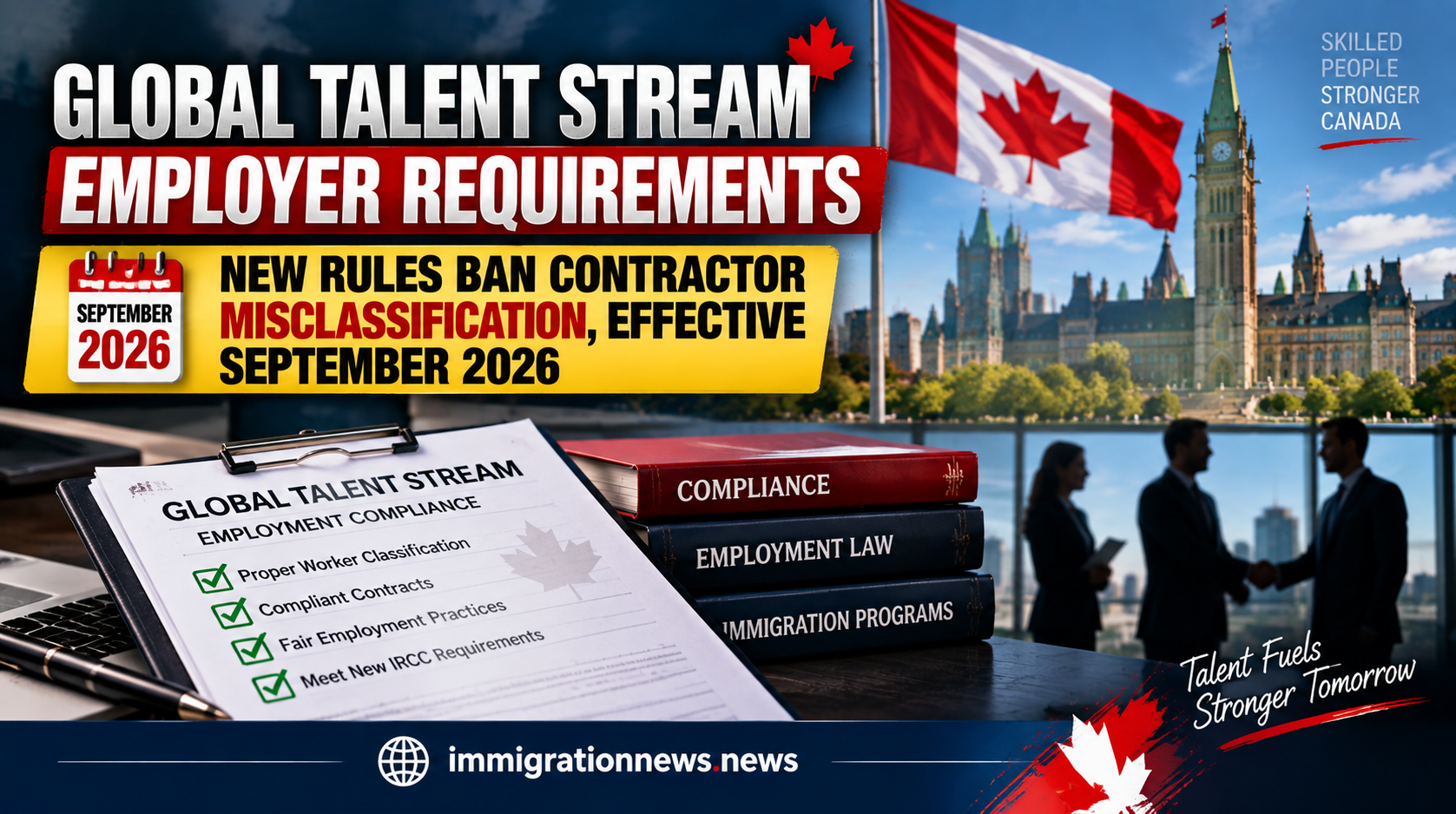
- New Global Talent Stream employer requirements took effect September 18, 2026
- ESDC introduced a detailed multi-factor test to determine genuine employer status
- Staffing and employment agencies are explicitly excluded from qualifying as employers under the program
- Misclassifying temporary foreign workers as independent contractors is now explicitly prohibited
- Employers cannot reclassify workers as contractors after receiving an approved LMIA
- Non-compliant employers face administrative monetary penalties and program bans
- The updated guidance also refreshed the list of designated referral partners for Category A, effective September 15, 2026
What Changed in the Global Talent Stream Employer Requirements
At the heart of this update is a considerably more detailed definition of what actually constitutes an employer under the GTS. Previously, the concept of “employer” was addressed more loosely within program guidance. Now, Service Canada applies a specific multi-factor test when assessing a Labour Market Impact Assessment (LMIA) application to determine whether the applicant genuinely qualifies as the employer.
Under the updated Global Talent Stream employer requirements, Service Canada considers factors including who is obligated to meet all Temporary Foreign Worker Program requirements, who directly benefits from the work performed, who controls where, when, and how the work is done, who is responsible for paying wages and other compensation, who determines job duties and monitors performance, who holds the authority to fire or dismiss the worker, and who the temporary foreign worker themselves recognizes as their employer.
The Employer-Employee Relationship Standard
The updated Global Talent Stream employer requirements establish a clear standard for what constitutes a genuine employer-employee relationship. This relationship exists specifically when an employer hires a worker, directs their duties, and pays them for their work—with the employer making a genuine offer of employment for a specified period in exchange for labour.
This relationship must be confirmed through a signed employment agreement, executed by both parties on or before the worker’s first day of employment. According to ESDC, this structure helps ensure three critical protections: that a genuine job offer exists with a set wage rate and clear working conditions, that the worker will be employed full-time and protected under applicable labour laws, health insurance, and worker’s compensation, and that all required deductions—including income tax, CPP, QPP, and EI—will actually be made.
Staffing Agencies Explicitly Excluded
One of the clearest clarifications within the updated Global Talent Stream employer requirements addresses staffing and employment agencies directly. According to the new guidance, staffing or employment agencies that recruit workers for other businesses are not considered employers under the TFW Program. These agencies cannot be approved to hire a temporary foreign worker on behalf of other businesses, since no genuine employer-employee relationship exists between the agency and the worker in question.
This clarification closes a potential gap that could have allowed staffing intermediaries to attempt qualification under the program despite not being the entity that actually directs, supervises, and controls the worker’s day-to-day employment.
The New Prohibition on Contractor Misclassification
Perhaps the most consequential element of the updated Global Talent Stream employer requirements is the explicit prohibition on classifying temporary foreign workers as independent contractors. ESDC’s guidance states plainly that employers cannot classify temporary foreign workers this way, characterizing such misclassification as non-compliant conduct under the TFW Program.
The guidance specifically identifies the harms this practice can cause: it can weaken wage protections, allow employers to avoid required statutory deductions like income tax, CPP/QPP, and EI, and violate federal or provincial employment laws. Employers must ensure that a worker’s actual status reflects the employer-employee relationship identified in both the approved LMIA and the signed employment agreement.
Critically, the updated Global Talent Stream employer requirements make clear that employers won’t be approved to hire a temporary foreign worker in the first place where no genuine employer-employee relationship exists. Beyond the initial approval stage, employers are also explicitly barred from reclassifying a temporary foreign worker as an “independent contractor” after hiring, or restructuring the employment relationship in any way designed to avoid payroll, compensation, or other program requirements.
A Direct Reference to Trucking Sector Concerns
Notably, ESDC’s updated guidance specifically points employers toward its “Misclassification in the Road Transportation Industry: Awareness Kit” for additional information—a clear signal that misclassification concerns within trucking and transportation have factored into the department’s decision to tighten these Global Talent Stream employer requirements more broadly across the entire Temporary Foreign Worker Program.
Consequences for Non-Compliant Employers
Employers found to have violated the updated Global Talent Stream employer requirements around misclassification face serious consequences. These include administrative monetary penalties and outright bans from participating in the Temporary Foreign Worker Program going forward.
Beyond these direct penalties, non-compliant employers could also be listed publicly on federal or provincial government websites, including the Labour Program’s public naming list for contraventions and violations under the Canada Labour Code and related regulations—a reputational consequence that extends well beyond the immediate financial penalties involved.
Updated Referral Partner List for Category A
Alongside the employer definition changes, ESDC also refreshed its list of designated referral partners for Category A of the Global Talent Stream, effective September 15, 2026. Category A remains available to innovative companies referred by one of these designated partners seeking to hire individuals with unique and specialized talent to help their business scale up and grow. The updated partner list spans organizations across Atlantic Canada, Central Canada, and Western Canada, including economic development agencies, provincial government departments, and organizations like the Business Development Bank of Canada and Invest in Canada at the pan-Canadian level.
Category A vs. Category B: A Quick Refresher
Understanding these updated Global Talent Stream employer requirements requires understanding the program’s basic two-category structure. Category A requires a referral from one of the program’s designated partners and targets unique and specialized positions, generally limited to one or two per company annually, with a minimum wage requirement of $38.46 per hour ($80,000 annual base salary) for the first two positions, rising to $72.11 per hour ($150,000 annually) for any additional positions requested in the same calendar year.
Category B, by contrast, doesn’t require a referral but is restricted to occupations appearing on ESDC’s global talent occupations list—covering roles like computer and information systems managers, various types of engineers, data scientists, cybersecurity specialists, and software developers, among others.
What Employers Should Do Now
Given these updated Global Talent Stream employer requirements, businesses currently using or considering the GTS should conduct an internal review of their working relationships with any temporary foreign workers to confirm genuine employer-employee status exists, rather than any arrangement resembling independent contracting.
Companies working with staffing agencies or similar intermediaries should reassess their structure entirely, given the explicit exclusion of such agencies from qualifying as employers under the program. Employers should also ensure their employment agreements are properly signed before a worker’s first day, and that all statutory deductions are being correctly applied and maintained throughout the employment period, since these elements now factor directly into how Service Canada assesses genuine employer status under an LMIA application.
Businesses in trucking and transportation specifically should review ESDC’s dedicated misclassification awareness kit, given the direct reference to that sector within this update.
Key Takeaways Of Global Talent Stream Employer Requirements
These updated Global Talent Stream employer requirements represent a meaningful tightening of Canada’s Temporary Foreign Worker Program compliance framework, introducing a detailed multi-factor employer test, explicitly excluding staffing agencies from qualifying as employers, and firmly prohibiting the misclassification of temporary foreign workers as independent contractors both before and after LMIA approval. With serious consequences for non-compliance—including monetary penalties, program bans, and public naming—businesses using or considering the Global Talent Stream should review their employment structures carefully to ensure full alignment with these updated standards.
FAQs : Global Talent Stream Employer Requirements
What changed in the Global Talent Stream employer requirements on September 18, 2026?
ESDC introduced a detailed multi-factor test for determining genuine employer status, explicitly excluded staffing agencies from qualifying as employers, and prohibited misclassifying temporary foreign workers as independent contractors.
Can a staffing agency hire a temporary foreign worker under the Global Talent Stream?
No. Staffing or employment agencies that recruit workers for other businesses are not considered employers under the TFW Program and cannot be approved to hire on behalf of other companies.
What happens if an employer reclassifies a worker as an independent contractor after LMIA approval?
This is explicitly prohibited. Employers cannot reclassify a temporary foreign worker as an independent contractor after hiring, or restructure the relationship to avoid payroll or compensation requirements.
What penalties apply for misclassification under these updated requirements?
Non-compliant employers can face administrative monetary penalties, bans from the Temporary Foreign Worker Program, and potential public naming on federal or provincial government websites.
Did the list of designated referral partners for Category A also change?
Yes. ESDC updated the list of designated referral partners for Category A effective September 15, 2026, spanning organizations across Atlantic, Central, and Western Canada.
Source : Government Of Canada
Read About : Canada Study Visa Competition 2026: Why Indian Students Face Tougher Approval Conditions