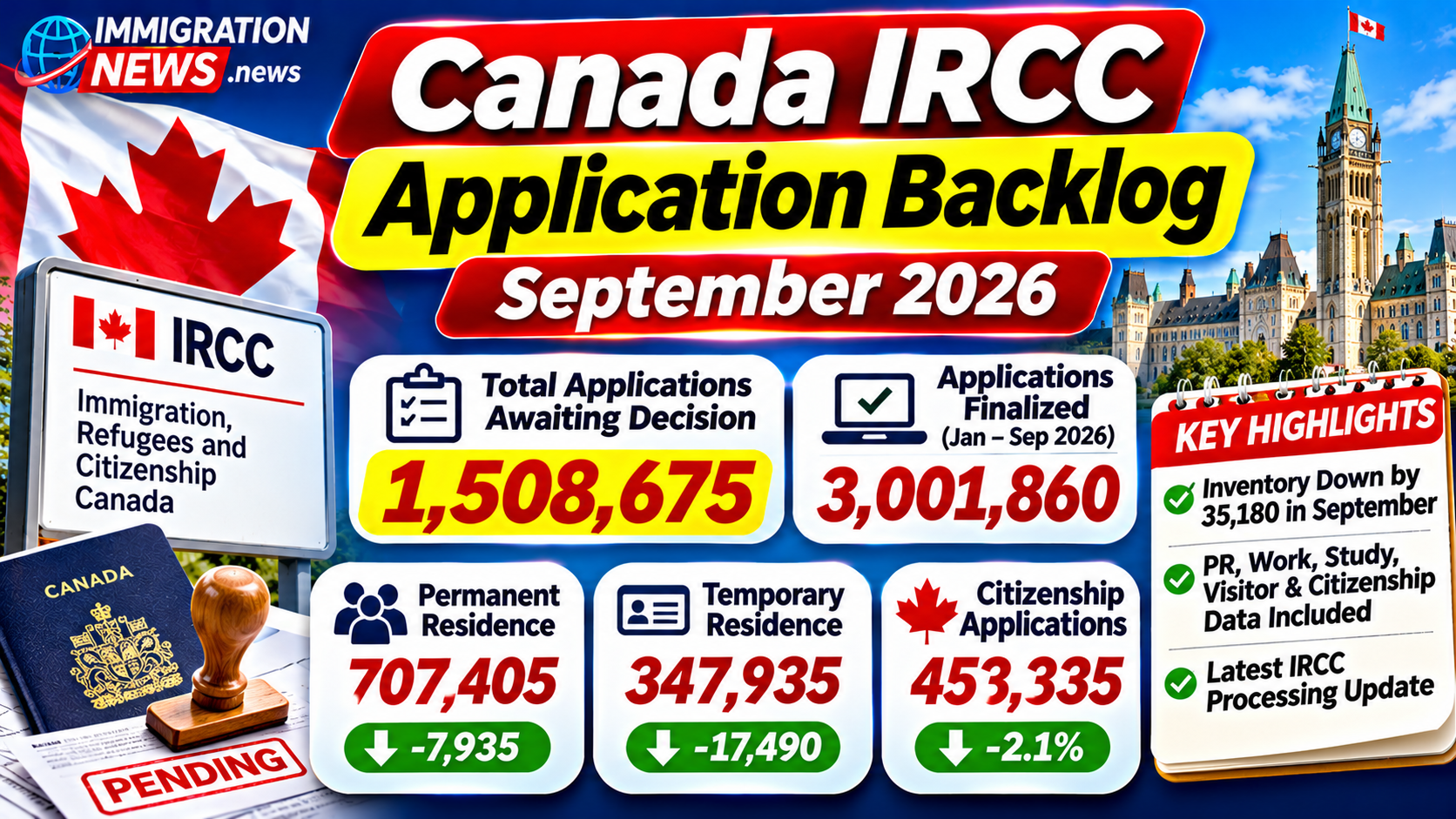
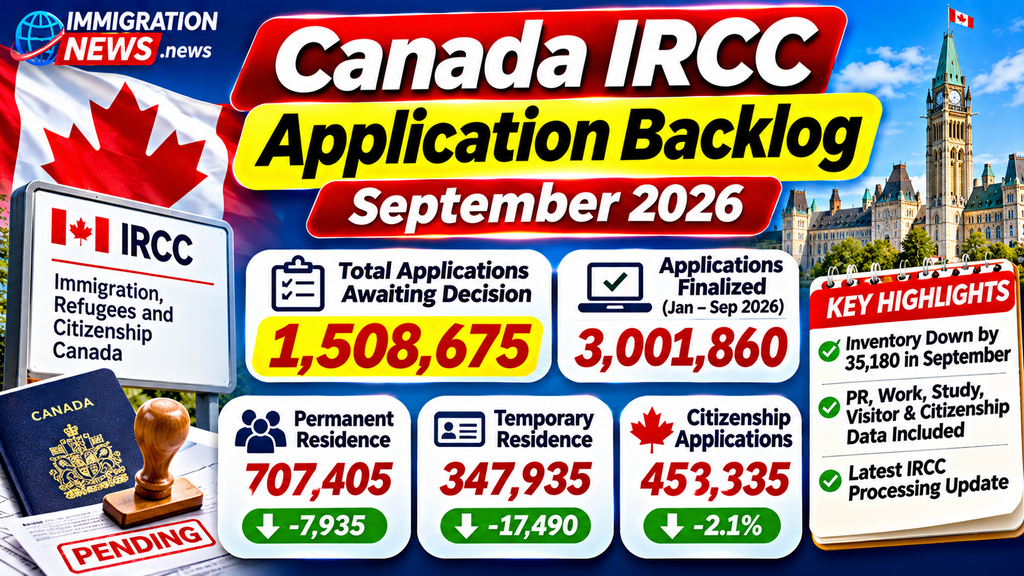
Canada’s immigration department has reduced its pending application inventory after finalizing more than three million immigration and citizenship applications during the first nine months of 2026. However, more than 1.5 million applications were still awaiting a final decision at the end of September.
According to the latest figures released by Immigration, Refugees and Citizenship Canada (IRCC) on November 17, the department had 1,508,675 applications awaiting finalization as of September 30, 2026, representing a decrease of 35,180 applications compared with August.
The latest Canada IRCC application backlog September 2026 figures cover permanent residence, temporary residence and citizenship applications, including Express Entry, Provincial Nominee Program (PNP), family sponsorship, work permits, study permits, visitor visas and citizenship certificates.
Between January 1 and September 30, IRCC finalized 3,001,860 applications, including 311,510 in September alone.
Despite the progress, the figures reveal significant differences across immigration categories. Economic permanent residence applications declined, visitor visa inventories recorded a substantial reduction, and citizenship applications also moved lower.
However, family-class permanent residence applications increased during September, while hundreds of thousands of protection-related applications continued to await decisions.
The latest update offers an important picture of Canada’s immigration processing system and what applicants should understand about their pending files.
Canada IRCC Application Backlog September 2026: Latest Figures at a Glance
The latest IRCC report shows that the department reduced its total inventory of applications awaiting finalization by 35,180 during September.
| Key indicator | Latest figure |
|---|---|
| Total applications awaiting finalization | 1,508,675 |
| Reduction during September | 35,180 |
| Applications finalized January–September | 3,001,860 |
| Applications finalized in September | 311,510 |
| Permanent residence inventory | 707,405 |
| Temporary residence inventory | 347,935 |
| Citizenship inventory | 453,335 |
The figures show that permanent residence accounts for the largest share of pending immigration applications, followed by citizenship and temporary residence.
However, a pending application does not automatically mean that IRCC has exceeded its official processing time.
IRCC’s inventory includes both applications being processed within service standards and applications that have already exceeded those standards.
This distinction is important when interpreting the latest figures.
Permanent Residence Applications: 707,405 Cases Awaiting Finalization
Canada had 707,405 permanent residence applications awaiting finalization on September 30, 2026.
This represented a reduction of 7,935 applications compared with the end of August.
IRCC divides permanent residence applications into three principal categories:
- Economic immigration.
- Family sponsorship and reunification.
- Protection-related immigration.
Each category experienced a different trend during September.
Economic Immigration Applications Fall to 250,010
Economic immigration applications recorded the largest improvement among the permanent residence categories.
IRCC ended September with 250,010 economic immigration applications awaiting finalization, down 6,545 from August.
Of these applications:
- 78% were actively being processed.
- 22% were waiting for available space under annual immigration targets.
Economic immigration includes several important Canadian immigration pathways, such as:
- Express Entry.
- Federal Skilled Worker Program.
- Canadian Experience Class.
- Federal Skilled Trades Program.
- Provincial Nominee Program.
- Atlantic Immigration Program.
- Rural Community Immigration Pilot.
- Francophone Community Immigration Pilot.
- Federal business immigration pathways.
IRCC finalized 236,710 economic immigration applications between January and September 2026, including 36,520 in September.
The 22% waiting for space is particularly important.
Canada’s Immigration Levels Plan determines how many permanent residents the country intends to admit each year. When the number of applications exceeds the available admission spaces, some cases may have to wait for a future allocation.
This means that an application can remain pending even when the applicant has submitted all required documents.
For Express Entry and PNP candidates, the latest figures highlight the importance of understanding the difference between application processing and the availability of permanent residence admission spaces.
Family Sponsorship Applications Increase to 168,855
Unlike economic immigration, family-class applications increased during September.
IRCC had 168,855 family applications awaiting finalization at the end of September, an increase of 1,685 compared with August.
The department reported:
- 58% of family applications were actively being processed.
- 42% were waiting for available space.
Family immigration covers reunification and international adoptions.
Important pathways include:
- Spousal sponsorship.
- Common-law partner sponsorship.
- Conjugal partner sponsorship.
- Dependent child sponsorship.
- Parents and Grandparents Program.
- International adoption cases.
IRCC finalized 79,705 family applications between January 1 and September 30, including 8,995 in September.
The increase in the family inventory is worth watching, particularly for applicants sponsoring spouses, partners, children, parents and grandparents.
IRCC also reported that applications for spouses, partners and children submitted within and outside Canada, for destinations outside Quebec, were processed in approximately 15 months over the October 2025–September 2026 period.
Processing times for Quebec-bound applications differ because Quebec sets its own immigration targets.
Parents and grandparents sponsorship continues to face capacity limitations because demand exceeds the number of available spaces under the immigration levels plan.
Protection Applications Remain the Largest Permanent Residence Category
Protection-related applications continued to represent the largest portion of Canada’s permanent residence inventory.
IRCC reported 288,540 protection applications awaiting finalization on September 30, down 3,075 from August.
The category includes:
- Protected persons already in Canada.
- Government-assisted refugees.
- Privately sponsored refugees.
- Humanitarian and compassionate applications.
According to IRCC:
- 56% of protection applications were actively being processed.
- 44% were waiting for available space.
The department finalized 103,075 protection applications between January and September 2026.
This category is particularly important because it covers people seeking permanent residence after receiving protection in Canada.
IRCC has also introduced a one-time initiative to process up to 115,000 additional permanent residence applications from protected persons and their in-Canada dependants during 2026 and 2027.
The initiative is intended to provide greater certainty and stability to people already recognised as needing Canada’s protection.
Temporary Residence Applications Decline to 347,935
Temporary residence recorded the largest monthly reduction among the three major immigration streams.
IRCC had 347,935 temporary residence applications awaiting finalization at the end of September, a decrease of 17,490 from August.
This category includes initial applications for:
- Work permits.
- Study permits.
- Visitor visas.
The published figures cover new temporary residence applications, not extensions.
Between January and September 2026, IRCC finalized 2,292,410 temporary residence applications, including 215,665 in September.
The improvement was mainly driven by visitor visa processing, although work permit and study permit inventories also declined.
Work Permit Applications Fall to 24,970
Canada’s pending work permit inventory declined by 1,025 applications during September.
At the end of the month, IRCC had 24,970 work permit applications awaiting finalization.
The department finalized 204,250 work permit applications during the first nine months of 2026, including 13,255 in September.
Canada continues to prioritise certain work permit applications to address labour shortages and economic requirements.
IRCC identifies several priority processing arrangements, including:
- Global Skills Strategy applications.
- Special measures supporting certain workers in Quebec.
- A 14-day processing arrangement for up to 5,000 licensed doctors with qualifying job offers and provincial nominations.
The doctor initiative allows eligible physicians to work while awaiting permanent residence.
For foreign workers, the latest inventory reduction is encouraging, although individual processing times will continue to depend on application type, completeness and other assessment requirements.
Study Permit Applications Decline to 24,910
The number of study permit applications awaiting finalization fell to 24,910 by September 30.
This represented a reduction of 3,530 applications compared with August.
IRCC finalized 164,735 study permit applications between January and September 2026, including 14,115 during September.
Study permit applications can fluctuate throughout the year because most international students begin their academic programmes during the fall or winter intake periods.
IRCC encourages students to apply as soon as they receive admission from a designated learning institution.
This gives the department more time to process the application before the intended course start date.
An additional development concerns doctoral students.
As part of Canada’s International Talent Attraction Strategy, IRCC has introduced two-week processing for eligible study permit applicants who intend to study at the PhD level.
This measure is designed to help Canada attract international research talent.
However, it should not be interpreted as a two-week processing guarantee for all international students.
Visitor Visa Inventory Remains the Largest Temporary Residence Category
Visitor visas continued to account for the overwhelming majority of temporary residence applications awaiting finalization.
IRCC reported 298,060 visitor visa applications in its inventory at the end of September, down 12,930 from August.
The department finalized 1,923,425 visitor visa applications between January and September 2026.
Of these, 188,295 were finalized in September alone.
Despite the reduction, visitor visas still represented the largest temporary residence inventory.
For tourists, business visitors and people travelling to Canada to meet family members, the latest figures indicate that IRCC continues to process a substantial number of applications.
However, the inventory reduction does not mean every applicant will receive a faster decision.
According to IRCC, visitor visa processing times can depend on:
- Whether the application is complete.
- How quickly biometrics are provided.
- Whether additional documents are requested.
- Whether security screening is required.
- The volume of applications received from the applicant’s country.
Applicants should check the official IRCC processing-time tool rather than assuming that the overall inventory reduction reflects the waiting time for their individual application.
Canadian Citizenship Applications Fall to 453,335
Citizenship applications also recorded a decline during September.
IRCC had 453,335 citizenship applications awaiting finalization as of September 30, representing a month-over-month decrease of approximately 2.1%.
The citizenship inventory includes two main categories:
- Citizenship grant applications.
- Proof of citizenship applications.
These categories serve different purposes and should not be confused.
Citizenship Grant Applications Decline to 322,650
Citizenship grant applications are submitted by eligible permanent residents seeking to become Canadian citizens.
By the end of September, IRCC had 322,650 citizenship grant applications awaiting finalization.
This represented a decrease of 4,475 applications compared with August.
The department reported that Canada welcomed 245,900 new citizens between January and September 2026.
September alone accounted for 27,940 new citizens.
Applicants seeking citizenship must meet the applicable eligibility requirements, including physical presence, language and knowledge requirements where applicable, and must complete the citizenship oath process.
A reduction in the pending inventory is encouraging, but applicants should continue monitoring their individual application status.
Proof of Canadian Citizenship Applications Fall to 130,685
The second category covers applications for proof of Canadian citizenship.
These applications are generally submitted by people seeking a citizenship certificate, including new certificates and replacements.
IRCC had 130,685 proof of citizenship applications awaiting finalization on September 30.
This was 5,280 fewer than at the end of August.
The latest figures suggest that IRCC also made progress in this category during September.
However, proof of citizenship applications are different from citizenship grant applications.
A proof of citizenship certificate confirms an existing citizenship status, while a citizenship grant application is the process through which an eligible permanent resident becomes a Canadian citizen.
Which Canadian Immigration Category Has the Biggest Pending Inventory?
The September figures show that different immigration categories continue to face different levels of processing pressure.
The following table combines the major categories published by IRCC.
| Immigration category | Applications awaiting finalization |
|---|---|
| Protection permanent residence | 288,540 |
| Visitor visas | 298,060 |
| Citizenship grants | 322,650 |
| Economic permanent residence | 250,010 |
| Family permanent residence | 168,855 |
| Proof of citizenship | 130,685 |
| Work permits | 24,970 |
| Study permits | 24,910 |
Visitor visas have the largest individual temporary residence inventory, while citizenship grants represent a substantial share of the citizenship inventory.
Protection applications remain the largest individual permanent residence category.
These numbers demonstrate why a single national processing-time figure cannot accurately describe the experience of every immigration applicant.
Different programmes have different eligibility requirements, annual targets, service standards and assessment procedures.
Why Is Canada’s Immigration Application Inventory Declining?
Several factors help explain the reduction in IRCC’s September inventory.
More Applications Finalized
The department finalized 3,001,860 applications during the first nine months of 2026.
The September total alone reached 311,510.
The high number of final decisions contributed to the reduction in pending applications.
Immigration Admission Limits
Canada’s 2026–2028 Immigration Levels Plan sets annual targets for permanent residents and certain temporary resident arrivals.
When the number of applications exceeds the available spaces, some cases must wait.
This is particularly relevant for economic and family immigration applications.
Different Processing Priorities
IRCC does not process every application category in exactly the same way.
Certain programmes and applicants receive priority because of economic requirements, labour shortages, humanitarian commitments or specific government initiatives.
For example, the department has introduced accelerated arrangements for certain highly skilled workers and doctoral students.
New Applications Continue to Arrive
A falling inventory does not necessarily mean that processing times will decrease for every applicant.
IRCC continues receiving new applications while finalising existing files.
The overall inventory can therefore increase or decrease depending on the balance between applications received and applications completed.
Does a Lower IRCC Backlog Mean Faster Visa Approvals?
Not necessarily.
This is one of the most important points for anyone following Canada’s immigration processing figures.
The number of applications awaiting finalization is a snapshot of unfinished cases.
It does not tell applicants exactly how long their individual files will take.
There are also important differences between an application inventory and a processing backlog.
Inventory: All applications that have not yet received a final decision, including those still within normal processing standards.
Backlog: Applications that have exceeded IRCC’s applicable processing service standards.
IRCC’s September figures primarily describe inventory, not exclusively overdue applications.
There is another important distinction: finalized applications are not necessarily approved applications.
A final decision can result in approval, refusal or withdrawal.
Therefore, the fact that IRCC finalized more than three million applications does not mean that all three million were approved.
Applicants should use IRCC’s individual processing-time information and application tracker to understand the status of their cases.
What Should Applicants Waiting for a Canadian Visa Do Now?
The latest figures offer useful information, but applicants should not make immigration decisions based solely on changes in the overall inventory.
People waiting for different types of Canadian applications should take the following steps.
Express Entry and PNP applicants: Keep employment records, passports, language test results and other supporting documents current. Monitor IRCC messages and requests.
Spousal sponsorship applicants: Ensure that relationship evidence, identity documents and supporting information remain accurate and up to date.
Work permit applicants: Check the conditions of their current status and any applicable work authorisation. Do not assume that a pending application automatically permits employment.
International students: Apply well before the intended academic start date and ensure that all required documents are submitted.
Visitor visa applicants: Provide complete travel information, financial evidence and supporting documents. Monitor requests for biometrics or additional information.
Citizenship applicants: Continue checking the online application tracker and respond promptly to requests from IRCC.
The most reliable source for individual case updates remains the official Government of Canada immigration website.
Conclusion: Canada IRCC Application Backlog September 2026
The latest Canada IRCC application backlog September 2026 report shows that Immigration, Refugees and Citizenship Canada made considerable progress during the first nine months of the year.
The department finalized more than three million applications and reduced its total pending inventory by 35,180 during September.
Permanent residence, temporary residence and citizenship inventories all recorded an overall decline.
However, the figures also reveal continuing pressure in important immigration categories.
Family-class permanent residence applications increased, protection-related cases remained substantial, and almost 300,000 visitor visa applications were still awaiting finalization.
For international students, skilled workers, visitors, family sponsorship applicants and people seeking Canadian citizenship, the latest update offers an indication of IRCC’s processing activity, but it does not guarantee faster decisions for individual files.
The key takeaway is that Canada’s immigration department is processing millions of applications, but the size of its remaining inventory means applicants should continue preparing for possible delays and rely on official processing-time information.
FAQs : Canada IRCC Application Backlog September 2026
1. What is Canada’s IRCC application backlog in September 2026?
IRCC reported 1,508,675 applications awaiting finalization as of September 30, 2026. This includes permanent residence, temporary residence and citizenship applications. Not all these cases are overdue.
2. How many applications did IRCC finalize in 2026?
IRCC finalized 3,001,860 applications between January 1 and September 30, 2026, including 311,510 applications in September.
3. Did Canada’s immigration backlog decrease in September 2026?
Yes. IRCC’s total inventory awaiting finalization declined by 35,180 applications during September.
4. How many permanent residence applications are pending in Canada?
Canada had 707,405 permanent residence applications awaiting finalization as of September 30, 2026.
5. How many Express Entry and economic immigration applications are pending?
IRCC reported 250,010 pending economic immigration applications. This category includes Express Entry, federal business immigration and regional economic programmes, including the PNP.
6. How many family sponsorship applications are pending?
IRCC had 168,855 family-class applications awaiting finalization at the end of September 2026.
7. How many protection applications are waiting for permanent residence?
There were 288,540 protection-related permanent residence applications awaiting finalization on September 30, 2026.
8. How many Canadian work permit applications are pending?
IRCC reported 24,970 work permit applications awaiting finalization at the end of September 2026.
9. How many Canadian study permit applications are pending?
There were 24,910 study permit applications awaiting finalization as of September 30, 2026.
10. How many Canada visitor visa applications are pending?
Canada had 298,060 visitor visa applications awaiting finalization at the end of September 2026.
11. How many citizenship applications are pending in Canada?
IRCC reported 453,335 citizenship applications awaiting finalization, including citizenship grant and proof of citizenship applications.
12. How many citizenship grant applications are pending?
There were 322,650 citizenship grant applications awaiting finalization as of September 30, 2026.
13. How many proof of citizenship applications are pending?
IRCC had 130,685 proof of citizenship applications awaiting finalization at the end of September.
14. Does a reduction in IRCC inventory mean faster visa processing?
Not necessarily. A lower inventory indicates that the department has more applications finalized than added to the pending inventory during the period. Individual processing times depend on the application category, completeness, security checks and other factors.
15. Is every pending IRCC application part of the backlog?
No. The inventory includes applications still within their service standards as well as those that have exceeded them. The term backlog should not be used to describe every unfinished application.
16. Does IRCC finalizing an application mean it has been approved?
No. Finalization means that a decision has been made or the application has otherwise been closed. The outcome can be approval, refusal or withdrawal.
17. Where can applicants check Canadian immigration processing times?
Applicants can use the official IRCC processing-time tool at https://www.canada.ca/en/immigration-refugees-citizenship/services/application/check-processing-times.html.
18. Where can applicants check their Canadian immigration application status?
Applicants can use the official IRCC online application tracker or their secure online account, depending on the application type.
Source : CIC News