
British Columbia has conducted a new targeted immigration draw, inviting skilled workers in childcare, healthcare, construction and veterinary occupations to apply for provincial nomination under the British Columbia Provincial Nominee Program (BC PNP).
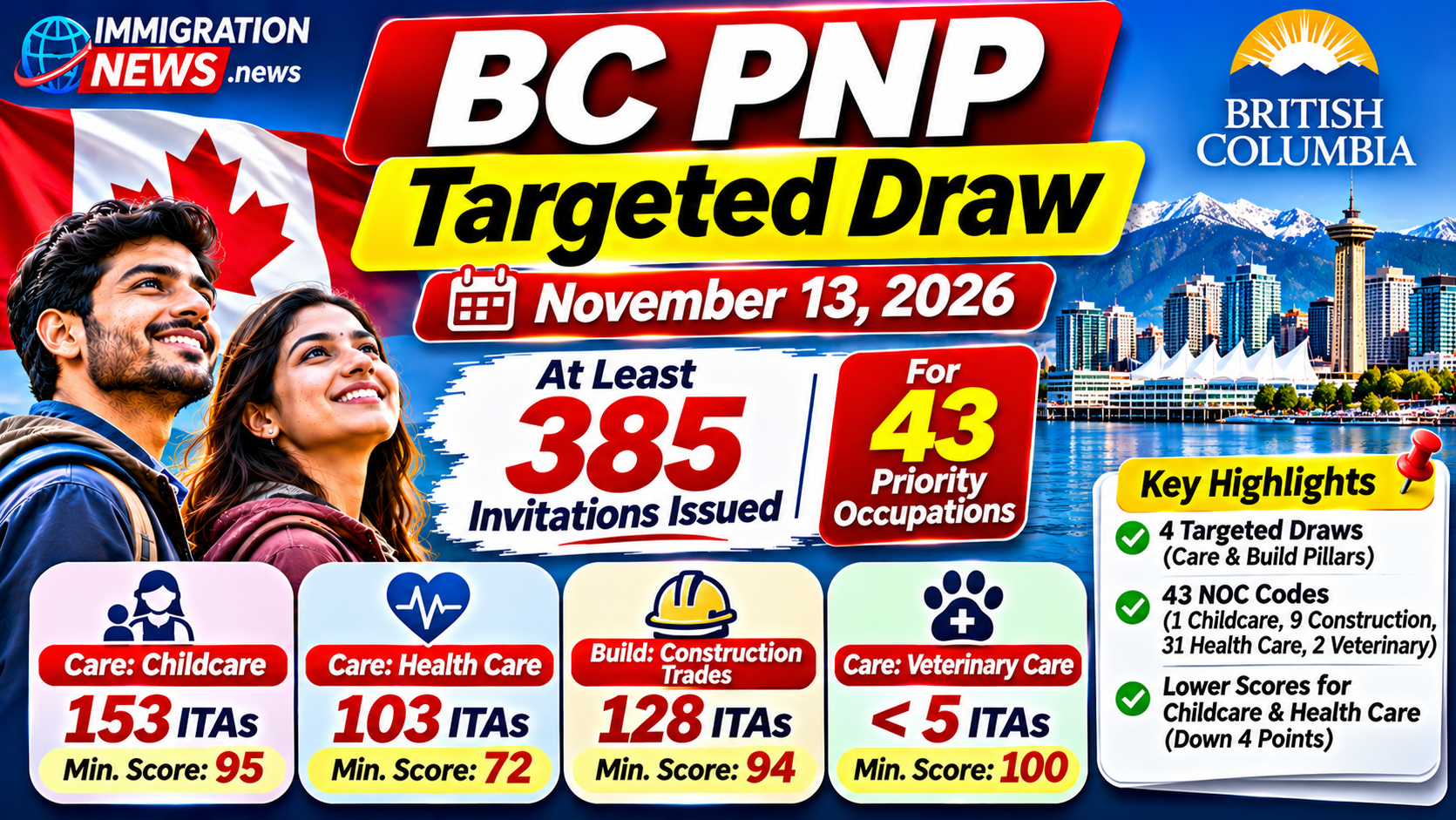
The BC PNP Targeted Draw November 13, 2026 featured four separate selections under the province’s Care and Build priorities, with minimum scores ranging from 72 to 100 points.
According to the official results published by WelcomeBC, the province issued:
- 153 invitations to early childhood educators with a minimum score of 95.
- 103 invitations to healthcare professionals with a minimum score of 72.
- 128 invitations to construction trades workers with a minimum score of 94.
- Fewer than five invitations to eligible veterinary care professionals with a minimum score of 100.
The three categories with published exact invitation numbers account for 384 invitations. The province has not disclosed the exact number of veterinary invitations, reporting only that fewer than five candidates were selected.
The latest round is particularly important for foreign workers already employed in British Columbia and skilled professionals looking to establish their careers in Canada.
Unlike general immigration selections, the BC PNP targeted draw focuses on occupations that British Columbia considers important for its labour market, public services and infrastructure development.
The November 13 selections also produced encouraging changes for childcare and healthcare candidates, as their minimum scores fell by four points compared with the October 8 draw.
Construction maintained its previous cutoff, while veterinary care recorded a substantial increase.
Here is a complete breakdown of the latest BC PNP draw results, minimum scores, invitation numbers, eligibility requirements and all 43 priority occupation codes.
BC PNP Targeted Draw November 13, 2026: Complete Results
The latest BC PNP selection included four targeted occupational categories under two major provincial priorities: Care and Build.
The Care priority focuses on occupations supporting healthcare, childcare and veterinary services, while Build focuses on skilled construction trades needed for infrastructure and development projects.
November 13 BC PNP Draw Results
| Targeted category | Minimum score | Invitations |
|---|---|---|
| Care: Childcare | 95 | 153 |
| Care: Health | 72 | 103 |
| Care: Veterinary Care | 100 | Fewer than 5 |
| Build: Construction Trades | 94 | 128 |
| Published exact subtotal | 384 |
The province has not published a combined total for all four selections.
Since the veterinary category is reported as fewer than five invitations, the actual combined number cannot be established from the published figures alone.
The minimum scores also differ considerably between categories.
Healthcare workers received the lowest cutoff at 72 points, while veterinary professionals faced the highest minimum score of 100.
This reflects the separate selection criteria and the number of qualified candidates invited in each occupational group.
How the November 13 BC PNP Draw Compares With October 8
The latest results show different trends across the four occupational categories.
Childcare and healthcare candidates benefited from lower minimum scores, while construction maintained its previous cutoff.
Veterinary care experienced the biggest increase.
| Category | October 8 score | November 13 score | Score change | October invitations | November invitations |
|---|---|---|---|---|---|
| Childcare | 99 | 95 | -4 | 86 | 153 |
| Healthcare | 76 | 72 | -4 | 82 | 103 |
| Construction | 94 | 94 | No change | 115 | 128 |
| Veterinary Care | 86 | 100 | +14 | Fewer than 5 | Fewer than 5 |
Childcare: More Invitations and Lower Score
The childcare category recorded a significant increase in invitations.
British Columbia selected 153 early childhood educators, compared with 86 in the October 8 round.
The minimum score also decreased from 99 to 95.
This represents 67 additional invitations and a four-point reduction in the cutoff.
The result is encouraging for registered candidates working as qualified early childhood educators in British Columbia.
Healthcare: Lowest Minimum Score in the Latest Draw
Healthcare professionals received 103 invitations at a minimum score of 72.
In the previous targeted round, the province issued 82 invitations with a cutoff of 76.
The latest draw therefore included 21 additional invitations, while the minimum score decreased by four points.
Among the four categories, healthcare recorded the lowest minimum score.
Construction: Minimum Score Remains at 94
The construction category maintained its minimum score of 94.
However, the number of invitations increased from 115 to 128.
This represents 13 additional invitations compared with October 8.
The result indicates continued demand for certified construction trades professionals.
Veterinary Care: Highest Cutoff Increase
Veterinary care recorded the most significant score movement.
The minimum score increased from 86 in October to 100 in November.
The province continued to issue fewer than five invitations in this category.
The high cutoff indicates that candidates in this selection needed substantially higher scores than those invited in the previous round.
Which 43 Occupations Were Targeted in the November 13 BC PNP Draw?
The latest BC PNP targeted draw covered 43 priority occupational codes across four groups.
These occupations are classified under Canada’s National Occupational Classification (NOC) 2021 system.
The breakdown is:
- Childcare: 1 occupation.
- Construction trades: 9 occupations.
- Healthcare: 31 occupations.
- Veterinary care: 2 occupations.
Candidates should verify their actual job duties against the relevant NOC description rather than relying exclusively on their job title.
A. Childcare: NOC 42202
<text weight=”medium” color=”secondary” size=”xs”>1 TARGETED OCCUPATION</text>
NOC 42202 – Early Childhood Educators and Assistants
This category was specifically targeted in the November 13 draw.
However, not everyone working in childcare automatically qualifies for targeted selection.
Early childhood educators must hold a valid one-year or five-year Early Childhood Educator certificate issued by British Columbia’s ECE Registry.
The requirement is particularly important for candidates whose job titles include childcare assistant, daycare worker or early learning assistant.
Simply working in a childcare facility does not establish eligibility for this targeted category.
Applicants should confirm that their certification and employment meet the province’s requirements.
B. Construction Trades: 9 Targeted NOC Codes
<text weight=”medium” color=”secondary” size=”xs”>9 PRIORITY CONSTRUCTION OCCUPATIONS</text>
British Columbia continues to prioritise certified construction trades workers to support infrastructure development, housing projects and major construction activities.
The November 13 draw covered the following nine occupations:
| NOC code | Occupation |
|---|---|
| 72106 | Welders and related machine operators |
| 72200 | Electricians (except industrial and power system) |
| 72201 | Industrial electricians |
| 72300 | Plumbers |
| 72301 | Steamfitters, pipefitters and sprinkler system installers |
| 72310 | Carpenters |
| 72400 | Construction millwrights and industrial mechanics |
| 72401 | Heavy-duty equipment mechanics |
| 72402 | Heating, refrigeration and air conditioning mechanics |
Important certification requirement
Construction candidates must have a valid trade certificate issued by SkilledTradesBC or an apprenticeship registered with SkilledTradesBC.
The certification or apprenticeship must correspond to the job they have been offered.
This means that having construction work experience alone may not be sufficient for targeted selection.
Candidates should ensure that their trade qualifications and employment details match the applicable requirements.
C. Healthcare: 31 Targeted NOC Codes
<text weight=”medium” color=”secondary” size=”xs”>31 PRIORITY HEALTHCARE OCCUPATIONS</text>
Healthcare professionals represented the largest occupational group in the November 13 targeted selections.
The list includes physicians, specialists, nurses, pharmacists, therapists, medical technologists, laboratory professionals and other healthcare workers.
The complete list of 31 priority healthcare occupations is provided below.
Healthcare management and medical specialists
| NOC code | Occupation |
|---|---|
| 30010 | Managers in health care |
| 31100 | Specialists in clinical and laboratory medicine |
| 31101 | Specialists in surgery |
| 31102 | General practitioners and family physicians |
| 31110 | Dentists |
Therapy, diagnosis and pharmacy
| NOC code | Occupation |
|---|---|
| 31112 | Audiologists and speech-language pathologists |
| 31120 | Pharmacists |
| 31121 | Dietitians and nutritionists |
| 31200 | Psychologists |
| 31201 | Chiropractors |
| 31202 | Physiotherapists |
| 31203 | Occupational therapists |
| 31204 | Kinesiologists and other professional occupations in therapy |
| 31209 | Other professional occupations in health diagnosing and treating |
Nursing and allied health professionals
| NOC code | Occupation |
|---|---|
| 31300 | Nursing coordinators and supervisors |
| 31301 | Registered nurses and registered psychiatric nurses |
| 31302 | Nurse practitioners |
| 31303 | Physician assistants, midwives and allied health professionals |
| 32101 | Licensed practical nurses |
| 32102 | Paramedical occupations |
Medical technologists and technicians
| NOC code | Occupation |
|---|---|
| 32103 | Respiratory therapists, clinical perfusionists and cardiopulmonary technologists |
| 32111 | Dental hygienists and dental therapists |
| 32112 | Dental technologists and technicians |
| 32120 | Medical laboratory technologists |
| 32121 | Medical radiation technologists |
| 32122 | Medical sonographers |
| 32123 | Cardiology technologists and electrophysiological diagnostic technologists |
Traditional medicine, healthcare support and social work
| NOC code | Occupation |
|---|---|
| 32200 | Traditional Chinese medicine practitioners and acupuncturists |
| 33101 | Medical laboratory assistants and related technical occupations |
| 33102 | Nurse aides, orderlies and patient service associates |
| 41300 | Social workers |
Additional requirement for nurse aides
Candidates whose employment falls under NOC 33102 must be registered with the BC Care Aide & Community Health Worker Registry to receive a targeted invitation.
Healthcare professionals should also check whether their occupation requires provincial licensing, registration or professional certification before accepting employment in British Columbia.
D. Veterinary Care: 2 Targeted NOC Codes
<text weight=”medium” color=”secondary” size=”xs”>2 PRIORITY VETERINARY OCCUPATIONS</text>
British Columbia has also included veterinary professionals in its Care priority.
The two occupations are:
| NOC code | Occupation |
|---|---|
| 31103 | Veterinarians |
| 32104 | Animal health technologists and veterinary technicians |
The November 13 veterinary selection had a minimum score of 100 and fewer than five invitations.
The official invitation information specifically identifies animal health technologists and veterinary technicians under NOC 32104 as requiring a valid professional designation.
Veterinary professionals should carefully check the applicable provincial designation and certification requirements before registering.
Why Is British Columbia Prioritising Care and Construction Occupations?
The latest BC PNP draw reflects British Columbia’s broader immigration strategy.
The province has organised its economic immigration priorities around three major objectives:
Care: Supporting healthcare, childcare, education and veterinary services.
Build: Addressing skilled labour requirements associated with infrastructure projects and construction delivery.
Innovate: Attracting highly skilled professionals, experts and entrepreneurs who can contribute to economic growth.
The November 13 selections focused on Care and Build.
Care: Supporting Essential Public Services
Healthcare professionals and qualified childcare workers play an important role in supporting British Columbia’s public services and community well-being.
The province continues to prioritise workers who can fill shortages in healthcare facilities, childcare centres and veterinary services.
This includes professionals working in both public and broader healthcare settings, subject to the applicable selection criteria.
Build: Supporting Construction and Infrastructure
Construction trades professionals are important for housing development, infrastructure delivery and major projects.
British Columbia has therefore prioritised nine certified construction occupations.
The certification requirement is designed to ensure that selected workers possess relevant trade qualifications corresponding to their employment.
Innovate: Attracting High-Impact Talent
Although the November 13 draw did not include an Innovate selection, it remains an important part of the BC PNP.
The province uses High Economic Impact invitations to attract highly skilled workers and entrepreneurs across different sectors.
For example, on October 29, 2026, British Columbia issued 524 invitations based on wage and occupational criteria and another 248 invitations based on a points threshold of 131.
This demonstrates that the BC PNP uses different selection approaches depending on provincial labour market priorities.
How Many Candidates Are Waiting in the BC PNP Registration Pool?
The number of candidates already registered with the BC PNP provides useful context for understanding the competitive nature of the programme.
According to the provincial invitation page, the Skills Immigration registration pool contained 7,235 registrations as of November 3, 2026.
The distribution was:
| Registration score range | Number of candidates |
|---|---|
| 150+ | 2 |
| 140–149 | 13 |
| 130–139 | 104 |
| 120–129 | 746 |
| 110–119 | 1,085 |
| 100–109 | 1,351 |
| 90–99 | 1,435 |
| 80–89 | 1,234 |
| 70–79 | 693 |
| 60–69 | 360 |
| 0–59 | 212 |
| Total | 7,235 |
The largest group consisted of candidates scoring between 90 and 99 points, followed by those in the 100–109 range.
However, this is the overall registration pool and should not be treated as a breakdown of candidates eligible for each targeted occupation.
The November 13 draw also demonstrates why occupational eligibility matters.
A candidate’s score alone does not guarantee an invitation if their registration does not meet the selection criteria for the relevant category.
What Does the November 13 BC PNP Draw Mean for Indian Applicants?
The latest draw may be particularly relevant to Indian professionals working in British Columbia or planning to enter the Canadian labour market.
India is an important source of skilled international workers in healthcare, childcare, engineering and construction-related occupations.
However, the targeted BC PNP selection is based on occupation, registration details and the province’s selection criteria rather than nationality.
Indian candidates should consider the following steps.
1. Check the correct NOC code
Match actual job duties with the official NOC description.
A similar job title does not necessarily mean two positions have the same NOC classification.
2. Confirm professional certification
Childcare, construction, healthcare and veterinary occupations may require provincial registration, licensing or recognised professional credentials.
3. Review your BC PNP registration score
Candidates should verify their registration information and ensure that their points are calculated correctly.
4. Check your job offer and employer eligibility
A qualifying job offer and eligible employer are important components of the applicable Skills Immigration pathway.
5. Monitor future targeted invitations
Minimum scores can change between selection rounds. Previous cutoffs do not guarantee that a candidate will receive an invitation in a future draw.
Indian professionals outside British Columbia should also understand that the targeted draw does not create an automatic route to nomination simply because their occupation appears on the list.
They must meet the programme’s registration and employment requirements.
What Happens After Receiving a BC PNP Invitation to Apply?
Receiving an Invitation to Apply (ITA) is an important step, but it does not mean that a candidate has already received provincial nomination or Canadian permanent residence.
The process generally involves the following stages:
Stage 1: Registration
The candidate submits an online registration under an eligible Skills Immigration category.
Stage 2: Selection
British Columbia selects qualified candidates from the registration pool based on its current priorities and selection criteria.
Stage 3: Invitation to Apply
Selected candidates receive an invitation to submit a complete application for provincial nomination.
Stage 4: Application submission
The candidate must submit the required documents, supporting evidence and applicable fees within the deadline stated in the invitation.
Stage 5: Provincial assessment
The BC PNP reviews the application to determine whether the candidate meets the programme requirements.
Stage 6: Nomination
If approved, the candidate receives a provincial nomination.
Stage 7: Federal permanent residence application
The successful nominee must complete the relevant federal immigration process through Immigration, Refugees and Citizenship Canada (IRCC).
An invitation alone does not guarantee approval at the provincial or federal stage.
Candidates should ensure that their employment, qualifications, certification and supporting documents are accurate and consistent.
Is the BC PNP Still a Good Immigration Option for Skilled Workers in 2026?
The November 13 targeted selections show that British Columbia continues to use occupational priorities to identify skilled workers who can support its economy and essential services.
The programme remains relevant for qualified professionals who have an eligible job offer and meet the applicable Skills Immigration requirements.
However, candidates should not assume that every occupation will receive invitations in every draw.
British Columbia has limited nomination capacity and adjusts its selection priorities according to labour market requirements and government objectives.
The province also announced an additional 1,000 nominations for 2026, bringing its total allocation to 6,254, with plans to use the allocation by December 31, 2026.
This makes it particularly important for prospective candidates to monitor official programme updates and understand the difference between general eligibility and selection for an invitation.
Conclusion: BC PNP Targeted Draw November 13 2026 Offers Opportunities for 43 Priority Occupations
The BC PNP Targeted Draw November 13, 2026 highlights British Columbia’s continued focus on attracting skilled workers in essential occupational sectors.
The province issued 153 invitations to early childhood educators, 103 to healthcare professionals, 128 to construction trades workers and fewer than five to veterinary care professionals.
The published exact invitation numbers total 384, while the precise combined figure remains undisclosed.
Childcare and healthcare candidates benefited from four-point reductions in their minimum scores, construction remained at 94, and veterinary care increased to 100.
The 43 priority occupational codes provide opportunities for qualified professionals across childcare, healthcare, construction and veterinary services.
For candidates interested in Canadian permanent residence, the most important step is to verify their NOC classification, professional credentials, employment arrangements and BC PNP registration eligibility.
Future invitations will depend on British Columbia’s labour market priorities, available nomination spaces and the province’s selection decisions.
For the latest developments, applicants should monitor the official WelcomeBC BC PNP invitation updates.
FAQs : BC PNP Targeted Draw November 13 2026
1. When was the latest BC PNP targeted draw in November 2026?
The latest targeted Skills Immigration selections covered in this report took place on November 13, 2026.
2. How many invitations did BC PNP issue on November 13, 2026?
The province published exact counts totalling 384 invitations across childcare, healthcare and construction. Veterinary care received fewer than five invitations. The exact combined total was not disclosed.
3. What was the lowest BC PNP score in the November 13 draw?
The lowest minimum score was 72 points in the Care: Health category.
4. What was the minimum score for childcare in the latest BC PNP draw?
The minimum score for early childhood educators was 95 points, compared with 99 in the October 8 draw.
5. What was the healthcare cutoff in the November 13 BC PNP draw?
The healthcare minimum score was 72 points, down from 76 in the previous targeted round.
6. What was the construction cutoff in the latest BC PNP draw?
Construction trades candidates needed a minimum score of 94 points, unchanged from October 8.
7. What was the veterinary care cutoff?
The veterinary care category had a minimum score of 100, compared with 86 in the previous targeted draw.
8. Which NOC code is eligible for the BC PNP childcare draw?
The targeted childcare occupation is NOC 42202, Early Childhood Educators and Assistants. Candidates must hold a valid one-year or five-year certificate issued by the BC ECE Registry to receive a targeted invitation.
9. Which construction occupations were included in the November 13 draw?
The nine occupations were welders, electricians, industrial electricians, plumbers, steamfitters and pipefitters, carpenters, construction millwrights, heavy-duty equipment mechanics, and heating, refrigeration and air conditioning mechanics.
10. Do construction workers need SkilledTradesBC certification?
Yes. Candidates must have a valid trade certificate issued by SkilledTradesBC or a trades apprenticeship registered with the organisation that corresponds to their job offer.
11. How many healthcare occupations were targeted?
The November 13 healthcare selection covered 31 priority healthcare occupations, including physicians, nurses, pharmacists, therapists, medical technologists, laboratory professionals and social workers.
12. Can nurse aides apply under the BC PNP healthcare category?
Nurse aides fall under NOC 33102. To receive a targeted invitation, candidates with a job offer classified under this NOC must be registered with the BC Care Aide & Community Health Worker Registry.
13. How many veterinary occupations were included?
Two occupations were identified: NOC 31103, veterinarians, and NOC 32104, animal health technologists and veterinary technicians.
14. Does the BC PNP targeted draw guarantee permanent residence?
No. An invitation allows a candidate to submit an application for provincial nomination. The BC PNP must approve the application, and the candidate must subsequently complete the federal permanent residence process.
15. Can Indian applicants participate in the BC PNP targeted draw?
Yes. Eligible Indian nationals can participate if they meet the relevant immigration, employment, registration and occupational requirements. The targeted selections are not restricted to a particular nationality.
16. What is the difference between an ITA and provincial nomination?
An ITA is an invitation to submit an application. Provincial nomination is granted only after the BC PNP assesses and approves that application.
17. Does a lower BC PNP cutoff guarantee more invitations in the next draw?
No. Minimum scores depend on the candidates selected, the number of invitations available and the province’s priorities. Previous cutoffs cannot guarantee future selection.
18. Where can applicants check official BC PNP draw results?
Applicants can check the official WelcomeBC website at https://www.welcomebc.ca/immigrate-to-b-c/about-the-bc-provincial-nominee-program/invitations-to-apply and log in to their BC PNP Online User Profile to check their invitation status.
Source : Official Welcome BC
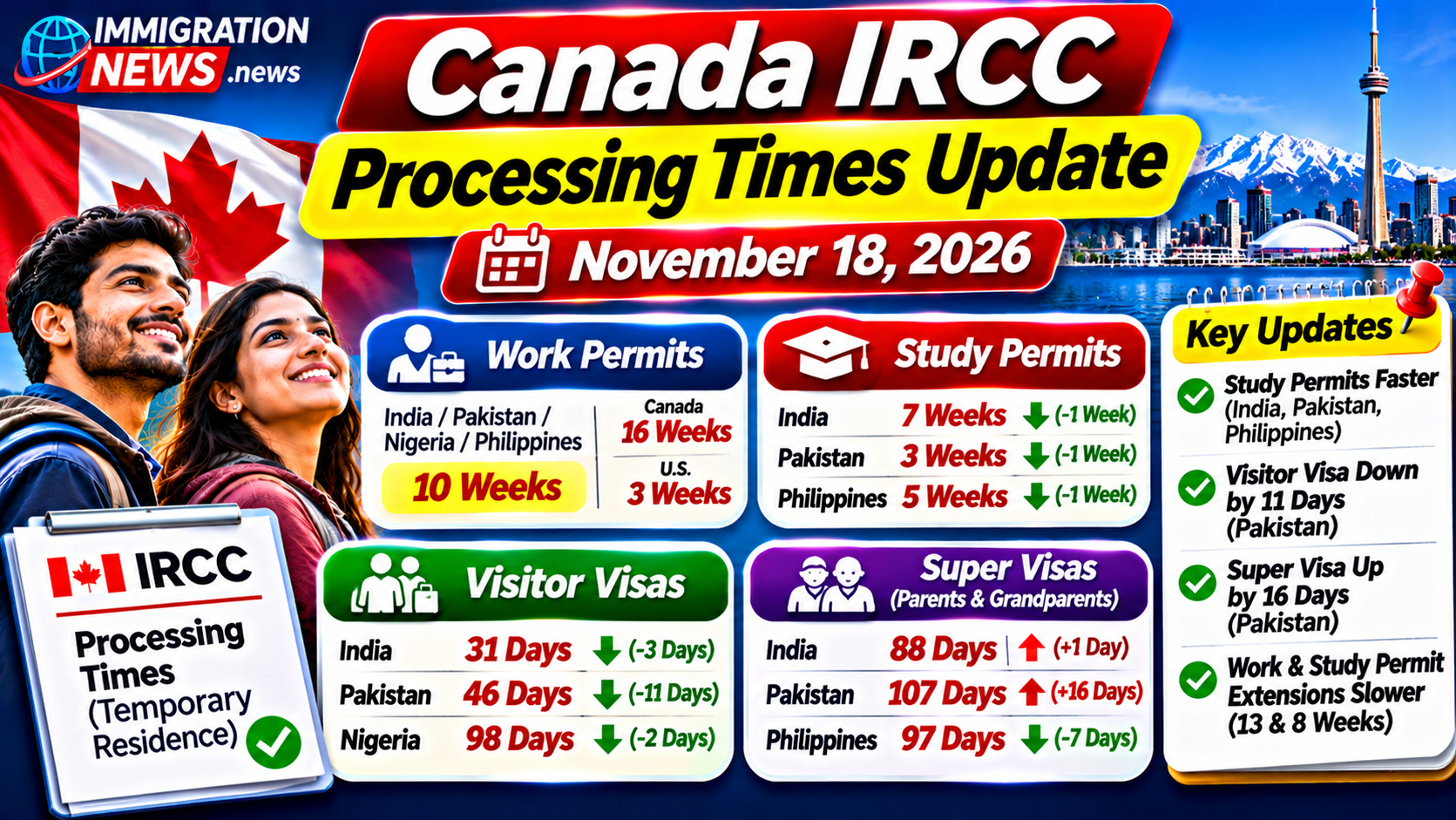
Read About : Canada Visa Processing Times Update: Visitor And Super Visa Waits Rise For Indian Applicants (November)
One thought on “BC PNP Targeted Draw November 13 2026: 384 Invitations Issued for Childcare, Healthcare, Construction and Veterinary Workers”