
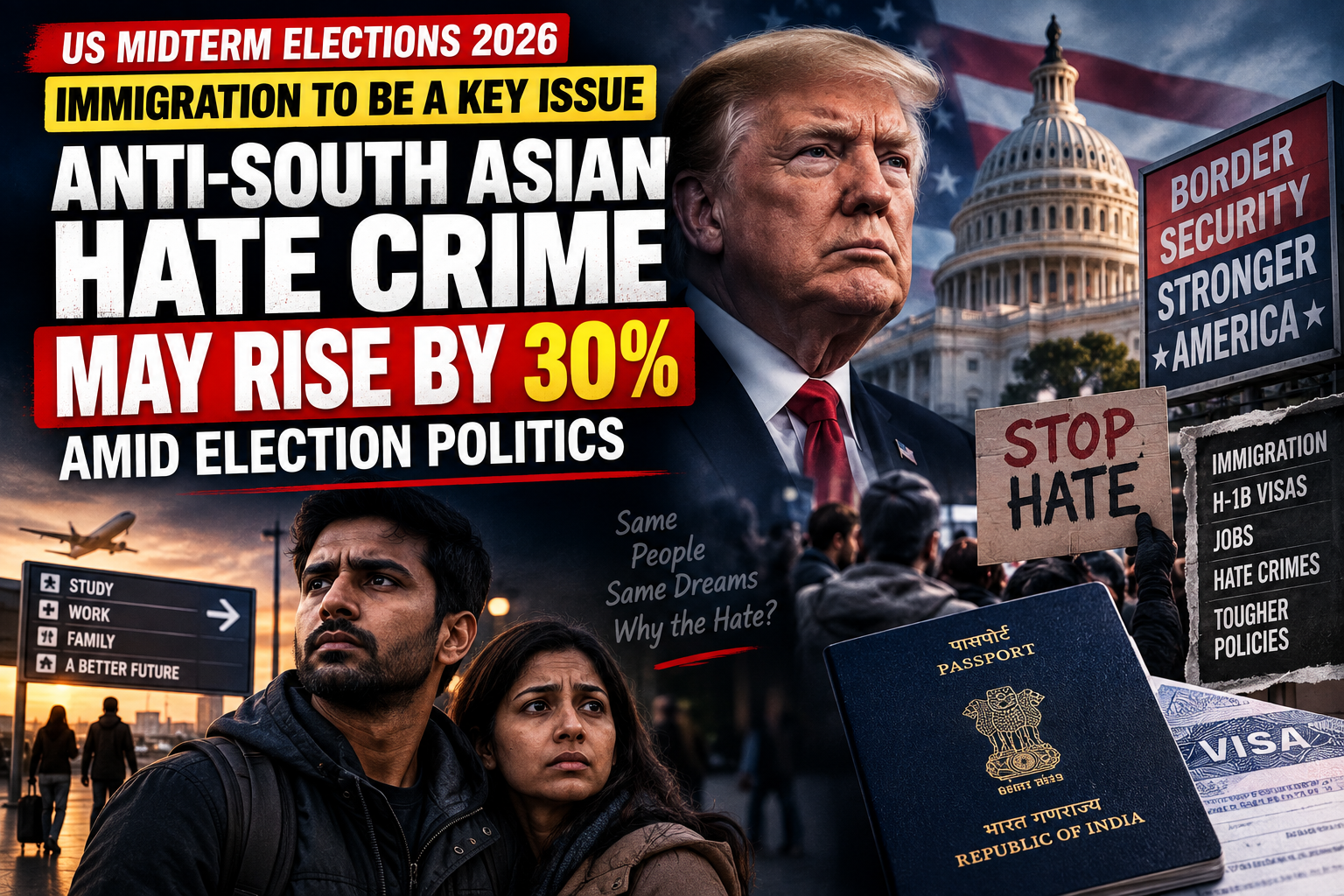
The anti-South Asian hate in the US debate is receiving renewed attention as the country approaches the November 2026 midterm elections, with immigration enforcement, H-1B visas and the treatment of immigrant communities increasingly part of the wider political conversation.
The federal general election is scheduled for November 3, 2026, when voters will elect members of Congress and decide a range of state and local offices.
At the same time, new research from Stop AAPI Hate points to a significant rise in online hostility toward South Asian communities. The organisation reported that anti-South Asian slurs increased 109% between January 2023 and December 2025, while 71% of anti-Asian threats of violence recorded in targeted-violence online spaces between August 2024 and December 2025 were directed at South Asians.
These developments have raised concerns among community organisations about how political rhetoric, immigration policy and online hostility could interact during an election year.
What the Data Actually Shows About Anti-South Asian Hate
One important distinction is necessary when discussing anti-South Asian hate in the US: online slurs, threats, hate incidents and legally recorded hate crimes are not the same thing.
The FBI defines a hate crime as a criminal offence motivated, in whole or in part, by bias against characteristics including race, religion, ethnicity, sexual orientation, disability and gender identity. FBI hate-crime statistics are based on reports submitted by participating law-enforcement agencies.
Stop AAPI Hate, meanwhile, uses several different sources, including online monitoring, surveys and reports submitted to its reporting centre. Its September 2026 report says 48% of South Asian adults surveyed reported experiencing a hate act because of their race, ethnicity or nationality in 2025. It also found that 55% said they or another AAPI person in their community had been affected by changing immigration policies or anti-immigrant sentiment.
That means figures circulating online should be described carefully.
The 44,535 figure
The source material behind the current discussion cites 44,535 incidents involving Indians, but the underlying Stop AAPI Hate research uses the figure differently.
Its 2025 analysis reported 44,535 anti-South Asian slurs in June alone in online spaces monitored with research organisation Moonshot. These were not 44,535 confirmed criminal hate crimes against Indian Americans.
This distinction matters when discussing the scale of anti-South Asian hate in the US.
The research nevertheless documents a substantial online hostility problem, particularly toward South Asian communities.
Why Indian Americans Are Closely Connected to the H-1B Debate
Immigration policy has become one of the areas where South Asian communities, particularly Indian Americans, have faced intense online discussion.
The H-1B programme is particularly relevant because Indians make up a large share of H-1B beneficiaries. Stop AAPI Hate reported that South Asians accounted for 73% of people approved for H-1B visas in 2024, including 71% from India. The organisation also linked the H-1B debate to increased anti-South Asian rhetoric in extremist online spaces.
The debate has included claims that Indian technology professionals are taking jobs from American workers. Stop AAPI Hate documented examples of Indian immigrants being targeted with such accusations in online extremist communities.
These political and economic debates do not by themselves constitute hate crimes. However, researchers studying anti-South Asian hate in the US have documented instances where immigration-related arguments overlap with racial and ethnic hostility.
Online Hate Spikes Have Previously Coincided With Political Events
The relationship between politics and anti-South Asian hate in the US has also been documented during earlier election cycles.
Stop AAPI Hate’s research found that anti-South Asian slurs in extremist online spaces increased sharply during periods when South Asian political figures received greater public attention.
In June 2025, for example, the organisation reported 44,535 anti-South Asian slurs in online spaces monitored with Moonshot. It said May and June were among the highest months for violent threats against South Asians since its tracking began in January 2023.
Earlier research also found that anti-South Asian slurs more than doubled from approximately 23,000 to more than 46,000 during 2023-24, with a major spike occurring in August 2024 around the U.S. presidential election campaign.
The data therefore supports a documented relationship between periods of heightened political attention and increases in online anti-South Asian rhetoric, although it does not establish that elections themselves cause hate crimes.
Immigration Is a Major Issue for Voters, But Not the Only One
The November election is taking place amid debates over immigration, the economy, inflation, healthcare, foreign policy and other domestic issues.
Recent polling of AAPI voters illustrates the range of concerns within the community.
The 2026 AAPI Voter Survey found that 90% of AAPI registered voters said they planned to vote in the midterm elections. Cost of living and inflation were the dominant concerns, with 90% of Asian American respondents describing them as very or extremely important in deciding how they vote.
Separate AAPI Data research found that racism, racial discrimination and hate crimes were important issues for many respondents, while immigration was also considered important by a substantial share of Asian American voters.
This means the political discussion surrounding anti-South Asian hate in the US should not be reduced to immigration alone. Economic conditions, public safety, healthcare, education and discrimination are also significant issues for AAPI voters.
Immigration Enforcement Is Affecting Asian Communities
The concerns extend beyond online rhetoric.
Stop AAPI Hate’s September 2026 analysis of ICE data found that arrests of Asian immigrants reached 1,950 in July 2026, the highest monthly level recorded during the second Trump administration.
According to the organisation’s analysis, from January 20, 2025 through August 6, 2026:
- Asian immigrant arrests increased by 436%;
- Asian immigrant detentions increased by 512%;
- Asian immigrant deportations increased by 1,103%; and
- Indian citizens were among the largest groups affected alongside citizens of China, Vietnam, Uzbekistan and Laos.
Stop AAPI Hate’s separate ICE Tracker analysis recorded 21,078 arrests, 18,769 detentions and 9,590 deportations involving Asian people during the period covered.
These are immigration-enforcement figures rather than hate-crime statistics. However, they form part of the broader environment in which concerns about anti-South Asian hate in the US are being discussed.
What About Claims of Indian Restaurants Being Reported to ICE?
The source material includes accounts from Indian-origin business owners who say people have monitored their businesses or contacted immigration authorities about suspected undocumented workers.
Such individual allegations need to be distinguished from independently verified enforcement data.
ICE does conduct workplace and other immigration-enforcement operations, but the available national data does not establish that Indian restaurants as a group are being systematically targeted by Trump supporters.
Individual reports can be important, particularly when they are documented through legal proceedings, police records or credible reporting. But they should not automatically be treated as evidence of a nationwide pattern.
That distinction is especially important during politically charged discussions about anti-South Asian hate in the US.
AAPI Communities Report Significant Discrimination Concerns
The broader survey data indicates that concerns about discrimination are not limited to a small number of highly publicised incidents.
An April-May 2026 AP-NORC/AAPI Data survey found that 28% of AAPI adults had experienced a hate crime or hate incident in the previous year. The survey distinguished between hate incidents and hate crimes, reporting that 23% experienced hate incidents and 11% experienced hate crimes.
The survey also found that 59% of AAPI adults considered it at least somewhat likely that they would experience discrimination because of their race or ethnicity during the next five years, while 47% said the same about their immigrant background or status.
These findings provide broader context for the discussion around anti-South Asian hate in the US, although the survey covers the wider AAPI population rather than Indian Americans alone.
How the 2026 Midterms Could Shape the Immigration Debate
The November 3 election will determine control of Congress and could influence the legislative environment for the remainder of President Donald Trump’s current term.
Immigration is already prominent in the political debate. Recent reporting has shown disagreements within the Republican Party over immigration enforcement, including criticism from some Republican lawmakers and candidates of aspects of the administration’s enforcement approach.
At the same time, polling shows that Republican voters remain substantially more supportive of Trump’s immigration approach than the broader electorate. A September 2026 Reuters/Ipsos poll found 79% approval of Trump’s immigration approach among Republicans, compared with 36% approval among all respondents.
These measurements describe current public opinion; they do not establish what the November election result will be.
For Indian Americans and other South Asian communities, the election therefore arrives at a time when immigration enforcement, employment-based immigration and discrimination are all highly visible issues.
Why the H-1B Debate Matters Beyond Immigration Policy
The H-1B debate has become particularly sensitive because of the size of the Indian professional community in the programme.
Arguments about wages, employment, outsourcing and skilled immigration are legitimate subjects of public policy debate.
However, when discussions shift from policy disagreements to generalisations about an ethnic or national group, researchers say the distinction between immigration-policy debate and racial hostility can become blurred.
Stop AAPI Hate’s research has documented examples of anti-Indian and anti-South Asian rhetoric associated with H-1B discussions. Its 2025 analysis also reported that violent threats and slurs increased following political events involving prominent South Asian figures.
That is one reason anti-South Asian hate in the US has become an issue of concern for community organisations heading into another major election cycle.
What the 2026 Data Does—and Does Not—Show
The available evidence supports several observations.
First, online anti-South Asian hostility has increased significantly over the period tracked by Stop AAPI Hate. Second, South Asians accounted for a large share of anti-Asian threats recorded in targeted-violence online spaces. Third, AAPI surveys show substantial concerns about discrimination and hate.
But the data does not establish that Indian Americans will experience a specific 30% increase in legally recorded hate crimes because of the November election.
The claim that the number of Indian hate crimes will reach 58,000 by November should therefore be treated as an extrapolation or warning rather than an established forecast. The 44,535 figure cited in the underlying research refers to anti-South Asian slurs tracked online, not confirmed criminal hate crimes against Indians.
That distinction is essential for accurate reporting.
What Indian Americans and Other South Asians Should Watch
As the election approaches, community organisations are likely to continue monitoring several areas:
Online threats and harassment: Researchers are tracking slurs and threats across online spaces associated with targeted violence.
Immigration enforcement: ICE arrest, detention and deportation data provides a separate measure of how immigration enforcement is affecting Asian communities.
H-1B policy: Changes to employment-based immigration remain particularly important for Indian professionals.
Political rhetoric: Campaign statements about immigration can affect public debate, although rhetoric alone should not be treated as evidence that a particular group will experience criminal violence.
Reporting and documentation: Community organisations encourage people experiencing discrimination or hate incidents to document and report them through appropriate channels.
FAQs : Anti-South Asian Hate In The US
Is anti-South Asian hate increasing in the US?
Research from Stop AAPI Hate shows a substantial increase in online anti-South Asian slurs. Its September 2026 report found a 109% increase between January 2023 and December 2025.
Are 44,535 cases confirmed Indian hate crimes?
No. The 44,535 figure refers to anti-South Asian slurs tracked online in June 2025. It should not be described as 44,535 confirmed criminal hate crimes against Indians.
Could anti-South Asian hate increase around the 2026 election?
Researchers have documented increases in online hostility during previous periods of heightened political attention, but there is not enough evidence to state as a fact that the 2026 election will cause a specific increase in criminal hate incidents.
Is immigration an important issue for AAPI voters?
Yes, although it is one of several major concerns. The 2026 AAPI Voter Survey found cost of living and inflation were dominant concerns, while other surveys have also identified racism, discrimination and immigration as important issues.
Are Indian immigrants being affected by increased ICE enforcement?
Stop AAPI Hate’s analysis of publicly available ICE data shows substantial increases in enforcement against Asian immigrants, with Indian citizens among the largest affected national groups.
Final Takeaway On Anti-South Asian Hate In The US
The 2026 U.S. election is taking place against a backdrop of intense debate over immigration, H-1B visas, enforcement and the treatment of immigrant communities.
Available research shows that anti-South Asian hate in the US has become a significant concern, particularly in online spaces. Stop AAPI Hate reports a 109% increase in anti-South Asian slurs since 2023, while its 2026 research also documents substantial reported experiences of hate and discrimination among South Asian adults.
However, the numbers must be reported accurately. Online slurs are not the same as criminal hate crimes, and the available evidence does not establish a specific 30% increase in Indian hate crimes or confirm that 58,000 Indian hate crimes will occur by November.
What is clear is that South Asian communities are entering the 2026 election season amid heightened political attention to immigration and documented concerns about discrimination and online hostility.
The November 3 election will provide another important test of how immigration, the economy, public safety, discrimination and other issues shape the political debate in the United States.
Source : Dainik Bhaskar
Read About : New Public Charge Rule 2026 : Could Make Green Card Approval Harder for Immigrants Using Public Benefits
One thought on “Anti-South Asian Hate in the US: Immigration Debate and 2026 Midterm Election Raise New Concerns”