
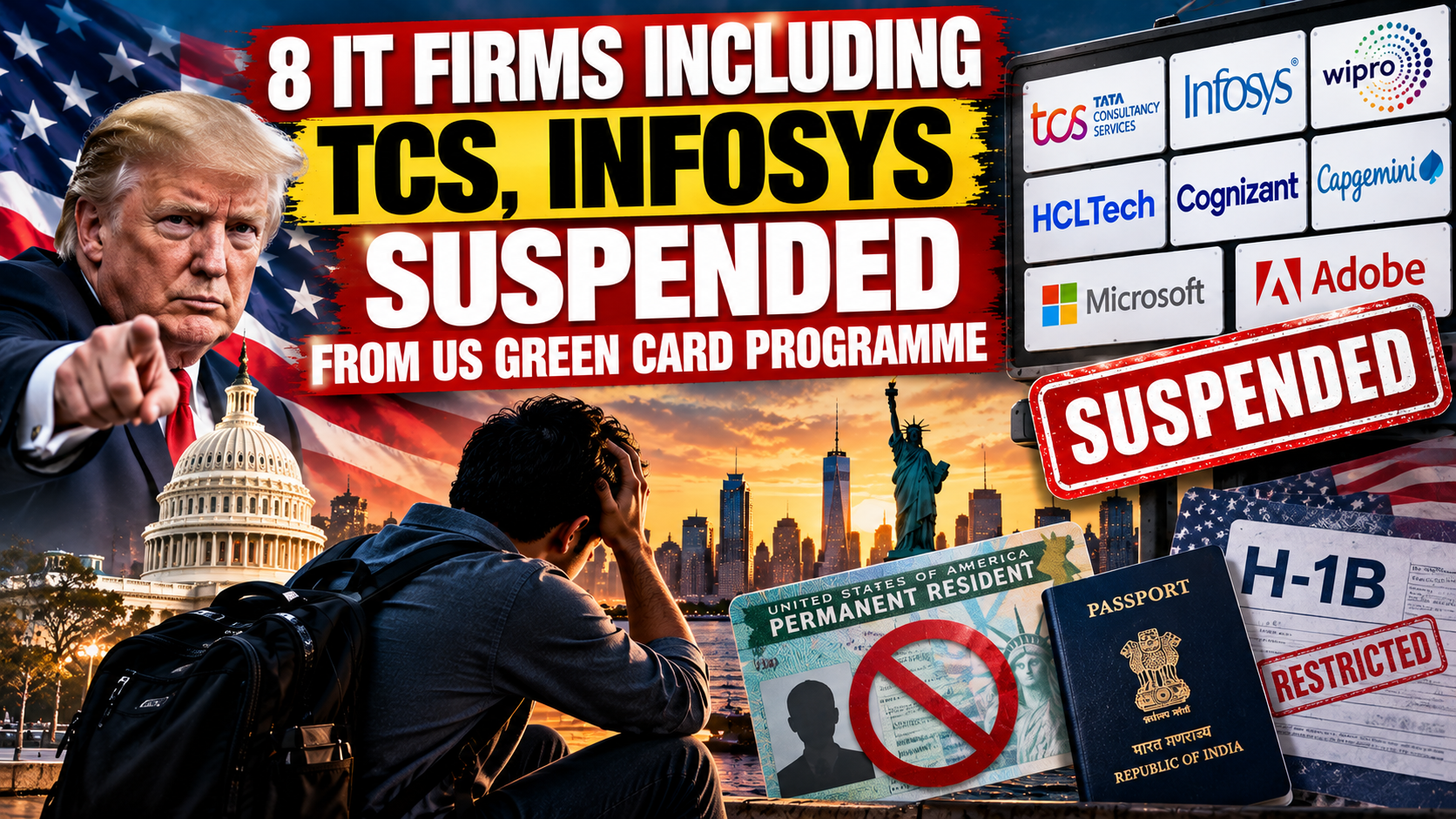
The PERM suspension for Indian IT companies has created fresh uncertainty for technology professionals working in the United States or hoping to move there through major IT services firms. On October 8, 2026, the Trump administration announced that eight technology and outsourcing companies would be suspended from the US Permanent Labour Certification Programme, a key stage in the employment-based green card process.
The companies named in the announcement include Tata Consultancy Services (TCS), Infosys, Wipro, HCL Technologies, Cognizant, Capgemini, Microsoft and Adobe. The US Department of Labor (DOL) said it would stop accepting new PERM applications involving these companies and halt the processing of pending applications.
The PERM suspension for Indian IT companies could affect employees whose long-term immigration plans depend on employer-sponsored permanent residency. However, the announcement does not automatically cancel existing H-1B visas or green cards. The consequences will depend on individual immigration circumstances, the status of existing applications and how the restrictions are implemented.
What Is PERM and Why Is It Important for Green Cards?
The Permanent Labour Certification Programme, commonly known as PERM, is an important step in the US employment-based immigration system. It generally requires an employer to demonstrate that there are not sufficient able, willing, qualified and available US workers for the relevant position and that employing a foreign worker will not adversely affect the wages and working conditions of similarly employed US workers.
For many employment-based green card applicants, particularly those applying through the EB-2 and EB-3 categories, PERM is the first major stage of the process.
The process generally involves three stages:
- PERM labour certification: The employer completes the required recruitment process and submits a labour certification application to the Department of Labor.
- Form I-140 immigrant petition: After labour certification is approved, the employer generally files an immigrant petition with US Citizenship and Immigration Services (USCIS).
- Green card application: When an immigrant visa number is available, the applicant may apply for adjustment of status in the United States or complete consular processing abroad, subject to eligibility.
The PERM suspension for Indian IT companies interrupts the first stage for affected employers. If a company cannot file a new PERM application or move a pending case forward, employees who depend on that employer for sponsorship may face delays or uncertainty about their permanent residency plans.
Which Eight Companies Have Been Suspended?
The October 8 announcement named eight major technology and IT services companies.
| Company | Industry |
|---|---|
| Tata Consultancy Services (TCS) | IT services and consulting |
| Infosys | IT services and consulting |
| Wipro | IT services and consulting |
| HCL Technologies | IT services and consulting |
| Cognizant | IT services and consulting |
| Capgemini | IT services and consulting |
| Microsoft | Software and technology |
| Adobe | Software and digital technology |
According to the announcement, the Department of Labor will not accept new PERM applications involving these employers and will not process their pending applications while the restrictions remain in effect.
The administration linked the action to concerns about alleged abuse of employment-based immigration programmes and investigations involving the affected companies. The announcement does not, by itself, establish that every company or employee has committed a violation.
The duration of the restrictions and the treatment of individual cases will be important factors in determining the ultimate impact on workers.
Why Has the Trump Administration Taken This Step?
The administration has argued that some employers have used foreign-worker programmes in ways that disadvantage American workers. Officials have raised concerns about recruitment practices, wages, layoffs and whether employers adequately considered qualified US workers before seeking to employ foreign nationals.
Vice President JD Vance and Labour Secretary Keith Sonderling announced the action alongside other officials involved in the administration’s anti-fraud initiative.
Sonderling said the affected companies had collectively requested millions of foreign workers over the years. He also cited historical H-1B approvals and permanent labour certifications as part of the administration’s argument that the system required greater scrutiny.
Vance separately criticised Microsoft, questioning how the company could lay off American workers while continuing to use employment-based immigration programmes. These statements represent the administration’s allegations and rationale for the action; they should not be treated as proof of individual violations by every affected employer.
The PERM suspension for Indian IT companies therefore reflects a broader policy focus on how employers recruit, pay and sponsor foreign workers, rather than a change limited to one immigration category.
Concerns About Labour Intermediaries and Outsourcing
Some industry observers have argued that the debate is partly about how technology workers are recruited and deployed through staffing companies, subcontractors and outsourcing arrangements.
For example, an intermediary might recruit a foreign professional for a client project and charge the client more than the amount paid to the worker. If the arrangement involves underpayment, misleading job descriptions or failure to follow applicable labour rules, it could attract regulatory scrutiny.
However, legitimate outsourcing and employing foreign workers are not automatically unlawful. The relevant questions include whether the employer followed the rules, paid the required wage, conducted the required recruitment and accurately represented the job and employment relationship.
For Indian professionals, the distinction matters because the government action is directed at employers’ participation in the PERM programme, while individual employees may have complied with all applicable immigration requirements.
How Will the PERM Suspension Affect Indian IT Professionals?
The PERM suspension for Indian IT companies could affect workers differently depending on whether they already hold H-1B status, have an ongoing green card case or are planning to move to the United States.
1. Indian professionals already working in the US
Employees working for an affected company on valid H-1B status do not automatically lose their status because of the PERM suspension.
Their ability to remain and work in the United States continues to depend on their immigration status, approved petitions, employment arrangements and compliance with applicable rules.
However, employees who were expecting their employer to begin or advance their green card process may face uncertainty. A delayed PERM filing can affect their long-term immigration plans, particularly if they are approaching the usual six-year H-1B limit.
2. Workers waiting for PERM approval
Employees whose PERM applications are already pending may face delays because the Department of Labor has announced that it will stop processing applications involving the suspended companies.
The practical consequences will depend on the status of each case and any subsequent government decisions, court proceedings or changes to the restrictions.
Workers should not assume that a pending application will automatically be approved, denied or permanently cancelled. They should obtain case-specific advice before making decisions about employment, travel or immigration status.
3. H-1B workers approaching the six-year limit
This group could face particular uncertainty.
H-1B status is generally subject to a six-year maximum period, although certain workers can qualify for extensions beyond that limit under specific provisions of US immigration law.
For example, some workers may qualify for extensions when a labour certification or employment-based immigrant petition has been pending for the required period. Others may qualify after an I-140 petition has been approved but an immigrant visa number is not yet available.
These rules have specific eligibility requirements. A PERM suspension does not automatically make every affected worker ineligible for an extension, but it may complicate the process for employees who have not yet reached the relevant milestones.
Workers approaching their H-1B limit should consult an experienced US immigration attorney to review their current status, filing history and possible options.
4. Indian professionals planning to move to the US
The PERM suspension for Indian IT companies could also affect professionals in India who were considering joining one of the eight companies with the expectation of eventually obtaining a US green card.
A job offer and an H-1B petition are separate from an employer’s ability to sponsor a worker through PERM. Even if a company can employ a professional through a legally available route, its participation in the employment-based green card process may be restricted.
Applicants should therefore ask prospective employers whether they can currently sponsor employment-based permanent residency, whether the role involves a US assignment and what immigration support is available.
Candidates should avoid making relocation or financial decisions based solely on an assumption that an employer will begin the green card process after hiring.
Does the PERM Suspension Cancel Existing H-1B Visas?
No. The PERM suspension for Indian IT companies does not, by itself, revoke existing H-1B visas or automatically terminate lawful immigration status.
PERM is a labour certification process used in many employment-based green card cases. H-1B is a temporary, employment-based nonimmigrant classification. Although the two pathways can be connected, they serve different purposes.
An employee’s H-1B status depends on factors such as the validity of the approved petition, continued qualifying employment, authorised stay and compliance with immigration requirements.
Similarly, an existing green card is not automatically cancelled merely because an employer is suspended from PERM. Permanent residents retain their status unless a separate legal basis affects it.
Workers should distinguish between a delay in starting or completing a green card application and a change to their current immigration status.
Could the Suspension Affect Green Card Extensions Beyond Six Years?
Potentially, but not in the same way for every employee.
Certain H-1B workers can qualify for extensions beyond the standard six-year limit under the American Competitiveness in the Twenty-First Century Act (AC21) and related provisions.
Depending on the circumstances, an extension may be available when a qualifying labour certification or employment-based immigrant petition has been filed and has remained pending for at least 365 days. Other qualifying workers may obtain extensions in connection with an approved I-140 petition when an immigrant visa number is unavailable.
These provisions have detailed eligibility requirements, and not every employee with a delayed PERM case qualifies.
The PERM suspension for Indian IT companies may create complications for workers who have not yet reached a qualifying filing milestone. Those who already have an approved I-140 or who qualify under a separate provision may have different options.
Employees should have an immigration lawyer examine their priority date, PERM filing history, I-140 status, time spent in H-1B status and any previous extensions before determining what the suspension means for them.
How Does the PERM Action Fit Into Other US Immigration Restrictions?
The latest action comes amid wider scrutiny of employment-based immigration programmes and foreign-worker hiring.
The administration has also pursued changes involving H-1B visas, including a separate payment requirement announced for certain new H-1B petitions involving workers entering from abroad. As of October 9, 2026, the implementation of that payment requirement has faced federal court challenges and blocking orders, so its applicability must be assessed separately from the PERM suspension.
Other policy changes and proposals have focused on visa selection, wage levels and employer compliance. Their legal status and scope may differ.
For Indian professionals, it is important not to treat all these developments as a single rule. The PERM suspension for Indian IT companies specifically affects the named employers’ participation in the labour certification process. It does not automatically prohibit every affected company from hiring foreign nationals through every available immigration route.
What Should Affected Indian Professionals Do Now?
Employees and prospective applicants can take practical steps to understand their position and reduce avoidable risks.
- Check your current immigration status: Confirm the validity of your H-1B approval, I-94 record and employment authorisation where applicable.
- Review your green card case: Find out whether your PERM application has been filed, whether it is pending or approved, and whether an I-140 petition has been submitted or approved.
- Speak to your employer’s immigration team: Ask how the suspension affects your specific case and whether the company has received further instructions from the Department of Labor.
- Get independent legal advice: This is especially important if you are approaching the H-1B six-year limit, changing employers or considering travel outside the United States.
- Explore alternative employers carefully: A move to another employer may provide a different sponsorship route, but a new employer’s willingness and ability to sponsor you should be confirmed before you resign or relocate.
- Keep your documents organised: Maintain copies of approval notices, labour certification records, I-140 filings, pay statements, employment letters and immigration correspondence.
- Avoid relying on unverified claims: Do not assume that your visa has been cancelled or that you must immediately leave the country solely because your employer appears on the suspension list.
The PERM suspension for Indian IT companies is a significant development for workers who rely on employer sponsorship, but the right response depends on their individual circumstances and the latest official instructions.
FAQs : PERM Suspension for Indian IT Companies
1. Which companies have been suspended from the PERM programme?
The eight companies named in the October 8, 2026 announcement are TCS, Infosys, Wipro, HCL Technologies, Cognizant, Capgemini, Microsoft and Adobe.
2. Does the PERM suspension cancel existing H-1B visas?
No. The suspension does not automatically cancel existing H-1B visas or terminate lawful status. Employees must continue to meet the requirements applicable to their individual immigration status.
3. What happens to pending PERM applications?
The Department of Labor has announced that it will stop processing pending PERM applications involving the affected employers. The final outcome and timing for individual cases may depend on subsequent government action or legal proceedings.
4. Can affected employees still get a US green card?
The suspension may prevent affected employers from advancing PERM-based cases while the restrictions remain in effect. An employee’s options depend on their case status, eligibility and whether another lawful sponsorship route is available.
5. Will Indian professionals in India be affected?
Potentially. Professionals planning to join the affected companies for US assignments may face greater uncertainty if they expected employer-sponsored green card processing. They should confirm current sponsorship arrangements before making career or relocation decisions.
6. Can an H-1B worker extend their stay beyond six years?
Some H-1B workers qualify for extensions beyond six years under specific provisions of US immigration law. Eligibility depends on factors such as labour certification and I-140 filing history, so affected workers should obtain individual legal advice.
7. Can affected employees change employers?
Changing employers may be an option for some workers, depending on their immigration status and the circumstances of the new job. However, a job change does not automatically transfer or preserve every stage of a green card case.
8. How long will the PERM suspension last?
The duration and eventual outcome of the restrictions were not established in the announcement. Employees should monitor official updates and seek case-specific advice rather than assume a fixed end date.
Final Takeaway On PERM Suspension for Indian IT Companies
The PERM suspension for Indian IT companies creates new uncertainty for thousands of professionals whose plans for permanent residency depend on employer sponsorship. TCS, Infosys, Wipro, HCL Technologies, Cognizant, Capgemini, Microsoft and Adobe have been named in the action, with new and pending PERM applications affected.
The most important distinction is that a suspension of labour certification processing is not the same as cancelling an employee’s H-1B status or existing green card. Workers approaching the H-1B limit or waiting for an employer-sponsored green card should review their individual cases, speak with their employers and obtain qualified immigration advice before making major decisions.
Source : The Times Of India
Read About : Supreme Court New Term 2026: Immigration, Gun Rights and Religion Cases to Watch


One thought on “PERM Suspension for Indian IT Companies: How 8 IT Firms Green Card Restrictions Could Affect Indian Professionals”