
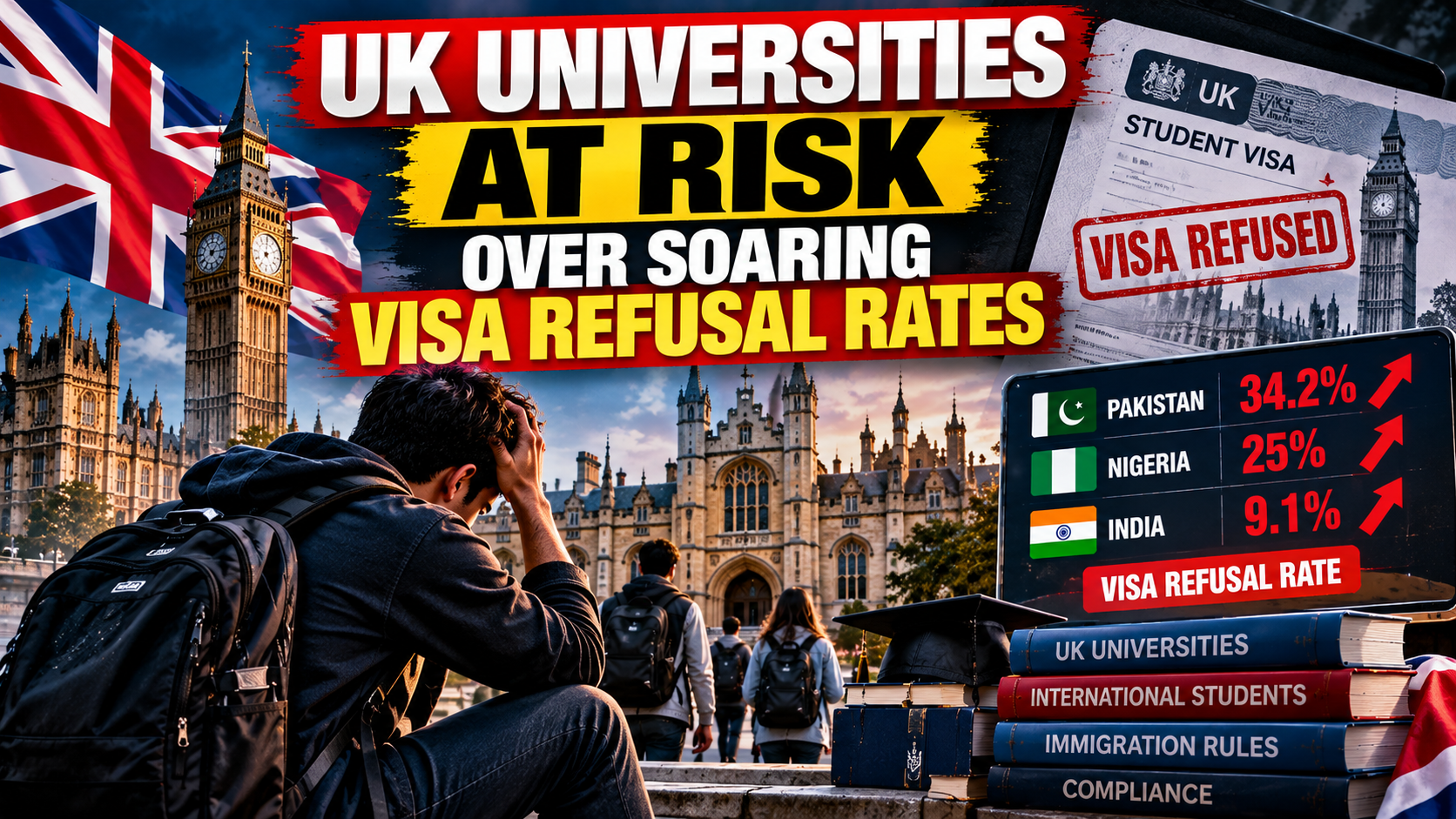
Rising UK university visa refusal rates are creating growing pressure across the higher education sector, with universities facing tougher immigration compliance requirements and potentially serious consequences if too many sponsored students are refused visas.
The concerns intensified after the Home Office suspended the student sponsor licence of Buckinghamshire New University on September 30, 2026. The decision was significant because the university became the first full university in around a decade to face this type of sanction.
The suspension has also raised a broader question for the UK higher education sector: How many universities could eventually struggle to meet the government’s tougher visa compliance thresholds?
The issue is particularly important for universities that depend heavily on international student tuition fees while recruiting from countries where UK university visa refusal rates have increased sharply.
New UK Visa Compliance Rules Put Universities Under Greater Pressure
The latest concerns come after the UK introduced a significantly tougher Basic Compliance Assessment (BCA) framework in June 2026.
Under the new system, universities and other student sponsors are assessed against three key measures:
- Student visa refusal rate
- Student enrolment rate
- Course completion rate
For BCA applications made from June 1, 2026, sponsors must have a visa refusal rate of less than 5%, an enrolment rate of at least 95%, and a course completion rate of at least 85%.
The refusal threshold was previously less than 10%.
This reduction has made UK university visa refusal rates a much more important financial and compliance issue for institutions recruiting international students.
From June 2027, the course completion requirement is also scheduled to increase to at least 90%.
Buckinghamshire New University Suspension Raises Fresh Concerns
The Home Office suspended Buckinghamshire New University’s Student sponsor licence on September 30, 2026.
The suspension took effect immediately, and the university was removed from the Register of Student Sponsors.
The university has 20 working days to respond to the decision. If it cannot demonstrate why the licence should be reinstated, the licence could be revoked.
The Home Office said the suspension followed concerns about the university’s compliance with its sponsor duties.
The action has attracted particular attention because the institution was the last university to face a comparable sanction in 2015 before subsequently regaining its sponsorship powers.
The latest case has therefore become an important warning for institutions trying to manage increasingly strict immigration compliance requirements.
Visa Refusal Rates Are Rising in Several Major Student Markets
The pressure on universities is being compounded by higher visa refusal rates among applicants from several major international student markets.
For the 12 months ending June 2026, the refusal rate for Pakistani student visa applicants was around 18.9%, compared with approximately 5% a year earlier.
For Nigeria, the rate increased to 11.7%, compared with 4.3% the previous year.
India recorded a lower refusal rate of approximately 4.2%, but that was still higher than the previous year’s 2.9%.
The figures become even more significant when looking at shorter periods. In the latest quarter cited in the article, refusal rates were approximately:
| Country | Latest reported quarterly refusal rate |
|---|---|
| Pakistan | 34.2% |
| Nigeria | 25% |
| India | 9.1% |
These figures help explain why universities recruiting heavily from particular markets are increasingly concerned about their institutional compliance position.
Why the New Rules Could Hit Some Universities Harder
Not every UK university has the same international recruitment strategy.
Research-intensive universities with strong global reputations may attract large numbers of students from markets where visa refusal rates are comparatively low.
Other institutions, particularly teaching-focused universities, may rely more heavily on markets where applicants are currently experiencing higher refusal rates.
That creates a difficult situation.
A university can strengthen its recruitment screening and reduce applications from higher-risk markets, potentially protecting its compliance record. But doing so could also reduce international enrolment and tuition income.
As international student mobility becomes more competitive, universities may find themselves choosing between recruitment growth and immigration compliance risk.
Universities Are Divided Over How Widespread the Problem Is
University leaders do not appear to agree on how widely the new compliance pressures are affecting the sector.
Some senior university figures believe the issue is concentrated among a relatively small number of institutions that have historically relied heavily on international recruitment from higher-refusal markets.
One Russell Group leader cited in the article argued that the problem had not yet significantly affected the more selective part of the sector.
Another research-intensive university leader suggested that the majority of non-compliance was concentrated among a handful of institutions and argued that enforcement action was overdue.
However, other higher education leaders have warned that UK university visa refusal rates could become a much broader issue.
They argue that even research-intensive institutions may eventually have to recruit more heavily from markets where refusal rates are higher as traditional low-risk markets become less accessible or less willing to send students to the UK.
International Recruitment Is Becoming a Difficult Balancing Act
Higher education consultant Charles Knight described the situation as a difficult choice for universities.
Institutions that continue recruiting heavily from countries with higher refusal rates could increase their compliance risk.
But universities that withdraw from those markets could face significant financial pressure.
The problem is particularly serious because international students provide an important source of income for UK universities.
As competition for international students increases, institutions may have fewer opportunities to replace lost enrolment from traditional markets.
This means UK university visa refusal rates are no longer simply an immigration compliance statistic. They can also influence recruitment strategies, financial planning and institutional sustainability.
Indian Students Could Also Be Affected
The latest figures are particularly relevant for Indian students considering UK universities.
India remains one of the UK’s major international student markets, but the refusal rate for Indian student visa applicants increased from approximately 2.9% to 4.2% over the year ending June 2026.
The latest quarterly figure cited in the article was higher at 9.1%.
That does not mean Indian students face a UK-wide visa ban or that an individual applicant with a strong application is likely to be refused.
However, universities must consider their overall sponsored-student refusal rate when managing their BCA compliance.
If an institution’s refusal rate approaches or exceeds the applicable threshold, it could become more cautious about recruitment and admissions from certain markets.
Universities Say Some Visa Refusals Are Difficult to Understand
Some university leaders have also questioned the reasoning behind individual visa refusals.
Gary Davies, deputy vice-chancellor at London Metropolitan University, said some applicants had been refused for reasons that universities found difficult to reconcile with official guidance.
Examples cited included students being unable to recall the opening hours of a university library or explain how UK courses compared with programmes in Canada.
Another case involved an applicant who was reportedly refused because officials concluded that the person’s motivation for studying law appeared to be professional advancement rather than a broader academic interest.
Universities argue that such decisions can create difficulties because institutions have limited control over individual UKVI decisions while still being held accountable for the resulting refusal rate.
Could More UK Universities Lose Their Student Sponsor Licences?
This is one of the biggest questions surrounding the new rules.
The current framework gives UKVI significant powers when sponsors fail to meet the required compliance standards.
A red BCA rating can result from failing one of the core metrics. The system uses a Red-Amber-Green framework, with the refusal rate classified as:
| Refusal rate | BCA rating |
|---|---|
| 5% or higher | Red |
| 4% to below 5% | Amber |
| Below 4% | Green |
A red rating does not automatically mean that every university will immediately lose its licence.
UKVI can consider representations and, during the transitional period, may exercise operational discretion in certain circumstances.
However, repeated or serious compliance failures can lead to enforcement action, including licence revocation.
That is why rising UK university visa refusal rates are attracting such close attention from university leaders.
Financial Pressure Could Become a Bigger Issue
The immigration compliance debate is also connected to the wider financial challenges facing UK universities.
Universities have increasingly relied on international student income to support their finances, particularly as domestic tuition fee income has struggled to keep pace with institutional costs.
Charles Knight argued that universities are caught between two government objectives: controlling immigration while encouraging the education sector to expand international income.
The government has previously targeted significant growth in education exports, creating a situation in which universities are encouraged to recruit internationally while simultaneously facing tougher restrictions around international student sponsorship.
That tension could become increasingly difficult to manage.
The UK Could Face a Debate Over University Funding
If more universities experience serious financial difficulties because they cannot maintain international recruitment while meeting immigration compliance requirements, pressure could grow for a wider review of the UK higher education funding model.
The current system leaves universities with a difficult financial equation.
International tuition fees can help institutions compensate for limitations in domestic funding, but increased reliance on overseas students also exposes universities to changes in immigration policy.
If international recruitment becomes more difficult, universities may need alternative sources of funding.
That could eventually push the government toward a broader discussion about university funding rather than treating student immigration compliance as a standalone issue.
China Could Become Another Challenge for UK Universities
Another issue highlighted by university leaders is the changing international student market in China.
UK universities have historically attracted significant numbers of Chinese students, but demographic and geopolitical changes could affect future demand.
Gary Davies argued that UK institutions cannot assume that Chinese student numbers will remain at previous levels indefinitely.
Students from China increasingly have alternative destinations, including Hong Kong and Singapore, while demographic changes may reduce the pool of potential students.
If Chinese enrolments decline further, UK universities could become more dependent on other international markets.
That could increase exposure to countries where UK university visa refusal rates are currently higher.
What This Could Mean for International Students
For international students, the immediate concern is not that the UK has introduced a blanket restriction on applicants from particular countries.
Instead, the bigger issue is that individual universities may become more selective about international recruitment as they try to protect their sponsor licences.
Students may therefore see universities:
- Conducting more detailed credibility checks
- Asking additional questions before issuing CAS
- Reviewing academic and financial backgrounds more closely
- Becoming more cautious about applicants from higher-refusal markets
- Reducing recruitment in certain countries
- Increasing pre-visa compliance checks
These measures could vary significantly between universities.
Students should therefore distinguish between UK-wide visa requirements and individual university recruitment or compliance policies.
What Should Prospective UK Students Do?
International students planning to study in the UK should carefully research their university before paying tuition fees or making travel arrangements.
Students should verify that:
- The university holds a valid Student sponsor licence.
- The intended course is eligible for sponsorship.
- They meet the academic requirements.
- They can demonstrate the required financial resources.
- Their English-language requirements are satisfied.
- Their study plans are genuine and consistent.
- Their visa application is complete and supported by accurate documentation.
Students should also understand that receiving an offer from a university does not guarantee a Student visa.
The final immigration decision remains with UK Visas and Immigration.
Could UK Universities Become More Selective About International Students?
The combination of stricter BCA requirements and rising UK university visa refusal rates could encourage institutions to become more selective.
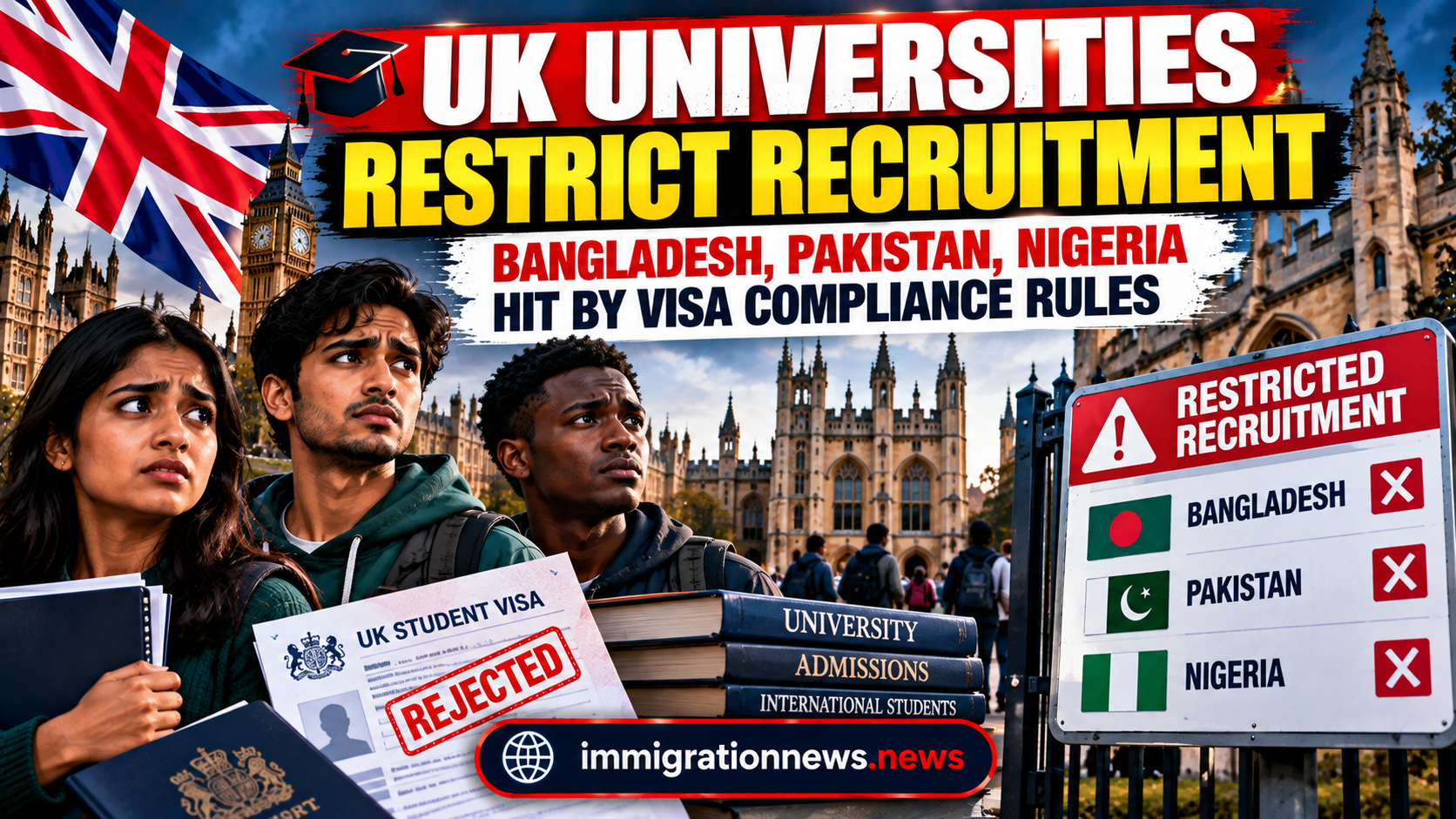
This does not necessarily mean that universities will stop recruiting from countries such as India, Pakistan, Nigeria or Bangladesh.
Instead, universities may increase internal screening and focus more heavily on applicants who can demonstrate clear academic progression, credible study intentions and the ability to meet visa requirements.
The impact could vary significantly depending on each institution’s recruitment profile and historical compliance record.
UK University Visa Refusal Rates: What the New Rules Mean
The latest developments represent a major shift in how the UK government links international recruitment with university compliance.
Previously, universities could operate with a refusal threshold below 10%.
Since June 2026, the requirement has become significantly stricter, with the refusal rate needing to remain below 5% for the relevant BCA assessment.
At the same time, visa refusals have increased in several major recruitment markets.
The result is a growing pressure point for universities that depend on international tuition revenue.
The suspension of Buckinghamshire New University’s sponsor licence demonstrates that the government is willing to take enforcement action.
Whether that eventually results in more universities losing their licences remains uncertain.
FAQs : UK University Visa Refusal Rates
Why are UK university visa refusal rates becoming a major issue?
The UK introduced tougher Basic Compliance Assessment rules in June 2026. Universities must keep their student visa refusal rate below 5% under the new framework, making refusal rates directly relevant to their sponsor compliance.
What happens if a university has a visa refusal rate of 5% or higher?
A refusal rate of 5% or higher places the sponsor in the red category for that metric. Depending on the circumstances and other compliance factors, the institution can face further compliance action.
Has a UK university recently lost its student sponsor licence?
Buckinghamshire New University’s Student sponsor licence was suspended on September 30, 2026. The university has 20 working days to respond to the decision, after which the licence could be revoked if reinstatement is not justified.
Are Indian students being banned from UK universities?
No. There is no UK-wide ban on Indian students. However, India’s student visa refusal rate increased to approximately 4.2% for the year ending June 2026, with a higher rate reported for the latest quarter cited in the article.
Which countries have high UK student visa refusal rates?
The article highlights Pakistan, Nigeria and India among major student markets where refusal rates have increased. Pakistan recorded the highest rate among the countries discussed.
Will UK universities stop accepting students from India?
There is no indication of a nationwide decision to stop accepting Indian students. Individual universities may, however, adjust recruitment strategies depending on their compliance position and visa outcomes.
Can a university lose its sponsor licence because of visa refusals?
Yes. Visa refusal rates are one of the core metrics in the Basic Compliance Assessment. Serious or repeated non-compliance can result in enforcement action, potentially including suspension or revocation of the Student sponsor licence.
Will the stricter rules affect UK university fees?
The immediate rules concern immigration compliance rather than tuition fees. However, if universities lose international enrolment and associated tuition income, the financial impact could contribute to wider pressure for reform of the UK higher education funding model.
Final Takeaway On UK University Visa Refusal Rates
Rising UK university visa refusal rates are creating a new challenge for institutions already operating under financial and recruitment pressure.
The introduction of the tougher Basic Compliance Assessment framework means universities now need to maintain a student visa refusal rate below 5%, alongside stricter enrolment and completion requirements.
The suspension of Buckinghamshire New University’s Student sponsor licence has added urgency to the debate and raised questions about whether other universities could face similar action.
For international students, the changes do not represent a blanket restriction on studying in the UK. But universities may become more cautious about recruitment, particularly from markets where visa refusal rates are increasing.
The bigger issue may ultimately extend beyond immigration. If universities become increasingly dependent on international tuition income while facing tougher restrictions on international recruitment, the UK could face renewed pressure to reconsider how its higher education system is funded.
Source : Times Higher Education
Read About : UK Immigration Rules September 2026: New Erasmus+ Changes for Students, Visitors and Child Students



One thought on “UK University Visa Refusal Rates 2026 Put More Universities at Risk as Immigration Rules Tighten”