
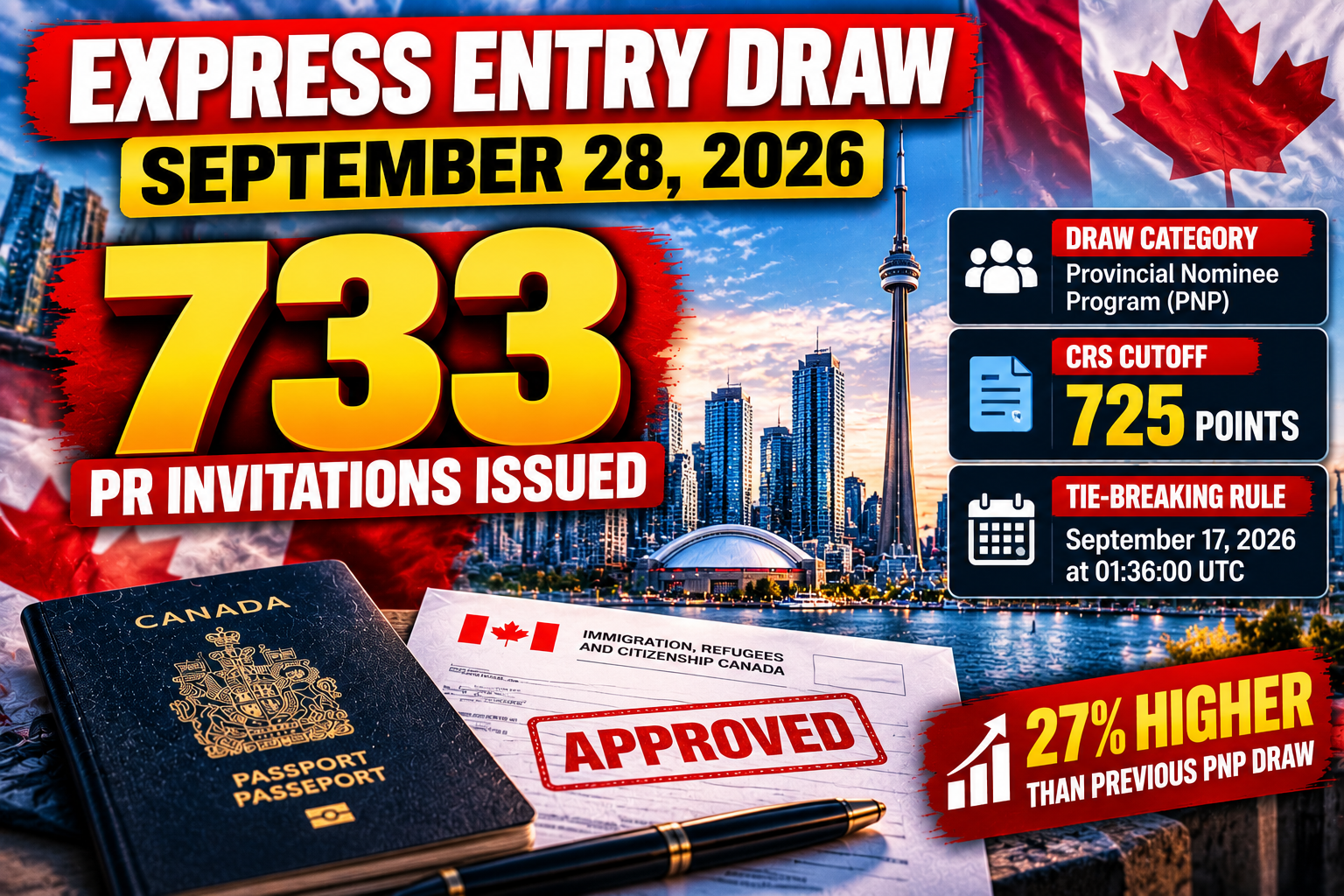
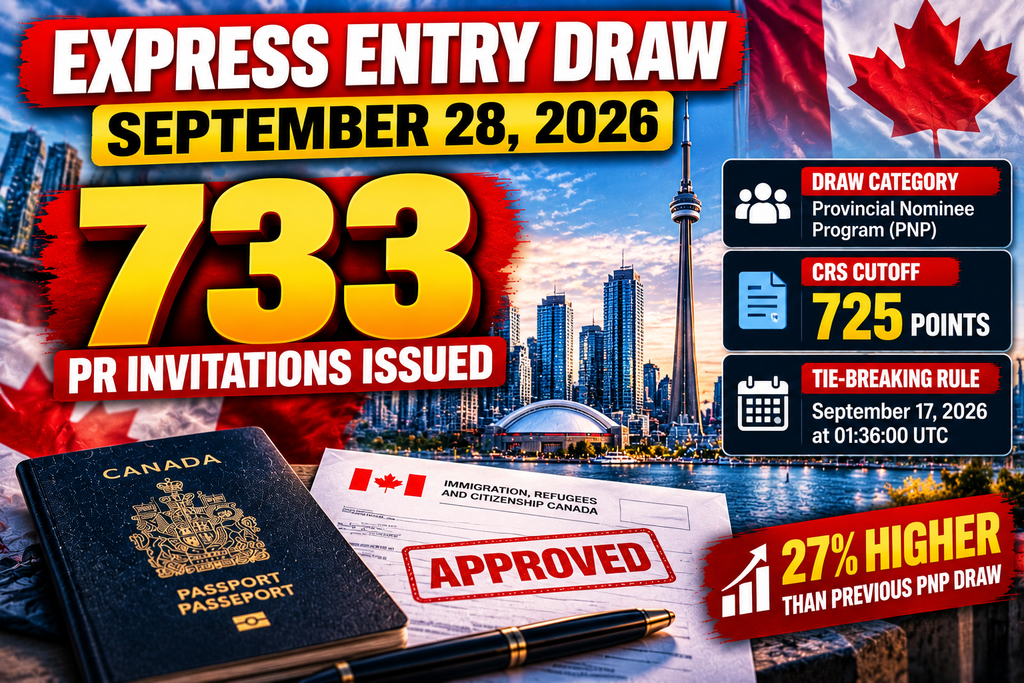
Canada held a new Provincial Nominee Program (PNP) Express Entry draw on September 28, 2026, issuing 733 Invitations to Apply (ITAs) for permanent residence to candidates with valid provincial nominations.
The September 28 Express Entry draw recorded a minimum Comprehensive Ranking System (CRS) score of 725 points, nine points lower than the 734-point cutoff in the September 14 draw.
The latest round also saw a 27% increase in invitations compared with the previous PNP-specific draw, which issued 576 invitations. It was the largest PNP draw since June 22, 2026, when Immigration, Refugees and Citizenship Canada (IRCC) invited 955 candidates with a minimum CRS score of 730.
With this round, Canada has conducted 57 Express Entry draws in 2026, issuing approximately 129,715 invitations across all draw categories so far this year.
The September 28 Express Entry draw continues the pattern of PNP-specific selections during the second half of 2026, providing another opportunity for candidates who hold an eligible provincial nomination to apply for Canadian permanent residence.
September 28 Express Entry Draw: Complete Details
IRCC selected candidates from the Express Entry pool based on their CRS scores and the requirements of the Provincial Nominee Program category.
The following table summarizes the key details of the September 28 Express Entry draw.
| Draw Detail | Information |
|---|---|
| Draw date | September 28, 2026 |
| Draw category | Provincial Nominee Program (PNP) |
| Invitations issued | 733 |
| Minimum CRS score | 725 |
| Tie-breaking date and time | September 17, 2026, at 01:36:00 UTC |
| Immigration authority | Immigration, Refugees and Citizenship Canada (IRCC) |
Candidates needed a minimum CRS score of 725 to receive an invitation in this round.
However, candidates with exactly 725 points also had to meet the tie-breaking requirement. Their Express Entry profiles needed to have been submitted before September 17, 2026, at 01:36:00 UTC.
Candidates who scored above 725 points were not subject to the tie-breaking rule for this cutoff.
The September 28 Express Entry draw was specifically for candidates with provincial nominations and did not include candidates selected under the Canadian Experience Class or other category-based selection rounds.
What the CRS Cutoff of 725 Means for PNP Candidates
The CRS cutoff of 725 in the September 28 Express Entry draw reflects the additional points awarded to candidates who receive an eligible provincial nomination aligned with Express Entry.
Under the CRS system, an accepted Express Entry-linked provincial nomination adds 600 points to a candidate’s overall score.
This means a candidate with a base CRS score of 125 could reach 725 points after receiving the nomination bonus, provided they meet all applicable eligibility requirements.
How Provincial Nomination Points Work
The provincial nomination bonus significantly changes a candidate’s position in the Express Entry pool.
For example:
| CRS Component | Points |
|---|---|
| Base CRS score | 125 |
| Provincial nomination bonus | 600 |
| Total CRS score | 725 |
The September 28 Express Entry draw therefore primarily benefited candidates who had already secured a qualifying provincial nomination and met the requirements of the PNP-specific selection round.
Candidates should remember that receiving a nomination does not automatically guarantee permanent residence. They must still satisfy the applicable federal immigration requirements and submit a complete application after receiving an invitation.
How the September Cutoff Compares With Earlier Draws
The September 28 Express Entry draw recorded a cutoff of 725 points, down from 734 points in the September 14 PNP round.
The latest round also issued 733 invitations, compared with 576 in the previous draw.
The increase in invitation volume and the lower CRS threshold indicate a change in the selection parameters between the two rounds. However, the cutoff depends on the number and scores of eligible candidates in the pool, along with the number of invitations IRCC issues.
Latest Express Entry CRS Score Distribution
The CRS score distribution provides an overview of the number of candidates waiting in the Express Entry pool across different score ranges.
As of September 27, 2026, the pool contained 229,904 candidates, according to the figures provided for this update.
The table below shows the distribution before the September 28 Express Entry draw.
| CRS Score Range | Number of Candidates |
|---|---|
| 601–1,200 | 728 |
| 501–600 | 21,070 |
| 451–500 | 73,131 |
| 491–500 | 12,745 |
| 481–490 | 12,817 |
| 471–480 | 16,465 |
| 461–470 | 16,257 |
| 451–460 | 14,847 |
| 401–450 | 62,611 |
| 441–450 | 13,677 |
| 431–440 | 13,419 |
| 421–430 | 12,173 |
| 411–420 | 11,888 |
| 401–410 | 11,454 |
| 351–400 | 47,298 |
| 301–350 | 17,359 |
| 0–300 | 7,707 |
| Total | 229,904 |
The distribution shows that a substantial number of candidates were concentrated in the 451–500 CRS range.
Candidates without a provincial nomination generally need to qualify through other Express Entry selection categories, where the CRS cutoff and eligibility criteria can differ from those of PNP-specific rounds.
Note: The score ranges above are reproduced from the supplied figures. The overall ranges and their subcategories should not be added together because the narrower ranges are breakdowns of broader categories.
What Happens After Receiving an Invitation to Apply?
Candidates who received an invitation in the September 28 Express Entry draw have 60 calendar days to submit a complete permanent residence application through their Express Entry account.
The deadline is important because an invitation expires if the candidate does not submit the application within the specified period.
An expired invitation cannot be restored. Candidates generally need to create a new Express Entry profile to re-enter the pool, provided they remain eligible.
Documents Required for a Permanent Residence Application
Applicants should begin preparing their supporting documents as soon as they receive an invitation.
Depending on their circumstances and immigration program, the required documents may include:
- Proof of qualifying work experience.
- Valid language test results.
- Police certificates.
- Immigration medical examination results.
- Educational Credential Assessment (ECA), where required.
- Identity and civil status documents.
- Provincial nomination documentation.
- Supporting documents for accompanying family members.
Applicants relying on foreign education may need an ECA if they are using that education to qualify as the principal applicant under the Federal Skilled Worker Program or to claim CRS points for foreign education.
Police certificates are generally required for applicants and family members aged 18 or older for countries where they have lived for six consecutive months or longer during the past 10 years, excluding time spent in Canada.
The precise document requirements depend on the applicant’s circumstances and the instructions provided by IRCC.
Express Entry Permanent Residence Fees in 2026
Candidates invited through the September 28 Express Entry draw should account for government application fees and any additional expenses associated with supporting documents.
According to the fee figures provided for this article, the following charges apply from April 30, 2026.
| Fee Category | Amount |
|---|---|
| Adult processing fee | $990 |
| Right of permanent residence fee for an adult | $600 |
| Total for an adult applicant | $1,590 |
| Dependent child under 22 | $270 |
| Biometrics fee per individual | $85 |
| Maximum family biometrics fee | $170 |
The total for an adult applicant is $1,590, including the processing fee and the right of permanent residence fee.
Dependent children under 22 are charged $270 each, without a right of permanent residence fee.
Biometrics cost $85 per individual, up to a maximum of $170 per family.
These amounts do not include additional expenses such as medical examinations, police certificates, language testing, or educational credential assessments.
Applicants should confirm the applicable fees through IRCC before submitting their applications.
Express Entry PNP Processing Time and Bridging Open Work Permits
IRCC has a six-month service standard for Express Entry Provincial Nominee Program permanent residence applications.
However, the service standard is not a guarantee that every application will be finalized within six months. Actual processing times can vary depending on application volumes, annual admissions targets, background checks, security screening, and individual circumstances.
Candidates should check IRCC’s official processing-time tool for the latest estimate.
Can PNP Candidates Apply for a Bridging Open Work Permit?
Some candidates living in Canada may be eligible for a Bridging Open Work Permit (BOWP) while their permanent residence applications are being processed.
Eligibility depends on the applicant’s circumstances and the applicable immigration rules.
For Express Entry PNP applicants, the conditions described in the supplied information include:
- Being the principal applicant.
- Living in Canada and intending to reside outside Quebec.
- Having submitted a complete permanent residence application that passed the completeness check.
- Having received an acknowledgement of receipt.
- Having no employment restrictions attached to the provincial nomination.
Candidates whose work permits are approaching expiry should review the current BOWP requirements and determine whether they qualify before applying.
What the September 28 Express Entry Draw Means for Future Candidates
The September 28 Express Entry draw issued 733 invitations to provincial nominees at a CRS cutoff of 725, continuing the pattern of PNP-specific selections during the second half of 2026.
The draw also brought the annual number of Express Entry rounds to 57, with approximately 129,715 invitations issued across all categories.
For candidates who already hold a valid Express Entry-aligned provincial nomination, the additional 600 CRS points remain a significant component of their overall score.
Candidates who are still pursuing provincial nomination should monitor provincial immigration program announcements for changes to eligibility requirements, application windows, targeted occupations, and nomination availability.
Those who received an invitation in the latest round should prioritize gathering their documents and completing their permanent residence applications within the 60-day submission period.
The September 28 Express Entry draw provides another opportunity for provincial nominees to move forward with their Canadian permanent residence applications, while candidates who were not selected can continue monitoring upcoming rounds and provincial immigration pathways.
For further updates on Express Entry draws, provincial nominee programs, and Canadian immigration developments, follow Immigration News Canada.
FAQs : September 28 Express Entry Draw
1. How many invitations were issued in the September 28 Express Entry draw?
IRCC issued 733 Invitations to Apply in the September 28, 2026, Provincial Nominee Program Express Entry draw.
2. What was the CRS cutoff for the September 28 Express Entry draw?
The minimum CRS score was 725 points. Candidates with exactly 725 points also had to meet the tie-breaking rule.
3. What was the tie-breaking date for the September 28 PNP draw?
The tie-breaking timestamp was September 17, 2026, at 01:36:00 UTC. Candidates with exactly 725 CRS points needed to have submitted their profiles before that time.
4. Why are CRS cutoffs higher in PNP-specific Express Entry draws?
Candidates with an accepted Express Entry-aligned provincial nomination receive 600 additional CRS points. This significantly increases their overall score compared with candidates who do not have a provincial nomination.
5. How long do candidates have to apply after receiving an Express Entry invitation?
Candidates generally have 60 calendar days to submit a complete permanent residence application after receiving an invitation.
6. How much does an adult applicant pay for permanent residence through Express Entry in 2026?
Based on the supplied fee figures, the total is $1,590 per adult applicant, including a $990 processing fee and a $600 right of permanent residence fee. Additional expenses may apply.
7. Can candidates apply for a Bridging Open Work Permit after receiving a PNP invitation?
Some candidates may qualify, but receiving an invitation alone does not establish eligibility. Applicants must meet the applicable BOWP requirements, including the relevant permanent residence application and work permit conditions.
8. How many Express Entry draws have taken place in 2026?
The September 28 round brought the total to 57 Express Entry draws in 2026, according to the supplied information.
Final Takeaway On September 28 Express Entry Draw
The September 28, 2026, Express Entry PNP draw issued 733 invitations at a minimum CRS score of 725. The round saw more invitations and a lower cutoff than the September 14 draw.
Candidates who received an invitation should focus on submitting a complete permanent residence application within the 60-day deadline. Those still waiting for selection can monitor future Express Entry rounds and provincial nomination opportunities.
Source : Immigration News Canada
Read About : BC PNP Draw On September 24 2026: British Columbia Invites 714 Candidates for Permanent Residence

One thought on “September 28 Express Entry Draw: Canada Issues 733 PR Invitations at CRS 725”