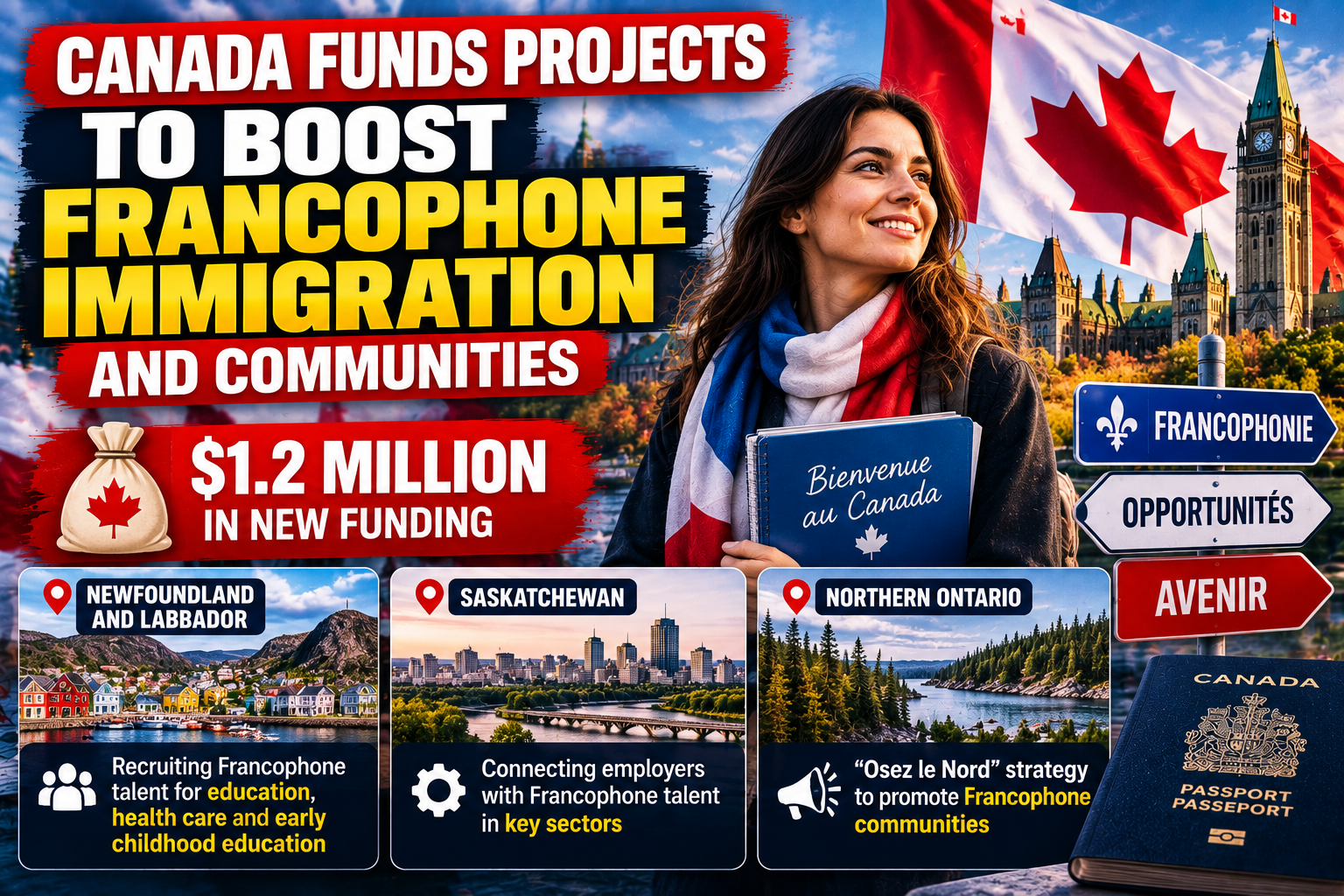
Francophone immigration in Canada is receiving new support as the federal government announces approximately $1.2 million in funding for projects designed to attract French-speaking and bilingual workers and strengthen Francophone minority communities outside Quebec.
The announcement was made on September 29, 2026, in St. John’s, Newfoundland and Labrador, by Immigration, Refugees and Citizenship Minister Lena Metlege Diab alongside Newfoundland and Labrador Minister of Jobs, Growth and Rural Development Lin Paddock.
The funding will support projects in Newfoundland and Labrador and Saskatchewan, while a separate promotional strategy in Northern Ontario will also move forward under the Francophone Immigration Support Program.
The initiatives are designed to connect international Francophone and bilingual talent with regional labour-market needs, improve access to French-language services and help Francophone communities attract and retain newcomers.
The federal government has identified Francophone immigration as an important part of efforts to support French-speaking communities outside Quebec. Under the Francophone Immigration Support Program (FISP), projects can focus on recruitment, promotion, collaborative selection, innovation and research. (Canada)
Canada Announces $1.2 Million for Francophone Immigration Projects
The approximately $1.2 million investment announced on September 29 will support two new projects funded through the Francophone Immigration Support Program.
The first project is being led by the Government of Newfoundland and Labrador, while the second is being delivered by the Conseil économique et coopératif de la Saskatchewan.
Both projects have a common objective: connect French-speaking and bilingual newcomers with communities and employers that need workers.
The investment comes as Canada continues efforts to increase the number of French-speaking permanent residents settling outside Quebec.
The federal government reported that French-speaking permanent residents represented about 8.9% of admissions outside Quebec in 2025, exceeding the target for that year. Canada has also set progressively higher targets for French-speaking permanent residents outside Quebec under its immigration planning framework. (Canada)
The latest initiatives therefore form part of a broader strategy rather than being standalone immigration programs.
Newfoundland and Labrador Project to Create a Francophone Talent Corridor
The Newfoundland and Labrador project is intended to create a more sustainable pathway for attracting Francophone and bilingual talent from overseas.
The project will focus on connecting international recruitment with the province’s population and labour-market requirements.
According to the announcement, targeted recruitment will focus on sectors including:
- Education
- Health care
- Early childhood education
The objective is not only to bring additional workers to the province but also to increase the availability of services in French.
More Francophone and bilingual workers in public and private-sector positions could help Francophone residents access services in their preferred official language.
The project reflects the broader role that Francophone immigration in Canada can play in addressing workforce shortages while supporting minority-language communities.
Newfoundland and Labrador is one of several provinces and territories outside Quebec where the federal government is supporting initiatives aimed at attracting and retaining French-speaking newcomers.
In July 2026, Canada also announced approximately $860,000 for a Francophone Immigration Support Program project in the Northwest Territories focused on retention, integration, foreign credential recognition and stronger employer participation. (Canada)
Saskatchewan Project Connects Francophone Workers With Labour-Market Needs
The second project is being led by the Conseil économique et coopératif de la Saskatchewan.
Its approach is designed to directly connect international Francophone talent with employers and labour-market needs in Saskatchewan.
The project will include several components intended to make recruitment and settlement easier.
These include:
- An interactive mapping platform.
- In-person and virtual recruitment activities.
- Assistance with recognition of academic credentials.
- Support related to professional certification examinations.
- Cultural transition workshops.
- Connections between international talent and Saskatchewan employers.
The project will focus on employers operating in sectors such as agriculture, health care, mining, energy, technology and hospitality.
This approach could help address two challenges at the same time: attracting workers for occupations facing labour shortages and strengthening Francophone communities through new immigration.
For employers, access to international Francophone and bilingual talent can expand recruitment options. For newcomers, better information about employment opportunities, credential recognition and community integration can make the transition to Saskatchewan easier.
Northern Ontario’s “Osez le Nord” Strategy Moves Forward
The September 29 announcement also included an update involving Northern Ontario.
The Carrefour francophone de Sudbury developed the “Osez le Nord” promotional strategy as part of a project funded during the first phase of the Francophone Immigration Support Program in 2025.
The strategy is intended to bring together stakeholders involved in Francophone immigration in Northern Ontario and promote the region as a destination for newcomers.
It will emphasize the opportunities available in Francophone communities across Northern Ontario while supporting the regionalization of immigration.
The initiative is significant because Canada’s Francophone immigration strategy is not limited to major urban centres.
Regional communities are increasingly being incorporated into efforts to attract and retain French-speaking and bilingual newcomers.
The federal government has previously expanded its Welcoming Francophone Communities initiative and has emphasized the role of communities outside Quebec in supporting settlement and retention. (Canada)
What Is the Francophone Immigration Support Program?
The Francophone Immigration Support Program (FISP) is a federal grants and contributions program administered through the Centre for Innovation in Francophone Immigration.
Its purpose is to strengthen the role of Francophone communities in Canada’s immigration system and support the attraction, recruitment and integration of French-speaking candidates outside Quebec.
The program operates through three main streams:
| FISP Stream | Main Focus |
|---|---|
| Collaborative selection projects | Increasing the number of French-speaking candidates |
| Promotion of Francophone minority communities abroad | Promoting Francophone communities to potential immigrants |
| Case studies, innovation and applied research | Identifying barriers and testing innovative approaches |
The program is intended to apply a stronger Francophone perspective throughout the immigration process and help address French-speaking and bilingual labour needs across Canada’s economy. (Canada)
The program is scheduled to operate through March 31, 2028, according to IRCC’s current transfer-payment information. (Canada)
Why Francophone Immigration Is Important Outside Quebec
Canada has Francophone and Acadian minority communities across the country, including in provinces and territories where French is not the majority language.
The federal government has identified demographic decline among some Francophone minority communities as an ongoing challenge.
IRCC says the Francophone Immigration Support Program is intended to help counter this trend by increasing the involvement of Francophone stakeholders and attracting French-speaking candidates to communities outside Quebec. (Canada)
Government documents indicate that close to one million Francophones live outside Quebec, representing approximately 3.5% of the population outside the province. The federal government has also identified restoring and increasing the demographic weight of Francophone minority communities as a long-term objective. (Canada)
Immigration can contribute to this objective by bringing new French-speaking residents to communities where population growth and labour-force expansion are priorities.
How Francophone Immigration Could Help Canada’s Labour Market
One of the main themes behind the new funding is the connection between immigration and labour-market requirements.
The projects announced in Newfoundland and Labrador and Saskatchewan are specifically linked to sectors requiring workers.
In Newfoundland and Labrador, the focus includes education, health care and early childhood education.
In Saskatchewan, the targeted sectors include agriculture, health care, mining, energy, technology and hospitality.
This means the projects are not simply focused on increasing the number of French-speaking newcomers. They are also designed around the needs of employers and regional economies.
This labour-market focus is an important component of Francophone immigration in Canada, particularly as smaller communities compete for skilled workers.
The federal Francophone Immigration Support Program specifically identifies French-speaking and bilingual labour needs as one of its objectives. (Canada)
Canada’s Broader Francophone Immigration Targets
The new funding comes as Canada continues to increase its targets for French-speaking permanent residents outside Quebec.
In January 2026, IRCC announced that Canada had reached approximately 8.9% French-speaking permanent resident admissions outside Quebec in 2025, exceeding its target for the fourth consecutive year.
The government said its 2026–2028 Immigration Levels Plan would continue increasing the targets, with French-speaking permanent residents outside Quebec targeted at 9% in 2026, 9.5% in 2027 and 10.5% in 2028. (Canada)
The government has also indicated that, beginning in 2026, 5,000 federal selection spaces would be reserved to allow provinces and territories to designate French-speaking immigrants, in addition to annual Provincial Nominee Program allocations. (Canada)
These measures demonstrate that Francophone immigration in Canada is being addressed through multiple parts of the immigration system rather than a single pathway.
Does This Create a New Immigration Program for Francophone Applicants?
No.
The $1.2 million announcement does not create a new permanent residence program that applicants can directly apply to.
Instead, the funding supports organizations, governments and community partners working on recruitment, promotion, selection and integration initiatives.
French-speaking candidates may already have access to various federal and provincial immigration pathways depending on their qualifications and circumstances.
For example, Canada has a French-language proficiency category within Express Entry, while the Francophone Mobility program can facilitate work permits for eligible French-speaking workers outside Quebec.
The new projects are intended to strengthen the ecosystem around these and other immigration pathways rather than replace them.
Applicants should therefore check the eligibility requirements of the specific immigration program they intend to use rather than assuming that participation in a funded project guarantees permanent residence.
What the New Projects Mean for Prospective Francophone Immigrants
For prospective newcomers, the projects could provide more targeted information and recruitment opportunities in participating regions.
Potential benefits include better information about:
- Local employment opportunities.
- Employers seeking Francophone and bilingual workers.
- Credential recognition.
- Professional certification.
- Regional settlement opportunities.
- Community services.
- Cultural integration.
- Immigration pathways.
However, the projects do not guarantee a job offer, provincial nomination or permanent residence.
Applicants must continue meeting the eligibility criteria of the applicable immigration program.
The emphasis on regional recruitment may nevertheless make communities in Newfoundland and Labrador, Saskatchewan and Northern Ontario more visible to French-speaking candidates considering immigration destinations outside Quebec.
Canada Continues Expanding Francophone Immigration Initiatives
The September 29 announcement follows several other federal initiatives supporting Francophone immigration in Canada during 2026.
In July, Canada announced approximately $1.3 million for a Manitoba project designed to grow the province’s Francophone population through promotional initiatives, digital solutions, research and support for foreign credential recognition. (Canada)
Earlier in March, the federal government announced approximately $1.5 million for three new projects under the Francophone Immigration Support Program. That announcement also highlighted Canada’s 2025 achievement of admitting approximately 8.9% French-speaking permanent residents outside Quebec. (Canada)
The sequence of announcements indicates that federal support is being distributed across multiple provinces and territories rather than concentrated in a single region.
What Francophone Immigrants Should Watch Next
People considering Francophone immigration in Canada should continue monitoring official federal and provincial immigration announcements.
Important areas to watch include:
- Express Entry French-language category — French-language ability can be relevant to category-based selection where candidates meet the applicable requirements.
- Francophone Mobility — eligible French-speaking workers may have access to a work-permit pathway outside Quebec.
- Provincial immigration programs — provinces can establish their own selection criteria and recruitment initiatives.
- Regional recruitment projects — funded initiatives may create additional employment and information opportunities.
- Credential recognition — applicants in regulated occupations should understand provincial requirements before relocating.
- Settlement services — newcomers should identify available French-language settlement and community resources before arrival.
Immigration programs, eligibility criteria and application procedures can change, so candidates should verify current requirements through official government sources before making immigration decisions.
FAQs : Francophone Immigration in Canada
What is the latest funding for Francophone immigration in Canada?
The federal government announced approximately $1.2 million on September 29, 2026, for new projects supporting Francophone immigration and Francophone minority communities in Newfoundland and Labrador and Saskatchewan.
Which provinces are receiving funding under the latest announcement of Francophone Immigration in Canada?
The two newly announced projects are in Newfoundland and Labrador and Saskatchewan. The announcement also included the implementation of the “Osez le Nord” promotional strategy in Northern Ontario.
What is the Francophone Immigration Support Program?
The Francophone Immigration Support Program is a federal grants and contributions program that supports projects designed to attract French-speaking candidates, promote Francophone minority communities and develop innovative approaches to Francophone immigration. (Canada)
Does the $1.2 million investment provide direct immigration grants to applicants?
No. The funding supports projects and organizations rather than providing direct immigration grants to individual applicants.
Which industries are targeted by the Saskatchewan project?
The Saskatchewan initiative will target employers in sectors including agriculture, health care, mining, energy, technology and hospitality.
Which occupations are targeted in Newfoundland and Labrador?
The Newfoundland and Labrador project specifically identifies education, health care and early childhood education as key sectors for overseas recruitment.
Does speaking French guarantee Canadian permanent residence?
No. French-language ability can support eligibility under certain immigration pathways, but applicants must meet all requirements of the specific program through which they apply.
What are current Francophone Immigration in Canada targets?
Under the 2026–2028 Immigration Levels Plan, Canada has targets of 9% in 2026, 9.5% in 2027 and 10.5% in 2028 for French-speaking permanent residents outside Quebec. (Canada)
Final Takeaway On Francophone Immigration in Canada
Canada is putting approximately $1.2 million into new initiatives designed to strengthen Francophone immigration in Canada, with projects focused on Newfoundland and Labrador and Saskatchewan and a separate promotional strategy advancing in Northern Ontario.
The Newfoundland and Labrador initiative will focus on overseas recruitment for sectors such as education, health care and early childhood education, while Saskatchewan’s project will connect international Francophone talent with employers in agriculture, health care, mining, energy, technology and hospitality.
The initiatives form part of a wider federal strategy to attract and retain French-speaking and bilingual newcomers outside Quebec and support the long-term vitality of Francophone minority communities.
For prospective French-speaking immigrants, the developments highlight the growing role of regional communities, targeted recruitment and French-language immigration pathways within Canada’s broader immigration system.
Source : Mirage News
Read About : September 28 Express Entry Draw: Canada Issues 733 PR Invitations at CRS 725