
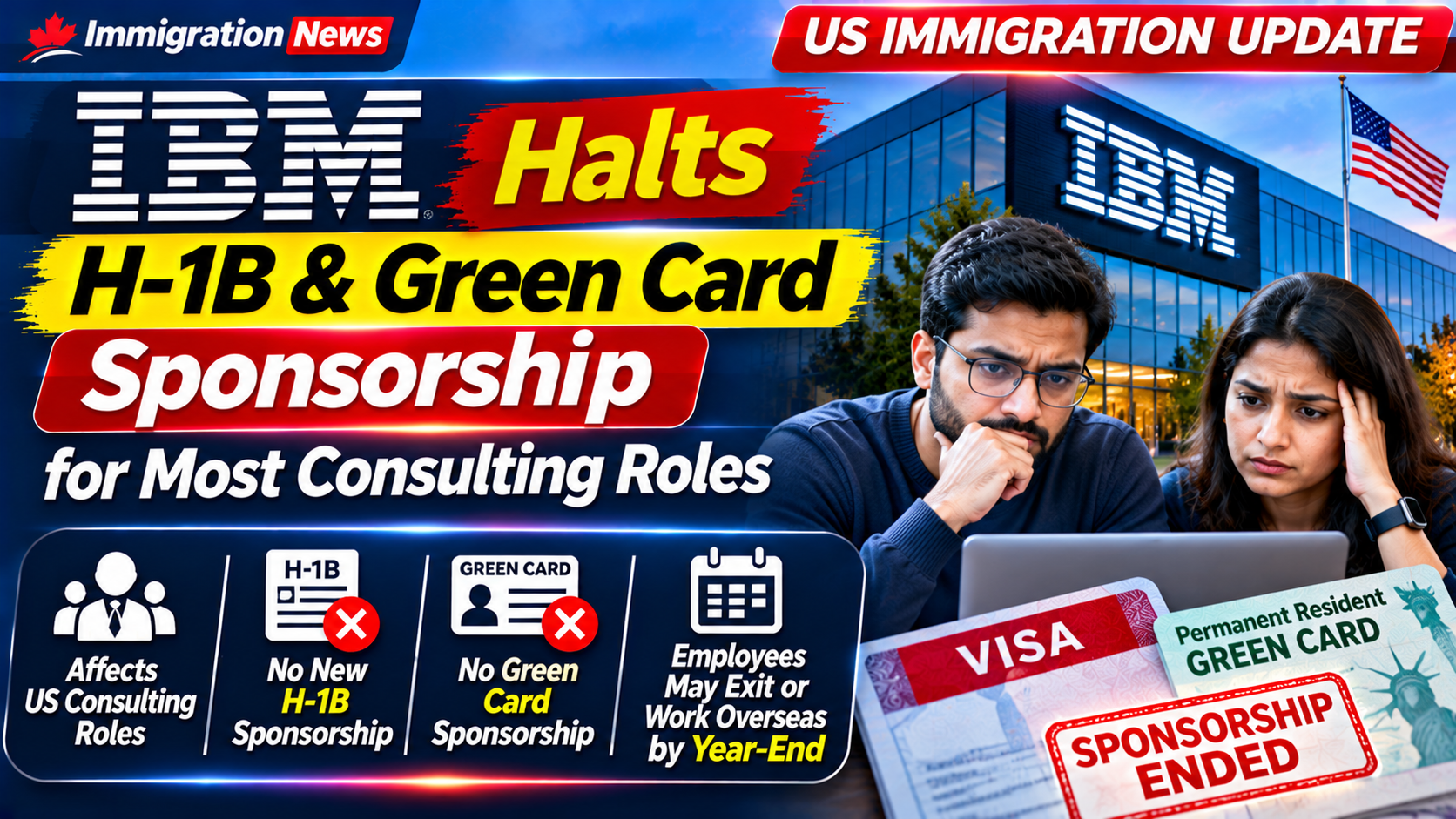
IBM H-1B visa sponsorship is coming to an end for the majority of roles within the technology company’s US consulting business, marking a significant change for foreign professionals seeking long-term employment and permanent residency in America.
IBM confirmed that it will discontinue H-1B visa and employment-based green card sponsorship for most positions in IBM Consulting. The decision could affect immigrant employees who depend on the company for continued work authorisation or employer-supported permanent residency.
According to a report by Bloomberg, affected employees have been given two options: continue working for IBM from outside the United States or leave the company by the end of 2026.
The announcement comes amid increased scrutiny of employer-sponsored immigration under the Trump administration, particularly the H-1B visa programme and the PERM labour certification process.
For Indian technology professionals working in the United States, the development raises important questions about employment continuity, visa transfers and future green card applications.
IBM H-1B Visa Sponsorship: What Has the Company Announced?
IBM has confirmed that it will discontinue visa and green card sponsorship for the majority of roles within its US consulting division.
An IBM spokesperson explained that the company had historically participated in high-skilled visa programmes to address skill shortages. However, its participation had been declining for several years.
The company attributed the decision to changing skill availability and evolving client requirements.
The announcement covers two important immigration processes:
- H-1B visa sponsorship: Employer sponsorship that allows eligible foreign professionals to work in specialised occupations in the United States.
- PERM labour certification: An important first step in many employer-sponsored employment-based green card applications.
The decision is focused on IBM Consulting rather than an announcement that IBM is ending immigration sponsorship across every business unit.
IBM Consulting employs more than 150,000 people, making it one of the company’s largest business divisions.
According to Bloomberg, employees affected by the decision may continue working for IBM outside the United States or leave the company by the end of the year.
Which IBM Employees Could Be Affected By IBM H-1B Visa Sponsorship?
The change in IBM H-1B visa sponsorship could affect immigrant professionals in US consulting roles who rely on the company for work visa sponsorship or permanent residency support.
Potentially affected employees include:
- Existing H-1B visa holders working in IBM Consulting.
- Employees expecting IBM to sponsor future H-1B petitions.
- Foreign professionals planning to begin the employment-based green card process.
- Employees whose PERM labour certification cases have not yet been completed.
- Workers relying on continued employer sponsorship to maintain their long-term US employment plans.
However, IBM has not publicly released a complete list of affected job titles, employees or exemptions.
It is also unclear how the company will handle every existing H-1B case or green card application already in progress.
The announcement should therefore not be interpreted as confirmation that every foreign employee at IBM will lose their job or immigration status.
The policy concerns sponsorship for the majority of roles in IBM Consulting, and individual outcomes may depend on an employee’s position, immigration status and any alternative arrangements offered by the company.
What Happens to Existing IBM H-1B Visa Holders?
One of the biggest concerns surrounding the IBM H-1B visa sponsorship decision is the future of employees who are already working in the United States on employer-sponsored visas.
According to Bloomberg, affected workers have been given the option of continuing their employment with IBM outside the United States or leaving the company by the end of 2026.
However, the company has not publicly clarified every possible arrangement for existing visa holders.
An H-1B visa is employer-specific in the sense that a worker’s authorised employment is tied to the sponsoring employer and the terms of the approved petition.
If IBM stops sponsoring an employee’s future H-1B employment, the employee may need to explore other options, depending on their circumstances.
These could include:
- Changing employers: Finding another US employer willing to sponsor an H-1B petition.
- H-1B portability: Eligible workers may be able to begin employment with a new qualifying employer after the required petition is properly filed.
- Working outside the United States: Continuing employment with IBM from another country, if the company offers an appropriate arrangement.
- Exploring another immigration category: Assessing whether another employment-based or family-based immigration option is available.
Employees should not assume that an internal transfer or a new job offer automatically resolves their immigration situation. They should obtain individual immigration advice and confirm the relevant filing requirements and deadlines.
IBM Also Ends PERM and Green Card Sponsorship for Most Consulting Roles
The decision involving IBM H-1B visa sponsorship also affects employer-supported green card applications.
IBM has indicated that it will discontinue green card sponsorship for the majority of roles in its consulting business.
Many employment-based green card cases begin with the PERM labour certification process, administered by the US Department of Labor.
Under the PERM process, an employer generally must demonstrate that there are not sufficient available, qualified and willing US workers for the offered position and that employing the foreign worker will not adversely affect the wages and working conditions of similarly employed US workers.
The process normally involves several stages:
PERM labour certification
The employer conducts the required recruitment process and submits a labour certification application to the Department of Labor.
Immigrant petition
After PERM approval, the employer generally files an employment-based immigrant petition, such as Form I-140, where required.
Green card application
The foreign worker may then proceed with the final permanent residence stage when eligible, depending on visa availability and their circumstances.
By discontinuing PERM sponsorship for most consulting roles, IBM could prevent affected employees from beginning new employer-supported green card cases through those positions.
The impact on existing cases will depend on their individual stage and the company’s handling of applications already in progress.
Employees should obtain confirmation directly from IBM and qualified immigration counsel rather than assuming that all pending cases have automatically been cancelled.
IBM’s H-1B Visa Activity Compared with Other Technology Companies
Despite the latest sponsorship decision, IBM has historically participated in US high-skilled immigration programmes.
According to the figures cited in the supplied report, IBM submitted more than 1,100 H-1B visa applications during fiscal year 2026, which ended on September 30.
However, this figure should be understood in the context of the company’s overall immigration activity and should not be treated as the number of employees affected by the new policy.
Other major technology companies have reported substantially higher H-1B petition activity.
| Technology company | H-1B activity cited in the report |
|---|---|
| IBM | More than 1,100 applications |
| Amazon | More than 13,715 applications by Q3 FY2026 |
| Apple | Approximately four times IBM’s reported figure |
| Meta | Approximately four times IBM’s reported figure |
| Microsoft | Approximately four times IBM’s reported figure |
These figures are not necessarily directly comparable because reporting periods and petition categories can differ. H-1B filings may include new employment, extensions and amendments.
Nevertheless, they provide context for the scale of IBM’s participation in the employer-sponsored visa system.
Trump Administration Increases Scrutiny of H-1B and Green Card Sponsorship
The IBM H-1B visa sponsorship announcement comes during a period of increased federal scrutiny of employment-based immigration.
The Trump administration has taken several steps affecting employers that recruit foreign professionals through H-1B visas and employment-based green card programmes.
The H-1B programme allows US employers to hire foreign nationals in specialised occupations requiring specialised knowledge and, generally, a bachelor’s degree or its equivalent in a directly related field.
An H-1B visa is generally granted for an initial period of up to three years and may be extended, typically to a maximum of six years, subject to applicable exceptions.
Employers seeking to retain foreign employees permanently often use the employment-based green card process, which can involve PERM labour certification.
Recent government actions and policy changes have increased the compliance burden for employers and raised concerns among foreign professionals.
PERM programme scrutiny
In October 2026, the administration announced enforcement action involving Microsoft, Adobe and several major outsourcing companies over alleged misuse of the PERM labour certification system.
The affected companies reportedly included Cognizant, Infosys and Tata Consultancy Services.
The government raised concerns about recruitment practices and whether certain employers had complied with requirements intended to protect US workers.
Higher scrutiny of H-1B petitions
The administration has also introduced changes and proposed measures affecting H-1B applications, including a $100,000 payment requirement for certain new petitions.
The applicability of such measures depends on the relevant rules, exceptions and legal developments.
These broader policy changes have created additional uncertainty for companies that depend on international talent.
However, IBM has not been publicly identified in the supplied reports as one of the companies suspended from PERM processing over alleged violations.
Its decision has been attributed by the company to changing skill availability and client requirements.
What Should Indian Professionals Working at IBM Do Now?
The IBM H-1B visa sponsorship decision is particularly important for Indian professionals because many foreign technology workers rely on employer-sponsored immigration to continue their US careers.
Employees who may be affected should avoid making decisions based only on media reports.
Instead, they should take the following steps:
- Confirm whether your position is affected: Ask IBM HR or the immigration team for written clarification about your role and sponsorship eligibility.
- Review your H-1B status: Check your current petition validity, I-94 record and any applicable deadlines.
- Understand your green card stage: Confirm whether your case is at the PERM, I-140 or adjustment-of-status stage.
- Explore employer transfer options: If necessary, identify prospective employers willing to sponsor your continued employment.
- Review dependent family members’ status: Check whether a change in your employment or immigration status could affect your spouse or children.
- Seek legal advice: Consult a qualified US immigration attorney before resigning, relocating or making changes to your employment arrangements.
Employees with pending green card cases should also ask whether any employer-specific steps are required to preserve their existing immigration options.
Will IBM Employees Have to Leave the United States by December 2026?
Not necessarily every affected employee will have the same outcome.
Bloomberg reported that employees impacted by the policy could continue working for IBM outside the United States or leave the company by the end of 2026.
However, the report does not establish that every foreign employee must leave the country on a single date.
The actual immigration consequences will depend on the employee’s current visa status, employment arrangements, eligibility for another employer-sponsored petition and any applicable grace periods or other immigration provisions.
An employee whose employment ends may have a limited period to take appropriate action, depending on their immigration circumstances. The commonly applicable H-1B grace period can be up to 60 consecutive calendar days or until the end of the authorised validity period, whichever is shorter, subject to the relevant rules.
Workers should not treat the grace period as an automatic extension of work authorisation.
FAQs : IBM H-1B Visa Sponsorship
Is IBM ending H-1B visa sponsorship?
IBM has announced that it will discontinue H-1B visa sponsorship for the majority of roles in its US consulting division. The announcement does not establish that sponsorship is ending across every IBM business unit.
Is IBM also stopping green card sponsorship?
Yes. IBM has confirmed that it will discontinue green card sponsorship for the majority of roles in IBM Consulting, including the associated PERM process.
Will existing IBM H-1B employees lose their jobs?
Not automatically. Bloomberg reported that affected employees may continue working for IBM outside the United States or leave the company by year-end. Individual arrangements may differ.
What happens to IBM employees with pending PERM applications?
IBM has not publicly clarified the treatment of every pending PERM case. Employees should obtain written confirmation from the company and consult an immigration attorney about their individual circumstances.
Can an IBM H-1B employee transfer to another company?
Eligible H-1B workers may be able to change employers through the H-1B portability process if the statutory and filing requirements are met. A new employer must take the required immigration steps.
Does IBM’s decision affect all Indian employees?
No. The announcement concerns sponsorship for the majority of roles in IBM Consulting. It does not establish that every Indian employee or every foreign worker at IBM is affected.
Why is IBM stopping sponsorship?
IBM said its participation in high-skilled visa programmes had been declining for several years and that changing skill availability and client needs influenced the decision.
Conclusion On IBM H-1B Visa Sponsorship
The decision to discontinue IBM H-1B visa sponsorship for most US consulting roles represents a significant development for foreign technology professionals relying on employer-sponsored immigration.
The change also affects the company’s green card sponsorship approach, potentially disrupting the long-term immigration plans of employees who were expecting IBM to support their PERM applications.
Although IBM has offered affected workers the possibility of continuing employment outside the United States or leaving the company by year-end, important questions remain about existing visa holders and pending green card cases.
For Indian professionals working in IBM Consulting, the immediate priority should be to confirm their individual sponsorship status, understand their immigration timelines and explore alternative options before making employment or relocation decisions.
The development also highlights the growing uncertainty surrounding employer-sponsored immigration in the US technology sector.
Source : India Today
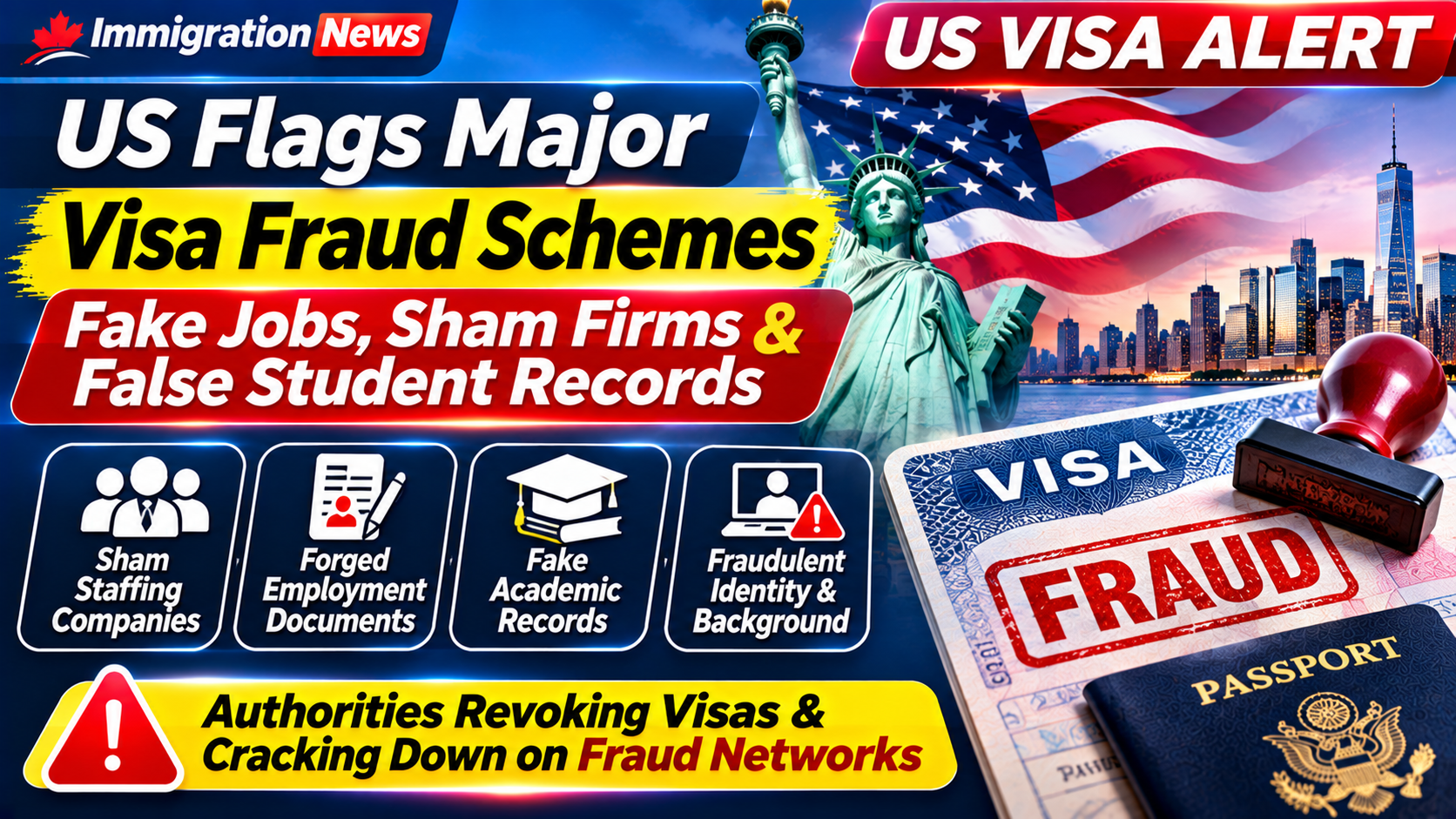
Read About : US Visa Fraud Schemes 2026: State Department Warns of Fake Staffing Firms and Student Records


One thought on “IBM H-1B Visa Sponsorship Ends for Most Consulting Roles: Green Card Support Also Discontinued”