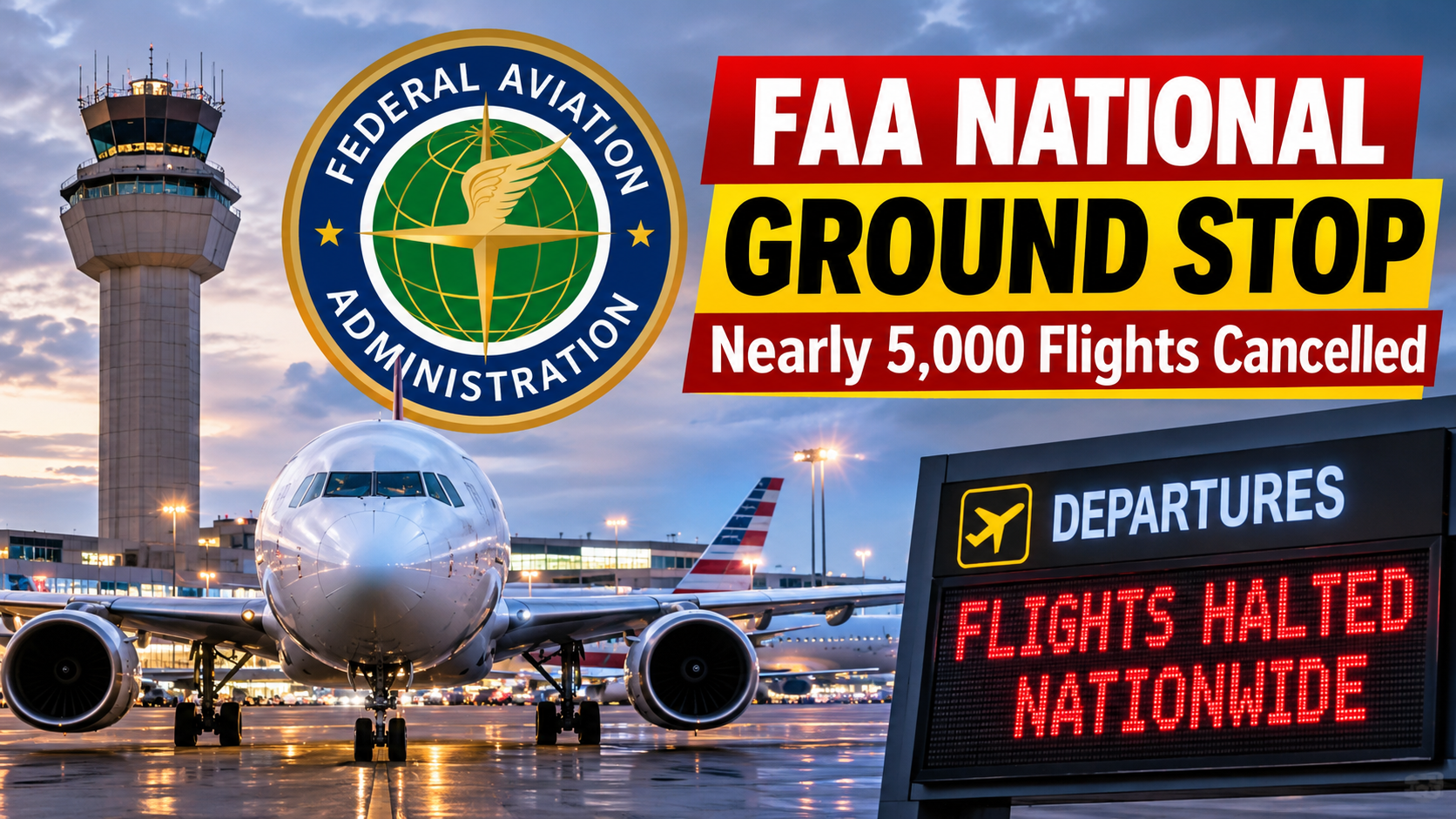
A rare FAA national ground stop disrupted air travel across the United States on November 13, 2026, forcing airlines to halt departures at airports nationwide after communication problems affected multiple Federal Aviation Administration (FAA) Air Route Traffic Control Centers. Thousands of passengers faced cancellations, delays and uncertainty as aircraft remained on the ground.
The nationwide restriction lasted approximately four and a half hours before the FAA lifted it at around 8:15 p.m. Eastern Time. However, ending the ground stop did not immediately restore normal flight operations. Airlines warned that disruptions could continue as they worked to reposition aircraft and crews and accommodate stranded passengers.
The incident also attracted attention because it occurred just days after the FAA expanded its new artificial intelligence-assisted SMART system to all 22 air route control centers. Although the timing raised questions, the system’s developer denied that its technology was responsible for the disruption.
What Happened During the FAA National Ground Stop?
The FAA national ground stop was ordered on Friday, November 13, following communication problems affecting multiple Air Route Traffic Control Centers across the country.
The FAA initially said that the nationwide restriction was necessary because of extraordinary circumstances and safety concerns. The agency’s technicians began investigating the issue while airlines and airport authorities worked to manage the disruption.
At Seattle-Tacoma International Airport, an air traffic controller informed a Southwest Airlines pilot that a nationwide ground stop was in effect for all aircraft, with no confirmed update time.
The message reflected the uncertainty facing pilots and airport operations teams as the disruption spread across the aviation network.
The FAA’s decision meant that departing aircraft had to remain grounded until further instructions were issued. Flights already airborne were generally allowed to continue, while international arrivals and certain other operations were handled on a case-by-case basis.
Why Did the FAA Stop Flights Nationwide?
The initial explanation from the FAA pointed to communication problems affecting air traffic control facilities.
Transportation Secretary Sean Duffy later said that the disruption involved ageing legacy equipment that became overloaded during an upgrade process. He described the affected infrastructure as an older, analogue system and said that newly deployed equipment had not gone down.
The communication network is essential to the safe operation of the US aviation system. Air Route Traffic Control Centers manage aircraft travelling between airports, helping controllers coordinate routes and maintain safe separation between planes.
If critical information cannot reliably reach the appropriate facilities, controllers may not have the information needed to manage aircraft movements safely.
Officials therefore considered stopping departures a necessary precaution rather than allowing flights to continue under uncertain operating conditions.
Homeland Security Secretary Markwayne Mullin said there was no evidence at that stage that the incident was caused by a cyberattack. However, officials said the investigation was continuing.
FAA National Ground Stop: How Many Flights Were Affected?
The disruption created significant problems for airlines and passengers across the country.
Flight-tracking estimates reported by major news organisations indicated that the incident resulted in nearly 5,000 flight cancellations and more than 10,000 delays on Friday.
Some of the busiest airports experienced particularly severe disruption.
| Airport | Reported cancellations |
|---|---|
| Chicago O’Hare International Airport | 722 |
| Hartsfield-Jackson Atlanta International Airport | 691 |
| Dallas/Fort Worth International Airport | 491 |
| Washington Dulles International Airport | 240 |
These figures were reported during the disruption and may vary depending on the flight-tracking source and reporting time.
The impact was not limited to passengers whose flights were directly stopped. Once aircraft and crew members were left in the wrong locations, airlines faced additional operational challenges even after the FAA lifted the restriction.
Did the New FAA AI SMART System Cause the Ground Stop?
The timing of the incident raised questions about the FAA’s recently expanded artificial intelligence-assisted air traffic management technology.
On November 10, the FAA announced that its Strategic Management of Airspace, Routes and Trajectories (SMART) system was expanding from its initial Washington-area rollout to the airspace managed by all 22 Air Route Traffic Control Centers.
The expansion came just three days before the nationwide disruption.
However, there was no confirmed evidence establishing that SMART caused the outage.
Air Space Intelligence (ASI), the company behind the technology, publicly denied that its system was involved in the ground stop. The company said the disruption was not caused by SMART, its products or its integration with the FAA and air traffic control operations.
Transportation officials also said that the failure involved legacy equipment, while the investigation continued.
What Is the FAA SMART System?
SMART is an AI-assisted system designed to help the FAA manage air traffic more efficiently.
The platform brings together approximately 200 data streams, including:
- Weather patterns and forecasts.
- Aircraft flight paths.
- Air traffic flow information.
- Controller staffing metrics.
- Other operational information used for traffic planning.
FAA specialists analyse and validate the information before providing scheduling recommendations to the agency’s Air Traffic Control System Command Center. The recommendations are then sent to air traffic control facilities for local leadership to consider.
The agency says the technology is intended to reduce flight delays, lower fuel consumption and improve the travel experience.
According to the FAA, since the system began operating on September 21, it had helped reroute 180 flights, saved an average of 10 minutes per flight and reduced fuel consumption by almost 80 gallons per flight.
The SMART programme is part of a broader $875 million, 12-year software and AI contract awarded to ASI in June 2026.
Why Did US Lawmakers Raise Safety Concerns About SMART?
The expansion of AI-assisted technology in air traffic management has also attracted scrutiny from lawmakers.
In early October 2026, a group of Democratic members of the US House and Senate sent a letter to the FAA asking the agency to pause the tool’s use until questions about safety testing, implementation and oversight were addressed.
Their concerns focused on the potential consequences of introducing AI-enabled tools into a safety-critical aviation environment without sufficient transparency about how the technology was tested and how its recommendations would be evaluated.
The FAA has described SMART as a tool that provides recommendations to aviation authorities. Its stated purpose is to support operational planning and help controllers manage traffic more effectively.
The November 13 outage does not, by itself, establish that the technology is unsafe or responsible for the disruption. Any conclusions about a connection would require evidence from the ongoing technical investigation.
How Does the 2026 Ground Stop Compare With the 2023 FAA Outage?
The November 2026 disruption brought back memories of another nationwide aviation shutdown on January 11, 2023.
On that occasion, the FAA’s Notice to Air Missions (NOTAM) system, which distributes important safety information to pilots and flight dispatchers, became unavailable.
The agency temporarily stopped departing flights while technicians worked to restore the system.
The 2023 shutdown lasted approximately two hours and resulted in more than 1,300 flight cancellations and nearly 10,000 delays.
The FAA later attributed the problem to contract workers who accidentally deleted files while working on the primary and backup databases.
Although both incidents resulted in nationwide flight restrictions, the underlying problems were different.
| Detail | January 2023 outage | November 2026 outage |
|---|---|---|
| Main system affected | NOTAM system | Air traffic control communications |
| Reported problem | Critical files were accidentally deleted | Communication problems involving legacy equipment |
| Nationwide restriction | Approximately two hours | Approximately four and a half hours |
| Reported cancellations | More than 1,300 | Nearly 5,000 |
| Reported delays | Nearly 10,000 | More than 10,000 |
The comparison highlights the importance of reliable technology and communication infrastructure in managing US air traffic.
What Should Passengers Do After the FAA National Ground Stop?
Although the FAA lifted the restriction on November 13, passengers should not assume that all flights immediately returned to their normal schedules.
Airlines needed time to reposition aircraft, arrange crew availability and accommodate passengers affected by cancellations.
Travellers with upcoming domestic or international flights should:
- Check their flight status directly through their airline’s website or mobile application.
- Confirm departure times before travelling to the airport.
- Review airline rebooking policies and travel waivers.
- Keep notifications enabled for schedule changes.
- Contact the airline if their flight is cancelled or significantly delayed.
- Avoid relying only on airport departure boards or third-party flight-tracking services.
Passengers should also check whether their airline has issued additional flexibility for affected bookings.
What the Incident Means for the Future of US Air Traffic Control
The November 2026 disruption has renewed attention on the condition of America’s air traffic control infrastructure.
The FAA is pursuing a broader modernisation programme to replace ageing communications, surveillance, weather and air traffic management systems.
A September 2026 Government Accountability Office report highlighted challenges in the agency’s modernisation plans, including incomplete cost estimates, scheduling issues and the risks of continuing to rely on outdated technology.
The report noted that ageing systems and maintenance difficulties could contribute to further delays and aviation safety risks if modernisation efforts do not progress effectively.
The latest FAA national ground stop demonstrates why dependable communication infrastructure remains essential, even as the agency introduces newer digital and AI-assisted tools.
The investigation into the November outage will be important in determining precisely what failed and what corrective measures are needed. For passengers, airlines and aviation professionals, the priority will be ensuring that the systems supporting the country’s airspace remain reliable.
FAQs : FAA National Ground Stop
Was the FAA national ground stop lifted?
Yes. The FAA lifted the nationwide ground stop at approximately 8:15 p.m. Eastern Time on November 13, 2026, after around four and a half hours.
Why did the FAA issue a nationwide ground stop?
The FAA initially cited communication problems affecting multiple Air Route Traffic Control Centers. Transportation Secretary Sean Duffy later said ageing legacy equipment had become overloaded during an upgrade process.
Did the FAA’s SMART AI system cause the flight disruption?
No confirmed evidence established that SMART caused the outage. Air Space Intelligence, the system’s developer, denied any involvement, while officials said the failure concerned legacy equipment and continued investigating.
How many flights were cancelled during the November 2026 ground stop?
Nearly 5,000 flights were reported cancelled, while more than 10,000 experienced delays. Figures varied by reporting time and flight-tracking source.
Was this the first nationwide FAA ground stop?
No. The United States experienced another nationwide ground stop on January 11, 2023, following an outage affecting the NOTAM system. The November 2026 incident was another major nationwide aviation disruption.
Will flights remain delayed after the ground stop is lifted?
Yes, some disruption can continue after restrictions are removed. Airlines may need time to reposition aircraft, restore crew schedules and rebook affected passengers.
Conclusion On FAA National Ground Stop
The November 13 FAA national ground stop exposed the operational risks associated with ageing air traffic control infrastructure in the United States. Although the restriction was lifted after approximately four and a half hours, thousands of cancellations and delays created disruption that continued beyond the initial shutdown.
The timing of the incident raised questions about the FAA’s newly expanded SMART AI system, but no confirmed evidence linked the technology to the outage. The investigation and the agency’s wider modernisation efforts will be important in determining how similar disruptions can be prevented.
For passengers, the key lesson is to check directly with airlines for updated flight information, even after a nationwide ground stop has officially ended.
Source : The Washington Post
Read About : Dignity Act Immigration Reform: Veronica Escobar Plans to Reintroduce Bipartisan Bill in 2027