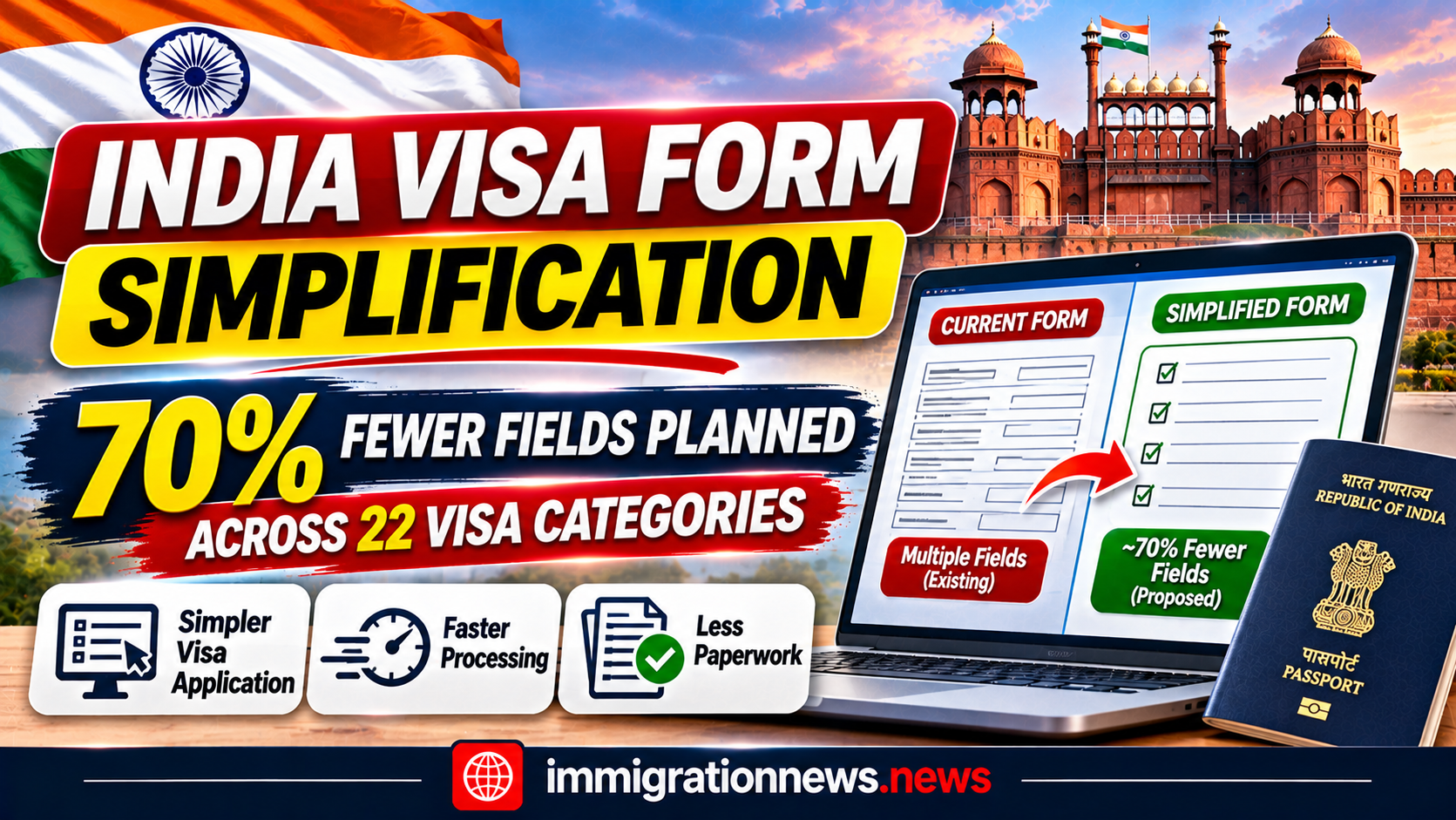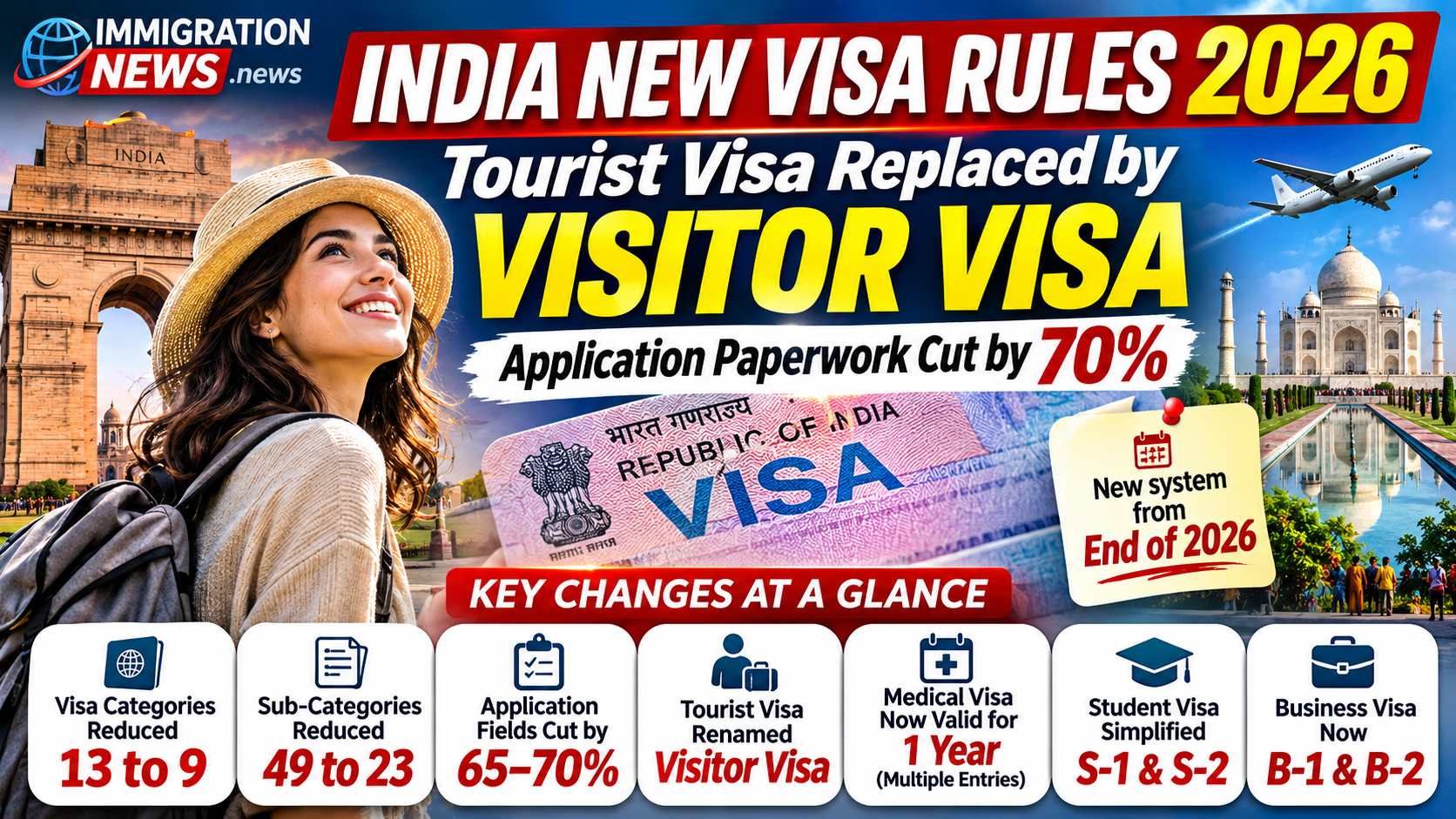
India has announced a major overhaul of its visa system, introducing significant changes for foreign tourists, international students, medical travellers and business professionals. Under the India New Visa Rules 2026, the government has reduced the number of main visa categories from 13 to nine and sub-categories from 49 to 23, while cutting the number of fields in visa application forms by 65% to 70%.
One of the most notable changes is the renaming of the existing Tourist Visa as the Visitor Visa, which will cover a wider range of activities, including short-term business meetings, medical consultations, wellness retreats and cultural programmes.
The revised framework also introduces longer-validity medical visas, reorganised student visa categories and clearer provisions for foreign professionals working with Indian companies.
According to the Ministry of Home Affairs (MHA), the changes are intended to simplify visa applications, reduce overlapping categories and encourage foreign nationals to visit India for tourism, education, healthcare and business.
Although the revised framework was rationalised on August 27, 2026, the government is upgrading its technology systems, with visa issuance under the new framework expected to begin by the end of 2026.
What Are the India New Visa Rules 2026?
The India New Visa Rules 2026 represent a significant restructuring of the country’s existing immigration framework.
The government has consolidated several overlapping visa categories to make it easier for foreign nationals to identify the appropriate visa based on their purpose of travel.
The latest changes follow an earlier rationalisation exercise in October 2025, when India reduced its main visa categories from 22 to 13 and sub-categories from 63 to 49.
The latest revision has further reduced these numbers.
| Visa framework | Earlier | Revised |
|---|---|---|
| Main visa categories | 13 | 9 |
| Visa sub-categories | 49 | 23 |
| Application form fields | Existing requirements | Reduced by 65–70% |
| E-visa availability | 172 countries | 172 countries currently |
The Ministry of Home Affairs says the simplified application forms will retain essential information required for visa processing while reducing the amount of information applicants need to provide.
The objective is to make the application process more straightforward and improve administrative efficiency.
Tourist Visa Replaced by Visitor Visa Under New India Visa Rules
One of the biggest developments under the India New Visa Rules 2026 is the replacement of the traditional Tourist Visa with a broader Visitor Visa category.
Previously, foreign nationals generally selected a Tourist Visa when visiting India for leisure and tourism. The revised Visitor Visa framework covers additional short-term activities, making it suitable for a wider range of visitors.
The Visitor Visa has been divided into two categories: V-1 and V-2.
V-1 Visitor Visa: Multiple Entries for 30 Days
The V-1 Visitor Visa is designed for eligible foreign nationals undertaking short-term visits to India.
It covers several activities, including:
- Tourism and leisure travel.
- Short-term business meetings.
- Medical consultations.
- Wellness retreats.
- Short-duration medical treatment.
- Short courses in Indian languages.
- Music, art and craft programmes.
- Short-duration yoga programmes.
The V-1 visa will be granted for 30 days with multiple entries, subject to applicable eligibility conditions.
This means foreign visitors undertaking different short-term activities may be able to use the same visa category rather than navigating separate options for each purpose.
V-2 Visitor Visa: Validity of Up to 10 Years
The V-2 Visitor Visa is designed for foreign nationals planning longer visits or requiring greater flexibility for repeated travel to India.
Depending on eligibility and the visa granted, it will be available with validity periods of:
- One year.
- Five years.
- Ten years.
The V-2 category covers activities permitted under the V-1 visa and also includes mountaineering.
For mountaineering activities, a separate six-month multiple-entry visa provision will apply.
The longer validity options could be particularly useful for international visitors who regularly travel to India for tourism, family visits, cultural activities or other permitted purposes.
However, visa validity should not be confused with the permitted duration of an individual stay. Travellers must follow the conditions mentioned on their visas.
New Medical Visa Rules: One-Year Validity With Multiple Entries
The India New Visa Rules 2026 also introduce important changes for foreign nationals travelling to India for medical treatment.
India attracts international patients seeking specialised healthcare, hospital treatment and traditional medical services. The revised framework aims to make repeated visits easier for patients who require multiple consultations, procedures or follow-up appointments.
Under the new framework, the Medical Visa system will have separate categories for conventional medical treatment and treatment under AYUSH systems.
M-1 Visa for Conventional Medical Treatment
The M-1 Medical Visa will cover foreign nationals travelling to India for medical treatment other than treatment under AYUSH systems.
This category will generally be granted for one year with multiple entries, including its electronic visa variant.
The longer validity is expected to help patients who require multiple hospital visits or treatment procedures.
M-3 Visa for AYUSH Treatment
The M-3 Medical Visa will cover foreign nationals seeking treatment under AYUSH systems.
These include traditional Indian healthcare systems such as Ayurveda, Yoga and Naturopathy, Unani, Siddha and Homoeopathy.
Like the M-1 category, the M-3 visa will ordinarily be granted for one year with multiple entries.
Medical Attendant Visas for Accompanying Family Members
The revised medical framework also provides separate visa categories for people accompanying patients.
| Visa category | Purpose |
|---|---|
| M-1 | Conventional medical treatment |
| M-2 | Attendants accompanying M-1 visa holders |
| M-3 | AYUSH medical treatment |
| M-4 | Attendants accompanying M-3 visa holders |
The new provisions are expected to improve convenience for patients and their accompanying family members.
The changes also support India’s broader Heal in India initiative, which aims to strengthen the country’s medical value tourism sector.
India New Visa Rules 2026: Student Visa Categories Simplified
Foreign students planning to study in India will also benefit from the revised visa framework.
The government has consolidated the existing Student Visa arrangements into two broad categories: S-1 and S-2.
The objective is to make the visa selection process clearer for international students, researchers, academic professionals and exchange programme participants.
S-1 Student Visa for School and Higher Education
The S-1 visa will cover foreign nationals pursuing:
- School education.
- Undergraduate programmes.
- Graduate education.
- Postgraduate education.
It is intended to provide a clearer pathway for international students enrolled in recognised educational programmes in India.
S-2 Student Visa for Research and Academic Activities
The S-2 category will cover a wider range of academic and research-related activities, including:
- PhD programmes.
- Research scholars in Indian universities.
- Visiting faculty assignments.
- Foreign research students visiting India.
- Scientific and anthropological expeditions.
- Internships.
- Student exchange programmes.
This category is particularly relevant for international researchers and academic professionals visiting India for specialised educational activities.
Five-Year E-S1 Visa Through Study in India
One of the notable provisions under the India New Visa Rules 2026 concerns international students enrolled through the government’s Study in India portal.
Eligible students admitted to Indian educational institutions through this portal may receive a multiple-entry electronic S-1 visa.
The visa may be granted for up to five years or the duration of the academic course, whichever is shorter.
This provision could provide greater flexibility for international students who need to travel outside India during their studies.
However, the benefit is subject to eligibility requirements and applicable visa conditions.
Business Visa Changes: New B-1 and B-2 Categories
The revised visa framework also reorganises business-related travel arrangements.
Under the India New Visa Rules 2026, Business Visas have been consolidated into two categories: B-1 and B-2.
The distinction is primarily based on the nature and duration of business activities.
B-1 Visa for Long-Term Business Activities
The B-1 category will cover long-term, licence-based business activities.
This includes foreign nationals planning to establish industrial or commercial ventures in India.
The revised category is intended to provide greater clarity for international investors and business professionals involved in setting up business operations.
B-2 Visa for Short-Term Contract-Based Activities
The B-2 category will cover short-term business activities, including:
- Production investment activities.
- Attending business conferences.
- Sports-related activities.
- Cultural and performing arts programmes.
- Film production.
- Specialised contractual assignments.
- Technical and professional activities.
An important provision has also been introduced for foreign engineers, technical specialists and subject-matter experts engaged by Indian companies.
These professionals may qualify for a Production Investment Business Visa under the B-2 category through the e-Visa platform.
Eligible assignments may include:
- Installation and commissioning of equipment.
- Quality checks and essential maintenance.
- Production-related activities.
- IT and ERP implementation.
- Technical training.
- Supply-chain development.
- Plant design and operational support.
- Transfer of technology and technical expertise.
The new provision replaces the earlier e-B4 nomenclature for the specified Production Investment Business Visa arrangement.
This could make it easier for Indian companies to bring foreign technical specialists into the country for eligible industrial and production-related assignments.
India E-Visa Available to Nationals of 172 Countries
India currently offers electronic visa facilities to nationals of 172 countries.
The existing e-Visa system operates through Electronic Travel Authorisation (ETA) under 13 sub-categories.
Under the India New Visa Rules 2026, the government intends to implement the revised framework through upgrades to its information technology systems.
The changes are expected to simplify visa administration and make the new categories easier to navigate.
However, the announcement does not mean that every foreign national automatically qualifies for an Indian e-Visa.
Eligibility continues to depend on nationality, purpose of travel, visa category and applicable immigration conditions.
Foreign nationals should check the official Indian visa portal before submitting an application.
What Are the Nine New Visa Categories in India?
The revised Indian visa framework will consist of nine main categories.
| No. | Visa category | Main purpose |
|---|---|---|
| 1 | Business Visa | Business activities, investments and eligible commercial assignments |
| 2 | Diplomatic Visa | Diplomats and eligible dependants |
| 3 | Work Visa | Long-term employment and specified organisational activities |
| 4 | Journalist Visa | Accredited journalists |
| 5 | Medical Visa | Conventional and AYUSH medical treatment and attendants |
| 6 | Official Visa | Non-diplomatic government and UN officials |
| 7 | Student Visa | Education, research, internships and exchange programmes |
| 8 | Visitor Visa | Tourism, short-term visits, wellness and other eligible activities |
| 9 | Miscellaneous Visa | Persons of Indian origin, eligible dependants and other specified purposes |
The Miscellaneous Visa category will cover certain people of Indian origin and their spouses and children, dependants of foreign nationals holding specified long-duration visas, people joining designated institutions such as the Auroville Foundation, Afghan nationals seeking stay visas and certain eligible nationals from neighbouring countries.
It will also accommodate other purposes that do not fall under the remaining main visa categories.
When Will the New India Visa Rules 2026 Come Into Effect?
Although the Ministry of Home Affairs has already rationalised the visa categories, the revised system requires further technology upgrades before the new framework can be fully implemented.
The government announced that it is updating its IT infrastructure to support the changes.
According to the Ministry of Home Affairs, visas under the revised framework are expected to be issued by the end of 2026.
The key dates are:
| Development | Date |
|---|---|
| Earlier visa rationalisation | October 2025 |
| Latest visa category rationalisation | August 27, 2026 |
| Official public announcement | November 11, 2026 |
| Expected implementation through updated systems | By the end of 2026 |
Until the revised visa issuance system becomes operational, foreign nationals should follow the application procedures and instructions currently available on official government platforms.
Applicants should not assume that every new visa category or application form change is already available for use.
How Will the India New Visa Rules 2026 Benefit Foreign Nationals?
The revised framework is intended to make India more accessible to foreign nationals visiting for different purposes.
The changes could have practical benefits for several groups.
Foreign Tourists
The broader Visitor Visa category will accommodate additional short-term activities beyond conventional tourism.
The V-2 category will also provide longer validity options for eligible repeat visitors.
International Students
The consolidation of Student Visa categories should make it easier for foreign students to identify the correct visa for their educational programmes.
Eligible students using the Study in India portal may also benefit from longer-validity multiple-entry e-S1 visas.
Medical Travellers
The default one-year multiple-entry medical visa arrangement could reduce the need for repeated applications during ongoing treatment.
Separate provisions for medical attendants will also help accompanying family members.
International Businesses
The B-1 and B-2 categories provide a clearer distinction between long-term business activities and short-term contractual assignments.
The dedicated provision for technical specialists could also support international companies and Indian manufacturers requiring foreign expertise.
Visa Applicants Generally
The 65% to 70% reduction in application form fields is among the most significant administrative changes.
Fewer fields could reduce the time required to complete applications and make the process less complicated.
However, simplified forms do not mean automatic approval or exemption from supporting documentation and immigration checks.
What Should Foreign Nationals Do Before Applying for an Indian Visa?
Foreign nationals planning to visit India should take a few precautions before submitting their applications.
- Identify the correct visa category based on the actual purpose of travel.
- Check whether their nationality qualifies for the Indian e-Visa facility.
- Verify the latest application requirements through the official government portal.
- Check visa validity, permitted stay and entry conditions separately.
- Ensure that all supporting documents are accurate.
- Avoid relying on outdated visa application forms.
- Do not assume that the revised categories are fully operational before the government completes its IT upgrades.
The India New Visa Rules 2026 are designed to simplify the visa framework, but applicants must still satisfy the applicable eligibility and immigration requirements.
Official information is available through the Indian Visa Online portal: https://indianvisaonline.gov.in/
Conclusion: India New Visa Rules 2026
The India New Visa Rules 2026 mark an important step in India’s efforts to modernise its immigration framework and make the country more accessible to international visitors.
Reducing the number of main visa categories from 13 to nine, replacing the Tourist Visa with a broader Visitor Visa and cutting application form fields by up to 70% could make the system easier to understand and navigate.
The introduction of longer-validity medical visas, consolidated student visa categories and clearer business visa provisions also addresses the requirements of foreign patients, students, investors and professionals.
However, the actual impact will depend on the successful completion of the government’s technology upgrades and the implementation of the revised application system.
Foreign nationals planning to visit India should monitor official announcements and check the latest visa requirements before making travel or education arrangements.
FAQs : India New Visa Rules 2026
What are the India New Visa Rules 2026?
India has reduced its main visa categories from 13 to nine and sub-categories from 49 to 23. The government has also reduced visa application form fields by 65% to 70% and introduced a broader Visitor Visa category.
Has India replaced the Tourist Visa with a Visitor Visa?
Yes. The traditional Tourist Visa has been renamed the Visitor Visa. The new category covers tourism as well as eligible short-term business meetings, medical consultations, wellness retreats and cultural activities.
What is the validity of the new Indian Visitor Visa?
The V-1 Visitor Visa is granted for 30 days with multiple entries. The V-2 Visitor Visa is available with validity of one, five or 10 years, depending on the visa granted and eligibility.
What are the new medical visa categories in India?
The M-1 visa covers conventional medical treatment, while M-3 covers AYUSH treatment. M-2 and M-4 visas are for attendants accompanying the respective medical visa holders.
Will foreign students receive five-year Indian visas?
Eligible foreign students enrolled through the Study in India portal may receive a multiple-entry e-S1 visa valid for up to five years or the duration of their academic course, whichever is shorter.
What are the new Indian Business Visa categories?
The revised framework includes B-1 for long-term, licence-based business activities and B-2 for short-term, contract-based business activities.
How much paperwork has India removed from visa applications?
The Ministry of Home Affairs has reduced the number of fields and columns in visa application forms by approximately 65% to 70% across the revised visa categories and sub-categories.
When will the new Indian visa system become operational?
The government is upgrading its IT systems, with visa issuance under the revised framework expected to begin by the end of 2026.
How many countries are eligible for an Indian e-Visa?
India currently offers e-Visa facilities to nationals of 172 countries. Applicants must check the official eligibility requirements for their nationality and intended travel purpose.
Do the new visa rules guarantee approval for foreign applicants?
No. Simplified categories and application forms do not guarantee visa approval. Applicants must still meet the relevant eligibility criteria and immigration requirements.
Source : Gulf News
Read About : New Passport Rules for Foreigners in India: Key Exemptions for Pakistanis, Refugees, Sri Lankan Tamils and Tibetans