
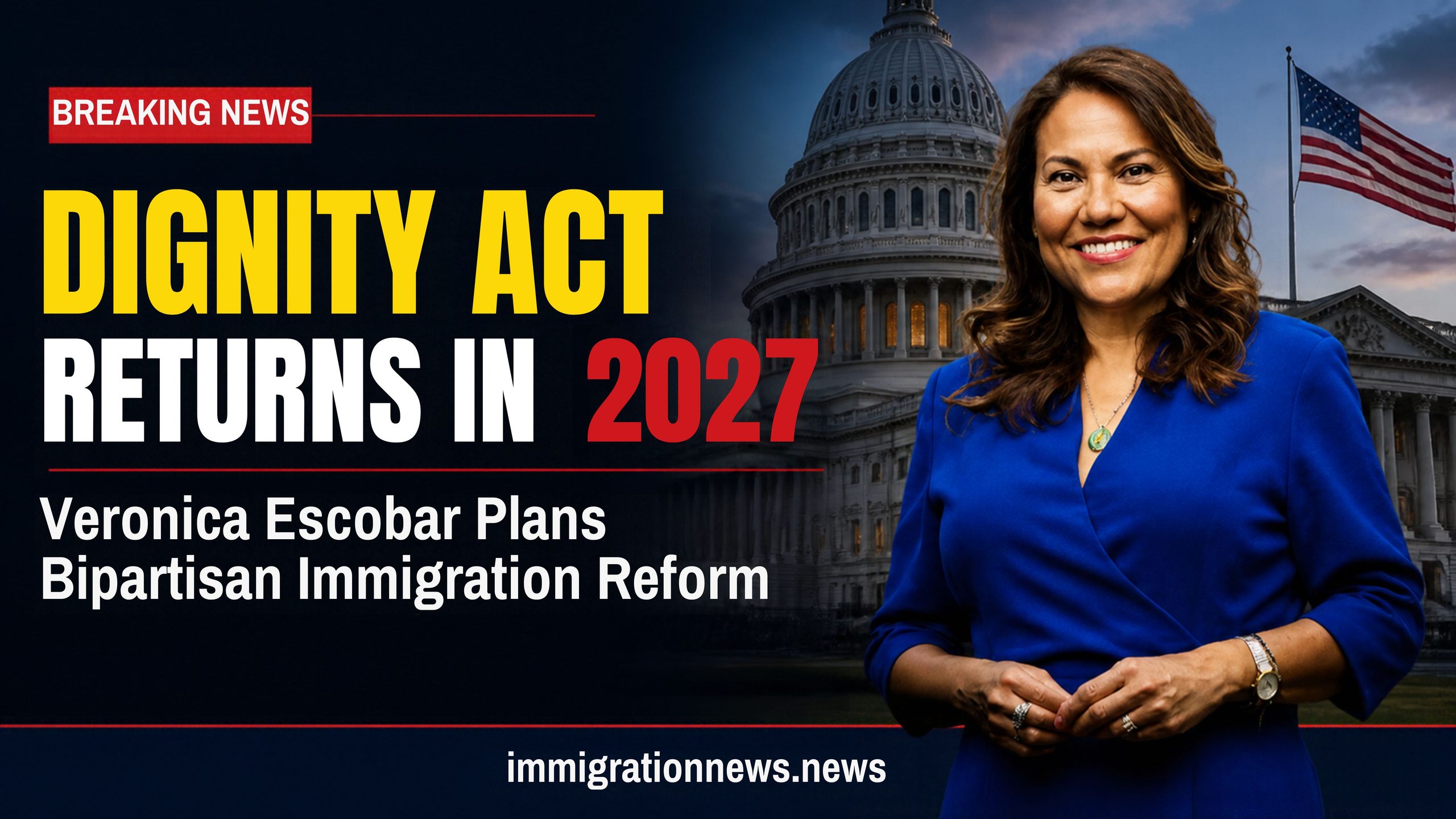
The proposed Dignity Act immigration reform initiative could return to the centre of US immigration policy discussions in 2027, as Democratic Representative Veronica Escobar has announced plans to reshape and reintroduce the bipartisan legislation.
Speaking on Capitol Hill on November 11, 2026, the Texas congresswoman confirmed that she intends to work with Republican lawmakers to revise the proposal and build broader support before introducing it in the next congressional session.
Escobar, who co-authored the legislation with Republican Representative María Elvira Salazar of Florida, said the updated proposal would welcome ideas from lawmakers who previously opposed the bill.
The announcement signals another attempt to develop a bipartisan immigration compromise that combines border security, changes to legal immigration and protections for certain undocumented immigrants.
The earlier version of the Dignity Act included a seven-year programme that could allow eligible undocumented immigrants to obtain legal status to live and work in the United States, subject to strict conditions. However, the programme did not provide a general pathway to US citizenship.
Importantly, the revised legislation has not yet been published. Its eligibility requirements, immigration benefits and enforcement provisions could change during negotiations.
Dignity Act Immigration Reform: What Did Veronica Escobar Announce?
Representative Veronica Escobar confirmed on November 11 that she remains committed to bringing the Dignity Act back to Congress in 2027.
The legislation was originally developed as a bipartisan effort involving Escobar and Republican Representative María Elvira Salazar.
According to Escobar, the previous version attracted support from 20 Republican and 20 Democratic representatives. She also indicated that two senators, one from each political party, had expressed interest in the proposal.
However, she did not identify the senators or announce a date for introducing the legislation in the Senate.
Escobar said the bill would be reshaped in the coming weeks to address concerns raised by lawmakers who felt that the earlier proposal did not adequately meet their immigration policy objectives.
Her message was directed at both Republicans and Democrats who want to participate in negotiations.
The congresswoman’s objective is to build a compromise that can pass through the House and Senate and ultimately reach President Donald Trump.
Why Is the Dignity Act Being Revised for 2027?
The previous version of the Dignity Act immigration reform proposal faced criticism from lawmakers across the political spectrum.
Some Republicans opposed provisions they considered insufficiently strict on immigration enforcement, while some Democrats believed the proposed protections did not go far enough.
Escobar acknowledged these political differences and described herself as both a progressive Democrat and a pragmatist.
She argued that comprehensive immigration reform would require Republican support, particularly given the political composition of Congress and the need to secure sufficient votes in the Senate.
Rather than abandoning the proposal, she wants lawmakers from both parties to participate in rewriting it.
The revised negotiations could potentially address disagreements involving:
- Border security and immigration enforcement.
- Legal protections for undocumented immigrants.
- Employment authorisation.
- Asylum and immigration processing.
- Protections for immigrants brought to the United States as children.
- Employer and workforce immigration requirements.
These are areas associated with the earlier legislative proposal and broader immigration reform discussions. Escobar has not confirmed which specific provisions will appear in the 2027 version.
What Did the Previous Dignity Act of 2025 Propose?
To understand the potential impact of the proposed Dignity Act immigration reform, it is important to examine the legislation introduced during the previous Congress.
The 2025 version was introduced as H.R. 4393 and combined immigration enforcement measures with changes to legal immigration and protections for certain undocumented immigrants.
One of its most significant components was the proposed Dignity Program.
Seven-year Dignity Program
The earlier proposal included a seven-year programme designed for certain undocumented immigrants who met specified eligibility requirements.
Participants would have been required to comply with several conditions, including:
- Passing applicable background checks.
- Paying required taxes.
- Maintaining employment or participating in education for at least four years, subject to specified exceptions.
- Complying with federal and state laws.
- Making restitution payments totalling $7,000.
- Completing periodic check-ins with the Department of Homeland Security.
The proposed programme was designed to provide qualifying participants with legal status and employment authorisation under specified conditions.
However, participation in the Dignity Program itself would not have provided a general pathway to US citizenship.
Separate provisions for immigrants brought to the United States as children
The previous legislation also included separate provisions addressing certain immigrants who arrived in the United States as children.
These provisions were distinct from the seven-year Dignity Program and should not be confused with its eligibility requirements.
The final details of any such protections in a revised 2027 bill remain unknown.
Border security and immigration system changes
The earlier proposal also sought to combine immigration relief with stronger border management and changes to immigration processing.
This bipartisan approach was intended to bring together lawmakers who prioritised border enforcement and those seeking legal protections for long-term undocumented residents.
The 2027 negotiations could retain, revise or remove elements of the earlier proposal.
Could the Dignity Act Give Undocumented Immigrants Legal Status?
The earlier version of the Dignity Act immigration reform proposal included a mechanism through which certain undocumented immigrants could obtain legal status and work authorisation.
However, this was not an automatic benefit for everyone living in the United States without legal immigration status.
Potential participants would have needed to satisfy eligibility requirements and comply with programme conditions.
The proposed seven-year Dignity Program also did not provide a general pathway to citizenship.
Because Escobar has announced plans to reshape the legislation, it would be premature to assume that the same programme, eligibility requirements or benefits will appear in the 2027 version.
Undocumented immigrants should therefore not treat the announcement as an opportunity to apply for legal status.
No new application process has been opened under the proposed legislation.
Will the Dignity Act Include a Pathway to US Citizenship?
This is one of the most important questions surrounding the proposed Dignity Act immigration reform initiative.
The 2025 proposal included different immigration provisions for different categories of applicants.
While the seven-year Dignity Program was designed to provide qualifying undocumented immigrants with legal status and work authorisation, it did not establish a general pathway to citizenship.
Separate provisions addressing certain immigrants brought to the United States as children had different objectives.
Whether the revised 2027 legislation will introduce additional permanent residence or citizenship opportunities remains unclear.
Escobar has not released updated legislative language confirming the scope of any future pathway.
Any claims that the revised bill will automatically provide green cards or citizenship to all undocumented immigrants would therefore be premature.
Why Bipartisan Support Will Be Essential for Immigration Reform
Escobar has made it clear that bipartisan support will be central to the next phase of the legislation.
The United States has experienced repeated difficulties in passing comprehensive immigration reform because of disagreements over border enforcement, undocumented immigration, asylum and legal immigration pathways.
The Dignity Act attempted to address these competing priorities through a single legislative package.
According to Escobar, the earlier effort attracted 40 House members, equally divided between Republicans and Democrats.
She now wants to expand that support and bring additional lawmakers into the negotiations.
The congresswoman also indicated that bipartisan interest exists in the Senate, although the two senators involved have not been publicly identified.
For the Dignity Act immigration reform proposal to become law, it would need to pass the legislative process in both chambers and receive presidential approval.
A reintroduction in 2027 would only be the beginning of that process.
Escobar Calls for Return of Deported US Military Veterans
During her Veterans Day appearance, Escobar also raised concerns about former US military service members who have been deported.
She argued that veterans who served the United States should not be left outside the country because of immigration enforcement actions.
The congresswoman called for their return and urged lawmakers to address what she described as weaknesses in the immigration system.
She said hundreds of veterans had been deported under the current and previous administrations, although she did not provide a specific source or time period for that figure.
Escobar did not announce a separate return programme or confirm whether the revised Dignity Act would include specific protections for deported veterans.
Nevertheless, the issue formed part of her broader argument for changes to US immigration policy.
Camp East Montana Detention Facility Faces Renewed Criticism
Escobar also criticised Camp East Montana, an immigration detention facility located in her congressional district near El Paso, Texas.
She described the facility as a profit-making operation and questioned the use of taxpayer money for immigration detention.
During her November 11 remarks, she referred to the facility as a $1.24 billion operation.
The issue has also attracted scrutiny from the US Government Accountability Office (GAO).
A June 9, 2026, GAO report identified significant planning, spending and oversight problems associated with Camp East Montana.
The report found that the facility opened in August 2025 without meeting several key detention standards and without the required pre-occupancy inspection.
It also identified unnecessary spending on meals and other services when the facility was operating below its maximum capacity.
According to the GAO, the government paid up to $11.5 million for operational services between August 1 and August 15, 2025, when no detained noncitizens were being held at the facility.
The report also identified additional unnecessary meal payments and recommended improvements to contract pricing and detention facility inspections.
The GAO’s report referred to a contract valued at approximately $1.3 billion, while Escobar cited $1.24 billion in her remarks. These figures are reported in different contexts and should not be treated as identical accounting measures.
Escobar did not announce a specific provision to close Camp East Montana as part of the proposed 2027 legislation.
What Happens Next for the Dignity Act Immigration Reform Proposal?
The next stage will involve negotiations over the legislation’s structure, eligibility requirements and political support.
Based on Escobar’s announcement, the expected developments include:
| Expected development | Current position |
|---|---|
| Revision of the earlier bill | Escobar says reshaping will begin in the coming weeks |
| Bipartisan negotiations | Lawmakers from both parties are invited to participate |
| Senate involvement | Two senators have reportedly expressed interest |
| Formal reintroduction | Planned for 2027 |
| Final eligibility requirements | Not yet announced |
| Presidential approval | No legislation has been passed or sent for approval |
The most important development to watch will be the publication of updated legislative language.
Until then, the 2025 version remains a reference point for understanding the proposal, rather than a confirmed description of the next bill.
FAQs : Dignity Act Immigration Reform
What is the Dignity Act immigration reform proposal?
The Dignity Act is a bipartisan US immigration reform proposal developed by Democratic Representative Veronica Escobar and Republican Representative María Elvira Salazar. It combines border security and immigration system changes with proposed protections for certain undocumented immigrants.
When will the Dignity Act be reintroduced?
Representative Veronica Escobar has announced plans to reshape and reintroduce the legislation in 2027. A specific introduction date has not been announced.
Will the Dignity Act provide legal status to undocumented immigrants?
The 2025 version included a proposed seven-year Dignity Program that could provide qualifying undocumented immigrants with legal status and employment authorisation. The revised 2027 proposal has not yet been published.
Will participants receive US citizenship under the Dignity Program?
The earlier seven-year Dignity Program did not provide a general pathway to US citizenship. Separate provisions applied to certain immigrants brought to the United States as children.
Who introduced the Dignity Act?
The legislation was developed by Democratic Representative Veronica Escobar of Texas and Republican Representative María Elvira Salazar of Florida.
Does the Dignity Act apply to Indian immigrants?
The earlier proposal was designed around eligibility categories rather than nationality. Indian immigrants could potentially have been affected if they met the relevant requirements. However, the revised bill’s eligibility rules have not been announced.
Can undocumented immigrants apply under the proposed 2027 programme now?
No. The proposed legislation has not been reintroduced or passed, and no new application process is available under the announcement.
Has the Dignity Act become law?
No. The proposal remains a legislative initiative. It must be introduced, considered and passed by Congress and signed by the President before any provisions can become law.
Conclusion On Dignity Act Immigration Reform
The planned revival of the Dignity Act immigration reform proposal in 2027 could reopen an important debate over the future of US immigration policy.
Representative Veronica Escobar wants to build a broader bipartisan agreement by revising the earlier legislation and inviting critics from both political parties to participate in negotiations.
The 2025 proposal included a seven-year programme for certain undocumented immigrants, employment authorisation and separate provisions for immigrants brought to the country as children. However, the revised bill could look different, and its final requirements remain unknown.
For undocumented immigrants, Indian professionals and other foreign nationals following US immigration developments, the next important milestone will be the publication of the revised legislation.
Until Congress introduces and passes a new bill, the announcement should be viewed as a political and legislative development—not a new immigration benefit or an open application pathway.
Source : FOX 8
Read About : IBM H-1B Visa Sponsorship Ends for Most Consulting Roles: Green Card Support Also Discontinued




One thought on “Dignity Act Immigration Reform: Veronica Escobar Plans to Reintroduce Bipartisan Bill in 2027”