
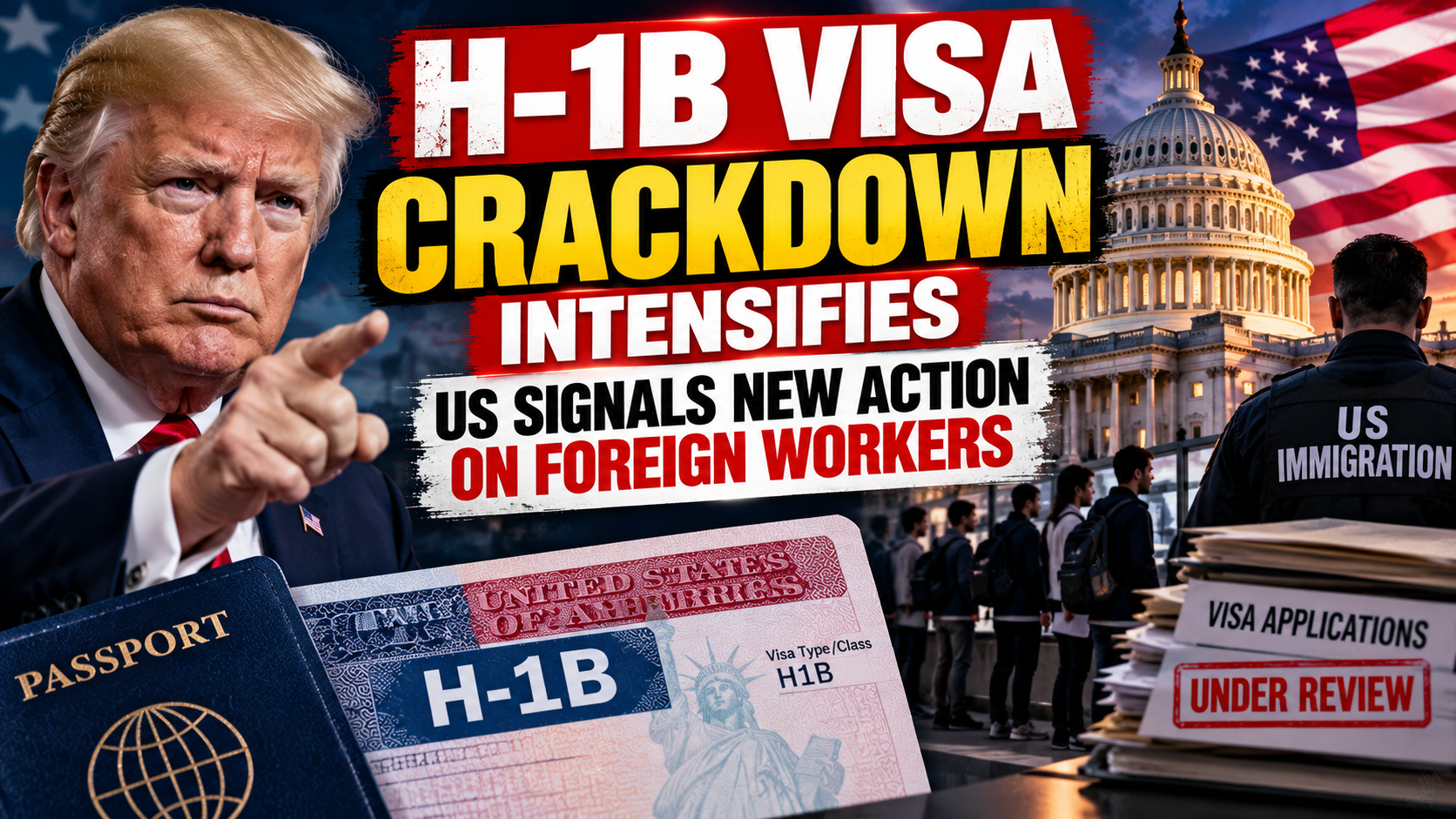
The H-1B visa crackdown in the United States could intensify this week as federal officials signal increased scrutiny of employers using foreign-worker visa programmes.
U.S. Department of Labor Inspector General Anthony D’Esposito recently said there was a “big week ahead” on the foreign-labor visa front while emphasizing the administration’s focus on American jobs and American workers.
D’Esposito did not identify a specific employer, visa programme or investigation in his statement. However, his remarks come at a time when the Trump administration is pursuing a broader crackdown on alleged fraud, abuse and misuse of employment-based immigration programmes.
The latest developments are particularly significant for H-1B workers and employers because the administration has already introduced major changes involving H-1B selection, employer scrutiny, wages and entry requirements.
At the same time, the controversial proposed $100,000 H-1B payment remains subject to legal challenges, adding another layer of uncertainty for foreign professionals and U.S. employers.
What triggered the latest H-1B visa crackdown warning?
The latest H-1B visa crackdown warning came from Department of Labor Inspector General Anthony D’Esposito.
In a social-media post, D’Esposito indicated that federal officials were preparing for new action involving foreign-labor visa programmes and again highlighted the administration’s “American jobs, American workers” message.
However, he did not provide details about what federal agencies would announce or which specific employers or visa categories could be targeted.
That distinction is important.
Although the broader immigration environment clearly points toward increased scrutiny of employment-based immigration, the statement itself did not establish that a new H-1B rule, fee or restriction had already taken effect.
The comments instead suggest that enforcement activity could become more visible in the coming days.
New York hospital case puts foreign-worker hiring under scrutiny
The latest developments also follow controversy surrounding residency hiring at a New York hospital.
Claims have circulated that the hospital hired approximately 80 foreign workers for residency positions while only two American candidates were selected.
The allegations have attracted attention from federal officials and have raised questions about how hospitals use employment-based immigration programmes when recruiting international medical graduates.
However, the figures should be treated as allegations rather than an established finding of unlawful hiring discrimination.
The case has nevertheless become part of the broader debate surrounding the H-1B visa crackdown, particularly over whether employers are using foreign-worker programmes in a way that disadvantages U.S. workers.
Medical residency programmes can involve different immigration categories, including H-1B and J-1 visas. Therefore, foreign-worker hiring in a residency programme should not automatically be treated as an H-1B case.
H-1B programme already faces major policy changes
The current H-1B visa crackdown is not the result of a single announcement.
The Trump administration has introduced several measures aimed at changing how the H-1B programme operates and increasing scrutiny of employers that sponsor foreign workers.
The administration has argued that the programme has been misused by some companies to obtain cheaper foreign labour or replace American workers.
Its policies have therefore focused heavily on:
- H-1B employer compliance
- Wage levels
- Foreign-worker recruitment
- IT outsourcing and staffing companies
- Worker displacement
- Fraud and programme abuse
- Selection of higher-paid workers
- Entry of certain H-1B workers from outside the United States
These measures have created a significantly more restrictive environment for some employers and foreign professionals.
$100,000 H-1B payment remains at the centre of the controversy
One of the most controversial elements of the H-1B visa crackdown is the proposed $100,000 payment associated with certain H-1B workers seeking entry to the United States from abroad.
The Trump administration extended the relevant restrictions through September 21, 2027, subject to applicable exceptions and ongoing legal proceedings.
The administration has argued that the measure is intended to discourage misuse of the H-1B system and encourage employers to prioritize highly skilled and highly paid workers.
However, the policy has faced significant legal challenges.
A federal judge blocked implementation of the $100,000 payment requirement, and another federal court had previously taken similar action.
As a result, employers and foreign workers should not assume that the $100,000 amount automatically applies to every H-1B case.
The legal status of the measure remains an important issue to watch.
Why the $100,000 H-1B payment matters
The proposed payment is dramatically higher than the normal government fees associated with H-1B sponsorship.
That makes it potentially significant for companies that regularly sponsor foreign professionals.
Large technology companies, staffing companies, outsourcing businesses, universities and healthcare organisations could face very different financial consequences depending on how the policy ultimately survives legal challenges.
For foreign workers, the issue is equally important because employers may reconsider sponsorship decisions if immigration costs rise substantially.
However, the H-1B visa crackdown should not be interpreted as meaning that every H-1B applicant or existing worker is subject to a $100,000 payment.
The measure has specific conditions and has also been challenged in court.
New executive order expands H-1B oversight
Another major part of the H-1B visa crackdown involves increased coordination among federal agencies.
A September 2026 executive order directed agencies to strengthen programme integrity and coordination in the administration of the H-1B system.
The order focuses particularly on situations where employers may seek H-1B workers while simultaneously reducing or eliminating positions held by U.S. workers.
The administration wants federal agencies to identify potential cases in which foreign workers could be used to replace American employees.
This approach represents a significant shift toward enforcement and programme-integrity investigations.
Employers are therefore likely to face greater scrutiny of the relationship between their U.S. workforce and H-1B sponsorship activities.
H-1B registrations from major outsourcing firms have fallen
Government figures indicate that the H-1B visa crackdown has already coincided with major changes in registration patterns among large IT staffing and outsourcing companies.
According to administration figures, registrations from the largest IT staffing and outsourcing companies declined from approximately 24,946 to 2,055 between the relevant H-1B cap seasons.
That represents a decline of more than 90%.
The administration has presented the change as evidence that its policies are reducing reliance on certain foreign-worker staffing models.
It has also reported a dramatic decline in requests for consular processing among some H-1B applicants.
These figures are particularly important because IT outsourcing and third-party staffing arrangements have long represented a significant portion of the H-1B system.
More H-1B selections are going to higher-skilled workers
Another major development associated with the H-1B visa crackdown is the administration’s shift toward higher-paid and higher-skilled workers.
Government data has indicated a substantial increase in the proportion of H-1B registrations involving beneficiaries with U.S. master’s degrees.
The administration has also highlighted an increase in selections associated with higher wage levels.
The stated objective is to reduce the possibility that the H-1B programme will be used primarily for lower-paid positions.
Under the administration’s approach, employers offering higher salaries can have a stronger position in the selection process than employers offering lower wages for comparable occupations.
This represents a significant change from the traditional H-1B selection system.
Wage rules are another major part of the crackdown
The H-1B visa crackdown also extends to wage policy.
The Department of Labor has proposed changes to the way prevailing wages are calculated for certain employment-based immigration programmes.
The proposal would affect wage calculations associated with H-1B and several other employment-based categories.
The administration argues that stronger wage requirements could reduce incentives for employers to hire foreign workers at salaries below what similarly situated U.S. workers would receive.
If implemented, changes to prevailing-wage calculations could increase the cost of sponsoring certain foreign professionals.
However, a proposed regulation is not the same as a final regulation.
Employers should therefore distinguish between proposals announced by federal agencies and rules that have actually become effective.
What does the H-1B crackdown mean for Indian workers?
The H-1B visa crackdown is especially important for Indian professionals because Indian nationals have historically represented a very large share of H-1B beneficiaries.
However, the current measures do not mean that Indian citizens are banned from obtaining H-1B visas.
Indian professionals can still pursue H-1B sponsorship when they meet the applicable requirements and an eligible U.S. employer sponsors them.
The bigger issue is that employers may face a more demanding environment when deciding whether and how to sponsor foreign workers.
Indian applicants could therefore be affected indirectly through:
- Higher sponsorship costs
- Increased employer scrutiny
- Wage requirements
- Selection changes
- Additional documentation
- Greater scrutiny of staffing arrangements
- Changes affecting H-1B workers outside the United States
Indian H-1B workers should also distinguish between policies affecting new workers seeking entry from abroad and rules affecting people who are already legally working in the United States.
Does the crackdown mean H-1B visas are ending?
No.
The H-1B visa crackdown does not eliminate the H-1B programme.
Instead, the administration is attempting to change how the programme operates and how employers use it.
The H-1B category remains available for qualified foreign professionals working in specialty occupations.
The government continues to process H-1B petitions, registrations and extensions subject to the applicable rules.
The current policy direction is therefore better understood as a tightening of the programme rather than its complete elimination.
For employers, this means compliance will become increasingly important.
For foreign workers, it means that immigration planning may require greater attention to employer eligibility, wages, job duties and travel circumstances.
Which employers could face greater scrutiny?
The H-1B visa crackdown could have particularly significant consequences for employers that rely heavily on foreign-worker sponsorship.
Potentially affected employers may include:
IT staffing companies
Companies that place H-1B workers at third-party client locations could face additional questions about job duties, wages and the actual employment relationship.
Outsourcing companies
Businesses using foreign workers to provide technology or professional services may receive increased scrutiny.
Healthcare employers
Hospitals and healthcare organisations employing international professionals could face greater attention, particularly where large numbers of foreign workers are recruited.
Technology companies
Technology businesses with large H-1B workforces may need to closely monitor wage and programme-integrity requirements.
Companies undergoing layoffs
Employers reducing their U.S. workforce while simultaneously filing H-1B petitions could face additional questions under the administration’s new programme-integrity approach.
What could happen next?
The latest H-1B visa crackdown warning does not provide a detailed list of what federal officials plan to announce.
However, several areas could receive increased attention.
Possible areas include:
- H-1B employer investigations
- Labor Condition Application compliance
- Wage violations
- Worker displacement allegations
- Fraud investigations
- Outsourcing arrangements
- Third-party staffing
- Employer recruitment practices
- H-1B entry requirements
- Foreign-worker documentation
The exact scope of any upcoming enforcement activity remains unclear.
Employers and foreign workers should therefore wait for formal announcements rather than relying on social-media speculation.
H-1B enforcement is broader than the $100,000 payment
It is important to understand that the H-1B visa crackdown is much broader than the controversial $100,000 payment.
The administration’s strategy includes multiple policy areas.
| Area | Current direction |
|---|---|
| H-1B entry | Increased restrictions for certain workers outside the U.S. |
| $100,000 payment | Subject to federal court challenges |
| Selection | Greater emphasis on higher-paid workers |
| Employer oversight | Increased federal coordination |
| Wage policy | Proposed changes to prevailing wages |
| Outsourcing | Greater scrutiny |
| Fraud | Increased enforcement focus |
| Worker displacement | Greater attention to layoffs and replacement claims |
Taken together, these measures indicate a broader attempt to reshape the employment-based immigration system.
What should H-1B employers do now?
Companies sponsoring H-1B workers should review their immigration compliance practices carefully.
Employers should ensure that:
- Wages comply with applicable requirements.
- Labor Condition Application information is accurate.
- Job duties match the sponsored position.
- Work locations are properly documented.
- Required immigration records are maintained.
- Third-party placement arrangements are properly documented.
- Employment changes are reported where required.
- Information submitted to immigration authorities is accurate.
Companies should also monitor formal updates from federal agencies because immigration requirements can change quickly.
A social-media statement should not be treated as a new legal requirement until the relevant agency or court establishes the applicable rule.
What should H-1B workers do?
Foreign professionals should keep their immigration documentation organized and current.
Workers should retain copies of:
- H-1B approval notices
- Passport and visa documents
- Employment records
- Pay statements
- Labor-related documentation where available
- I-94 records
- Previous immigration filings
- Employment contracts and offer letters
Anyone planning international travel should also check the latest entry requirements before leaving the United States.
Workers affected by an employer restructuring, termination or major change in employment should obtain professional immigration advice before taking action.
The H-1B visa crackdown does not automatically terminate the status of every foreign worker, but individual circumstances can have major immigration consequences.
Could the crackdown affect future H-1B applicants?
Yes.
The policy direction could make future H-1B sponsorship more complicated for some applicants.
Employers may become more selective about which positions they sponsor, particularly if sponsorship costs increase or compliance requirements become more demanding.
Applicants may also face stronger competition for positions that qualify for H-1B sponsorship.
The administration’s emphasis on higher wages and higher-skilled positions could make compensation and job qualifications increasingly important factors.
However, the exact long-term impact will depend on which proposed policies survive court challenges and which become final regulations.
FAQs : H-1B Visa Crackdown
What is the H-1B visa crackdown?
The H-1B visa crackdown refers to a series of Trump administration policies and enforcement efforts designed to increase scrutiny of H-1B employers, foreign-worker recruitment, wages, programme integrity and alleged displacement of U.S. workers.
Is the $100,000 H-1B payment currently required?
The administration has extended restrictions involving the $100,000 payment through September 2027, but federal courts have blocked implementation of the payment while legal challenges continue. The situation may change as litigation proceeds.
Does the crackdown mean H-1B visas are banned?
No. H-1B visas continue to exist, and eligible employers can continue to sponsor qualified foreign professionals under applicable rules.
Are Indian H-1B workers affected?
Indian nationals are not banned from the H-1B programme. However, because India represents a major share of H-1B workers, changes involving wages, selection, employer compliance and entry requirements could have a significant impact on Indian professionals.
What did the Labor Department Inspector General announce?
Inspector General Anthony D’Esposito indicated that federal officials were preparing for significant activity involving foreign-labor visas but did not publicly identify a specific employer, investigation or visa programme.
What happened at the New York hospital?
Claims emerged that a New York hospital hired a large majority of foreign workers for residency positions compared with a very small number of American candidates. The claims have attracted federal scrutiny, but the allegations should not automatically be treated as a confirmed finding of unlawful discrimination.
Are H-1B wage rules changing?
The Department of Labor has proposed changes to prevailing-wage methodology affecting H-1B and other employment-based immigration programmes. Proposed changes should not be confused with final rules.
Will H-1B enforcement increase further?
The administration’s recent policy announcements and statements indicate that increased enforcement is likely, but the exact scope and timing of future actions remain uncertain.
Final Takeaway On H-1B Visa Crackdown
The H-1B visa crackdown is entering another potentially important phase as U.S. Labor Department officials signal increased scrutiny of foreign-worker visa programmes.
The latest warning does not identify a specific new enforcement action, but it comes after several major changes to the H-1B system, including stronger programme-integrity measures, changes to selection, increased attention to wages and restrictions affecting certain H-1B workers outside the United States.
The controversial $100,000 H-1B payment remains one of the biggest issues to watch. Although the administration has extended the underlying restriction, federal courts have blocked implementation of the payment, leaving its future uncertain.
For Indian professionals, the H-1B visa crackdown does not mean that H-1B opportunities have ended. However, employers and workers should expect closer scrutiny and potentially more complicated immigration planning.
The biggest takeaway is that the U.S. employment-based immigration system is moving toward greater emphasis on higher wages, employer compliance, programme integrity and protection of American workers.
As further announcements are expected, foreign workers and employers should rely on formal government guidance and court decisions rather than unverified claims circulating online.
Source : Hindustan Times
Read About : US Visa Bond: 50 Countries Face Up to $20,000 as India Stays Off the List
One thought on “H-1B Visa Crackdown Intensifies as US Signals New Action on Foreign Workers”