
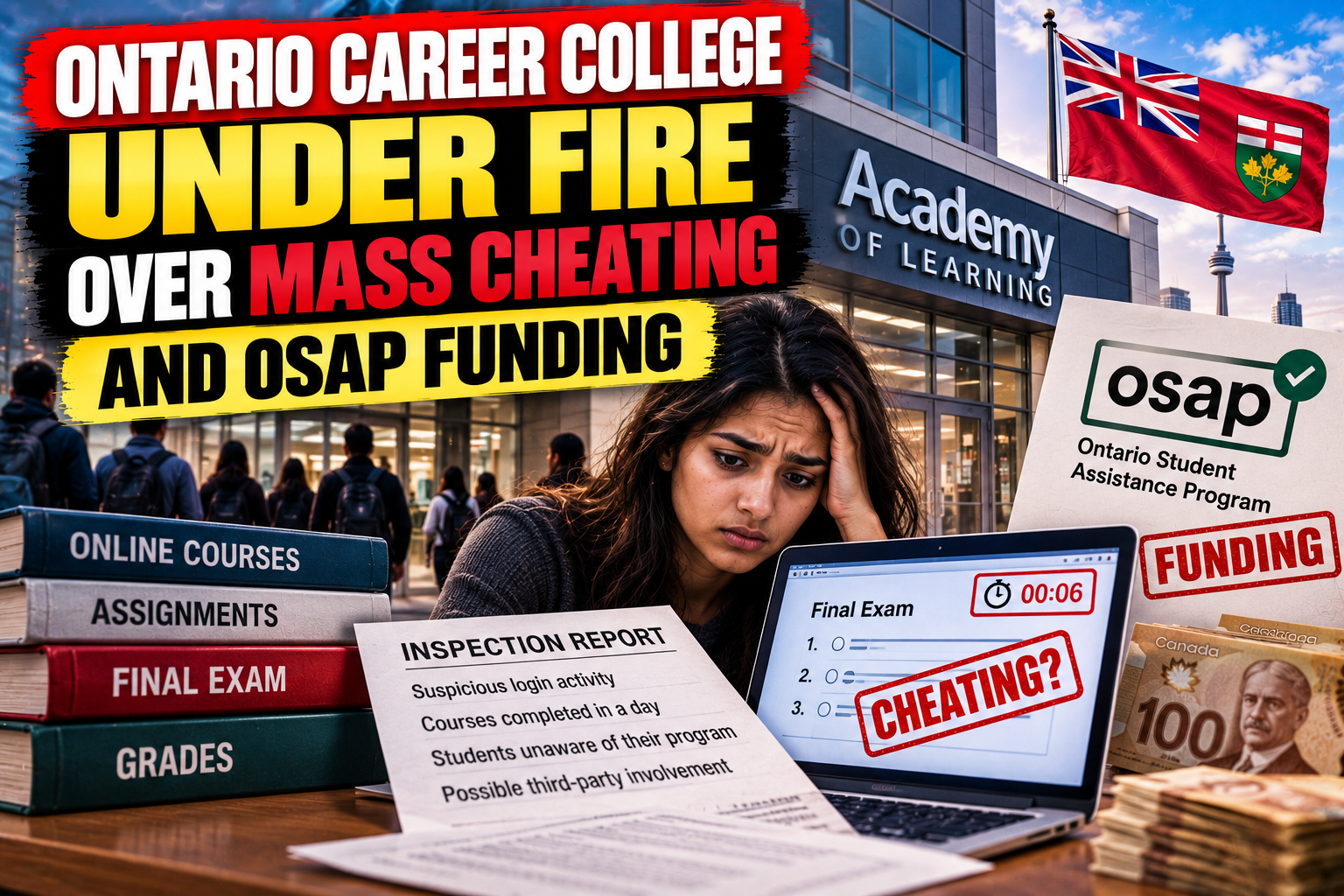
Ontario’s private career college sector is facing renewed scrutiny after government inspections raised serious questions about student participation, academic integrity and the use of public financial aid at three Academy of Learning locations.
Court records reviewed in a judicial review case allege that some students appeared to complete entire courses unusually quickly, while inspectors also found login patterns and student interviews that raised questions about whether some learners were actually completing their own coursework. The developments have put Ontario career college OSAP funding under a much brighter regulatory spotlight.
The three affected Academy of Learning locations — Bay Street in downtown Toronto, Brampton East and North York — were made ineligible for the Ontario Student Assistance Program (OSAP) beginning August 1, 2026. The colleges have challenged the government’s decision in court and deny most of the allegations, saying they have implemented corrective measures and stronger identity-verification systems.
The issue is particularly significant because the three locations received more than $219 million in OSAP grants for about 14,800 students during the 2024–25 academic year, according to data obtained through freedom-of-information requests. By comparison, students across all publicly funded Ontario colleges received about $385 million in OSAP grants during the same period.
What Triggered the Ontario Career College OSAP Funding Controversy?
The controversy began with government inspections of the three Academy of Learning locations.
According to court documents reported by The Canadian Press and other Canadian media, provincial inspectors identified patterns they considered inconsistent with normal student participation. The concerns included extremely rapid course completion, shared or unusual IP addresses, questionable login activity and difficulties confirming students’ knowledge of their own programmes.
One inspection report reportedly described a student completing all tests and a final examination for a course on the same day. The final examination took only six minutes.
Another student reportedly completed a final examination on the first day they accessed the course, while another account completed all modules and tests for a course in less than 15 minutes.
These findings do not by themselves establish that students cheated or that a particular person committed fraud. Rather, they formed part of the government’s stated basis for questioning whether the schools could demonstrate that OSAP-funded students were actively participating in their programmes.
That distinction is important as the Ontario career college OSAP funding dispute remains subject to a court challenge.
Inspectors Raised Questions About Student Identity and Login Activity
The investigation also focused on digital activity.
Court records cited in media reports indicate that some student accounts were accessed from numerous IP addresses. At the Bay Street location, inspectors reportedly found that 39 of 42 student files examined had IP addresses that were also associated with accounts belonging to other students, all of whom had reportedly been referred by the same recruiter.
Another account was reportedly accessed using more than 200 IP addresses.
Government inspectors said these patterns could suggest shared login credentials, unauthorized access or coordinated activity. The schools, however, have disputed the interpretation of some of these findings and have pointed to factors such as dynamic IP addresses and the nature of online learning.
The investigation also involved direct contact with students.
Officials reportedly attempted to contact six students, with three available for interviews. Some students allegedly could not identify their institution, programme or courses, while other responses did not match the enrolment information reviewed by inspectors.
Again, these are allegations and inspection findings presented in the legal proceedings, rather than findings that have been finally established by a court.
$219 Million in OSAP Grants Raises Bigger Questions
The scale of Ontario career college OSAP funding involved is one reason the case has attracted significant attention.
Approximately 14,800 students at the three Academy of Learning locations received more than $219 million in OSAP grants during 2024–25, according to freedom-of-information data obtained by The Canadian Press.
For comparison, students at all publicly funded colleges in Ontario received approximately $385 million in OSAP grants during the same academic year.
The numbers prompted questions about the rapid expansion of financial-aid applications at certain private career colleges.
Career Colleges Ontario had previously identified the three locations among a group of institutions with unusually high OSAP application growth. Reports indicate applications at the flagged schools had increased by approximately 500% to 600% over two years, while activity at many other schools remained relatively stable.
The growth alone does not prove wrongdoing. However, combined with inspection findings, it became part of the government’s broader concern about whether the Ontario career college OSAP funding system was being adequately protected.
Ontario Cuts OSAP Eligibility for Three Academy of Learning Locations
Ontario Colleges and Universities Minister Nolan Quinn notified five career colleges, including the three Academy of Learning locations, that they would not remain eligible for OSAP beginning August 1, 2026.
The three Academy of Learning locations subsequently sought judicial review of the government’s decision.
The schools argue that the minister did not have the authority to make the decision in the manner used and that the decision was unreasonable. They have also said they took the government’s concerns seriously and introduced corrective measures, including enhanced identity verification and monitoring.
This means the current dispute should not be described as a final judicial finding that the colleges engaged in cheating or fraud.
Instead, the government has taken regulatory action based on inspection and compliance concerns, while the affected schools are challenging that action through the courts.
For students and families, the case highlights how closely Ontario career college OSAP funding can be connected to institutional compliance.
What Does OSAP Actually Fund?
OSAP is Ontario’s student financial-aid programme for eligible students attending approved postsecondary education programmes.
Depending on eligibility, OSAP can provide students with grants, which generally do not have to be repaid, and student loans, which must be repaid.
This makes institutional eligibility especially important.
When students choose a private career college expecting to use OSAP, they are relying not only on the school’s programme and academic services but also on the institution’s continued ability to participate in the provincial financial-aid system.
The recent controversy shows why prospective students should verify the school’s current status rather than relying solely on advertising or statements made during recruitment.
BizTech College Shows Another Risk for Career College Students
The concerns surrounding Ontario career college OSAP funding are not isolated from other problems that have affected private career colleges.
BizTech College of Health Sciences, Business and Technology in Mississauga lost its registration as an Ontario career college in January 2026 following a regulatory dispute involving its Diagnostic Medical Sonography programme.
According to Ontario’s official revocation notice, the Superintendent of Career Colleges had revoked approval for the programme in March 2025 after determining that the school no longer met programme-approval conditions.
The revocation required refunds for affected students.
The school sought judicial review, but the Superior Court upheld the programme revocation in April 2025. Ontario subsequently directed the college to provide refunds.
The province said the required refunds had not been provided by July 2025. The school appealed the proposed registration revocation to the Licence Appeal Tribunal, which directed the Superintendent to carry out the revocation on January 12, 2026.
The BizTech case illustrates another important risk for students: even when a student has successfully enrolled and received financial assistance, problems at the institutional level can disrupt education, programme recognition and financial arrangements.
Truck Training Colleges Face Separate Compliance Problems
Another part of Ontario’s broader career-college regulatory picture involves commercial truck-driver training.
The sector has faced concerns about whether some private training providers delivered the required amount and quality of instruction.
Ontario’s regulatory records show that Revolution Truck Training Academy had its registration revoked in August 2026 following proceedings before the Licence Appeal Tribunal.
The official notice says the academy maintained multiple training and operational records that were false or misleading, including records for training that did not occur as documented.
Ontario also said the academy failed to provide several students with the required 103.5 hours of instruction before graduating them and allowing them to challenge the Class A road test. The province further said some in-class tests were completed for students before those students attended the relevant classroom instruction.
The Licence Appeal Tribunal ordered the Superintendent to proceed with revocation, and the registration was revoked on August 21, 2026.
Unlike the Academy of Learning dispute, these findings concern a separate institution and a different training sector. They nevertheless demonstrate why Ontario’s oversight of private career colleges remains an important consumer-protection issue.
City Truck & Forklift Driving School Was Also Revoked
Ontario has previously taken enforcement action against other truck-training providers.
City Truck & Forklift Driving School had its registration revoked in April 2023 after the school withdrew its appeal of the proposed revocation.
Ontario’s official notice cited several compliance issues, including failure to deliver its Class A commercial truck-driver training in accordance with required standards, use of trucks that were not properly insured to the school, delivery of training at unapproved campuses and use of unqualified instructors.
The province also cited failures involving student receipts and information provided during regulatory inquiries.
These cases show that regulatory intervention can extend beyond Ontario career college OSAP funding issues and into programme delivery, student records, instructor qualifications and public safety.
Why This Matters for International Students
Private career colleges are an important part of Ontario’s postsecondary education landscape, including for newcomers and international students.
For students who depend on public financial assistance, however, institutional compliance can have significant consequences.
Students considering a career college should verify:
- Whether the institution is currently registered as a career college
- Whether the specific programme is approved
- Whether the programme is currently eligible for OSAP, if applicable
- Whether the campus they are considering is the approved location
- Whether the school has recently faced regulatory enforcement
- What refund protections apply
- What happens if the programme loses approval
- Whether the credential leads to the intended employment or licensing pathway
Students should also keep copies of their enrolment agreements, receipts, transcripts, academic records and communications with the institution.
The Academy of Learning case demonstrates why checking the current status of Ontario career college OSAP funding before enrolling can be important.
What Students Should Do If Their OSAP Is Affected
Students attending a college affected by an OSAP eligibility decision should avoid making assumptions about their individual funding status.
Instead, they should check their OSAP account and communicate directly with the college and the appropriate Ontario government authorities.
Students should keep documentation showing:
- Their admission and enrolment dates.
- Their programme and campus.
- OSAP assessment and funding information.
- Tuition invoices and payment receipts.
- Course registrations.
- Academic progress and grades.
- Any correspondence about changes to funding.
- Any notices received from the college or government.
OSAP rules can also change independently of a specific college investigation. Ontario introduced changes to the provincial portion of OSAP for programmes beginning on or after August 1, 2026, including a shift toward providing more provincial assistance as loans rather than grants.
Therefore, students should distinguish between a general OSAP policy change and an institution-specific eligibility decision.
Does This Mean All Ontario Career Colleges Are At Risk?
No.
The current controversy involves specific institutions and specific regulatory findings. It would be inaccurate to conclude that all private career colleges in Ontario are involved in academic misconduct or misuse of financial aid.
The Ontario career college OSAP funding controversy instead demonstrates the importance of effective oversight when public money is connected to private education providers.
The government must balance access to career-focused education and financial aid with safeguards against misuse.
At the same time, students who legitimately attend these institutions should not automatically be treated as responsible for institutional compliance problems.
What Happens Next in the Academy of Learning Case?
The immediate next step is the judicial review involving the affected Academy of Learning locations.
The schools are challenging the government’s decision to remove their OSAP eligibility, while Ontario is defending its regulatory action based on the inspection findings.
The court proceedings will be important because they may clarify questions about the government’s authority, the evidence relied upon and the reasonableness of the OSAP eligibility decision.
Until the legal process is resolved, allegations contained in inspection reports should not be treated as proven findings of wrongdoing.
For now, the case has already intensified scrutiny of Ontario career college OSAP funding, particularly where rapid enrolment growth, student identity verification and academic progression records intersect.
A Broader Lesson for Ontario’s Private Career College Sector
The latest Academy of Learning controversy follows several other regulatory actions involving Ontario career colleges and shows why student protection cannot depend solely on whether a college is currently accepting applications.
The combination of public financial aid, private education providers and short-duration career programmes creates a need for strong monitoring.
Regulators need reliable student identity checks, accurate attendance and academic records, meaningful inspections and effective enforcement when institutions fail to meet their obligations.
Students also need transparent information before committing significant amounts of money and time.
For the Ontario career college OSAP funding system, the central question is ultimately one of accountability: how can public financial assistance reach eligible students while ensuring that institutions receiving or relying on that funding maintain appropriate academic and regulatory standards?
FAQs : Ontario Career College OSAP Funding
What happened at the three Academy of Learning locations?
Ontario inspectors reported concerns about student participation, unusually rapid course completion, login activity and student identity verification at three locations: Bay Street, Brampton East and North York. The findings were presented in court documents connected to a judicial review.
How much OSAP funding did the three locations receive?
About 14,800 students at the three locations received more than $219 million in OSAP grants during 2024–25, according to freedom-of-information data reported by The Canadian Press.
Were the colleges found guilty of cheating?
No. The reported allegations and inspection findings have not established a final court finding that the colleges or their students committed cheating or fraud. The schools dispute many of the allegations and are challenging the government’s OSAP decision.
When did the three Academy of Learning locations lose OSAP eligibility?
The affected locations were scheduled to become ineligible for OSAP beginning August 1, 2026. The decision is being challenged through judicial review.
Why is OSAP eligibility important?
OSAP can provide eligible students with grants and loans to help pay for college or university. Losing eligibility can therefore significantly affect students who depend on provincial financial assistance.
Has Ontario revoked other career college registrations?
Yes. For example, Ontario revoked BizTech College’s registration on January 12, 2026, following a dispute involving its Diagnostic Medical Sonography programme and required student refunds.
What happened to Revolution Truck Training Academy?
Ontario revoked Revolution Truck Training Academy’s registration in August 2026 after regulatory proceedings. The province cited false or misleading training records and failure to provide several students with the required 103.5 hours of training, among other issues.
Should students avoid all private career colleges in Ontario?
No. Regulatory problems at particular institutions do not mean every private career college is unsafe. Students should independently verify the registration, programme approval, funding eligibility and regulatory history of the specific college and programme they are considering.
What should students check before enrolling?
Students should verify the school’s current registration, programme approval, OSAP eligibility where relevant, refund policies, campus approval and any recent regulatory notices. Keeping copies of all enrolment and payment documents is also advisable.
Final Takeaway On Ontario Career College OSAP Funding
The latest Ontario career college OSAP funding controversy has raised serious questions about student identity verification, academic participation, unusually rapid course completion and the oversight of public financial assistance.
Three Academy of Learning locations — Bay Street, Brampton East and North York — have been removed from OSAP eligibility beginning August 1, 2026, while the institutions challenge the decision in court. The case involves more than 14,800 students and over $219 million in OSAP grants during 2024–25, making it one of the more significant recent regulatory disputes involving Ontario’s private career college sector.
At the same time, regulatory action against institutions such as BizTech College and Revolution Truck Training Academy shows that Ontario’s concerns extend beyond one Ontario career college OSAP funding dispute and can involve programme approval, student refunds, training hours, academic records and consumer protection.
Most importantly, the allegations against the Academy of Learning locations should not be presented as proven wrongdoing while the court challenge remains unresolved. Students and prospective students should focus on verified registration, programme approval, funding eligibility and official regulatory information before making education or financial decisions.
Editorial Note: The Academy of Learning allegations discussed in this article are based on inspection findings and court records reported by Canadian media. The affected schools dispute many of the allegations, and the matter remains subject to judicial review.
Source : Juno News
Read About : New Laws in Ontario and British Columbia October 2026: Complete Guide to What Is Changing




One thought on “Ontario Career College OSAP Funding Under Scrutiny After Serious Academic Integrity Concerns”