
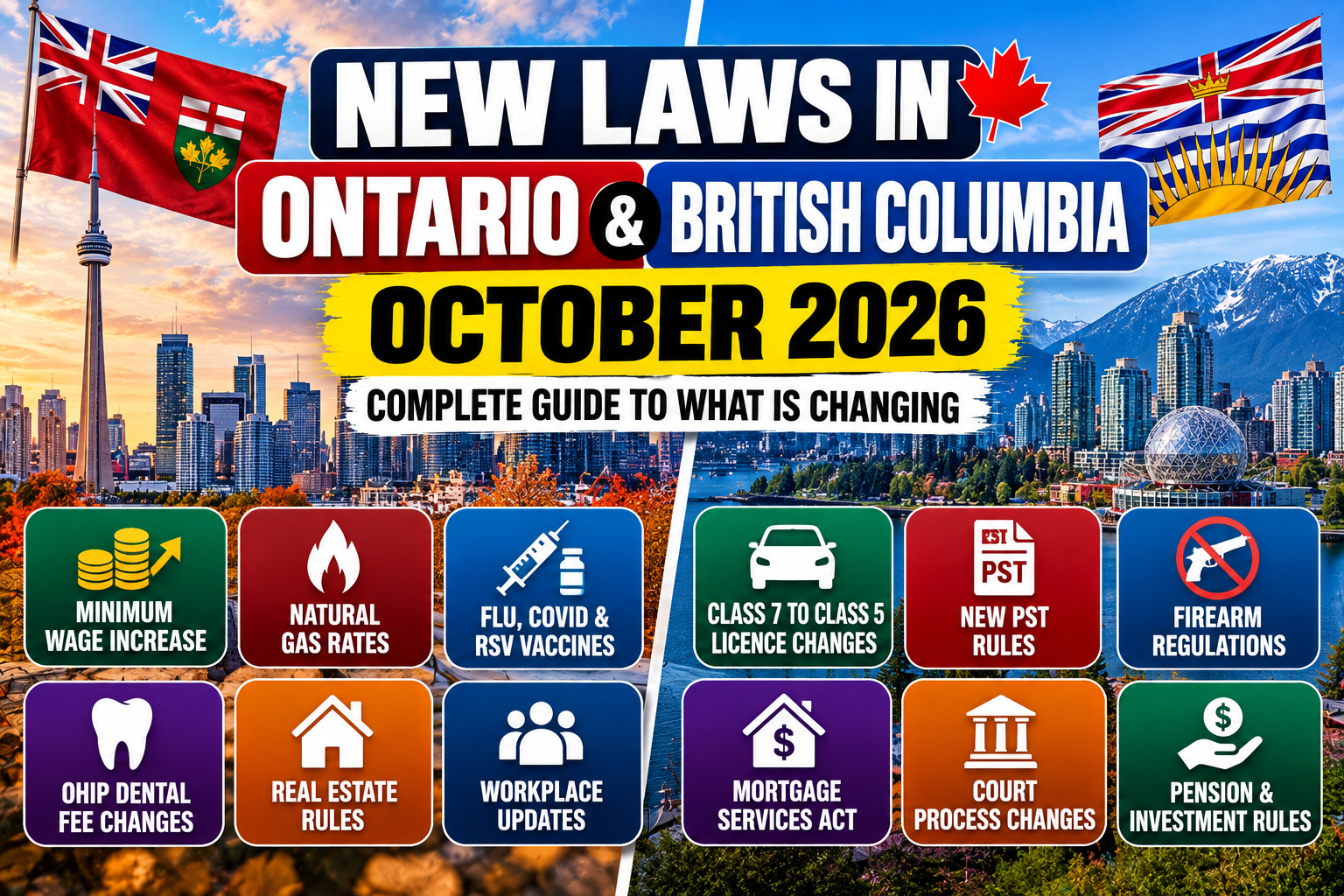
October 2026 brings a wide range of changes for residents, workers, newcomers, students, drivers, homeowners, investors and businesses across Canada’s two most populous western and central provinces. This guide combines the major developments covered in the new laws in Ontario and British Columbia October 2026 updates, including changes to minimum wages, driving licences, taxes, healthcare, mortgages, firearms, pensions, investments and consumer rules.
It is important to note that not every change is technically a new law. Some are regulations, regulator requirements, government-program changes, administrative deadlines or implementation dates. The new laws in Ontario and British Columbia October 2026 therefore cover a broader range of changes that residents need to know about rather than only Acts passed by provincial legislatures.
New Laws in Ontario and British Columbia October 2026: Biggest Changes at a Glance
The new laws in Ontario and British Columbia October 2026 affect different areas of everyday life.
| Area | Ontario | British Columbia |
|---|---|---|
| Minimum wage | General rate rises to $17.95/hour | No comparable October increase |
| Driving | — | Major Class 7/Class 5 licensing changes |
| Healthcare | Flu, COVID and RSV programme changes | — |
| Taxes | New provincial tax-interest rates | Several PST exemptions removed |
| Housing | Real-estate brokerage reporting | New Mortgage Services Act |
| Firearms | — | New provincial firearm restrictions |
| Courts | Condo Tribunal changes | New Supreme Court filing process |
| Investments | Mutual fund rule changes | Mutual fund rule changes |
| Pensions | Skilled Trades Ontario changes | Workplace pension changes |
| Consumer costs | Natural-gas rates | PST changes and smart thermostat programme |
The new laws in Ontario and British Columbia October 2026 are therefore not limited to immigration or employment. They affect several major areas of daily life.
Ontario Minimum Wage Rises to $17.95
One of the most important new laws in Ontario and British Columbia October 2026 developments for workers is Ontario’s minimum-wage increase.
Effective October 1, 2026, Ontario’s general minimum wage increased from $17.60 to $17.95 per hour. The provincial government says the increase affects more than 700,000 workers.
The new rates include:
| Worker category | October 1, 2026 rate |
|---|---|
| General minimum wage | $17.95/hour |
| Student minimum wage | $16.90/hour |
| Homeworkers | $19.70/hour |
| Wilderness guides, under 5 hours | $89.75/day |
| Wilderness guides, 5+ hours | $179.50/day |
A worker earning the general minimum wage and working 40 hours per week would receive approximately $728 more per year before deductions compared with the previous rate, according to the Ontario government.
For newcomers and international workers, this is among the most directly relevant new laws in Ontario and British Columbia October 2026 because it changes the minimum legal wage for covered Ontario employees.
British Columbia Changes the Path From Class 7 to Class 5
A major part of the new laws in Ontario and British Columbia October 2026 is British Columbia’s overhaul of its Graduated Licensing Program.
Starting October 19, 2026, eligible Class 7 novice drivers with a clean driving record will no longer need to take the second road test to progress to a restricted Class 5 licence.
Instead, ICBC will conduct a Driving Record Assessment reviewing the driver’s record for convictions, prohibitions and suspensions.
Drivers under 25 generally need:
- 24 months of safe novice driving; or
- 18 months if they completed an approved GLP course during the learner phase.
Drivers aged 25 and older generally need at least 12 months of safe driving.
After passing the assessment, drivers enter a 12-month restricted Class 5 period with zero blood-alcohol and zero blood-drug requirements.
The minimum age for a qualified supervisor also falls from 25 to 22.
Some existing Class 7 drivers who already meet the criteria may receive a one-time automatic upgrade, with ICBC notifying eligible drivers.
Ontario Natural Gas Rates Change
Another of the new laws in Ontario and British Columbia October 2026 developments concerns household energy costs.
Ontario Energy Board-approved natural-gas supply rates changed on October 1 for customers served by utilities including Enbridge Gas, EPCOR Aylmer and EPCOR Southern Bruce. The exact supply charge varies according to the utility and rate zone.
These figures represent supply charges, not the entire natural-gas bill.
Customers should therefore not interpret the published supply rate as their total monthly gas cost because delivery, transportation, storage and other regulated charges can also form part of the final bill.
British Columbia Removes Several PST Exemptions
For households and businesses, the new laws in Ontario and British Columbia October 2026 include important tax changes in B.C.
Starting October 1, British Columbia removed several long-standing Provincial Sales Tax exemptions. The 7% PST now applies to certain services and products that were previously exempt.
Newly taxable items include:
- Basic cable television service
- Traditional wired residential landline service
- Toll-free telephone service
- Certain clothing fabrics
- Yarn and natural fibres
- Synthetic thread
- Clothing-related fabric products
- Clothing and footwear alteration services
- Clothing and footwear repair services
Basic laundry services remain exempt.
However, B.C.’s planned October expansion of PST to several professional services was paused in September. The planned expansion included accounting, architecture, engineering, geoscience, non-residential real estate and security services. The province has not announced a new implementation date for those services.
British Columbia Introduces New Firearm and Public Safety Rules
Another major component of the new laws in Ontario and British Columbia October 2026 is British Columbia’s Firearm Violence Prevention Act.
Most key provisions came into force on October 1, 2026, together with supporting regulations.
The provincial framework creates additional offences concerning firearms and certain imitation or low-velocity firearms.
Among other provisions, the rules restrict:
- Discharging a firearm from a vehicle or boat
- Illegally transporting firearms in vehicles
- Transporting or storing loaded firearms in or on vehicles or boats, subject to the applicable rules
- Possessing firearms, low-velocity firearms and imitation firearms on designated properties
- Supplying certain low-velocity or imitation firearms and related ammunition to minors
Designated properties include places such as schools, post-secondary institutions, hospitals, childcare facilities, courthouses and places of worship.
The regulations contain exemptions for certain lawful activities, including hunting, sport shooting and firearms education and training.
British Columbia Introduces a New Mortgage Services Act
Homebuyers and mortgage borrowers are also affected by the new laws in Ontario and British Columbia October 2026.
British Columbia’s Mortgage Services Act takes effect on October 13, replacing the Mortgage Brokers Act that had governed the industry since 1972.
The new framework introduces licensing categories for:
- Mortgage brokerages
- Mortgage brokers
- Principal brokers
The B.C. Financial Services Authority receives expanded regulatory powers, including investigation, hearing and enforcement functions.
Mortgage professionals will also face expanded conduct and disclosure requirements.
For consumers, one practical change is greater disclosure concerning broker fees, compensation and potential conflicts of interest. B.C. advises consumers to confirm that mortgage professionals hold the appropriate licence under the new framework.
Ontario Real Estate Brokerages Face New Financial Reporting Rules
The new laws in Ontario and British Columbia October 2026 also include new requirements for Ontario real-estate brokerages.
Starting October 1, approximately 3,300 Ontario brokerages became subject to a mandatory annual financial filing regime administered by the Real Estate Council of Ontario.
The first filing deadline is October 30, 2026.
Brokerages must provide information including:
- Financial statements
- Trust assets
- Trust liabilities
- Unclaimed trust funds
- Broker-of-record attestations
Future filings will generally be required within 90 days of a brokerage’s fiscal year-end.
The requirement is intended to strengthen oversight of client money held in real-estate brokerage trust accounts.
Ontario Expands Publicly Funded Flu and COVID Vaccination
Healthcare is another major area covered by the new laws in Ontario and British Columbia October 2026 updates.
Beginning October 26, 2026, people aged six months and older who live, work or attend school in Ontario become eligible for publicly funded seasonal influenza and COVID-19 vaccination under the province’s fall respiratory illness programme.
A priority phase for higher-risk groups is being conducted before the general rollout.
Vaccinations can be accessed through participating:
- Pharmacies
- Public health units
- Doctors’ offices
- Nurse-practitioner offices
Availability can vary by provider.
Ontario Launches Its 2026–27 RSV Programme
Ontario’s 2026–27 RSV prevention programme also launched October 1.
Eligible infants can receive nirsevimab, marketed as Beyfortus, for protection during their first RSV season.
Certain high-risk children can also qualify during a second RSV season.
Pregnant individuals between 32 and 36 weeks of pregnancy who are expected to deliver during RSV season may have an alternative option involving the Abrysvo vaccine, subject to provincial eligibility and medical guidance.
Parents should speak with their healthcare provider about which option applies to their situation.
Ontario Updates OHIP Dental Fees
The new laws in Ontario and British Columbia October 2026 also include changes to Ontario’s insured dental services.
Ontario introduced a revised Schedule of Benefits on October 1, including a cumulative 3.83% increase to existing dental fee codes and two new complex-consultation codes. Eight older codes were removed.
However, this does not mean routine dental care has become universally free for all Ontario residents.
The change concerns specific insured dental services, including certain medically necessary or surgical dental procedures covered through OHIP.
British Columbia Offers Free Smart Thermostats
Not every item in the new laws in Ontario and British Columbia October 2026 is technically a law.
British Columbia is also launching a new BC Hydro smart-thermostat initiative.
Eligible residential customers with electric baseboard heating can receive up to five free smart thermostats, with an approximate value of $350 per home.
The thermostats are connected to the Peak Saver programme.
Eligible households can receive a standard $50 seasonal reward, while income-qualified customers may receive up to $100 under the applicable programme rules.
The initiative is intended to help manage electricity demand while potentially reducing household energy consumption.
New Court Procedures in British Columbia
The new laws in Ontario and British Columbia October 2026 include procedural changes for B.C. Supreme Court civil and family matters.
Starting October 1, the court moved from a “file and serve” approach to a “serve, then file” process for applicable chambers applications.
Under the new process, the person bringing the application generally serves the documents on the other party first.
The other party then has an opportunity to review and respond before the materials are filed with the court.
The change applies to various civil and family matters, including areas such as:
- Parenting arrangements
- Child support
- Property disputes
- Money claims
The Provincial Court Family Rules are not affected by these October 1 amendments.
Ontario Updates Condominium Tribunal Procedures
Ontario also introduced revised rules and a new online platform for the Condominium Authority Tribunal on October 1.
Cases filed from October 1 use the new framework, while existing cases remain subject to the applicable previous framework.
The changes include clearer timelines, updated notices, revised cost provisions and updated terminology.
The changes are relevant to condominium owners, condominium corporations, boards and other parties involved in eligible condominium disputes.
Mutual Fund Rules Change in Both Provinces
Investment-related rules are another common theme in the new laws in Ontario and British Columbia October 2026.
Changes affecting mutual-fund principal distributors took effect October 1.
Under the revised framework, a dealer acting as a principal distributor is generally restricted to mutual funds within the same fund family.
The amendments also affect deferred-sales-charge options and strengthen disclosure requirements around principal-distributor relationships and compensation arrangements.
Some related amendments under National Instrument 31-103 are scheduled for January 1, 2027, meaning not every related rule takes effect at the same time.
British Columbia Updates Workplace Pension Rules
Beginning October 30, B.C. pension amendments will allow certain defined-contribution pension plans with automatic enrolment to include automatic contribution escalation.
This can allow employee contributions to gradually increase, subject to applicable notice and opt-out requirements.
The changes also expand options for surviving spouses of pension-plan members who die before retirement.
In certain circumstances, surviving spouses will have the option of receiving a pension directly from the plan instead of being limited to a locked-in transfer.
Skilled Trades Ontario Pension Changes
The new laws in Ontario and British Columbia October 2026 also include a change affecting employees of Skilled Trades Ontario.
Skilled Trades Ontario became a participating employer under Ontario’s Public Service Pension Plan framework for service beginning October 1, 2026.
This applies to eligible employees of the provincial agency.
It does not mean that every tradesperson working in Ontario automatically becomes a member of the Public Service Pension Plan.
Ontario Tax Interest Rates Change
Ontario’s prescribed tax interest rates also changed for the quarter beginning October 1 and ending December 31, 2026.
The rate on taxes owing to Ontario’s Ministry of Finance is 7%.
General refunds receive 1% interest, while amounts arising from successful objections or appeals receive 4%, according to the source article.
These are prescribed tax-interest rates and should not be confused with ordinary consumer borrowing rates.
Trade Recognition Changes in British Columbia
B.C.’s Trade Recognition Act took effect October 1, making its interprovincial mutual-recognition framework permanent.
Generally, goods that can legally be sold or used in another Canadian province can also be sold or used in B.C., while services legally supplied in another province can generally be supplied in B.C., subject to specified exclusions.
The framework is intended to reduce duplicate provincial regulatory barriers and facilitate movement of goods and services between provinces.
Occupational licensing remains governed separately under B.C.’s labour-mobility framework.
What These Changes Mean for Newcomers and Immigrants
For newcomers, several of the new laws in Ontario and British Columbia October 2026 are particularly relevant.
Workers
Ontario’s $17.95 minimum wage directly affects eligible minimum-wage workers.
Drivers
New B.C. residents holding eligible novice licences may benefit from the revised Class 7-to-Class 5 process.
Homebuyers
People looking for a mortgage in B.C. will encounter the new Mortgage Services Act framework and its licensing and disclosure requirements.
Families
Ontario’s expanded publicly funded flu and COVID vaccination eligibility and the RSV programme may be particularly relevant to newcomer families with children.
Investors
Mutual-fund distribution and disclosure changes apply to investment products in both provinces.
Newcomers Moving Between Provinces
B.C.’s permanent interprovincial trade-recognition framework could affect businesses and service providers operating across provincial boundaries, although professional licensing remains subject to separate rules.
Ontario vs British Columbia: Which Changes Affect Everyday Life Most?
The new laws in Ontario and British Columbia October 2026 cover very different areas.
In Ontario, some of the most direct household and worker impacts come from the minimum-wage increase, natural-gas rate changes, vaccination eligibility and healthcare-related changes.
In B.C., the most visible everyday changes include the Class 7 licensing overhaul, new PST charges, mortgage rules and the firearm/public-safety framework.
Neither province’s October changes are limited to a single policy area, and residents should focus on the specific rules applicable to their occupation, household, licence, property or business.
Key Dates to Remember in October 2026
| Date | Province | Change |
|---|---|---|
| October 1 | Ontario | Minimum wage rises to $17.95 |
| October 1 | Ontario | New gas rates take effect |
| October 1 | Ontario | OHIP dental fee changes |
| October 1 | Ontario | RSV programme launches |
| October 1 | B.C. | PST exemptions removed for certain items |
| October 1 | B.C. | Firearm Violence Prevention Act provisions take effect |
| October 1 | B.C. | New Supreme Court chambers process |
| October 1 | B.C. | Trade Recognition Act framework becomes permanent |
| October 7 | Ontario | Revised WSIB hearing-loss policy |
| October 13 | B.C. | Mortgage Services Act takes effect |
| October 15 | Ontario | School-board trustee policy deadline |
| October 19 | B.C. | Class 7/Class 5 licensing changes |
| October 26 | Ontario | General flu/COVID vaccination eligibility expands |
| October 30 | B.C. | Pension amendments take effect |
| October 30 | Ontario | Real-estate brokerage financial filing deadline |
These dates bring together the main implementation dates and deadlines identified in the two provincial October updates.
Are All of These Actually New Laws?
No.
This distinction is important when discussing the new laws in Ontario and British Columbia October 2026.
Some developments are enacted legislation or regulations. Others are:
- Government programme changes
- Regulator rules
- Administrative implementation dates
- Compliance deadlines
- Rate adjustments
- Healthcare billing changes
- Public-service programmes
For example, the B.C. smart-thermostat programme is a new provincial initiative rather than a law, while Ontario’s minimum-wage increase operates under employment standards legislation. Similarly, Ontario’s natural-gas rates are established through the Ontario Energy Board’s regulatory process.
Using the broader phrase new laws in Ontario and British Columbia October 2026 is therefore useful for a public roundup, but individual changes should be understood according to their actual legal or regulatory status.
Frequently Asked Questions
What are the biggest new laws in Ontario and British Columbia October 2026?
The biggest changes include Ontario’s $17.95 minimum wage, expanded publicly funded flu and COVID vaccination eligibility, new real-estate brokerage reporting requirements, B.C.’s Class 7-to-Class 5 licensing overhaul, new PST charges, the Mortgage Services Act and firearm/public-safety rules.
What is Ontario’s new minimum wage in October 2026?
Ontario’s general minimum wage is $17.95 per hour from October 1, 2026. The student minimum wage is $16.90 per hour.
What is changing for drivers in British Columbia?
From October 19, eligible novice drivers with qualifying clean driving records can progress from Class 7 to a restricted Class 5 licence through a Driving Record Assessment instead of taking the second road test.
Does B.C. have new taxes in October 2026?
B.C. removed several PST exemptions beginning October 1, meaning the 7% PST now applies to certain cable, landline, toll-free telephone and clothing-related goods and services. The planned expansion of PST to several professional services was paused.
What is the new Mortgage Services Act in B.C.?
The Mortgage Services Act takes effect October 13, 2026, replacing the Mortgage Brokers Act and introducing new licensing categories and expanded regulatory and disclosure requirements for mortgage professionals.
Are free COVID and flu vaccines available to everyone in Ontario?
Beginning October 26, 2026, people aged six months and older who live, work or attend school in Ontario become eligible for publicly funded seasonal influenza and COVID-19 vaccination.
Are the new Ontario changes relevant to immigrants and newcomers?
Yes. The Ontario minimum-wage increase, healthcare access, workplace rules, housing-related regulations and other changes can affect newcomers depending on their employment, family, housing and financial circumstances.
Do the B.C. firearm rules replace federal firearm laws?
No. The provincial framework adds provincial offences and restrictions while federal firearm requirements continue to apply. B.C.’s regulations also contain exemptions for certain lawful activities.
Do these October changes apply to every resident?
No. The applicable rules depend on the person’s circumstances. Some changes affect employees, some apply to businesses or regulated professionals, while others apply to drivers, homeowners, investors, healthcare users or specific groups.
Final Takeaway
The new laws in Ontario and British Columbia October 2026 represent a broad collection of legislative, regulatory and government-program changes rather than one single package of new laws.
For Ontario residents, some of the most noticeable changes include the $17.95 minimum wage, updated natural-gas rates, revised OHIP dental fees, expanded flu and COVID vaccination eligibility, new real-estate brokerage financial reporting and updated condominium procedures.
For British Columbia residents, major developments include the Class 7-to-Class 5 licensing overhaul, new PST charges, the Mortgage Services Act, firearm and public-safety rules, new court procedures, permanent interprovincial trade recognition and workplace pension changes.
For immigrants and newcomers, the most immediately relevant areas are likely to be minimum wages, driving licences, healthcare access, housing and mortgages, employment rules and consumer costs.
Because some measures are laws while others are regulatory or programme changes, residents should check the applicable provincial government or regulator before making decisions based on a headline.
Source : Immigration News Canada
Read About : Canada College Closures 2026 : Do Students Lose Their Tuition Money?
One thought on “New Laws in Ontario and British Columbia October 2026: Complete Guide to What Is Changing”