
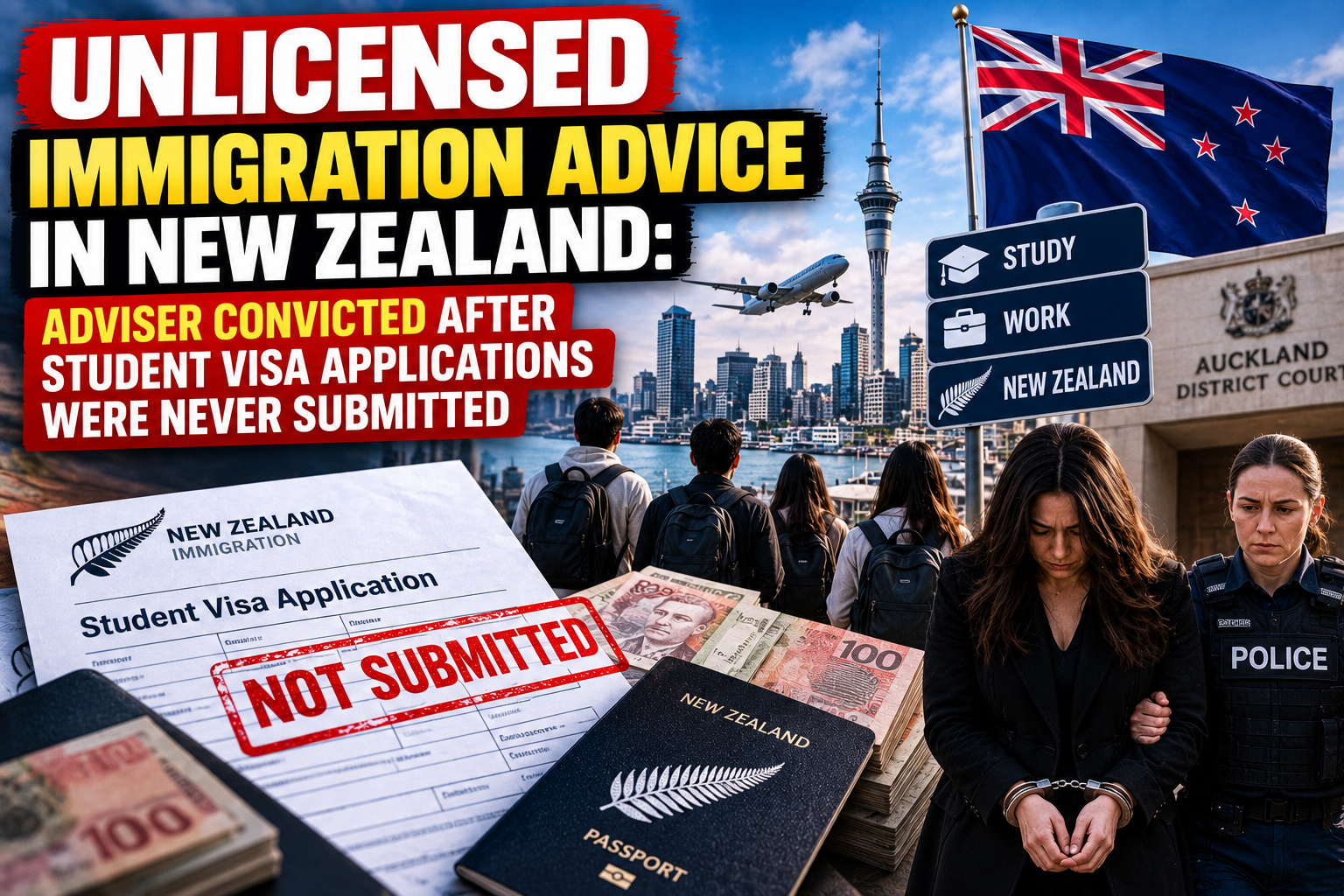
Four families paid tens of thousands of dollars for study and immigration packages in New Zealand, only to discover that many of their student visa applications had never been submitted. The case has resulted in convictions for two individuals accused of providing immigration advice without the required licence.
On September 15, 2026, Paola Walker-Rodriguez was found guilty in the Auckland District Court of 11 out of 12 charges under the Immigration Advisers Licensing Act 2007. Her husband and co-defendant, Mauro Donoso Godoy, was also found guilty of one charge of providing immigration advice without being licensed or exempt.
The case highlights the financial and personal consequences of unlicensed immigration advice in New Zealand, particularly for international students and families who rely on immigration advisers to navigate unfamiliar visa and education systems.
The convictions followed an investigation into complaints from Chilean citizens who purchased a programme marketed as “Study and Work in New Zealand.” Sentencing is scheduled for early 2027.
New Zealand Immigration Adviser Found Guilty of 11 Charges
On September 15, 2026, the Auckland District Court found Paola Walker-Rodriguez guilty of 11 of the 12 charges brought against her under the Immigration Advisers Licensing Act 2007.
The charges included:
- Providing immigration advice without being licensed or exempt.
- Holding herself out as an immigration adviser despite not being licensed or exempt.
- Asking for or receiving fees for providing immigration advice.
Her husband, Mauro Donoso Godoy, was found guilty of one charge of providing immigration advice without being licensed or exempt.
The case demonstrates the legal consequences associated with unlicensed immigration advice in New Zealand, where individuals who provide immigration advice must generally hold a licence unless they fall within a legally recognised exemption.
The court’s verdict followed complaints from families who said they had paid substantial amounts for immigration and education-related services that were not delivered as promised.
Four Families Paid Thousands for Study and Immigration Packages
Between March 2023 and May 2025, the Ministry of Business, Innovation and Employment (MBIE) received five complaints from Chilean citizens living in New Zealand.
The complainants had purchased a programme called “Study and Work in New Zealand” through Walker-Rodriguez’s companies, AIS.Walker and Walker Travel Education.
The packages were marketed as offering a range of services, including:
- Personalised immigration advice.
- Student visa application support.
- Assistance with studying in New Zealand.
- Guidance on living and working in the country.
Families paid substantial sums of money and made important decisions about their future based on the services and assurances they received.
However, the complaints revealed that some of the promised services had not been delivered.
The investigation ultimately led to the prosecution of Walker-Rodriguez and Godoy.
Student Visa Applications Were Not Submitted Despite Assurances
One of the most significant findings in the case involved student visa applications that had allegedly not been lodged with Immigration New Zealand.
When most of the affected individuals arrived in New Zealand, they discovered that their student visa applications had not been submitted, despite having been told by Walker-Rodriguez that their visas were being processed.
As a result, they were unable to access some of the study and work opportunities they had paid for and planned their move around.
The situation created uncertainty for families who had invested significant financial resources and made major life decisions based on the expectation that their immigration and education arrangements were progressing.
The case highlights the potential consequences of unlicensed immigration advice in New Zealand, particularly when individuals rely on assurances about visa applications without independently confirming their status.
Education Fees Allegedly Not Passed on to Institutions
The complaints also raised concerns about payments made for education-related services.
Some victims reportedly discovered that school or institute fees they had paid to Walker-Rodriguez had not been transferred to the education providers as promised.
This meant that affected individuals faced problems not only with their immigration arrangements but also with the educational opportunities they had expected to access.
For families moving to another country, unpaid education fees and unsubmitted visa applications can create significant financial and personal disruption.
The case underscores the importance of verifying both immigration arrangements and payments made to educational institutions.
Immigration Authorities Warn Against Unlicensed Advice
Bevan Yee, National Manager Occupational Regulation, said the case demonstrated the significant impact that unlicensed immigration advice can have on individuals and families making important decisions about their future.
Yee said the individuals involved had paid substantial amounts of money and made major decisions based on advice and assurances that proved to be false.
He also said the verdict reflected the seriousness of the harm caused and demonstrated that allegations of unlawful immigration advice would be investigated and, where appropriate, prosecuted.
Yee urged people seeking immigration advice and assistance to ensure they work with a licensed immigration adviser or a person legally exempt from licensing requirements under Section 11 of the Immigration Advisers Licensing Act 2007.
How to Check Whether a New Zealand Immigration Adviser Is Licensed
The Immigration Advisers Authority (IAA) regulates the provision of immigration advice in New Zealand and maintains the official register of licensed immigration advisers.
People can use the register to check whether an adviser is licensed before paying for immigration services.
The authority also allows individuals to ask advisers to show their digital licence certificates, which include a QR code linking to their public profile on the official register.
Before engaging an adviser, prospective clients should consider taking the following steps:
- Check the official register: Search for the adviser’s name in the Immigration Advisers Authority’s online register.
- Verify their licence: Ask to see their digital licence certificate and confirm the details.
- Confirm the scope of services: Understand exactly what immigration and education-related services are included in the package.
- Verify visa application status: Where possible, confirm that applications have been submitted through the appropriate official channels.
- Check education payments: Confirm directly with the school or institute that the required fees have been received.
These precautions can help reduce the risk of financial loss and disruption caused by unlicensed immigration advice in New Zealand.
Immigration Advisers Face Serious Penalties for Unlawful Advice
The Immigration Advisers Licensing Act 2007 establishes legal requirements for individuals providing immigration advice in New Zealand.
According to the authorities, individuals convicted of offences under the Act can face penalties of up to:
| Penalty | Maximum |
|---|---|
| Imprisonment | 7 years |
| Fine | NZD $100,000 |
The authorities have also warned that anyone providing immigration advice unlawfully should stop immediately.
Yee said the law was clear and that authorities would continue taking action against individuals who provide immigration advice unlawfully.
The convictions in this case demonstrate that unlicensed immigration advice in New Zealand can lead to criminal prosecution when the relevant legal requirements are breached.
Immigration New Zealand Highlights Cooperation Between Agencies
Aaron Smith, National Manager Risk and Verification for Immigration New Zealand, said the outcome reflected cooperation across different parts of the country’s immigration system.
Smith said Immigration New Zealand works closely with the Immigration Advisers Authority by providing information and supporting enquiries and investigations where appropriate.
He also highlighted the importance of protecting international students and their families, particularly those navigating unfamiliar education and immigration processes.
According to Smith, cooperation between immigration authorities helps prevent harm to migrants and protect the integrity of New Zealand’s immigration system.
The investigation into the complaints ultimately led to the prosecution and convictions of Walker-Rodriguez and Godoy.
Sentencing Scheduled for Early 2027
Following the September 15, 2026, verdict, sentencing for Walker-Rodriguez and Godoy is scheduled for early 2027.
Walker-Rodriguez was convicted on 11 of 12 charges, while Godoy was convicted on one charge of providing immigration advice without being licensed or exempt.
The case serves as a reminder that people seeking immigration assistance should verify an adviser’s credentials and ensure that promised services are being delivered.
For prospective international students and their families, checking an adviser’s licensing status and independently confirming visa and education arrangements can help prevent financial losses and disruptions to their plans.
FAQs : Unlicensed Immigration Advice in New Zealand
1. Who was convicted in the New Zealand immigration advice case?
Paola Walker-Rodriguez was found guilty of 11 of 12 charges under the Immigration Advisers Licensing Act 2007. Her husband, Mauro Donoso Godoy, was found guilty of one charge of providing immigration advice without being licensed or exempt.
2. When were the convictions announced?
The Auckland District Court found Walker-Rodriguez and Godoy guilty on September 15, 2026.
3. What happened to the student visa applications?
Many of the affected individuals reportedly discovered after arriving in New Zealand that their student visa applications had not been submitted, despite being told that their applications were being processed.
4. How many complaints were received in Unlicensed Immigration Advice in New Zealand?
The Ministry of Business, Innovation and Employment received five complaints from Chilean citizens living in New Zealand between March 2023 and May 2025.
5. What were the study packages called?
The packages were marketed as “Study and Work in New Zealand” and were sold through Walker-Rodriguez’s companies, AIS.Walker and Walker Travel Education.
6. How can people verify an immigration adviser’s licence?
People can search the official Immigration Advisers Authority register or ask the adviser to show their digital licence certificate, which includes a QR code linking to their public profile.
7. What penalties can apply to unlawful immigration advice?
Individuals convicted of offences under the Immigration Advisers Licensing Act 2007 can face up to seven years in prison and fines of up to NZD $100,000.
8. When is sentencing scheduled?
Sentencing is scheduled for early 2027.
Final Takeaway On Unlicensed Immigration Advice in New Zealand
The convictions of Paola Walker-Rodriguez and Mauro Donoso Godoy highlight the risks associated with unlicensed immigration advice in New Zealand.
Four families paid substantial sums for study and immigration packages, only to discover that visa applications had not been submitted and that some education fees had not reached the institutions as promised.
With sentencing scheduled for early 2027, the case reinforces the importance of checking an adviser’s credentials through the official Immigration Advisers Authority register before paying for immigration services.
Source : Official NZ Immigration
Read About : New Zealand Visitor Visa Application Changes From 24 September 2026: What Applicants Need to Know

2 thoughts on “Unlicensed Immigration Advice in New Zealand 2026: Adviser Convicted After Student Visa Applications Were Never Submitted”