
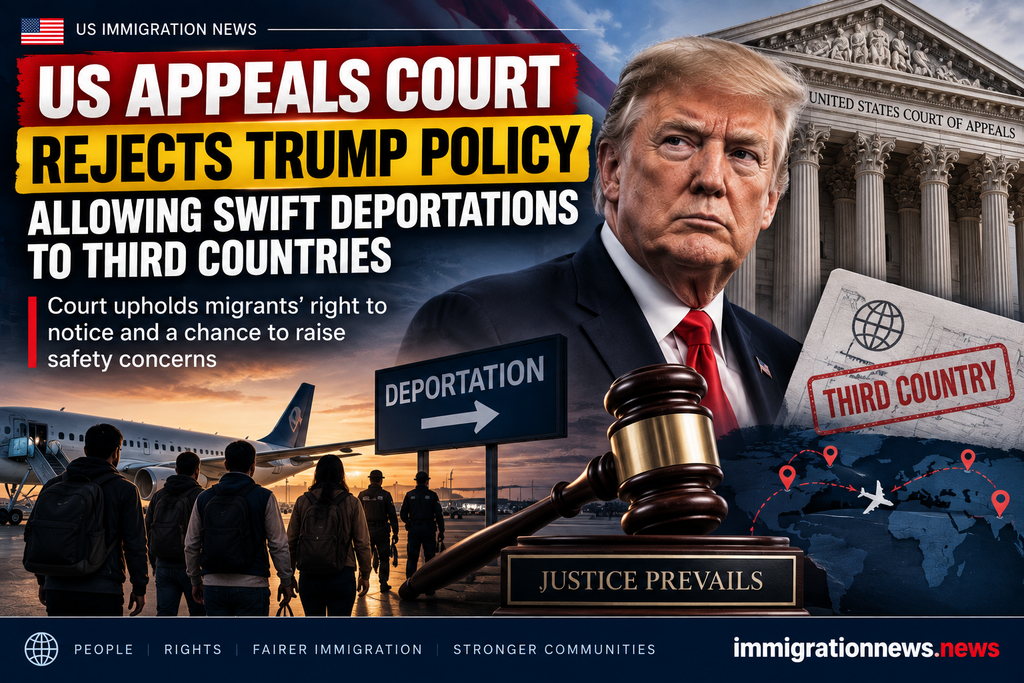
A US federal appeals court has rejected the Trump administration’s third-country deportation policy, ruling that migrants facing removal to countries other than their own must receive adequate notice and a meaningful opportunity to raise concerns about possible persecution or torture.
The September 18, 2026 decision by a three-judge panel of the US Court of Appeals for the First Circuit largely upheld a February ruling by US District Judge Brian Murphy, who had found the Department of Homeland Security (DHS) policy unlawful.
The ruling is significant because the administration has used agreements with multiple countries to facilitate the removal of migrants who cannot immediately be sent to their countries of origin. Reuters reported that more than 25,000 migrants have been sent to at least 29 third countries under such arrangements.
What Did the Appeals Court Rule?
The central issue in the third-country deportation policy case was whether DHS could remove a person to a country that was not identified in the person’s removal proceedings without giving them sufficient notice and an opportunity to challenge the destination.
The First Circuit largely agreed with Judge Murphy that migrants must have a meaningful opportunity to raise a fear-based claim before being removed to a third country.
Judge Seth Aframe, writing for the unanimous panel, said the government’s interpretation would deny that protection to people sent to third countries without knowing where they were going in advance.
The court therefore upheld the core requirement that DHS provide:
- Effective notice of the intended third-country destination.
- A meaningful opportunity to contest removal to that country.
- An opportunity to raise concerns involving potential persecution or torture.
The decision was unanimous among the three judges on the panel.
What Is the Third-Country Deportation Policy?
The third-country deportation policy was introduced by DHS in 2025 for migrants who had final removal orders but could not be returned to their countries of origin because they had received certain protections against removal.
Under the policy, DHS sought to send some individuals to alternative countries.
The administration’s position was that diplomatic assurances from receiving countries could address concerns about persecution or torture. The policy also contemplated limited notice in certain circumstances, including cases where the receiving country had not provided assurances to the State Department.
The litigation challenged whether those procedures provided enough protection under US immigration law.
Why Did the Court Find the Policy Unlawful?
The court focused on the practical consequences of removing someone to an unfamiliar country without adequate notice.
A person who does not know the destination may have little or no meaningful opportunity to explain why removal to that particular country could expose them to persecution or torture.
The First Circuit said the applicable immigration laws already provide protections for people who fear persecution or torture and rejected the government’s proposed interpretation that would substantially limit access to those protections for third-country removals.
The court’s decision therefore did not simply concern whether DHS could use third countries. Instead, it focused on what procedural protections must be provided before such a removal occurs.
Court Keeps One Part of Lower Ruling From Taking Effect
The appeals court did not uphold every part of Judge Murphy’s February ruling.
One requirement concerned the sequence in which DHS must consider possible destinations.
Judge Murphy had required the government to first seek removal to countries designated by the individual or countries of which the person was a national, citizen or subject before considering a third country.
The First Circuit overturned that particular portion on procedural grounds.
The court nevertheless maintained the central due-process requirements concerning notice and the opportunity to raise fear-based objections.
The ruling can therefore be summarized as follows:
| Issue | Appeals court ruling |
|---|---|
| Removal to a third country | Not prohibited outright |
| Notice of destination | Required |
| Opportunity to challenge destination | Required |
| Fear of persecution/torture claim | Must receive meaningful consideration |
| Mandatory priority for home/tied countries | Lower-court requirement overturned |
| Core DHS streamlined procedure | Largely rejected |
More Than 25,000 Migrants Sent to Third Countries
The case has broader significance because third-country removals have become an important component of the administration’s immigration enforcement strategy.
Reuters reported that more than 25,000 migrants had been sent to at least 29 third countries, with Mexico among the destinations used.
Other countries identified in reporting on the administration’s third-country arrangements include:
- Uganda
- Equatorial Guinea
- Liberia
- Central African Republic
- Mexico
The use of these arrangements has allowed the US government to remove individuals even when returning them directly to their countries of origin presents practical or legal complications.
The appeals court decision does not prohibit the government from negotiating or using third-country arrangements altogether. Instead, it places procedural requirements on removals covered by the ruling.
The Case Began With a Class-Action Lawsuit
The litigation, known as D.V.D. v. U.S. Department of Homeland Security, was brought as a class action by migrants facing removal to countries that were not identified in their original removal proceedings.
The plaintiffs argued that the government’s procedures did not provide adequate notice or an opportunity to raise country-specific protection claims.
Judge Brian Murphy initially issued protections for the migrants in 2025. The Supreme Court subsequently intervened on two occasions during the earlier stages of the litigation, allowing the government to proceed with certain removals while the broader legal dispute continued.
Murphy eventually issued a final judgment in February 2026, setting aside the DHS policy. The Trump administration appealed that decision, leading to the September 18 First Circuit ruling.
What DHS Says About the Decision
The government has indicated that it does not interpret the ruling as immediately ending the policy.
DHS General Counsel James Percival said on X that the third-country deportation policy remains in force because the First Circuit’s decision was not yet effective at the time of his statement.
He also argued that DHS has authority to send someone to another country when the individual claims fear of returning to their home country.
The government’s interpretation could become an important issue as the litigation continues.
Administration Expected to Continue the Legal Fight
The third-country deportation policy case could ultimately reach the US Supreme Court.
The administration has already sought Supreme Court intervention during earlier stages of the dispute. The appeals court decision now provides another potential avenue for government appeals, including a request for review by the full First Circuit or the Supreme Court.
That means the September 18 decision may not be the final word on the government’s authority to conduct third-country removals.
For now, however, the First Circuit’s ruling establishes important procedural requirements within the scope of the case.
What the Ruling Means for Migrants Facing Removal
For migrants covered by the decision, the most significant issue is the destination country.
If DHS intends to remove someone to a third country that was not part of the person’s earlier removal proceedings, the person must receive information about the destination and a meaningful opportunity to explain why removal there could expose them to persecution or torture.
This distinction is important.
The ruling does not create a general right to remain permanently in the United States simply because a person objects to a third-country destination.
Instead, it requires the government to follow the applicable procedural safeguards before carrying out covered removals.
Third-Country Deportation Policy and Due Process
The debate surrounding the third-country deportation policy ultimately centers on the relationship between immigration enforcement and due-process protections.
The administration has argued that streamlined removals are necessary to execute valid removal orders and manage individuals who cannot easily be returned to their home countries.
The plaintiffs, meanwhile, argued that migrants need a meaningful opportunity to raise country-specific safety concerns before being transported somewhere unfamiliar.
The First Circuit largely accepted the latter legal interpretation, concluding that existing immigration law requires meaningful procedural protection before covered third-country removals.
What Happens Next?
Several developments could determine the future of the third-country deportation policy:
1. Government appeal
The Trump administration could seek further review, potentially asking the full First Circuit or the Supreme Court to consider the case.
2. Implementation of the First Circuit ruling
Questions may arise over when and how the decision takes effect and how DHS applies the notice and opportunity-to-contest requirements.
3. Future third-country agreements
The US government may continue negotiating arrangements with other countries, but removals covered by the ruling would remain subject to the procedural requirements identified by the court.
4. Possible Supreme Court review
Because the case involves the government’s authority to remove migrants to countries not identified in their original proceedings, Supreme Court review could ultimately determine the longer-term legal framework.
FAQs : Third-Country Deportation Policy
What is the third-country deportation policy?
The third-country deportation policy refers to DHS procedures allowing certain migrants with final removal orders to be sent to countries other than their countries of origin.
What did the US appeals court decide?
The First Circuit largely upheld a lower-court ruling that found the DHS policy unlawful because migrants must receive effective notice and a meaningful opportunity to challenge removal to a third country based on fear of persecution or torture.
Does the ruling ban all third-country deportations?
No. The decision does not prohibit third-country removals altogether. It requires procedural protections before covered removals can occur.
How many migrants have been sent to third countries?
Reuters reported that more than 25,000 migrants had been sent to at least 29 third countries under arrangements established during the Trump administration.
Can the Trump administration appeal?
Yes. The government is expected to continue challenging the ruling, and the case could potentially reach the US Supreme Court.
What happens if a migrant fears persecution in the third country?
Under the First Circuit’s ruling, the migrant must receive a meaningful opportunity to raise that fear before being removed to the third country covered by the ruling.
Final Takeaway On Third-Country Deportation Policy
The September 18, 2026 First Circuit ruling places significant procedural limits on the third-country deportation policy while leaving the broader concept of third-country removals intact.
The court largely upheld the requirement that migrants receive effective notice of their intended destination and a meaningful opportunity to raise concerns about persecution or torture. At the same time, it overturned the lower court’s separate requirement that DHS prioritize countries with which migrants have an established connection.
The administration has indicated that it intends to continue defending its authority, making further litigation possible.
For migrants facing removal, the immediate significance of the ruling is that being sent to a country they have no connection with cannot, under the court’s ruling, be carried out through a process that denies them meaningful notice and an opportunity to raise relevant protection claims.
Source : Reuters
Read About : USCIS Form Changes September 15, 2026: Old I-539 & I-765 Editions to Be Rejected Without Grace Period