
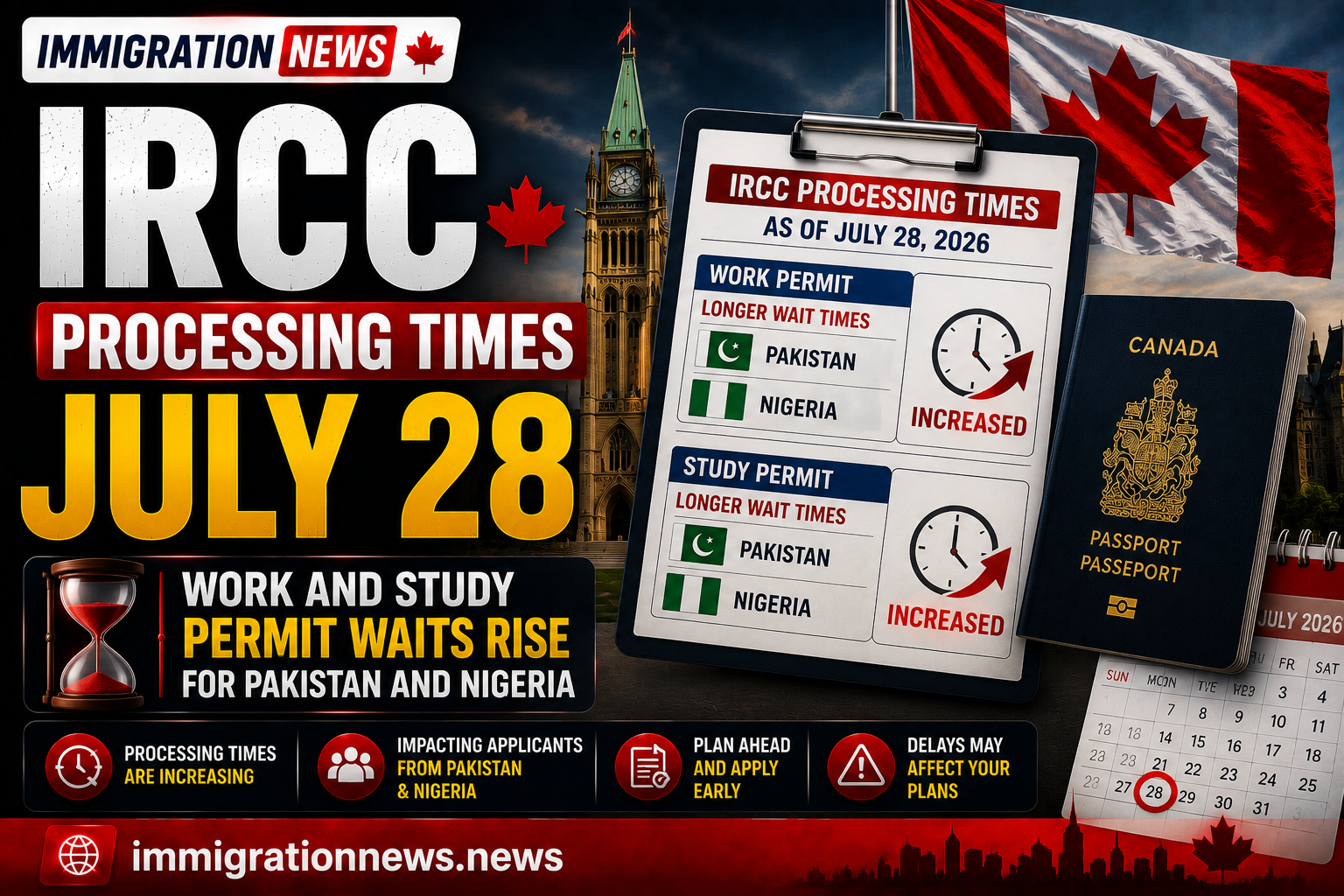
Canada’s immigration department has released updated figures showing wait times generally trending upward across multiple temporary residence categories. The IRCC processing times July 28 update, current as of that date, shows study and work permit wait times rising by one week for applicants in both Pakistan and Nigeria, alongside modest increases in visitor visa and super visa processing.
This week’s data compares processing-time estimates for newly submitted applications between July 22 and July 28, 2026. Canada is expected to release its next temporary residence processing times update on or around August 5, 2026.
Quick Highlights : IRCC Processing Times July 28
- IRCC processing times July 28 show work permit waits rising for Pakistan (10 to 11 weeks) and Nigeria (6 to 7 weeks)
- Study permit processing broke a four-week streak of stability, rising for Pakistan and Nigeria by one week each
- In-Canada work permit processing improved slightly, dropping from 122 to 120 days
- Visitor visa processing from within Canada improved from 29 to 24 days
- Super visa wait times increased slightly across most countries except the United States, which held steady at 124 days
- IRCC has finalized more than 1.2 million temporary residence applications in the first five months of 2026
- Over 404,000 temporary residence applications remained pending as of May 31
Work Permits: Mixed Results Across Key Countries
The IRCC processing times July 28 data shows work permit processing shortened for applications submitted from within Canada and the Philippines, but lengthened by one full week for both Pakistan- and Nigeria-based submissions.
| Applying From | Current (July 28) | Previous (July 22) |
|---|---|---|
| Canada | 120 days | 122 days |
| India | 9 weeks | 9 weeks |
| Pakistan | 11 weeks | 10 weeks |
| Nigeria | 7 weeks | 6 weeks |
| United States | 3 weeks | 3 weeks |
| Philippines | 6 weeks | 7 weeks |
The service standard for in-Canada submissions remains 120 days, meaning the current figure now sits precisely at the department’s own internal target following this week’s improvement. India and the United States held steady with no change, while the Philippines saw a one-week improvement, dropping from 7 to 6 weeks.
Study Permits: A Four-Week Stability Streak Breaks
Perhaps the most notable shift in this IRCC processing times July 28 release involves study permits, which had held steady for four consecutive weeks before this update. That stability broke this week, with both Pakistan and Nigeria seeing processing times climb by one week.
| Applying From | Current (July 28) | Previous (July 22) |
|---|---|---|
| Canada | 7 weeks | 7 weeks |
| India | 5 weeks | 5 weeks |
| Pakistan | 7 weeks | 6 weeks |
| Nigeria | 6 weeks | 5 weeks |
| United States | 5 weeks | 5 weeks |
| Philippines | 4 weeks | 4 weeks |
Canada, India, the United States, and the Philippines all held flat in this update, with Pakistan and Nigeria representing the only two countries to see any movement at all in the study permit category this cycle.
Visitor Visas: Small Gains for Canada and the U.S.
Visitor visa figures in this IRCC processing times July 28 update show a generally positive trend for in-Canada and U.S.-based applicants, while most other countries recorded relatively minor increases.
| Applying From | Current (July 28) | Previous (July 22) |
|---|---|---|
| Canada | 24 days | 29 days |
| India | 22 days | 21 days |
| Pakistan | 43 days | 40 days |
| Nigeria | 64 days | 63 days |
| United States | 26 days | 27 days |
| Philippines | 17 days | 16 days |
In-Canada visitor visa processing improved meaningfully, dropping five full days from 29 to 24 days. The United States also saw a modest one-day improvement. India, Pakistan, Nigeria, and the Philippines all recorded small increases, though none exceeded a few days.
Super Visas: Steady Climb Except for the U.S.
Super visa processing times in the IRCC processing times July 28 release increased for every tracked country except the United States, which held perfectly steady at 124 days.
| Applying From | Current (July 28) | Previous (July 22) |
|---|---|---|
| India | 52 days | 49 days |
| Pakistan | 196 days | 194 days |
| Nigeria | 41 days | 39 days |
| United States | 124 days | 124 days |
| Philippines | 73 days | 68 days |
Pakistan continues to hold the highest super visa processing time of any tracked country by a wide margin, now sitting at 196 days—well above the official 112-day service standard. India’s processing time rose by three days to 52 days, while the Philippines saw the largest single increase of any country in this category, climbing five days to 73 days.
Understanding What These Figures Actually Mean
IRCC’s processing times and service standards are two genuinely distinct concepts that shouldn’t be conflated when interpreting the IRCC processing times July 28 release. Processing times are published to help applicants gauge how long the department may realistically take to finalize a newly submitted application—but these figures are provided for general reference only. They are not maximums, and they are not guarantees that any particular application will be finalized within the stated window.
IRCC calculates processing times in two distinct ways. Historical estimates are based on how long it actually took the department to finalize 80% of applications completed in the past. Forward-looking estimates, by contrast, are calculated using the current number of applications awaiting processing combined with the department’s available capacity.
Service standards operate differently altogether. These are internal performance targets IRCC sets for itself, outlining how quickly the department aims to finalize a particular application type under normal conditions—again, generally targeting 80% of cases. A specific application may ultimately take more or less time than either the published processing estimate or the applicable service standard, depending on case complexity, existing backlogs, operational capacity, requests for additional information, or the need for further assessment.
It’s also worth noting the different update cadences involved: temporary residence processing times, like those covered in this IRCC processing times July 28 release, are updated weekly, while permanent residence and citizenship estimates are typically refreshed only once a month. Service standards themselves follow an even less frequent review cycle—temporary residence service standards, for instance, were last formally revised back in 2018–2019.
The Bigger Picture: Volume and Backlog
Beyond the specific country-by-country figures, this IRCC processing times July 28 update arrives alongside broader volume data that provides useful context. IRCC has finalized more than 1.2 million temporary residence applications in the first five months of 2026 alone, demonstrating substantial processing throughput even as individual wait times fluctuate week to week. At the same time, more than 404,000 temporary residence applications remained pending as of May 31, illustrating the scale of the ongoing workload the department continues managing.
What Applicants Should Do Now
Given the upward movement across multiple categories in this IRCC processing times July 28 release, applicants from Pakistan and Nigeria specifically should build additional buffer time into their travel or study planning, since both countries saw increases across multiple application types this cycle.
Applicants planning to submit visitor visa applications from within Canada should note the meaningful improvement in that specific category, which may make timing an in-Canada submission more favourable currently than in recent weeks. Super visa applicants from Pakistan should be particularly aware of the persistently elevated wait time in that country, now nearly double the 112-day service standard.
As always, applicants should treat these figures as planning benchmarks rather than guarantees, and should check IRCC’s official processing times page close to their intended submission date given how frequently these figures shift week to week.
Key Takeaways Of IRCC Processing Times July 28
This week’s IRCC processing times July 28 release shows a system trending mostly upward, with work and study permit processing lengthening for both Pakistan and Nigeria, and super visa wait times climbing across nearly every tracked country except the United States. Some bright spots remain, including improved in-Canada work and visitor visa processing. With the next update expected around August 5, 2026, applicants across all temporary residence categories should continue monitoring these figures closely and factor realistic buffer time into their application timelines.
FAQs : IRCC Processing Times July 28
What changed in the IRCC processing times July 28 update?
Work and study permit wait times rose by one week for applicants in Pakistan and Nigeria, while in-Canada work and visitor visa processing improved. Super visa wait times increased for all countries except the United States.
Why did super visa processing take so long for Pakistan-based applicants?
Pakistan’s super visa processing time reached 196 days in this update, well above the official 112-day service standard, continuing a trend of elevated wait times for this country throughout 2026.
How often does IRCC update temporary residence processing times?
Temporary residence processing times, including those covered in this IRCC processing times July 28 release, are updated weekly. Permanent residence and citizenship processing times are updated monthly.
Are IRCC processing times a guarantee of how long my application will take?
No. IRCC explicitly states these figures are for general reference only, not maximums or guarantees. Individual timelines can vary based on case complexity, backlogs, and requests for additional information.
When is the next IRCC processing times update expected?
IRCC is expected to release its next temporary residence processing times update on or around August 5, 2026.
Source : CIC News
Read About : Canada Study Permit Financial Checks 2026 Tightened For All Applicants



One thought on “IRCC Processing Times July 28: Work And Study Permit Waits Rise For Pakistan, Nigeria”