
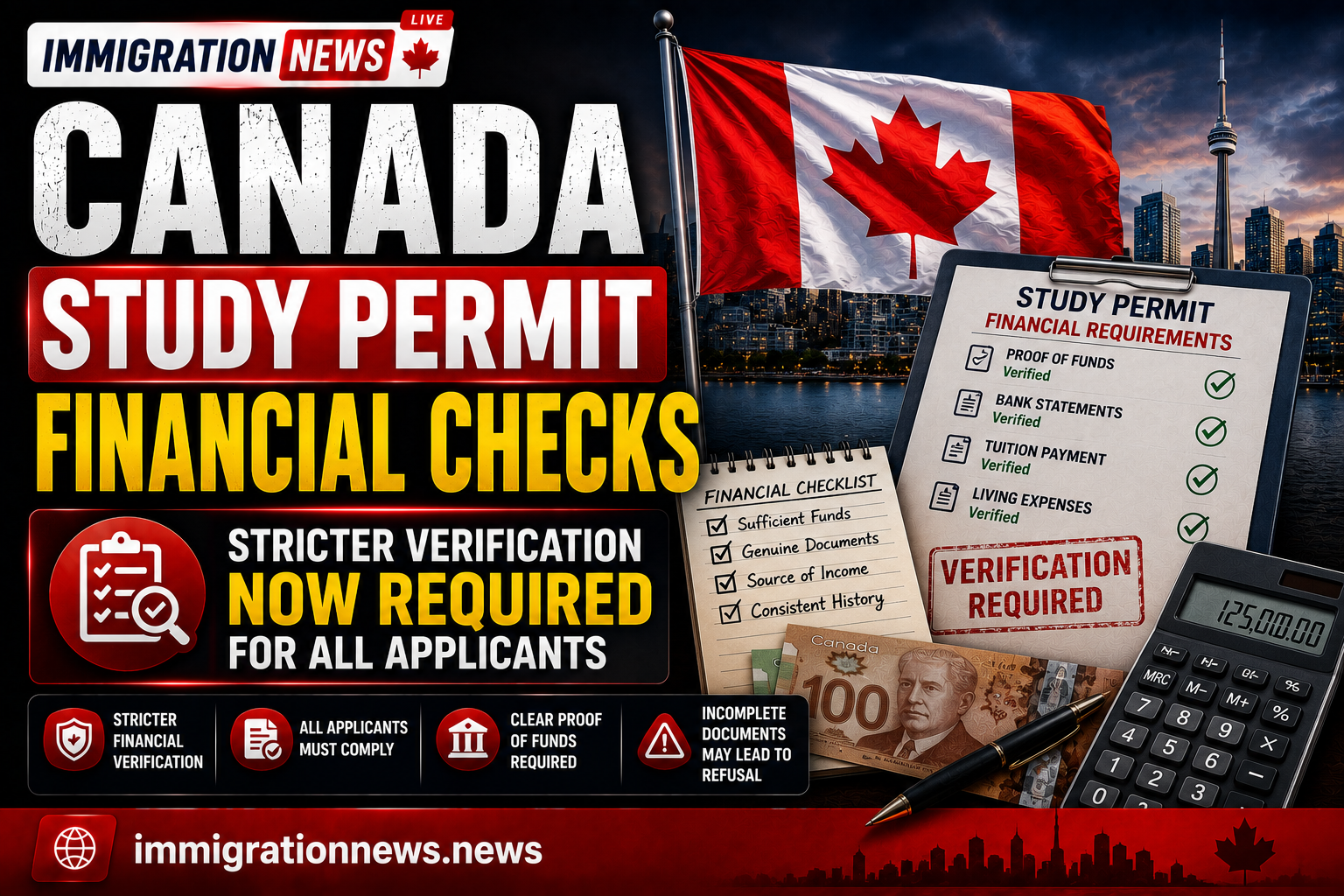
Canada has significantly toughened how immigration officers scrutinize the money behind every study permit application. New Canada study permit financial checks, detailed in updated officer instructions published on July 24, 2026, remove key qualifying language that previously limited deeper financial scrutiny to only the highest-risk cases—now requiring officers to assess the source of funds in every single application, without exception.
The updated instructions, titled “Study permits: Assessing the application,” represent a meaningful shift in how thoroughly Canada verifies that prospective international students can genuinely support themselves throughout their studies.
Quick Highlights : Canada Study Permit Financial Checks
- Canada study permit financial checks now require officers to assess the source of funds in all cases, not just high-risk applications
- The phrase limiting supplementary document review to “very high-risk environments” has been deleted entirely
- Officer discretion to request additional documents is now based on “the facts of the application” rather than known risk profiles
- Proof of funds documentation now requires six months of bank statements, up from four months previously
- Study permit renewals must now assess funds based on the first year following the extension
- Pension income and rental property income have been added as new acceptable proof of funds examples
- The required minimum funding amount itself remains unchanged at $22,895 for a sole applicant outside Quebec
What Changed in the Canada Study Permit Financial Checks
The most consequential shift in these Canada study permit financial checks is the removal of a key qualifying phrase from the previous officer instructions. Previously, digging into supplementary financial and employment documentation was suggested only “in some very high-risk environments”—language that gave officers a narrower, risk-targeted mandate for deeper scrutiny.
That qualifier has now been deleted entirely. The updated instructions state without qualification that “reviewing and verifying” supplementary individual or family financial and employment documentation “may be necessary to ensure that only genuine students capable of supporting themselves for the full duration of their program of studies are granted study permits.” In practical terms, this means officers now have a considerably broader mandate to dig deeper into an applicant’s finances, regardless of whether that applicant’s profile would previously have been flagged as high-risk.
A related shift reinforces this broader scrutiny: officer discretion to request additional supporting documents is now to be exercised based on “the facts of the application,” rather than “based on the known incidence of indigent and non-bona fide applicants,” as the previous version stated. This represents a move away from profiling based on aggregate risk patterns toward individualized assessment of each application on its own merits.
Bank Statement Requirements Have Expanded
Among the concrete procedural changes within these Canada study permit financial checks, the documentation window itself has grown. The updated instructions now suggest six months of bank statements as proof of funds, including “the month or month prior” to when the application was submitted. This replaces the previous standard, which called for only four months of bank statements—a 50% increase in the documentation window officers expect to review.
For study permit renewals specifically, the updated guidance introduces a new requirement: the amount of funds must now be assessed based on the first year following the extension, rather than simply confirming the applicant’s original funding calculation remains valid.
New and Removed Examples of Acceptable Proof of Funds
The revised Canada study permit financial checks framework also updates the specific types of documentation officers may accept as proof of funds. Two new examples have been added that weren’t previously included: pension income and income from rental properties. This expansion gives applicants—and particularly the families supporting them—additional legitimate avenues to demonstrate sufficient financial capacity.
At the same time, one previous example has been removed. A bank draft that can be converted to Canadian dollars, which appeared in the prior version of the instructions, no longer appears among the listed examples of acceptable proof of funds documentation.
The Required Funding Amount Itself Hasn’t Changed
Despite the substantially increased scrutiny embedded in these Canada study permit financial checks, one important element remains untouched: the actual dollar amount applicants must demonstrate. Applicants are still required to show a fixed amount covering a full year of financial support, on top of separate funds required for tuition and travel to and from Canada.
This required amount varies based on several factors: the size of the applicant’s family, whether they intend to study inside or outside Quebec, and whether they are applying under the standard study permit stream or a specific initiative such as the Francophone Minority Communities Student Pilot (FMCSP) or an active temporary public policy. As of the time of writing, a sole applicant with no family members intending to study outside Quebec under the standard stream must demonstrate $22,895 in available funds, according to the government’s official proof of financial support webpage. This figure is typically increased annually in proportion to Canada’s rising cost of living.
Why Canada Is Tightening Financial Scrutiny Now
The updated Canada study permit financial checks arrive within a much broader context of intensifying scrutiny across Canada’s entire immigration system, with the international student program and asylum process both facing heightened attention this year.
A report published by Canada’s Auditor General on March 23, 2026 revealed a striking enforcement gap: between 2023 and 2024, the immigration department had flagged more than 153,000 students for non-compliance, yet had funding to investigate only 2,000 cases annually. This massive disparity between flagged cases and actual investigative capacity has likely informed the department’s decision to shift enforcement further upstream—tightening verification at the application stage rather than relying solely on downstream compliance investigations that the department simply cannot scale to match demand.
This financial scrutiny update also follows several other significant 2026 reforms. On March 26, 2026, Canada’s federal government passed major immigration law reforms authorizing the Governor in Council to mass terminate applications and mass cancel immigration documents, alongside introducing two new asylum bans—one covering claims filed over a year after an applicant’s first entry to Canada, and another targeting claims filed by irregular crossers at the Canada-US border. Separately, in June 2026, the immigration department published new instructions for assessing language test results, including additional verification checks such as cross-referencing photographs.
The Broader Decline in International Student Numbers
These Canada study permit financial checks are being implemented against a backdrop of dramatically falling international student arrivals. The number of international students arriving in Canada in 2026 has fallen by 70% relative to 2024—a decrease of 225,335 students, based on data covering January through May, the most recent period available on the government’s temporary resident numbers webpage.
This steep decline suggests that tightened financial scrutiny is just one piece of a much larger, coordinated effort by Canada to substantially reduce and more carefully control international student volume, rather than an isolated administrative adjustment.
What Prospective Students Should Do Now
Given these updated Canada study permit financial checks, prospective applicants should prepare considerably more thorough financial documentation than may have been necessary in previous application cycles. This means gathering a full six months of bank statements, including the most recent month before submission, rather than the previously sufficient four-month window.
Applicants relying on family financial support should ensure the source of those funds is clearly documented and traceable, since officers can now request supplementary verification in any application, not just those flagged as higher-risk. Those planning to demonstrate financial capacity through pension or rental income should prepare clear supporting documentation for these newly recognized income sources. Applicants seeking a study permit renewal should also be prepared to demonstrate sufficient funds specifically for the first year following their extension, rather than assuming their original financial documentation remains sufficient.
Key Takeaways On Canada Study Permit Financial Checks
The updated Canada study permit financial checks represent a meaningful tightening of how thoroughly immigration officers scrutinize applicant finances, removing previous language that limited deep verification to high-risk cases and instead applying this scrutiny universally across all applications. While the actual required funding amounts remain unchanged, the expanded documentation window, new proof of funds examples, and removal of risk-based qualifiers together signal a system moving toward more individualized, rigorous verification for every study permit applicant. This shift fits within a broader pattern of 2026 reforms addressing compliance gaps across Canada’s immigration system, occurring alongside a dramatic 70% decline in international student arrivals this year.
FAQs : Canada Study Permit Financial Checks
What changed in the Canada study permit financial checks update?
Officers must now assess the source of funds in all applications, not just high-risk cases. Bank statement requirements increased from four to six months, and pension and rental income were added as acceptable proof of funds examples.
Did the required funding amount for a study permit change?
No. The minimum required amount remains $22,895 for a sole applicant outside Quebec, unchanged from before this update, though it typically rises annually with cost of living increases.
Why is Canada tightening study permit financial verification now?
The update follows an Auditor General report revealing IRCC had flagged over 153,000 students for non-compliance but could only investigate 2,000 cases annually, prompting a shift toward stricter upfront verification.
Do study permit renewals face the same financial scrutiny?
Yes. Renewal applicants must now demonstrate sufficient funds specifically for the first year following their extension, under the updated Canada study permit financial checks guidance.
How much have international student arrivals declined in 2026?
International student arrivals from January through May 2026 fell 70% compared to the same period in 2024, a decrease of 225,335 students.
Source : CIC News
Read About : Canada Online Passport Renewal 2026 Now Fully Available Nationwide

3 thoughts on “Canada Study Permit Financial Checks 2026 Tightened For All Applicants”