
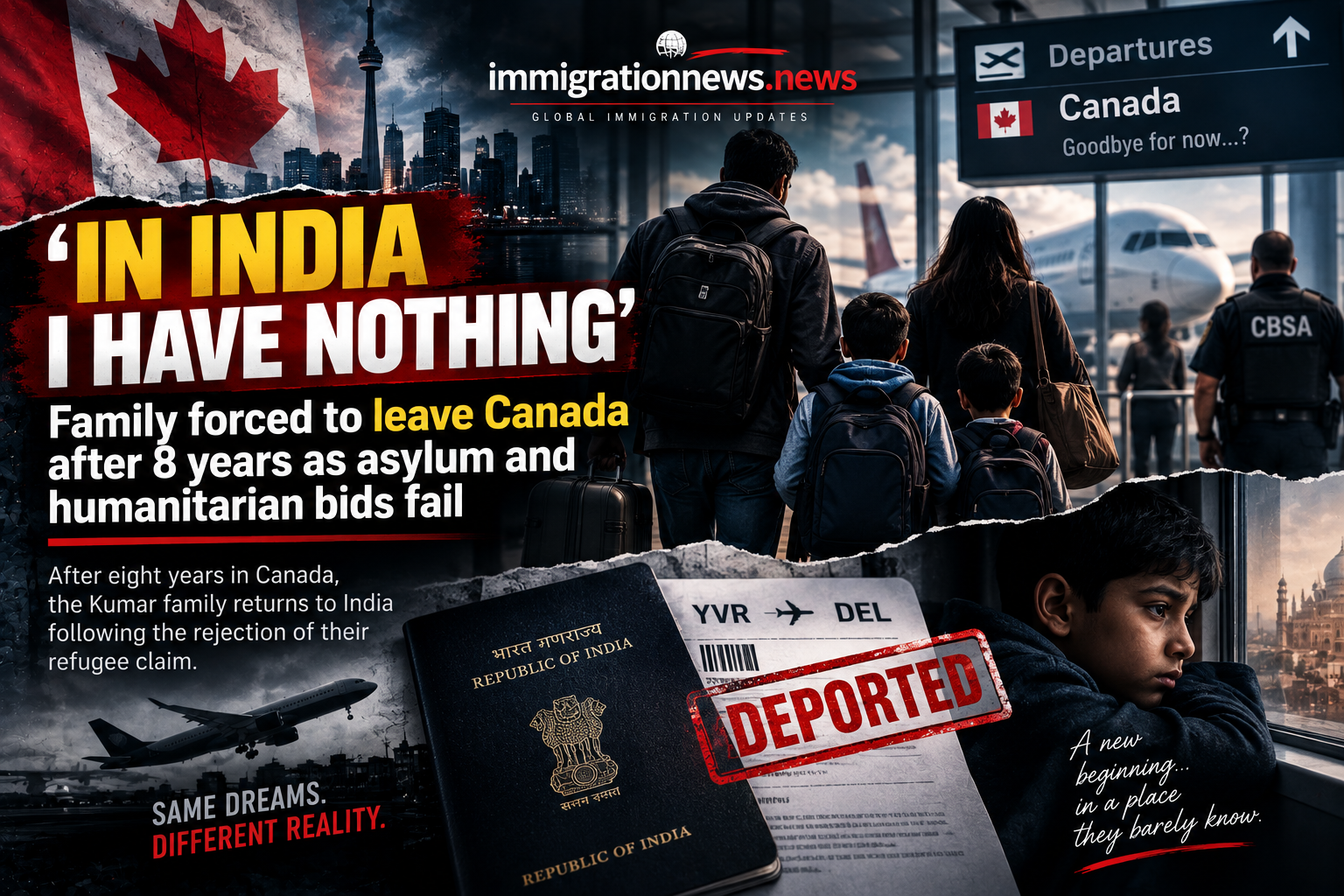
Kumar Family Canada Removal : After eight years of building a life in Quebec, the Kumar family has returned to India after its refugee claim and humanitarian and compassionate application were refused. Their two sons, who spent most of their childhood in Canada, now face starting over in a country they say they barely know.
The Kumar family’s eight-year stay in Canada has ended with a return to India after their refugee claim was rejected and subsequent efforts to remain in the country failed.
The family arrived in Canada in April 2018 and sought asylum after Harish Kumar said he left India because he believed his life was at risk.
After the refugee claim was refused, the family also pursued a humanitarian and compassionate (H&C) application and later sought judicial review. However, the family ultimately boarded a flight to India on September 7, 2026.
Speaking to CTV News before departure, Harish Kumar said he was devastated by the outcome.
“I’m very sad.”
For the family’s two young sons, the removal represents an especially difficult transition after spending most of their childhood in Quebec.
Family Spent Eight Years Building a Life in Quebec
The Kumar family arrived in Canada in 2018 and established their life in Quebec over the following eight years.
Harish worked as a truck driver, and supporters of the family highlighted his contribution during the COVID-19 pandemic.
But despite the family’s long residence in Quebec, their immigration status remained unresolved.
The family’s refugee claim was ultimately rejected. They were informed on August 4, 2026, that they would have to leave Canada on September 7.
The family then faced the difficult reality of leaving a country where their children had grown up.
‘I Grew Up Here’: Son Says He Has Nothing in India
The impact of the decision has been particularly emotional for the family’s children.
Fourteen-year-old Japesh Kumar was only six years old when he arrived in Canada. Quebec became the place where he spent most of his childhood, attended school and built friendships.
Speaking to CTV News, Japesh described the difficulty of returning to a country he barely remembers.
“I grew up here. I have friends here … in India, I have nothing.”
His 12-year-old brother, Gouresh, is facing a similar transition.
Having spent much of his childhood in Quebec, he will now have to adapt to a different country, education system, environment and social life.
For both children, India is not necessarily the place they remember as home.
Canada is where they grew up.
Refugee Claim Was Rejected After Years in Canada
The family initially sought refugee protection after arriving in Canada.
Harish said he believed his life was at risk in India and sought protection in Canada on that basis.
However, the family’s refugee claim was eventually refused.
Canadian immigration rules provide several possible avenues for rejected asylum claimants, depending on their circumstances, including certain appeals, pre-removal risk assessments and Federal Court judicial review.
A Federal Court judicial review is not the same as a new refugee hearing. According to the federal government, the Court examines whether the underlying decision was unfair, unreasonable or involved an error of law.
The Kumar family pursued judicial review after the other immigration options failed, but the legal challenge did not prevent the family from leaving Canada.
Humanitarian and Compassionate Application Also Refused
The family also attempted to remain in Canada through a humanitarian and compassionate application.
H&C applications can consider exceptional circumstances, including how established a person is in Canada, family ties and the best interests of children.
The Kumar family argued that their long residence in Quebec and the circumstances of their children should be considered.
However, the H&C application was refused.
Importantly, an H&C application does not automatically stop a removal order. Canada’s official guidance states that a person under a removal order may still have to leave Canada while an H&C application is being processed.
Harish’s Wife Was Detained by CBSA
The final days before the family’s departure were also difficult.
Harish told CTV News that his wife had been detained by the Canada Border Services Agency (CBSA) the previous week.
The family was then required to leave Canada on September 7.
Under Section 48 of Canada’s Immigration and Refugee Protection Act, a removal order becomes enforceable when it has come into force and is not stayed. Once enforceable, the law states that the person must leave Canada and the order must be enforced as soon as possible.
Supporters Question Removal After Eight Years
The family received support from Mostafa Henaway of the Immigrant Workers Centre, who questioned whether removing the family after eight years in Quebec was appropriate.
Henaway pointed to Harish’s work as a truck driver and his role during the COVID-19 pandemic.
He also highlighted the children’s connection to Quebec, arguing that they had spent most of their lives in the province.
The case has therefore raised broader questions about how Canada’s immigration system balances enforcement with family circumstances, length of residence and the best interests of children.
Quebec Accounts for a Large Share of Canada’s Removals
The Kumar family’s departure also comes amid increased removal activity in Canada.
According to current CBSA statistics, 10,607 enforced removals were recorded across Canada between January 1 and June 30, 2026. Quebec accounted for 5,467, representing more than half of the national total during that period.
The CBSA data shows that Quebec recorded:
| Period | Quebec Enforced Removals |
|---|---|
| January 2026 | 1,798 |
| February 2026 | 523 |
| March 2026 | 580 |
| April 2026 | 897 |
| May 2026 | 1,155 |
| June 2026 | 514 |
| Total | 5,467 |
The figures include removals involving different types of inadmissibility and removal orders and are not limited to failed refugee claimants.
CBSA says removal decisions are subject to legal processes and that people facing removal may have different options depending on their individual circumstances.
What Happens When a Refugee Claim Is Rejected?
Canada’s immigration system provides several potential avenues after an asylum claim is refused, although eligibility varies from case to case.
Possible options can include:
- An appeal to the Refugee Appeal Division where available
- An application for judicial review at the Federal Court
- A pre-removal risk assessment where eligible
- Humanitarian and compassionate consideration in qualifying circumstances
The Federal Court process is particularly important because a judicial review does not automatically put every removal order on hold.
Canada’s official guidance states that where the underlying decision was made by the Refugee Protection Division, the removal order is generally not automatically stayed simply because judicial review has been requested.
That distinction can become critical for families facing imminent removal.
Judicial Review Could Keep the Legal Battle Alive
Although the Kumar family has now returned to India, its legal efforts may not necessarily be finished.
The family has sought judicial review of its case.
A Federal Court judicial review examines whether the immigration decision was made fairly and reasonably and whether there was an error requiring the case to be reconsidered.
However, judicial review does not mean the Court automatically grants immigration status.
If the Court finds an error, the case can potentially be sent back for reconsideration. If the Court finds no reviewable error, the original decision remains in place.
Eight Years in Canada, Now Starting Again in India
For the Kumar family, the immigration case is about more than paperwork and legal proceedings.
It is also about eight years of memories, work, friendships, schooling and family life built in Quebec.
For Japesh, who arrived at only six years old, Canada became the country where he grew up.
Now, at 14, he is returning to India with his family.
His statement — “I grew up here … in India, I have nothing” — captures the emotional impact of a removal that comes after years of building roots in Canada.
The family’s story highlights the difficult intersection between Canada’s immigration enforcement system and the humanitarian realities faced by families with children who have spent much of their lives in the country.
FAQ: Kumar Family Canada Removal
Why did the Kumar family leave Canada?
The family left after its refugee claim was refused, its humanitarian and compassionate application was also refused, and a removal order became enforceable.
When did the Kumar family arrive in Canada?
The family arrived in April 2018 and remained in Quebec for about eight years.
When did the family return to India?
The Kumar family boarded a flight to India on September 7, 2026.
What happened to the children?
The family’s two sons, Japesh and Gouresh, returned to India with their parents after spending most of their childhood in Quebec.
Did the family apply on humanitarian and compassionate grounds?
Yes. The family submitted an H&C application, but it was refused. Canada says H&C applications are assessed on a case-by-case basis and can consider factors such as establishment in Canada, family ties and the best interests of children.
Has the family completely ended its legal fight?
Not necessarily. The family has sought judicial review in the Federal Court. The outcome of that legal process could determine whether the underlying immigration decision is reconsidered.
Source : Hindustan Times
Read About : Canada Tariffs September 8 2026: Full List of 629 U.S. Products Facing New Duties

One thought on “Kumar Family Canada Removal :‘In India I Have Nothing’: Family Forced to Leave Canada After 8 Years as Asylum and Humanitarian Bids Fail”