
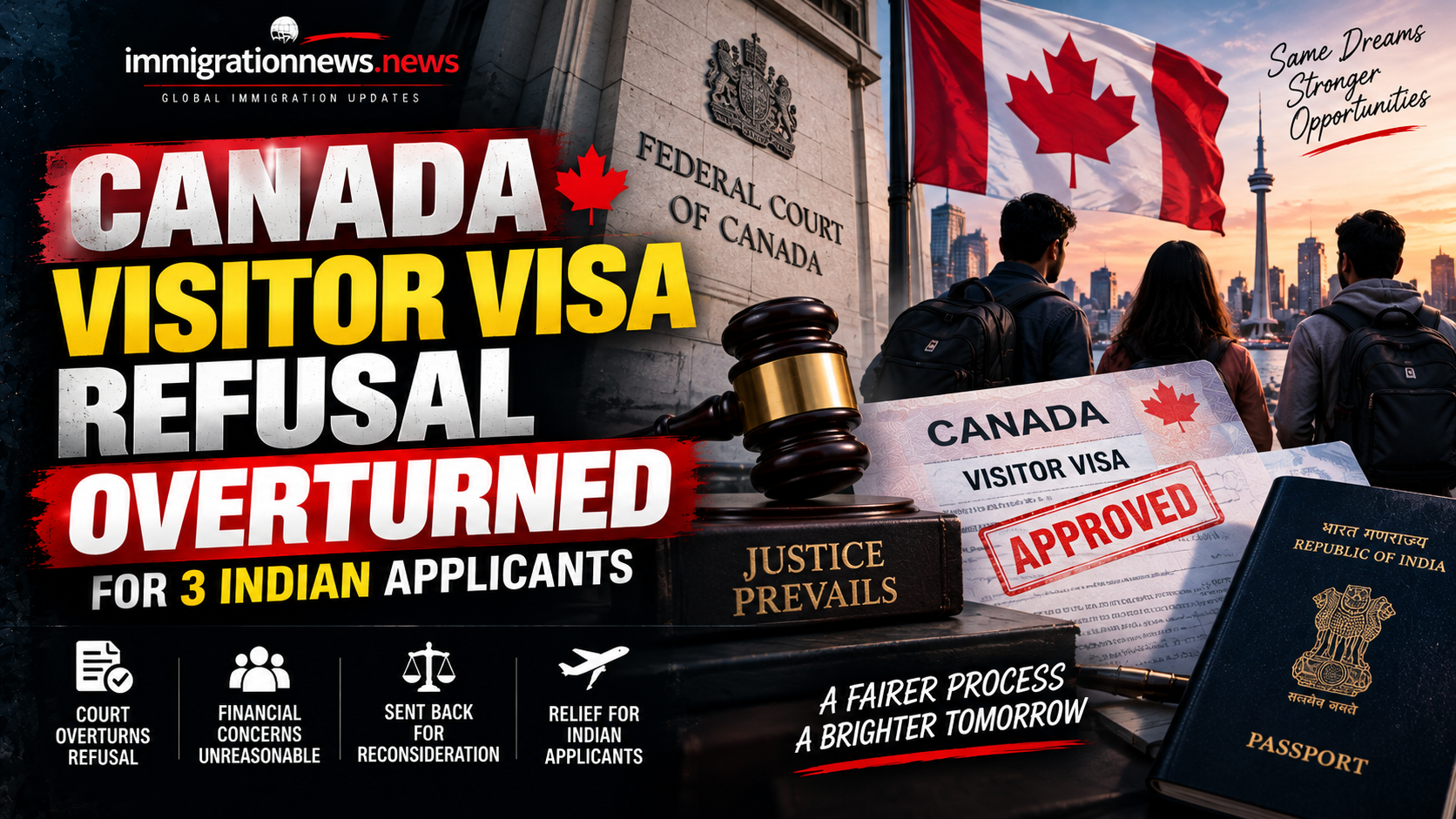
The Federal Court of Canada has overturned a visitor visa refusal involving three Indian applicants, finding that the immigration officer’s decision was unreasonable because important financial evidence was not properly considered. The applications have been sent back for reconsideration by a different officer.
A recent ruling offers important guidance for applicants challenging a Canada visitor visa refusal overturned after concerns about finances and unexplained bank deposits.
In a judgment issued on September 1, 2026, the Federal Court of Canada found that an immigration officer had acted unreasonably when refusing visitor visa applications from three Indian applicants.
The court ordered that the applications be reconsidered by a different immigration officer.
The case centred on the applicants’ financial evidence and whether the officer had properly assessed the information submitted with their applications.
Court Finds Canada Visitor Visa Refusal Unreasonable
The Canada visitor visa refusal overturned in this case was based primarily on the officer’s concerns about the applicants’ financial situation.
The officer concluded that the applicants’ assets and finances were insufficient to support the stated purpose of their proposed visit.
Particular attention was given to lump-sum deposits appearing in the principal applicant’s bank statements. The officer believed there was insufficient information explaining the source of those funds.
However, the applicants had submitted detailed financial documentation showing substantial funds and assets belonging to the principal applicant.
That evidence had reportedly been certified by accountants and banking representatives.
The Federal Court found that the officer had failed to meaningfully address important evidence that had been submitted.
Bank Statements Contained Information About Deposits
The applicants’ bank statements covered the period from July 1, 2024, to February 23, 2025.
Although the statements contained a large number of transactions and deposits, the court observed that the origins of the deposits had in fact been identified in the financial records.
The court acknowledged that an immigration officer could have requested further clarification or additional documentation about the source of the funds.
However, the problem was that the officer proceeded to refuse the applications without properly addressing the evidence already provided.
Justice Michael Battista stated:
“It was open to the officer to request more information about the source of the deposits, but it was not reasonable for the officer to definitively refuse the applications based on the absence of such information given that visitors, unlike students, are not required by statute to demonstrate sufficient and available financial resources.”
This observation formed a central part of the Canada visitor visa refusal overturned decision.
Visitors and Students Face Different Financial Requirements
One of the most significant aspects of the ruling is the distinction between visitors and international students.
Applicants for Canadian study permits are subject to specific financial requirements, including demonstrating that they have enough money to pay tuition, living expenses and transportation.
Visitor visa applicants, however, are assessed under a different legal framework.
Visitors must satisfy an immigration officer that they meet the requirements for temporary entry, including that they will leave Canada at the end of their authorized stay. They may also need to demonstrate that they have enough funds for the purpose and duration of their visit.
However, the court emphasized that visitors are not subject to the same statutory requirement as students to demonstrate “sufficient and available financial resources” in the same manner.
This does not mean that financial evidence is irrelevant to a visitor visa application. Rather, it means that an officer must assess the evidence reasonably and cannot reject an application without properly engaging with significant documentation.
Important Evidence Cannot Be Ignored
The court’s reasoning in the Canada visitor visa refusal overturned case also reinforces a broader principle of administrative law: decision-makers must meaningfully consider important evidence submitted by applicants.
An immigration officer is not required to agree with every document or explanation provided.
However, if an applicant submits substantial evidence that directly addresses a concern, the officer must explain why that evidence is insufficient or unpersuasive.
In this case, the applicants had provided financial information supported by professional and banking certifications.
The court found it significant that the officer’s decision did not adequately address this evidence before concluding that the applicants lacked sufficient financial resources.
A decision cannot simply reach a negative conclusion while overlooking evidence that could affect the outcome.
Applications Sent Back to a Different Officer
The Federal Court did not directly grant visitor visas to the three Indian applicants.
Instead, it overturned the refusal and ordered that their applications be reconsidered by a different immigration officer.
This distinction is important.
A successful judicial review generally does not mean that the applicant automatically receives a visa. It means that the original decision has been found legally flawed and must be reviewed again.
The new officer will have to reconsider the applications in accordance with the court’s findings.
The applicants may still need to provide updated documents or respond to additional questions during the reconsideration process.
The ruling therefore represents a legal victory, but not an automatic guarantee of approval.
India Is Canada’s Leading Visitor Source Country
The case is particularly relevant to Indian nationals because India remains one of Canada’s largest sources of visitors.
According to Canada’s 2025 Annual Report to Parliament on Immigration, India was the leading source country under the Visitor Program in 2024.
The report recorded 576,419 visitor admissions from India, representing approximately 11.5% of the total admissions under the program.
| Visitor Program Ranking | Country | 2024 Admissions | Share |
|---|---|---|---|
| 1 | India | 576,419 | 11.5% |
| 2 | France | 528,485 | 10.5% |
| 3 | United Kingdom | 480,928 | 9.6% |
| 4 | Mexico | 372,609 | 7.4% |
| 5 | China | 289,283 | 5.8% |
With hundreds of thousands of Indian nationals visiting Canada each year, decisions involving visitor visa refusals can have a significant impact on families, tourists, business travellers and people seeking to visit relatives.
What the Ruling Means for Visitor Visa Applicants
The Canada visitor visa refusal overturned ruling does not eliminate the need to submit strong financial documentation.
Applicants should still provide clear evidence that supports:
- The purpose of the visit
- The proposed travel dates
- Accommodation arrangements
- Travel history, where applicable
- Employment or business ties
- Family and social connections in the home country
- Available funds and regular income
- The source of major deposits
- The intention to leave Canada at the end of the authorized stay
The key lesson is that financial documents should be understandable and consistent.
Applicants with large recent deposits should explain whether the money came from:
- Salary savings
- Property sales
- Fixed deposits
- Business income
- Investments
- Loans
- Gifts from family
- Other legitimate sources
Supporting documents should be included wherever necessary.
What to Do After a Canada Visitor Visa Refusal
The ruling may also be relevant to applicants who believe their visitor visa application was refused without proper consideration of the evidence.
According to IRCC, applicants who believe a refusal was incorrect or procedurally unfair may be able to request judicial review through the Federal Court. IRCC also advises that applicants may reapply if their circumstances have changed or if they have new information addressing the refusal reasons.
Applicants should carefully review their refusal letter before deciding what to do next.
Possible steps include:
- Identifying the exact reasons for refusal
- Reviewing whether the officer overlooked important evidence
- Gathering additional documents
- Correcting inconsistencies in the application
- Reapplying with stronger evidence, where appropriate
- Consulting a qualified immigration lawyer about judicial review
Judicial review can be complex and involves strict procedural requirements. Applicants should obtain professional advice if they believe the decision was unreasonable or procedurally unfair.
Financial Evidence Must Be Clear and Credible
The Canada visitor visa refusal overturned case does not suggest that applicants can rely on unexplained funds or submit incomplete financial records.
Instead, it highlights the importance of a fair assessment of the complete application.
Applicants should avoid sudden unexplained deposits shortly before filing. If a large amount appears in a bank account, the applicant should provide a clear explanation and supporting evidence.
For example, a property sale may be supported by:
- Sale agreement
- Bank transfer records
- Property ownership documents
- Tax records, where relevant
Similarly, business income may be supported by business registration documents, tax filings, invoices and bank statements.
The objective is to ensure that the financial evidence accurately reflects the applicant’s circumstances.
Key Takeaway Of Canada Visitor Visa Refusal Overturned
The Canada visitor visa refusal overturned decision provides relief to three Indian applicants whose applications were rejected over concerns about their financial situation.
The Federal Court found that the officer had failed to properly engage with important financial evidence and had unreasonably treated the absence of further information about certain deposits as grounds for refusal.
The applications will now be reconsidered by a different officer.
The ruling does not guarantee visa approval for the applicants or establish that financial evidence is unnecessary for visitors. Instead, it reinforces that immigration decisions must be reasonable, evidence-based and responsive to important information submitted by applicants.
For Indian nationals applying for a Canadian visitor visa, the case underlines the importance of presenting a complete, consistent and well-documented application.
FAQs : Canada Visitor Visa Refusal Overturned
What happened in the Canada visitor visa refusal overturned case?
The Federal Court overturned the refusal of visitor visa applications involving three Indian applicants and ordered that their applications be reconsidered by a different immigration officer.
Why were the applicants’ visitor visas refused?
The immigration officer had concerns about their financial situation, including lump-sum deposits and the source of certain funds shown in the principal applicant’s bank statements.
Did the court grant the applicants Canadian visitor visas?
No. The court sent the applications back for reconsideration. A new officer will make another decision.
Did the court say visitor visa applicants do not need financial evidence?
No. The court distinguished visitors from international students regarding statutory financial requirements. Applicants should still provide credible evidence showing that they can support the proposed visit.
Can someone challenge a Canadian visitor visa refusal?
In certain circumstances, an applicant may seek judicial review through the Federal Court if they believe the decision was unreasonable or the process was unfair.
How many visitors from India came to Canada in 2024?
Canada’s 2025 immigration report recorded 576,419 visitor admissions from India in 2024, representing approximately 11.5% of the Visitor Program total.
Source : The Times Of India
Read About : Kumar Family Canada Removal : Forced to Leave Canada After 8 Years as Asylum and Humanitarian Bids Fail



One thought on “Canada Visitor Visa Refusal Overturned for 3 Indian Applicants Over Financial Concerns”