
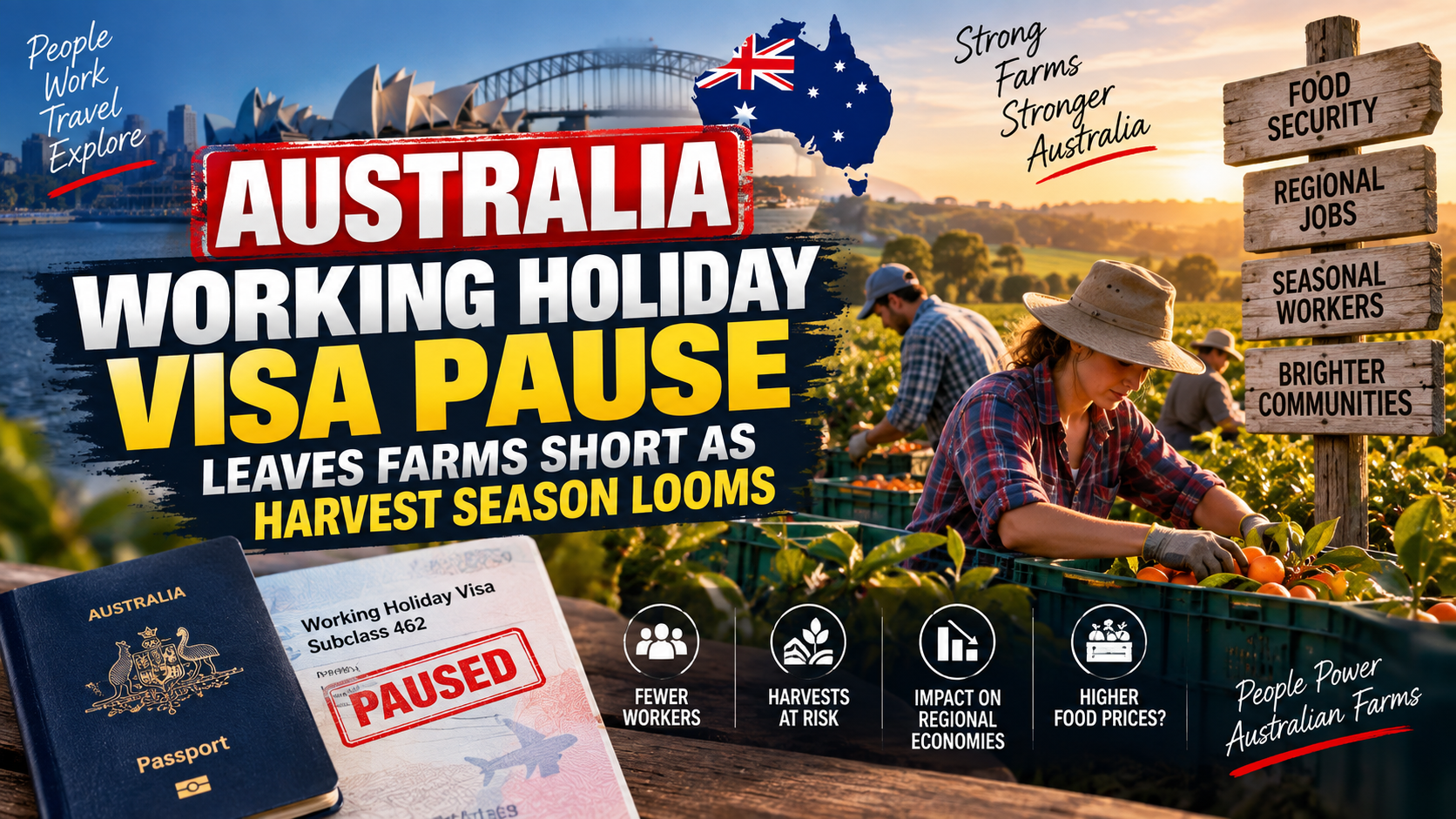
Australia’s seasonal farming industry is facing growing uncertainty after the government paused first Working Holiday Maker visa applications from 24 of 29 countries in the capped Work and Holiday stream.
The Australia working holiday visa pause has raised concerns among farmers, agricultural contractors and regional businesses that rely on overseas workers to pick, pack and harvest crops. With harvest season approaching in several parts of the country, employers say visa delays could leave them without enough workers when they are needed most.
The government says the changes are intended to manage demand, support migration settings and ensure the long-term sustainability of the Working Holiday Maker program. However, farmers warn that the timing could create serious workforce problems and potentially affect food production.
What Is the Australia Working Holiday Visa Pause?
The Australia working holiday visa pause applies to first Work and Holiday visa applications under subclass 462 from 24 partner countries.
The affected countries include:
- Argentina
- Austria
- Brazil
- Chile
- Czech Republic
- Ecuador
- Greece
- Hungary
- Indonesia
- Israel
- Luxembourg
- Malaysia
- Mongolia
- Papua New Guinea
- Peru
- Poland
- Portugal
- Singapore
- Slovak Republic
- Slovenia
- Spain
- Switzerland
- Thailand
- Uruguay
Applications from five countries continue to be handled through different arrangements:
- China: Ballot system
- India: Ballot system
- Vietnam: Ballot system
- San Marino: First-come, first-served allocation
- Türkiye: First-come, first-served allocation
The Department of Home Affairs explains that a country cap may be marked as “paused” when demand is high, when the annual allocation is close to being reached or when the government wants to spread applications throughout the program year. A paused cap may reopen later, unlike a closed cap, which generally remains closed until the next program year.
The pause does not necessarily mean that all Working Holiday Maker visas have been permanently cancelled. However, applicants may face uncertainty about when new applications will be accepted or when existing applications will be finalised.
Farmers Fear Harvest Workforce Shortages
The Australia working holiday visa pause has created concern across the agricultural sector because many farms depend on overseas workers during short and labour-intensive harvest periods.
The National Farmers’ Federation estimates that overseas workers make up around half of Australia’s peak harvest casual workforce. Working holiday-makers are especially important for farms that need large numbers of workers for only a few weeks or months.
In Victoria, agricultural contractor Matt Bourke had planned to recruit approximately 30 workers before the grain harvest. Many of those workers had previously worked with him and were expected to arrive from overseas.
However, he said that no Working Holiday visas had been approved for the workers he was expecting.
The uncertainty is particularly serious because farmers cannot always delay harvests. Crops may need to be picked, packed or processed within a narrow period. If sufficient workers are unavailable, produce may be wasted or farmers may decide not to plant certain crops in the first place.
Short Seasonal Jobs Depend on Fast Visa Decisions
In the Northern Territory, mango packing businesses have also reported difficulties recruiting workers ahead of the harvest.
Phillipa Johnson, a manager at Berry Creek, said the business was still searching for workers only weeks before the season was due to begin. The mango harvest generally lasts only two to three months, making the timing of visa approvals especially important.
Many workers apply from overseas specifically for seasonal employment. If their visas are delayed, employers may have to search for replacements at short notice, potentially from a much smaller domestic labour pool.
The Australia working holiday visa pause could therefore have a greater impact on seasonal industries than on businesses that can recruit workers throughout the year.
Working holiday-makers also contribute to regional economies by spending money on accommodation, food, transport, tourism and local services. Their absence could affect not only farms but also nearby towns and businesses.
Skilled Agricultural Workers Are Also Needed
The workforce issue is not limited to fruit pickers and packing staff.
Some agricultural operations rely on skilled migrants, including:
- Heavy machinery operators
- Agricultural engineers
- Dairy specialists
- Mechanics
- Irrigation technicians
- Farm managers
- Science and technology professionals
- Electrical trades workers
Victorian contractor Matt Bourke said skilled overseas workers were essential to operating agricultural machinery during harvest. He explained that some workers arriving from overseas already operated similar machinery on farms in their home countries.
Farmers argue that these workers bring experience that is not always readily available in Australia, particularly in regional areas where employers struggle to fill specialised positions.
Tasmanian dairy farmer Michele Lawrence has also highlighted the value of overseas workers to dairy production. She said her farm employs working holiday-makers and was waiting for an agricultural science engineer from Argentina.
According to Lawrence, overseas workers can bring a wide range of useful qualifications, including science degrees, nursing qualifications and electrical trade skills.
Skilled Visa Processing Has Also Changed
The Australia working holiday visa pause comes alongside changes to skilled visa processing priorities.
On July 25, 2026, Ministerial Direction 119 came into effect. The direction prioritises certain skilled visa and nomination applications based on the applicant’s occupation and location.
Under the new priorities:
- Defence and law enforcement-related applications receive the highest priority.
- Construction, healthcare and teaching occupations receive priority after defence and law enforcement.
- Applicants already in Australia generally receive higher priority than those applying from overseas.
- Other offshore skilled visa applications may be processed later.
The Department of Home Affairs confirms that construction, healthcare and teaching occupations are prioritised, while applicants outside Australia in other occupations are placed at the lowest priority level under the direction.
Farmers say these changes could make it harder for agricultural employers to bring in skilled workers from overseas, even when those workers have experience that is urgently needed.
Government Says the Program Needs Better Management
The Department of Home Affairs has defended the changes, saying the Working Holiday Maker program currently has historically high numbers of visa holders in Australia.
As of June 30, 2025, there were 206,187 working holiday-makers in the country. The government says applications may take longer than the published processing times as it manages demand and prioritises applications already lodged in Australia.
The department has also stated that reforms are being introduced to support a fairer allocation of Working Holiday Maker visas and ensure the program remains sustainable.
The official processing-time page says offshore Working Holiday Maker applications may take several months in some cases because onshore applications are being prioritised. It also advises applicants not to book flights or make work and travel commitments until their visa has been granted.
Why the Pause Matters for Regional Australia
The Australia working holiday visa pause is particularly significant for regional communities because working holiday-makers often fill jobs that are difficult to staff locally.
These workers may be employed in:
- Fruit and vegetable harvesting
- Mango and berry packing
- Grain production
- Dairy farming
- Hospitality
- Tourism
- Accommodation
- Regional retail
- Disaster recovery and community projects
Working holiday-makers are not only a source of labour. They also spend their earnings in regional communities, supporting local businesses and tourism operators.
Experts have warned that slowing visa approvals could create a backlog of applications without solving the underlying migration issue. Former immigration department deputy secretary Abul Rizvi described slow processing as a short-term approach that could create additional problems for applicants and employers.
What Applicants Should Know
Applicants affected by the Australia working holiday visa pause should monitor the official Department of Home Affairs country-cap page regularly.
Important points include:
- A paused application cap may reopen during the same program year.
- A closed cap generally will not reopen until the next program year.
- Country-cap information can change without a long advance notice.
- Applicants should not make non-refundable travel arrangements before receiving written visa approval.
- Existing applications may take longer than the standard published processing period.
- Second and third Work and Holiday visas are not subject to the same first-visa country caps.
The department advises applicants to check the latest country status before attempting to lodge a new application.
Could the Visa Pause Affect Food Prices?
Farmers and industry groups fear that labour shortages could increase production costs and place pressure on food prices.
If farms cannot recruit enough workers, they may need to:
- Pay higher wages to attract local workers.
- Reduce the amount of land planted.
- Delay harvesting.
- Increase reliance on labour contractors.
- Leave some crops unharvested.
- Pass additional costs through the supply chain.
The impact will vary by crop, location and the availability of alternative workers. However, agricultural leaders say the issue needs to be addressed before harvest operations reach their busiest point.
Final Outlook Of Australia Working Holiday Visa Pause
The Australia working holiday visa pause has become a major concern for farmers preparing for harvest season. While the government says the policy is intended to manage migration demand and improve the sustainability of the Working Holiday Maker program, agricultural employers fear that delays could leave them without essential workers.
The debate highlights a wider challenge for Australia: balancing migration reduction goals with the need for workers in farming, healthcare, construction, tourism and regional industries.
Until the government provides clearer timelines or reopens more country caps, applicants and employers will continue to face uncertainty over whether workers can arrive in time for the upcoming harvest.
FAQs : Australia Working Holiday Visa Pause
What is the Australia working holiday visa pause?
The Australia working holiday visa pause refers to the temporary suspension of first Work and Holiday subclass 462 applications from 24 of 29 capped partner countries.
Which countries are affected by the pause?
Countries affected include Argentina, Brazil, Indonesia, Spain, Thailand, Uruguay, Singapore, Poland, Portugal, Hungary, Chile and several others.
Can applicants from India still apply after Australia Working Holiday Visa Pause?
India’s applications are managed through a ballot system. Applicants should check the official Department of Home Affairs website for ballot announcements and current instructions.
Does the pause mean Working Holiday visas are permanently cancelled?
No. A paused country cap may reopen later during the same program year. A pause is different from a permanent closure.
Why are farmers concerned about the visa pause?
Farmers rely on working holiday-makers for seasonal jobs such as fruit picking, crop harvesting and packing. Visa delays may leave farms short-staffed during critical harvest periods.
Are skilled agricultural workers affected?
Skilled visa processing changes may affect overseas agricultural workers, including machinery operators, engineers, mechanics and other specialists. Processing priorities now favour certain occupations and applicants already in Australia.
Should applicants book flights before receiving approval?
No. The Department of Home Affairs advises applicants not to book flights or make travel, work or study commitments until their visa has been granted in writing.
Source : ABC News
Read About : OMARA Disciplinary Actions 2026: 23 Migration Agents Face Cancellation, Suspension, Caution or Bar



One thought on “Australia Working Holiday Visa Pause 2026 : Raises Fears of Farm Labour Shortages Ahead of Harvest”