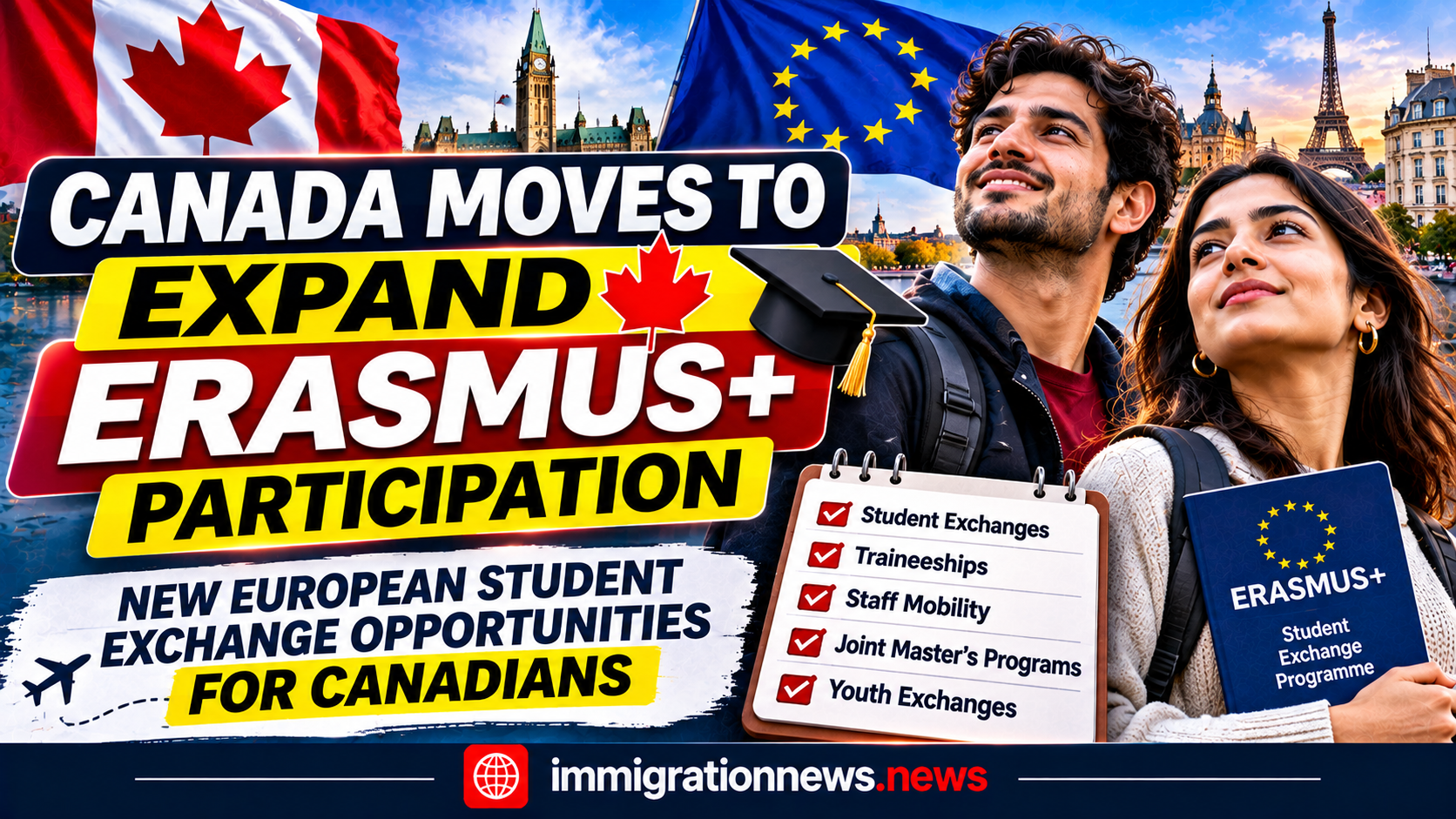
Canada is taking steps towards expanding its participation in Europe’s flagship student exchange and education programme, potentially creating new opportunities for Canadian students, graduates, educators and young professionals to study, train and gain international experience across Europe.
On October 30, 2026, the federal government announced that Canada and the European Union (EU) are launching negotiations to deepen Canada’s participation in Erasmus+, an EU-funded programme supporting education, training, youth development and sport.
The announcement was made during the Canada–EU Summit held in Montréal on October 29–30, where both sides introduced a broader partnership known as the Alliance for the Future.
The proposed expansion could make it easier for Canadian universities, educational institutions and youth organisations to collaborate with European counterparts. It could also improve access to international exchanges, joint learning programmes, research opportunities and professional training.
For Canadian students, the announcement is particularly significant because the country currently participates in Erasmus+ only through selected activities and partnerships rather than having full programme association.
However, the negotiations are still at an early stage. The governments have not yet announced the final participation model, funding arrangements, eligibility requirements or implementation date.
Here is what the proposed Canada Erasmus+ participation expansion could mean, how the existing programme works and what opportunities may become available in the future.
What Is Erasmus+ and Why Is Canada Seeking Greater Participation?
Erasmus+ is the European Union’s flagship funding programme for education, training, youth and sport.
It supports international learning experiences and partnerships between educational institutions, organisations and participants across different countries.
The programme provides opportunities for students, teachers, university staff, trainees and young people to gain experience abroad while developing academic, professional and personal skills.
Depending on the specific programme and eligibility requirements, funding may help cover expenses such as:
- International travel.
- Accommodation and living costs.
- Study and training activities.
- Professional development.
- Institutional cooperation and exchange projects.
Erasmus+ supports several types of international activities, including student exchanges, traineeships, staff mobility, joint master’s programmes and youth exchanges.
Canada’s proposed deeper participation is intended to strengthen academic and educational links with European institutions while giving more Canadians opportunities to gain international experience.
During the October summit, Canada and the EU agreed to launch negotiations towards expanding Canadian involvement in the programme. The initiative forms part of a broader effort to strengthen cooperation in education, research, skills development and youth mobility.
The proposed Canada Erasmus+ participation expansion could therefore become an important development for Canadian universities and students looking to access international learning opportunities.
Canada Currently Has Limited Participation in Erasmus+
Although Canadian institutions already participate in certain Erasmus+ activities, Canada is currently classified by the EU as a third country not associated to the programme.
This classification is important because it determines which programme activities a country can access and under what conditions.
The Erasmus+ programme is fully available to EU member states and six associated countries:
- Iceland
- Liechtenstein
- Norway
- North Macedonia
- Serbia
- Türkiye
Countries outside these groups may participate in certain activities, subject to specific eligibility criteria and funding conditions.
Canada currently falls into this non-associated category.
As a result, Canadian universities generally cannot independently access all Erasmus+ funding opportunities in the same way as institutions based in EU member states and associated countries.
Instead, Canadian institutions often participate through partnerships with eligible European organisations, which apply for funding under the relevant Erasmus+ actions.
The proposed negotiations could change the scope of Canada’s involvement, although the final arrangement has not yet been announced.
What Opportunities Does Erasmus+ Offer Students and Universities?
Erasmus+ supports a range of international education and professional development activities.
If Canada’s participation expands, these areas could become increasingly important for Canadian students, educational institutions and young professionals.
1. International Student Exchanges
Erasmus+ supports post-secondary students who want to complete part of their studies at an educational institution in another country.
Students can gain international academic experience while continuing their education through recognised exchange arrangements.
Under certain existing mobility projects involving non-associated countries, eligible students may spend between two and 12 months abroad, depending on the applicable action and project conditions.
Greater Canadian participation could create additional opportunities for students to study at European universities and develop international academic connections.
2. Traineeships and Professional Training
The programme also supports practical training placements for eligible students and recent graduates.
These opportunities can help participants gain workplace experience, improve professional skills and understand how businesses operate in other countries.
For Canadian students entering competitive sectors, international traineeships could provide valuable exposure to different working environments.
3. Staff Mobility and Educator Exchanges
Erasmus+ is not limited to students.
University employees, educators and other eligible staff can participate in international teaching assignments, training activities and professional development programmes.
Expanded cooperation could help Canadian institutions strengthen relationships with European universities and exchange teaching practices, research experience and academic expertise.
4. Erasmus Mundus Joint Master’s Programmes
Erasmus Mundus Joint Masters are international graduate programmes delivered by partnerships of universities in multiple countries.
Selected students can receive scholarships that may cover tuition, travel and living expenses, subject to the relevant scholarship conditions.
Canadian citizens can already apply for eligible Erasmus Mundus opportunities.
According to the information provided by the European Commission, 91 recipients from Canada were selected for Erasmus Mundus Joint Masters scholarships between 2021 and 2024.
These opportunities are already available under existing programme arrangements and should not be confused with the new negotiations.
5. Youth Exchanges and Skills Development
Erasmus+ also supports youth exchanges that bring together young people from different countries for learning, cultural exchange and skills development.
These activities can help participants build international networks, improve communication skills and gain experience working with people from different backgrounds.
A wider Canadian role could strengthen cooperation between Canadian youth organisations and European partners.
More Than 1,800 Students and Staff Already Participated in Canada–Europe Mobility Projects
Canada already has an established connection with Erasmus+ through international mobility partnerships.
According to a European Commission report covering projects selected between 2022 and 2024:
| Mobility direction | Planned participants |
|---|---|
| Canada to EU member states and associated countries | 1,007 |
| EU member states and associated countries to Canada | 866 |
| Total | 1,873 |
These figures represent planned student and staff mobility under selected projects, rather than a confirmed count of completed exchanges.
They nevertheless demonstrate the existing level of academic cooperation between Canadian and European institutions.
The proposed Canada Erasmus+ participation expansion could build on these existing relationships and potentially make international mobility accessible through a wider range of activities and institutional partnerships.
However, the final scale of any expansion will depend on the negotiations, funding arrangements and programme eligibility rules.
Canada and EU Also Plan a New Youth Mobility Partnership
The Erasmus+ negotiations are not the only development announced during the Canada–EU Summit.
Both sides also agreed to explore a next-generation Youth Mobility Partnership.
The proposed arrangement aims to make it easier for young Canadians and Europeans to access opportunities on both sides of the Atlantic.
According to the Canadian government’s October 30 backgrounder, the partnership could support:
- International education exchanges.
- Joint learning activities.
- Institutional partnerships.
- Skills development.
- Greater opportunities for young people to live and work abroad.
- Stronger connections between Canadian and European youth organisations.
The initiative could complement Erasmus+ by strengthening mobility opportunities beyond traditional university exchanges.
However, the governments have not yet published detailed eligibility criteria, age limits, application procedures or the exact benefits that participants could receive.
The proposed partnership should also be distinguished from existing work-permit arrangements under International Experience Canada.
International Experience Canada Already Offers Work Opportunities in 22 EU Countries
Canada already operates a youth mobility programme known as International Experience Canada (IEC).
The programme is based on reciprocal agreements with participating countries and allows eligible young citizens to travel and work in another participating country.
Canada currently has youth mobility arrangements with 22 of the EU’s 27 member states.
IEC offers three main categories.
Working Holiday
The Working Holiday category provides eligible participants with an open work permit.
This generally allows them to work for most Canadian employers without being tied to a single employer.
It is particularly useful for young people who want to travel while gaining employment experience.
Young Professionals
The Young Professionals category is designed for participants who want to gain professional work experience in another country.
It generally requires an eligible job offer and provides an employer-specific work permit.
International Co-op (Internship)
The International Co-op category supports eligible students who want to complete a work placement or internship related to their studies.
Participants generally need an eligible internship arrangement and receive an employer-specific work permit.
Who Can Apply for IEC?
Eligibility depends on nationality, the relevant bilateral agreement and the specific category.
Applicants are generally between 18 and 35 years old, although some participating countries have a lower maximum age.
Work permits are typically valid for 12 or 24 months, depending on the applicable arrangement.
Not all participating EU countries offer all three IEC categories. Applicants should check the specific country requirements before applying.
Importantly, IEC is a separate programme from Erasmus+. IEC focuses on youth work and travel opportunities, while Erasmus+ primarily supports education, training and institutional cooperation.
What Could Expanded Erasmus+ Participation Mean for Canadian Students?
If the negotiations lead to deeper programme association, Canadian students and universities could benefit from broader access to European education partnerships.
Potential benefits could include:
More international exchange opportunities: Students may gain access to a wider range of exchange projects and educational partnerships.
Greater institutional cooperation: Canadian universities could develop stronger relationships with European institutions.
Additional training opportunities: Eligible students and recent graduates could benefit from international traineeships and professional development.
More research collaboration: Academic institutions could strengthen their connections with European research and educational networks.
Access to funding opportunities: Depending on the final agreement, Canadian institutions and participants could gain access to additional programme funding mechanisms.
However, these are potential outcomes rather than confirmed benefits. The precise opportunities will depend on the terms agreed by Canada and the EU.
The proposed Canada Erasmus+ participation expansion does not currently guarantee free tuition, fully funded travel or automatic access to European universities for all Canadian students.
When Will Canada’s Expanded Erasmus+ Participation Begin?
The negotiations were announced on October 30, 2026, during the Canada–EU Summit in Montréal.
At the time of writing, neither side has published a final agreement or confirmed the date when expanded participation will begin.
The current Erasmus+ programme cycle runs through 2027. This makes the next programme period an important consideration for the negotiations, although the governments have not confirmed when any new arrangement would take effect.
Several important details remain outstanding:
| Pending detail | Current position |
|---|---|
| Final participation status | Not announced |
| Negotiation timeline | Not confirmed |
| Funding contribution | Not announced |
| Student eligibility criteria | Not published |
| University participation rules | Not published |
| Implementation date | Not confirmed |
Canadian students should therefore continue using existing exchange arrangements and currently available Erasmus+ opportunities rather than waiting for the proposed expansion.
Universities and educational organisations should monitor announcements from the Canadian government and the European Commission for further information.
FAQs : Canada Erasmus+ Participation
1. What is Canada planning to change about Erasmus+?
Canada and the European Union have launched negotiations to deepen Canada’s participation in Erasmus+, potentially expanding opportunities for students, educators, researchers and youth organisations to participate in international exchanges and learning activities.
2. Can Canadian students already participate in Erasmus+?
Yes. Canadian students can participate in certain Erasmus+ activities through eligible partnerships with European institutions. They can also apply for eligible Erasmus Mundus Joint Masters scholarships.
3. Will Canadian students receive fully funded study opportunities in Europe?
Some Erasmus+ activities and Erasmus Mundus scholarships provide financial assistance. However, funding depends on the specific programme, project, eligibility requirements and available budget. The new negotiations do not yet guarantee additional fully funded places.
4. When will expanded Canadian participation in Erasmus+ begin?
No implementation date has been announced. Canada and the EU launched negotiations on October 30, 2026, and further details are expected as discussions progress.
5. What is the difference between Erasmus+ and International Experience Canada?
Erasmus+ primarily supports education, training, youth and institutional exchange activities. International Experience Canada is a separate programme that provides eligible young citizens of participating countries with opportunities to work and travel through Working Holiday, Young Professionals and International Co-op categories.
6. How many EU countries have youth mobility agreements with Canada?
Canada currently has youth mobility arrangements with 22 of the EU’s 27 member states through International Experience Canada.
7. Can Indian students benefit from the new Canada–EU Erasmus+ agreement?
The announcement concerns Canada’s participation in Erasmus+ and opportunities for Canadians and European partners. It does not establish a new direct eligibility pathway for Indian students. Any participation by non-Canadian students will depend on the specific programme and institutional arrangements.
Final Takeaway On Canada Erasmus+ Participation
Canada’s decision to negotiate deeper participation in Erasmus+ marks an important development in its education and youth mobility relationship with the European Union.
The proposed expansion could create more opportunities for Canadian students, universities, educators and young professionals to study, train and collaborate with European institutions.
The announcement also comes alongside plans to explore a next-generation youth mobility partnership, potentially strengthening opportunities for young Canadians and Europeans to live, study and work across the Atlantic.
However, the negotiations are still at an early stage. No final participation agreement, funding model or implementation date has been announced.
For now, Canadian students can continue accessing existing Erasmus+ partnerships, Erasmus Mundus scholarships and International Experience Canada opportunities while waiting for further details.
The proposed Canada Erasmus+ participation expansion could become a significant step towards deeper international education cooperation and greater mobility opportunities between Canada and Europe.
Source : CIC News
Read About : Canada’s High-Wage NOC List 2026: 186 Occupations, CRS Points, And The November 3 Express Entry Changes