
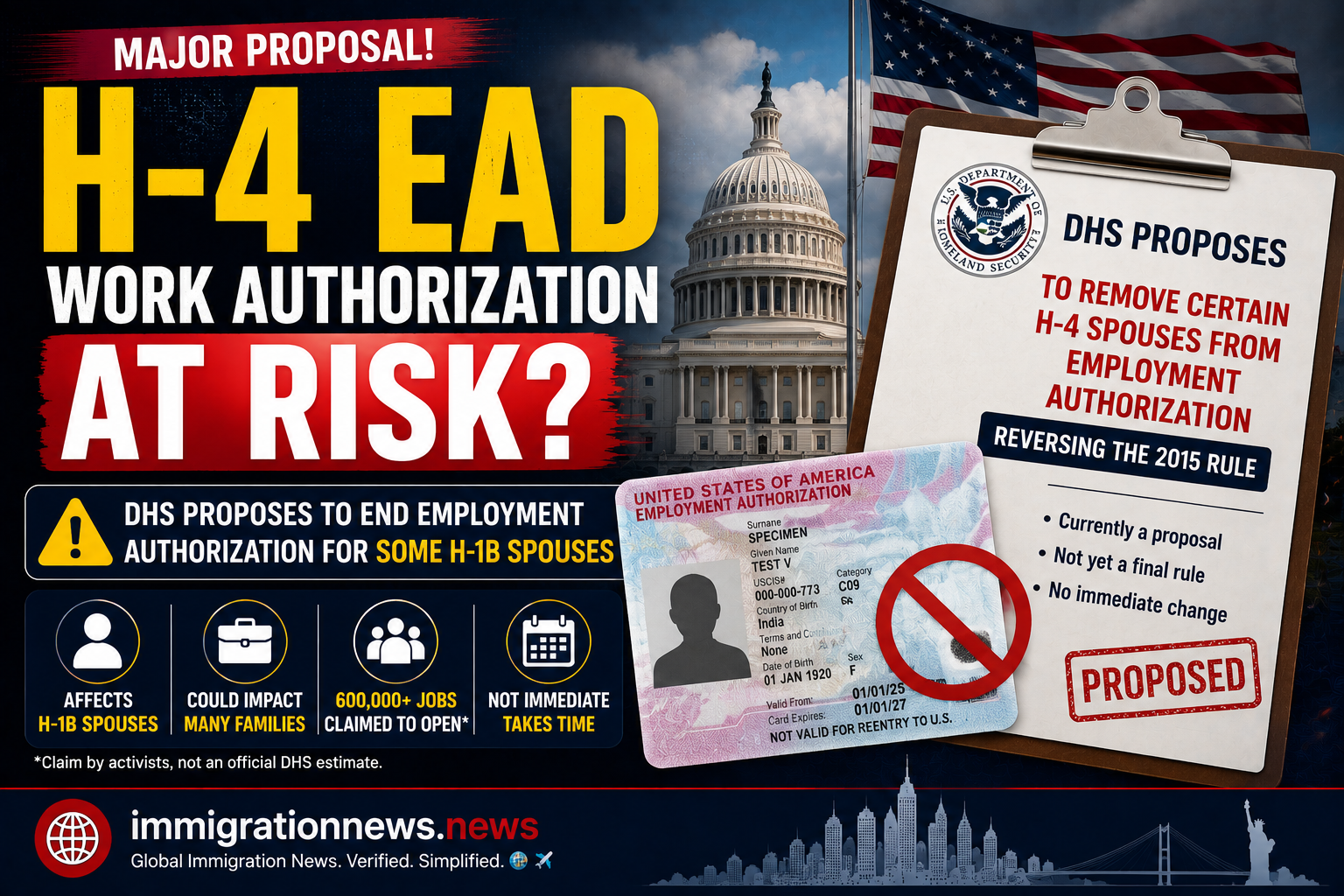
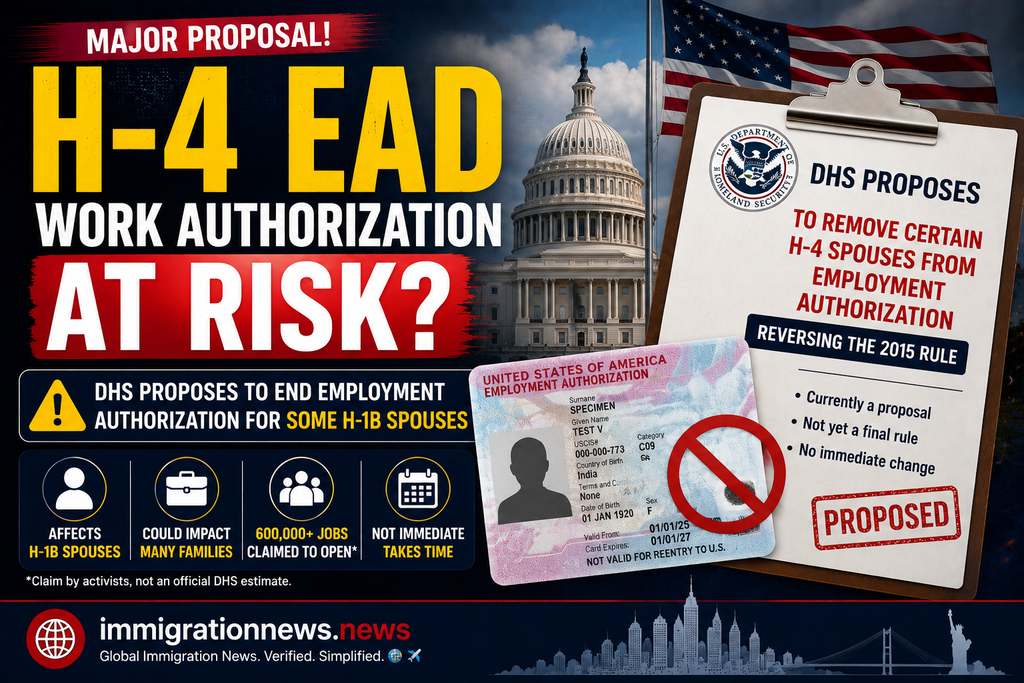
The Trump administration has revived a proposal that could end employment authorization for certain spouses of H-1B visa holders, potentially affecting thousands of H-1B families across the United States.
The Department of Homeland Security (DHS) has listed a new regulatory action titled “Removing H-4 Dependent Spouses From the Classes of Noncitizens Eligible for Employment Authorization.” The proposal would reverse the 2015 rule that allowed certain H-4 dependent spouses to apply for employment authorization.
The development has triggered concern among H-1B workers and their spouses, particularly families who have spent years in the United States waiting for employment-based green cards.
However, there is an important point applicants need to understand: this is currently a regulatory proposal, not a final ban on employment for H-4 spouses.
The H-4 EAD programme remains available under the current rules.
Key Highlights : H-4 EAD
- DHS has revived a proposal to remove certain H-4 spouses from employment authorization eligibility.
- The proposal would reverse changes introduced in 2015.
- The action is currently classified as a long-term regulatory action.
- No proposed rule has been published yet.
- No current H-4 work permits have been cancelled because of this announcement.
- Eligible H-4 spouses can continue working under existing rules.
- The widely circulated claim that 600,000+ jobs would open within 2–4 weeks is not an official DHS estimate.
- A final rule would require additional steps, including publication and public participation.
- H-4 spouses should continue monitoring their EAD validity and renewal requirements.
What Is the H-4 EAD Programme?
The H-4 EAD programme was created under a 2015 DHS regulation that allowed certain H-4 dependent spouses of H-1B nonimmigrants to apply for employment authorization.
Under current USCIS guidance, an H-4 spouse may qualify when the H-1B principal worker has either an approved Form I-140 or has received an H-1B extension under certain provisions of the American Competitiveness in the Twenty-First Century Act (AC21).
The programme has allowed qualifying spouses to obtain an Employment Authorization Document (EAD) and work for U.S. employers.
This was particularly important for families where the H-1B principal worker was pursuing permanent residence and the green-card process was taking several years.
DHS Wants to Reverse the 2015 Rule
The latest regulatory agenda is significant because DHS explicitly says it wants to reverse the changes introduced by the 2015 final rule.
According to the official Unified Agenda, DHS is proposing to remove certain H-4 dependent spouses of H-1B workers as a class eligible to request employment authorization under the (c)(26) category. The agency says the proposal would restore its earlier policy of not extending employment authorization eligibility to H-4 dependent spouses.
The proposal has been assigned RIN 1615-AD14.
But the government has not yet published the actual Notice of Proposed Rulemaking.
The regulatory agenda currently lists the NPRM date as “To Be Determined” and categorizes the action as a Long-Term Action.
That distinction is extremely important for people currently working in the United States.
H-4 EAD Holders Are Not Banned From Working Today
The H-4 EAD proposal does not mean that H-4 spouses have suddenly lost their work authorization.
USCIS’s current guidance continues to recognize employment authorization for qualifying H-4 spouses.
In other words, an H-4 spouse who currently has valid employment authorization does not need to quit their job simply because DHS has added the proposed regulatory action to its agenda.
The Department of Homeland Security has not announced an immediate termination of existing H-4 employment authorization.
The current regulatory action is still at the planning stage.
What Does the “600,000 Jobs” Claim Mean?
One of the most widely circulated claims following the announcement is that more than 600,000 jobs could become available within two to four weeks if the policy is implemented.
That figure has been promoted by America First activists and supporters of the proposed rollback.
However, it should not be treated as an official government forecast.
The DHS regulatory agenda does not state that 600,000 jobs would immediately become available. It only describes the proposed removal of certain H-4 spouses from the employment-authorization category.
Therefore, claims about “600,000+ jobs” should be presented as an advocacy or political estimate rather than a confirmed employment projection.
There is also no current basis for saying that such jobs would automatically open within two to four weeks.
Why Are H-1B Families Concerned?
For many H-1B families, the spouse’s ability to work is an important part of household finances.
An H-1B worker may have a highly skilled job in technology, healthcare, engineering, finance or another specialized field, while the spouse may also have professional qualifications and years of experience.
Losing employment authorization could therefore mean:
- One household income instead of two;
- Career interruptions for H-4 spouses;
- Loss of employer-sponsored benefits;
- Difficulty maintaining professional experience;
- Financial pressure on families; and
- Greater uncertainty while waiting for permanent residence.
The issue can be particularly serious for families whose green-card process has already taken several years.
The Green Card Backlog Is a Major Part of the Debate
The original 2015 rule was introduced partly because H-1B workers pursuing employment-based permanent residence could face lengthy waits.
DHS’s earlier regulatory analysis noted that the green-card process could take many years and that restricting spouses from working could create personal and economic hardship for H-1B families. It also argued that employment authorization could help employers retain highly skilled workers and encourage families to remain in the United States.
The new proposal would reverse that policy direction.
That means the debate is not simply about whether an H-4 spouse can work. It also concerns how the United States treats highly skilled immigrant families during long employment-based immigration processes.
What Happens Before H-4 EAD Rules Can Actually Change?
The H-4 EAD proposal cannot simply become law because it appears in the regulatory agenda.
DHS would first need to publish a formal Notice of Proposed Rulemaking (NPRM).
Once published, the proposal would generally be subject to a public comment process.
DHS would then have to consider the comments and decide whether to proceed, modify the proposal or abandon it.
If the agency proceeds, it would publish a final rule and establish an effective date.
The current regulatory record does not provide a date for publication of the proposed rule. It specifically lists the NPRM date as “To Be Determined.”
That means the timeline cannot currently be predicted with confidence.
This Issue Has Come Up Before
This is also not the first time DHS has considered removing H-4 spouses from employment authorization eligibility.
A similar regulatory action appeared repeatedly in previous Unified Agendas, including proposals during the Trump administration’s first term.
The earlier proposal was eventually withdrawn in 2021.
The latest proposal therefore represents a revival of a policy debate that has continued for years.
What Should H-4 Spouses Do Now?
Immigration experts quoted in the supplied report are advising H-4 spouses not to panic because no immediate rule change has occurred.
The most practical approach is to continue complying with current requirements while preparing for possible future changes.
H-4 spouses should:
1. Check EAD expiration dates
Know exactly when the current employment authorization expires.
2. Monitor USCIS announcements
Any actual change to eligibility would be communicated through formal government channels.
3. Keep immigration documents organized
Important records can include:
- Passport;
- H-4 approval notice;
- Form I-94;
- EAD;
- H-1B spouse’s approval notices;
- I-140 approval notice, where applicable;
- Labor certification documentation, where relevant; and
- Marriage certificate.
4. Review alternative immigration options
Depending on individual circumstances, some professionals may have independent immigration options such as H-1B, O-1, employment-based adjustment of status or other pathways.
These options are highly fact-specific and should be discussed with a qualified immigration attorney.
EAD Renewals Require Extra Attention
Another recent DHS policy change has already affected automatic EAD extensions.
DHS ended the broad practice of automatically extending employment authorization documents for certain renewal applicants who file on time, under an interim final rule published in October 2025. The rule does not invalidate automatic extensions that had already been triggered before the rule’s publication or extensions provided by law or Federal Register notice.
For H-4 families, this makes it particularly important to understand the expiration date and current renewal rules applicable to their specific EAD.
A proposed future change to eligibility would be separate from the existing EAD renewal framework.
What H-1B Employers Should Know
Employers that currently employ H-4 spouses should also pay attention to the regulatory process.
If DHS eventually publishes a proposed rule, employers and industry organizations will have an opportunity to submit comments.
The potential effect could extend beyond individual families because H-4 spouses are already participating in the U.S. workforce under existing authorization.
However, the precise economic impact of removing eligibility cannot be determined from the current regulatory agenda because DHS has not yet published the full proposal or its detailed economic analysis.
What Happens Next?
The next major milestone will be publication of the formal proposed rule.
Until that happens, several important questions remain unanswered.
DHS has not yet explained exactly which H-4 spouses would be affected, whether existing EADs would be allowed to remain valid until expiration, whether transition provisions would apply, or what implementation timeline would be used.
Those details will become clearer only if DHS publishes the NPRM.
For now, the official record confirms only that DHS intends to consider removing certain H-4 dependent spouses from the class eligible to request employment authorization.
Key Takeaways Of H-4 EAD
The proposed H-4 EAD rollback is an important development for H-1B families, but it is not an immediate work ban.
DHS has placed the proposal in the 2026 Unified Agenda under RIN 1615-AD14. The agency says it wants to reverse the 2015 rule that made certain H-4 spouses eligible for employment authorization.
However, the action is currently classified as a long-term regulatory action, and no NPRM publication date has been announced.
The frequently repeated claim that 600,000 or more jobs would open within two to four weeks is not an official DHS estimate.
For now, qualifying H-4 spouses can continue working under the existing rules.
The biggest development to watch is the publication of the actual proposed rule. That document should provide the details needed to determine who could be affected, what happens to existing work permits and how much time families would have to adjust.
FAQs : H-4 EAD
Can H-4 spouses still work in the U.S.?
Yes. Qualifying H-4 spouses remain eligible for employment authorization under the current rules.
Is the H-4 EAD programme ending immediately?
No. DHS has proposed changes, but the proposal has not yet become a final rule.
Who currently qualifies for an H-4 EAD?
Certain H-4 spouses qualify when the H-1B principal has an approved I-140 or has received an H-1B extension under specified AC21 provisions.
Will 600,000 jobs open if the proposal becomes effective?
There is no official DHS confirmation that 600,000 jobs would open within two to four weeks. That figure is being promoted by supporters of the proposal and should not be treated as an official government projection.
When will the new rule take effect?
There is currently no announced effective date. DHS has not even provided a date for publication of the proposed rule.
Should H-4 spouses stop working?
No. There is no current rule requiring qualifying H-4 spouses to stop working because of this regulatory agenda entry.
What should H-4 families do now?
Continue following the current rules, monitor official DHS and USCIS announcements, keep immigration documents organized and consider discussing independent immigration options with a qualified attorney if the proposal advances.
Source : The Times Of India
Read About : US Visa Appointments Paused Worldwide 2026: Trump Administration Launches Global Consular Training




One thought on “H-4 EAD Work Authorization at Risk as DHS Revives Plan to Restrict H-1B Spouses”