
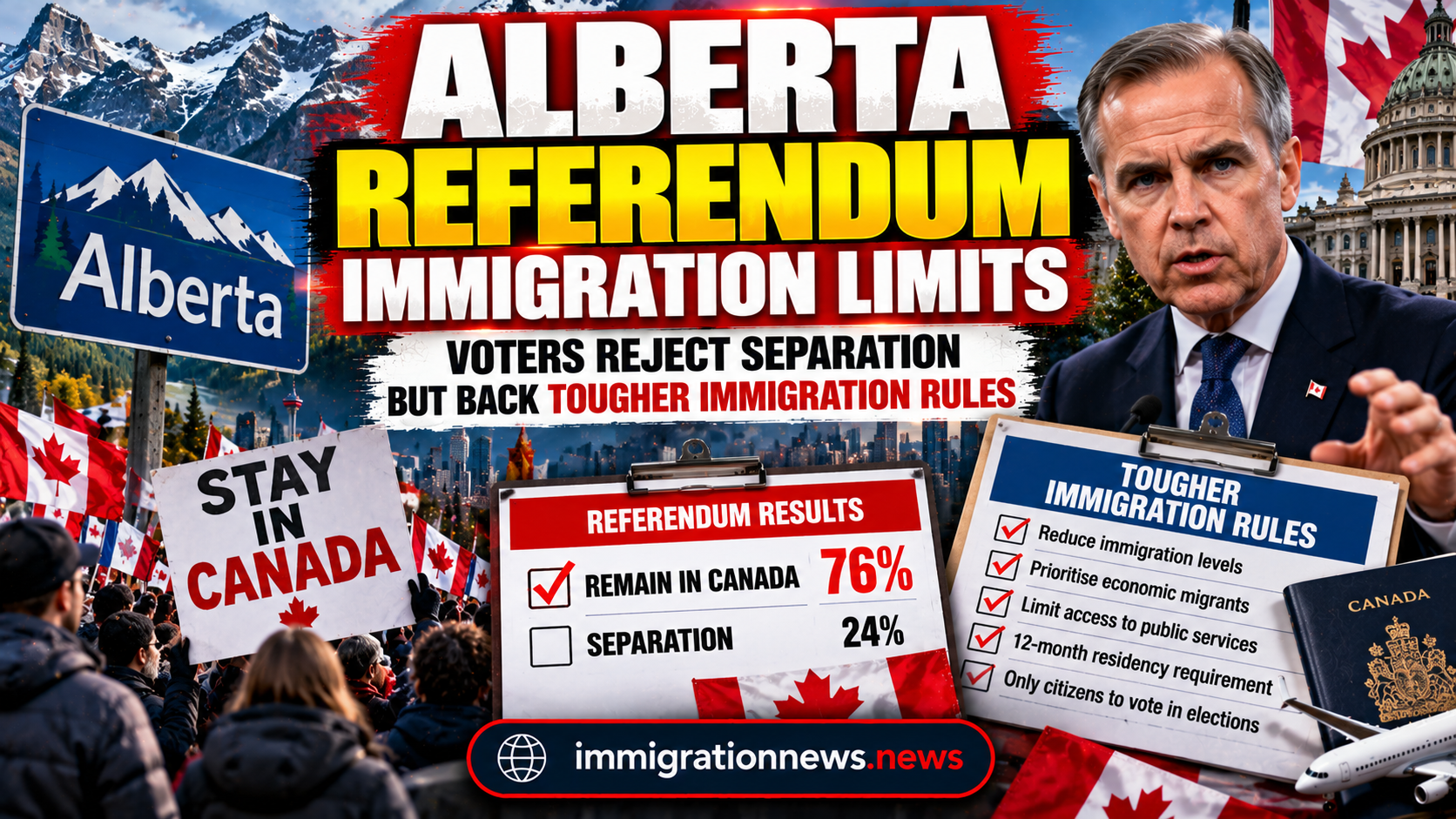
Alberta’s historic referendum has delivered a decisive message on Canadian unity while putting immigration policy, public services and provincial powers at the centre of a growing political debate. Early results from the October 19, 2026, vote showed that approximately 76% of voters supported remaining part of Canada, rejecting a proposal to begin the legal process for a future separation referendum.
However, the debate surrounding Alberta referendum immigration limits could prove more consequential for newcomers, international students and temporary foreign workers. The ballot included several separate, non-binding questions about reducing immigration, prioritising economic migrants, restricting eligibility for publicly funded services and introducing a minimum residency period for certain temporary residents.
The result on separation was a victory for Canadian unity and Prime Minister Mark Carney, who campaigned against moving towards independence. Yet the immigration questions reflected dissatisfaction among some Albertans about population growth, employment opportunities and pressure on healthcare, education and other public services.
The distinction matters: rejecting a move towards separation does not automatically mean voters rejected tougher immigration policies. The separate immigration questions must be assessed on their own results, and the proposals would still require appropriate legal and policy steps before becoming enforceable rules.
What Happened in Alberta’s October 19 Referendum?
Alberta held a province-wide referendum on Monday, October 19, 2026, asking voters to consider ten questions covering immigration, constitutional changes and the province’s future within Canada.
The main question asked whether Alberta should remain a Canadian province or whether its government should begin the legal process required to hold a future binding referendum on separation.
The question did not ask Albertans to make an immediate, final decision to leave Canada. Instead, it asked whether the provincial government should initiate the process leading towards a subsequent vote on independence.
Early results showed a clear preference for remaining in Canada. Major media organisations projected that the proposal to advance towards a separation referendum had been defeated, with roughly 76% supporting the option to remain.
Prime Minister Mark Carney welcomed the result, describing it as a choice for unity and cooperation. His campaign had argued that pursuing separation would create prolonged political and economic uncertainty at a time when Canada was facing significant external pressures.
The referendum also included nine other questions. Five concerned immigration and related policy changes, making the Alberta referendum immigration limits debate a major part of the ballot even though the separation question received the greatest national attention.
What Were the Immigration Questions on Alberta’s Referendum Ballot?
The five immigration-related questions focused on the provincial government’s ability to influence immigration levels, eligibility for public services, residency requirements and voting identification.
The proposals were designed to give the Alberta government a clearer mandate to pursue changes that it says could help manage population growth and protect public resources.
The main issues included:
| Policy area | Proposal put to voters |
|---|---|
| Immigration levels | Seek greater provincial control to reduce immigration to more sustainable levels |
| Economic migration | Prioritise economic migrants and give Albertans first priority for new employment opportunities |
| Public services | Limit eligibility for provincially funded programmes to Canadian citizens, permanent residents and people with Alberta-approved immigration status |
| Residency requirements | Require certain non-permanent residents to live in Alberta for at least 12 months before qualifying for specified provincially funded social support |
| Healthcare and education costs | Consider reasonable fees or premiums for non-permanent residents and their families |
| Provincial elections | Require proof of Canadian citizenship to vote in provincial elections |
These were separate questions rather than a single proposal that automatically changed all immigration rules.
The distinction is important for international students and foreign workers. Even if voters support a policy direction, implementation may require legislation, administrative changes, negotiations with the federal government or further legal review.
The referendum results on these questions also need to be distinguished from the projected result on separation.
Why Does Alberta Want Tougher Immigration Limits?
Alberta’s government has argued that rapid population growth has increased pressure on public services and made it more difficult to meet the needs of existing residents.
The province has experienced substantial population growth in recent years, attracting people from other Canadian provinces and newcomers from overseas. Its economy, energy industry and technology sector have created opportunities for workers, while its cities have also faced challenges related to housing, healthcare capacity and education.
Premier Danielle Smith has argued that Alberta should have greater influence over immigration levels and the selection of newcomers who settle in the province.
Under the government’s position, immigration policy should better reflect labour-market needs, available infrastructure and the province’s capacity to provide public services.
The proposed changes would place greater emphasis on economic migration and give existing Albertans priority in new employment opportunities.
Supporters argue that more provincial influence could help match immigration with housing, employment and service capacity. Critics, however, warn that restrictive policies could make it harder for employers to recruit workers and could create uncertainty for people already living, studying or working in Alberta.
The Alberta referendum immigration limits debate therefore reflects a wider question facing governments across Canada: how to balance the economic benefits of immigration with public concerns about infrastructure, affordability and service delivery.
What Could Tougher Immigration Rules Mean for International Students?
International students are among the groups watching the referendum closely because several proposals concern eligibility for public services and the costs associated with healthcare and education.
One question asked whether the government should introduce legislation limiting access to provincially funded programmes to Canadian citizens, permanent residents and individuals with an Alberta-approved immigration status.
Another asked whether non-permanent residents should have to live in Alberta for at least 12 months before qualifying for specified social support programmes.
A further proposal concerned charging reasonable fees or premiums to non-permanent residents and their families for using healthcare and education services.
If such proposals were developed into legislation, the practical effects would depend on the wording of the laws, the services covered and any exemptions.
International students should not assume that their existing study permits or legal status have automatically changed because of the referendum. A non-binding vote does not itself amend immigration documents or immediately introduce new eligibility rules.
Students should continue to follow official guidance from the Alberta government, their educational institutions and the relevant federal authorities.
For prospective students, the debate highlights the importance of checking the actual costs, healthcare arrangements and eligibility rules that apply to a particular programme before making financial commitments.
What Could the Proposals Mean for Temporary Foreign Workers?
Temporary foreign workers may also be affected if Alberta pursues changes to immigration selection, employment priorities or access to provincially funded services.
The proposal to prioritise economic migration suggests that the provincial government wants immigration to be more closely connected to the skills and occupations employers need.
For workers in industries facing shortages, this approach could create opportunities if future policy changes are designed around specific labour-market requirements.
At the same time, tighter overall immigration levels could affect some recruitment pathways or reduce the number of newcomers entering the province through particular programmes.
The effects would depend on which categories of workers were prioritised, how federal and provincial programmes were coordinated, and whether proposed changes applied to new applicants or people already living in Alberta.
The referendum did not itself cancel work permits or change the conditions attached to existing federal immigration documents.
Workers should therefore avoid making decisions based on headlines alone. They should check the conditions of their current permits and obtain advice from qualified professionals if a future policy change appears likely to affect their situation.
Does Alberta Have the Power to Control Immigration?
Immigration in Canada is a shared area of responsibility between the federal and provincial governments, although the federal government retains major authority over admission, immigration status and citizenship.
Alberta can seek greater influence over immigration selection and settlement through agreements and provincial programmes, and it can advocate for changes to the balance of responsibilities.
However, a provincial referendum cannot automatically transfer all federal immigration powers to Alberta.
Any significant change would need to operate within Canada’s constitutional framework and applicable federal legislation. Depending on the proposal, implementation could require cooperation with Ottawa, new provincial laws or further legal review.
This is especially relevant to the Alberta referendum immigration limits proposals. Even if voters support greater provincial control, the government must still determine which measures it can lawfully implement and which require federal agreement.
The same principle applies to restrictions on publicly funded services. Eligibility rules may differ between programmes, and changes must be assessed against the laws governing each service.
A non-binding referendum provides political direction, but it does not remove these legal requirements.
How Did Mark Carney Respond to Alberta’s Separation Vote?
Prime Minister Mark Carney campaigned for Alberta to remain part of Canada and argued that the province’s future would be stronger within a united country.
During visits to Calgary, Red Deer and Edmonton ahead of the referendum, Carney warned that pursuing separation could burden future generations with years of uncertainty and division.
After early results showed a decisive preference for remaining in Canada, Carney welcomed the outcome as a clear choice for unity.
The result was a political victory for his government, but it did not eliminate disagreements between Alberta and Ottawa.
Energy policy, federal-provincial relations, economic development and immigration remain important sources of tension.
The immigration questions are particularly significant because they could create pressure on the federal government to respond to concerns about population growth and the capacity of provincial services.
If Ottawa dismisses those concerns without addressing them, the debate could remain politically relevant even though the separation proposal was rejected.
Conversely, any federal response would need to consider national labour-market requirements, the rights of newcomers and the economic contribution of immigration.
What Does the Referendum Mean for Canada’s Immigration Policy?
The referendum is not a national vote on Canada’s immigration system, and its results do not automatically change federal immigration targets.
However, it may influence the political debate over how many newcomers Canada admits and how immigration is distributed across provinces.
Governments must consider labour shortages, economic growth, housing availability, infrastructure and public-service capacity when setting immigration policies.
The Alberta vote adds another signal that immigration levels and the costs of supporting population growth remain politically sensitive issues.
The federal government may face calls to give provinces a stronger role in selecting immigrants, prioritising certain occupations or coordinating newcomers with available housing and public services.
At the same time, restrictive policies can create challenges for businesses that depend on international recruitment and sectors that need additional workers.
For newcomers, the most important distinction is between political proposals and changes that have actually entered into force. Until the relevant authorities enact and implement new rules, existing immigration requirements continue to apply.
What Happens Next After Alberta’s Referendum?
The next steps depend on the final results of all ten questions and the government’s response to the outcome.
The separation question has produced a clear early result in favour of remaining part of Canada. The separate immigration and constitutional questions require their own results and interpretation.
If the immigration proposals receive support, the Alberta government could use that mandate to develop legislation, pursue negotiations with Ottawa or review provincial eligibility rules.
Each proposal would need to be assessed separately. Changes to immigration selection would involve different legal and administrative considerations from changes to healthcare eligibility, social support or voter identification.
The federal government will also have to decide how to respond to calls for greater provincial influence without undermining national immigration objectives or creating unnecessary uncertainty for workers and students.
For international students, temporary workers and permanent residents, the most useful approach is to monitor official announcements rather than assume that the referendum has already changed their legal status.
Final Takeaway On Alberta Referendum Immigration Limits
Alberta’s October 19, 2026, referendum delivered a decisive early rejection of the proposal to begin the process towards a future separation vote, with approximately 76% of voters choosing to remain in Canada.
However, the debate over Alberta referendum immigration limits remains important. The ballot included proposals to reduce immigration to more sustainable levels, prioritise economic migration, change eligibility for provincially funded services and introduce additional requirements for certain non-permanent residents.
The separation result does not determine the outcome of those separate questions, and the proposals do not automatically become law.
For international students, temporary foreign workers and other newcomers, the key issue is what the Alberta government does next and whether any proposed measures are legally enacted. Until official changes take effect, individuals should continue to follow the immigration and service-eligibility rules currently applicable to them.
FAQs : Alberta Referendum Immigration Limits
1. Did Alberta vote to separate from Canada in October 2026?
No. Early results showed that approximately 76% of voters supported remaining in Canada, rejecting the proposal to begin the legal process for a future binding referendum on separation.
2. What are the Alberta referendum immigration limits proposals?
They include seeking greater provincial control over immigration, reducing immigration to more sustainable levels, prioritising economic migrants, changing eligibility for provincially funded programmes and considering residency requirements or fees for certain non-permanent residents.
3. Will international students lose access to healthcare in Alberta?
The referendum proposals do not automatically change current eligibility rules. Any future changes would depend on legislation, programme-specific rules and applicable legal requirements.
4. Can Alberta independently reduce Canada’s immigration targets?
Alberta can seek greater influence over provincial immigration selection and settlement, but immigration is a shared responsibility and major aspects of admission and status remain under federal authority. Significant changes may require federal cooperation or legal measures.
5. When will Alberta’s tougher immigration rules come into effect?
There is no automatic effective date arising from the referendum alone. Any new rules would need to be developed and implemented through the appropriate legal and administrative processes.
Source : Hindustan Times
Read About : Canada Immigration Levels 2027: Government Signals Possible Increase as Population Growth Hits Historic Low

One thought on “Alberta Referendum Immigration Limits: Voters Reject Separation but Demand Tougher Rules In 2026”