
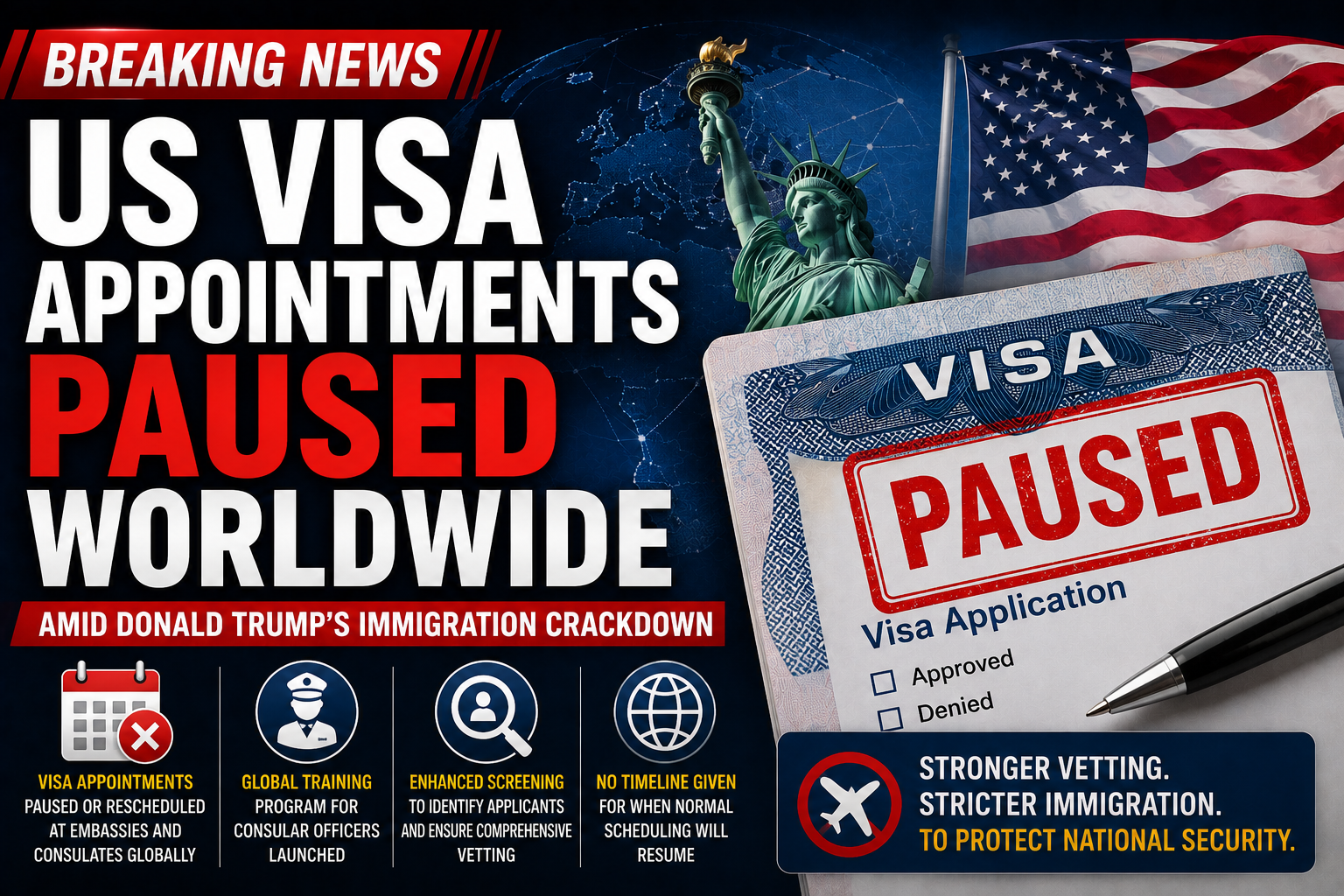
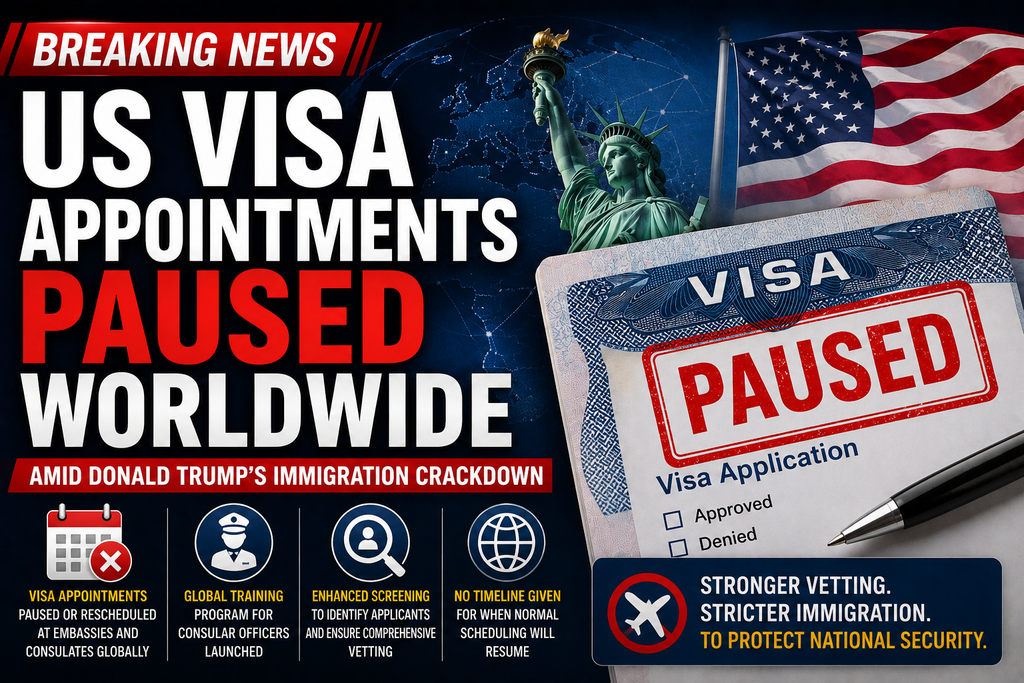
The United States has temporarily paused or rescheduled visa appointments at embassies and consulates around the world as the Donald Trump administration intensifies its immigration crackdown.
The development comes after the U.S. State Department launched a global training initiative for consular officers, with officials saying visa appointment schedules will be adjusted to accommodate the programme. The training is intended to strengthen screening of applicants, including those who could potentially become dependent on U.S. public benefits.
The US visa appointments paused worldwide development has created uncertainty for applicants who already had interviews scheduled, with some reportedly receiving notices that their appointments will be rescheduled. The State Department has not provided a specific timeline for when normal appointment scheduling will resume.
The move is the latest in a series of immigration and visa restrictions introduced by the Trump administration, including expanded vetting, visa revocations, visa bonds and a proposed six-figure H-1B fee.
Quick Highlights : US Visa Appointments Paused Worldwide
- U.S. visa appointments are being paused or adjusted worldwide
- The State Department has launched global consular officer training
- Applicants with scheduled interviews are reportedly being rescheduled
- No definite timeline has been given for normal appointment scheduling
- Training will focus on more comprehensive and consistent visa screening
- The administration is also tightening social-media and other background checks
- Up to 200,000 B1/B2 visas could potentially be revoked from certain asylum applicants
- DHS has proposed a $103,265 fee for cap-subject H-1B petitions
- Recent immigration restrictions have also faced legal challenges
US Visa Appointments Paused Worldwide Amid Global Training
The US visa appointments paused worldwide situation is linked to a new State Department training programme being conducted across U.S. embassies and consulates.
A State Department spokesperson said the department had begun the training initiative at posts around the world. Visa appointment schedules will be adjusted to accommodate the training, Reuters reported.
The department said the programme is designed to help consular officers identify applicants who could potentially become dependent on U.S. public benefits.
Officials also said the training is intended to ensure that visa applications are evaluated comprehensively and consistently.
However, the State Department has not disclosed how long the scheduling adjustments will continue.
Applicants Are Receiving Appointment Rescheduling Notices
The US visa appointments paused worldwide development has directly affected people who had already been waiting for interviews.
According to reporting cited in the supplied article, immigrant visa applicants with scheduled interviews at U.S. embassies and consulates received emails informing them that their appointments were being rescheduled.
Applicants were reportedly told that they would receive information about new appointment dates.
The absence of a confirmed rescheduling timeline is creating additional uncertainty for people who have already made travel plans, paid application fees and completed other steps required before their interviews.
Importantly, the latest reports describe an adjustment or pause in appointments and interviews, rather than a blanket cancellation of every existing U.S. visa.
Why Has the U.S. Paused Visa Appointments?
The immediate reason given by the State Department is consular officer training.
The administration says the training will help officers improve the screening and vetting process.
One area of focus is whether an applicant could become dependent on U.S. public benefits.
This fits into a broader policy direction under the Trump administration that places greater emphasis on financial self-sufficiency, national security and extensive background screening.
The State Department has already introduced or expanded several vetting measures in 2026.
For example, online presence reviews have been expanded to additional nonimmigrant visa categories. Applicants in several categories are instructed to make their social-media profiles public or open to facilitate screening.
U.S. Visa Screening Has Already Become Stricter
The US visa appointments paused worldwide development follows several earlier changes to the visa screening system.
The State Department says it conducts thorough vetting of visa applicants and uses available information to identify people who may be inadmissible or pose national-security or public-safety concerns.
Social-media screening has become an increasingly important part of this process.
The department previously expanded online presence review to H-1B and H-4 applicants, as well as F, M and J student and exchange-visitor applicants.
The latest global training programme therefore comes on top of an already more extensive screening framework.
Visa Bonds Add Another Layer of Screening
The administration has also introduced public-charge-related visa bond requirements for certain applicants.
The State Department says eligible applicants from designated countries may be required to post a bond as a condition of receiving certain B1/B2 visas.
Under the current bond framework, covered applicants can be required to post $5,000, $10,000 or $15,000, with the amount determined by the consular officer.
The department has also described public-charge bonds as an additional mechanism for certain immigrant visa applicants to overcome a public-charge determination, subject to eligibility.
The bond does not itself guarantee that a visa will be issued.
Trump Administration’s Immigration Crackdown Continues
The US visa appointments paused worldwide development comes amid a much broader immigration crackdown.
Since returning to office, President Donald Trump’s administration has introduced or pursued measures affecting:
- Immigrant visas
- Nonimmigrant visas
- H-1B workers
- International students
- Green card holders
- Asylum seekers
- Visa screening
- Social-media vetting
- Public-charge assessments
- Visa bonds
The administration has said the measures are intended to strengthen national security and ensure that immigration rules are enforced more strictly.
Critics have argued that some of the measures make legal immigration significantly more difficult and create uncertainty for applicants who have already spent substantial amounts of time and money pursuing U.S. visas.
Proposed $103,265 H-1B Fee Adds to Immigration Pressure
Another major development this week is the proposed $103,265 additional fee for H-1B cap-subject petitions.
The Department of Homeland Security proposed the fee on August 24.
According to USCIS, the proposed fee would apply to all H-1B cap-subject petitions, including those eligible for the advanced-degree exemption, and would be charged in addition to existing fees.
The annual H-1B cap includes:
- 65,000 regular cap visas
- 20,000 additional visas for qualifying U.S. advanced-degree holders
Certain cap-exempt organizations, including qualifying institutions of higher education and research organizations, would not be subject to the proposed additional fee.
The proposal is not yet a final rule and remains subject to the federal rulemaking process.
H-1B Screening Is Also Becoming More Extensive
The H-1B programme is particularly important for Indian professionals because Indian nationals make up a large share of H-1B workers.
The Trump administration has already increased scrutiny of H-1B applicants.
The State Department requires online presence reviews for H-1B applicants and their H-4 dependents, with applicants instructed to make social-media profiles public or open for screening.
The administration has also proposed changes intended to favour higher-skilled and higher-paid workers.
The H-1B programme currently has an annual allocation of 65,000 visas plus 20,000 for qualifying U.S. advanced-degree graduates.
Up to 200,000 B1 and B2 Visas Could Face Revocation
The crackdown is also extending to people who entered the United States on business or tourist visas and later sought asylum.
The Trump administration is preparing to revoke the B1 and B2 visas of potentially up to 200,000 foreigners who have applied for or are currently seeking asylum in the United States, according to AP reporting.
B1 visas are generally issued for business travel, while B2 visas cover tourism, family visits and certain medical travel.
The planned action would target people who originally entered the United States as temporary visitors but subsequently pursued asylum.
The proposed revocations could become one of the largest mass visa-revocation operations in U.S. history.
Visa Revocations Are Already Increasing
The US visa appointments paused worldwide story comes as the administration has also expanded visa revocations.
According to AP, approximately 175,000 visas had already been revoked over the previous 18 months for reasons including criminal records and other alleged violations or concerns.
The administration has argued that visa holders must comply with the conditions under which their visas were issued.
The planned B1/B2 action would take the policy further by targeting certain visitors who later sought asylum.
Immigration Policies Face Legal Challenges
Not every Trump administration immigration measure has survived legal scrutiny.
A federal judge recently struck down a policy that had suspended immigrant visa processing for nationals of 75 countries.
The court found that the policy exceeded the authority of Secretary of State Marco Rubio and that visa eligibility decisions must be made according to the statutory framework governing consular officers.
The ruling represents another legal challenge to the administration’s efforts to restrict immigration through executive and administrative action.
Other immigration policies are also facing litigation.
This means the rules affecting visa applicants can change quickly as courts consider challenges to the administration’s policies.
What the Appointment Pause Means for Applicants
For people affected by the US visa appointments paused worldwide situation, the immediate concern is uncertainty over interview dates.
Applicants with already scheduled interviews should:
- Check their email regularly for messages from the U.S. embassy or consulate.
- Check the official visa scheduling account used for the appointment.
- Avoid making non-refundable travel arrangements based solely on the original interview date.
- Keep required documents ready for the rescheduled interview.
- Follow instructions issued directly by the relevant U.S. embassy or consulate.
- Avoid relying on unofficial agents or social-media posts for appointment information.
The State Department has not announced a universal date for the restoration of normal appointment schedules.
Does the Pause Mean U.S. Visas Are Completely Suspended?
No.
The current reports describe a worldwide pause or adjustment in visa appointments and interviews, linked to consular training.
That is different from saying that every U.S. visa category has been permanently suspended.
The United States continues to operate visa services, while individual countries and posts can also have different arrangements.
The State Department maintains country-specific information and visa appointment systems, and applicants should follow instructions from the specific embassy or consulate handling their case.
There are also separate visa restrictions and suspensions affecting certain nationalities under existing presidential proclamations, which should not be confused with the current global appointment scheduling adjustment.
What Indian Applicants Should Know
The US visa appointments paused worldwide situation is particularly relevant for Indian students, workers, tourists and immigrant visa applicants because the United States remains one of India’s largest destinations for international education, employment and migration.
Applicants in India should not assume that a cancelled or rescheduled appointment means their visa application has been rejected.
Instead, the current reports indicate that appointments are being adjusted to accommodate the State Department’s global consular training.
The U.S. State Department’s visa system continues to provide appointment and processing information for posts including New Delhi and Mumbai.
Applicants should therefore wait for official communication regarding their new interview date rather than immediately submitting a new application.
What Happens Next?
The biggest unanswered question is how long the global appointment disruption will last.
The State Department has not provided a specific end date for the training or the resulting scheduling adjustments.
The outcome could depend on how quickly consular posts complete the training and reorganize appointment capacity.
At the same time, applicants are entering a U.S. immigration system undergoing several simultaneous changes.
These include expanded vetting, public-charge considerations, visa bonds, H-1B fee proposals and planned visa revocations.
The appointment pause therefore needs to be viewed as part of a broader restructuring of U.S. immigration and visa enforcement, rather than as an isolated scheduling problem.
Key Takeaways Of US Visa Appointments Paused Worldwide
The US visa appointments paused worldwide development has added another layer of uncertainty for people seeking to travel, work, study or immigrate to the United States.
The State Department says it has launched a global training programme for consular officers, with appointment schedules being adjusted to accommodate the training. The department says the programme is intended to improve screening for applicants who could potentially become dependent on U.S. public benefits and to ensure more consistent visa adjudication.
Applicants with scheduled interviews have reportedly received rescheduling notices, but there is currently no confirmed universal date for when normal appointment scheduling will resume.
The development comes alongside a wider immigration crackdown that includes expanded social-media screening, public-charge measures, visa bonds and a proposed $103,265 H-1B fee for cap-subject petitions.
The administration is also preparing to revoke potentially 200,000 B1/B2 visas held by certain people who entered the United States as visitors and later sought asylum.
For applicants, the most important step is to follow official embassy and consulate communications and avoid treating the appointment disruption as an automatic visa refusal.
FAQs : US Visa Appointments Paused Worldwide
Why are US visa appointments paused worldwide?
The State Department says visa appointment schedules are being adjusted to accommodate a global training initiative for consular officers. The training is focused on comprehensive and consistent screening of visa applicants.
Are all U.S. visa applications suspended?
No. The current reports concern the scheduling and rescheduling of visa appointments and interviews worldwide. Separate visa suspensions affecting certain nationalities and categories remain governed by other U.S. policies.
What happens if my U.S. visa interview was cancelled?
Applicants whose appointments are affected should monitor their email and official visa-scheduling account for information about a new appointment date.
How long will the U.S. visa appointment pause last?
The State Department has not provided a specific timeline for how long the global scheduling adjustments will continue.
Does a rescheduled appointment mean my visa was rejected?
No. A rescheduled appointment is a scheduling action and does not by itself mean that the visa application has been refused.
Is the $103,265 H-1B fee already in effect?
No. DHS has proposed the additional $103,265 fee for cap-subject H-1B petitions. It is not yet a final rule.
Who could be affected by the proposed H-1B fee?
The proposal covers H-1B petitions subject to the annual cap, including petitions eligible for the advanced-degree exemption. Certain cap-exempt organizations would not be subject to the proposed additional fee.
Are U.S. visa applicants still subject to social-media screening?
Yes. The State Department has expanded online presence review to several visa categories, including H-1B/H-4 and F, M and J applicants, among others.
Could B1/B2 visas be revoked from asylum applicants?
The Trump administration is preparing an action that could revoke up to 200,000 B1/B2 visas belonging to people who entered as visitors and later sought asylum, according to AP.
Source : The Times Of India
Read About : US Visa Bulletin September 2026: Big Green Card Relief for Indians as Family Dates Make Major Gains


One thought on “US Visa Appointments Paused Worldwide 2026: Trump Administration Launches Global Consular Training”