
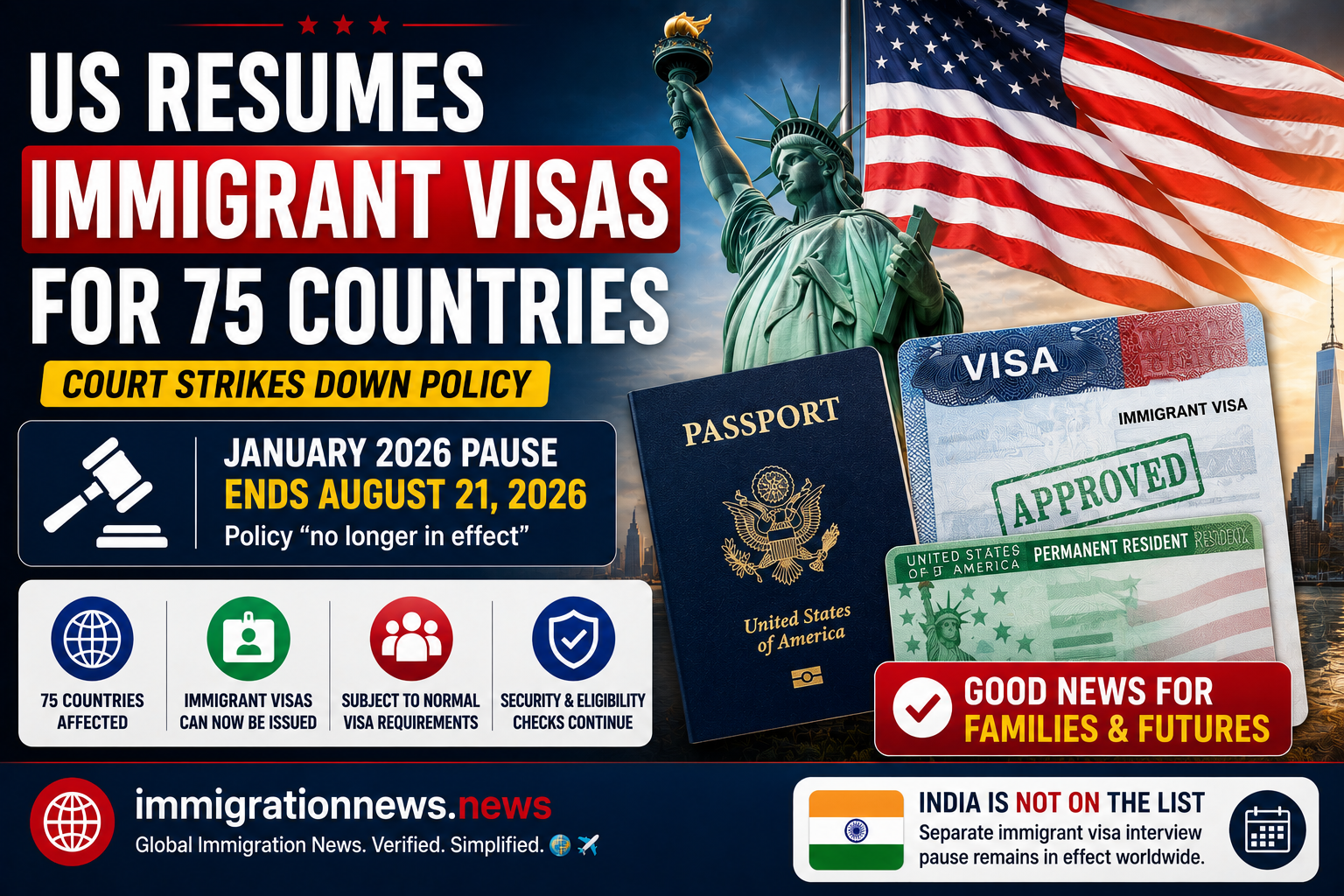
The United States has ended a months-long suspension on immigrant visa issuance for nationals of 75 countries after a federal court struck down the Trump administration’s policy.
The US resumes immigrant visas for 75 countries development follows an August 21, 2026 ruling by U.S. District Judge Jeannette Vargas of the Southern District of New York in CLINIC v. Rubio. The court found that the State Department’s nationality-based policy exceeded the Secretary of State’s statutory authority.
The U.S. Department of State has now officially confirmed that, as of August 21, the January 2026 pause on immigrant visa issuance to nationals of the 75 countries is no longer in effect.
However, applicants should not confuse the lifting of this particular policy with a return to completely normal U.S. immigrant visa processing. A separate worldwide pause affecting immigrant visa interviews was announced in August for consular training, and that measure remains a separate issue.
Key Highlights : US Resumes Immigrant Visas for 75 Countries
- The U.S. has ended the January 2026 immigrant visa issuance pause affecting 75 countries.
- The change took effect following a federal court ruling on August 21, 2026.
- The State Department officially confirmed the pause was no longer in effect on August 28.
- The original policy had been introduced over concerns about potential reliance on U.S. public benefits.
- India was never included in the 75-country list.
- Applicants from the affected countries can again have immigrant visas issued, subject to normal eligibility requirements.
- The ruling does not automatically approve every pending visa application.
- A separate worldwide immigrant visa interview scheduling pause remains an important issue for applicants.
- Nonimmigrant visas such as tourist, student and temporary work visas were not covered by the 75-country issuance pause.
Why Did the U.S. Pause Immigrant Visa Issuance?
The US resumes immigrant visas for 75 countries development reverses a policy that began in January 2026.
On January 21, the State Department paused the issuance of immigrant visas to nationals of 75 countries. The administration said it was conducting a review of applicants considered to be at higher risk of becoming dependent on U.S. public benefits.
The policy applied specifically to immigrant visas, which are visas used by foreign nationals seeking to immigrate permanently to the United States.
These can include visas issued to people immigrating through family-based or employment-based categories.
The January policy did not mean that applicants from the affected countries could not submit applications or attend interviews. The main restriction was on the final issuance of immigrant visas.
That distinction became important after the policy was challenged in federal court.
Federal Court Strikes Down 75-Country Policy
The US resumes immigrant visas for 75 countries change came directly after Judge Jeannette Vargas ruled against the State Department’s policy.
The lawsuit, Catholic Legal Immigration Network (CLINIC) v. Rubio, challenged the nationality-based suspension.
The court concluded that the policy was unlawful and exceeded Secretary of State Marco Rubio’s authority under the Immigration and Nationality Act. Reuters reported that the judge found the policy improperly prevented consular officers from issuing immigrant visas based solely on nationality.
The court’s ruling vacated the policy.
The State Department subsequently updated its official guidance to confirm that the January pause was no longer in effect as of August 21.
The ruling therefore represents a significant legal setback for the administration’s earlier attempt to restrict immigrant visa issuance based on nationality.
US Resumes Immigrant Visas for 75 Countries: Full List
The countries covered by the former pause included nations across Asia, Africa, Europe, Latin America and the Caribbean.
The official State Department list included:
Afghanistan, Albania, Algeria, Antigua and Barbuda, Armenia, Azerbaijan, Bahamas, Bangladesh, Barbados, Belarus, Belize, Bhutan, Bosnia and Herzegovina, Brazil, Burma, Cambodia, Cameroon, Cape Verde, Colombia, Cote d’Ivoire, Cuba, Democratic Republic of the Congo, Dominica, Egypt, Eritrea, Ethiopia, Fiji, The Gambia, Georgia, Ghana, Grenada, Guatemala, Guinea, Haiti, Iran, Iraq, Jamaica, Jordan, Kazakhstan, Kosovo, Kuwait, Kyrgyz Republic, Laos, Lebanon, Liberia, Libya, Moldova, Mongolia, Montenegro, Morocco, Nepal, Nicaragua, Nigeria, North Macedonia, Pakistan, Republic of the Congo, Russia, Rwanda, Saint Kitts and Nevis, Saint Lucia, Saint Vincent and the Grenadines, Senegal, Sierra Leone, Somalia, South Sudan, Sudan, Syria, Tanzania, Thailand, Togo, Tunisia, Uganda, Uruguay, Uzbekistan and Yemen.
The end of the policy means nationals of these countries are no longer subject to the January suspension solely because of their nationality.
What Does the Change Mean for Applicants?
The US resumes immigrant visas for 75 countries change allows the State Department to return to normal immigrant visa issuance rules for applicants who were affected by the January policy.
However, this does not mean every applicant will automatically receive a visa.
Applicants must still satisfy all applicable immigration and visa requirements.
A person can still be refused an immigrant visa for other reasons, including inadmissibility, missing documentation, failure to meet eligibility requirements or other grounds under U.S. immigration law.
The court decision removed the nationality-based suspension. It did not eliminate the rest of the U.S. immigration screening system.
The State Department also continues to review applicants for security, public-charge and other eligibility concerns under applicable law.
What About Visas That Were Already Issued?
The January suspension applied to the issuance of immigrant visas.
It did not automatically revoke immigrant visas that had already been issued.
The State Department’s guidance also indicates that the former pause was focused on issuing immigrant visas to nationals of the designated countries. Applicants could continue with parts of the application process while the issuance restriction was in place.
Therefore, people who already had validly issued visas should not assume that the court ruling itself cancels or changes their visas.
Is India Affected?
No.
India was not included in the original list of 75 countries. Therefore, Indian nationals were not subject to the January 2026 immigrant visa issuance pause based on this particular policy.
This means the court ruling does not create a new immigrant visa benefit specifically for Indians because India was never covered by the 75-country suspension.
However, Indian applicants should pay close attention to another U.S. immigration development that is currently affecting applicants around the world.
A Separate Worldwide Immigrant Visa Interview Pause
The US resumes immigrant visas for 75 countries headline should not be interpreted as meaning that all immigrant visa processing has returned to normal.
On August 26, the State Department announced a temporary adjustment to immigrant visa appointment schedules worldwide while consular officers undergo new training.
Reuters reported that applicants with scheduled immigrant visa interviews were being notified that appointments were being rescheduled. The training is intended to help consular officers evaluate applicants more comprehensively, including potential reliance on public benefits.
This is a separate policy from the January 75-country issuance pause.
The distinction is crucial:
| Policy | Status |
|---|---|
| January 2026 pause affecting 75 countries | Ended |
| Court ruling against 75-country policy | Issued August 21 |
| Worldwide immigrant visa interview scheduling adjustment | Separate and ongoing |
| Nonimmigrant visa applications | Not affected by the 75-country pause |
Therefore, an applicant from one of the 75 countries could once again be eligible for immigrant visa issuance under the normal rules but may still face interview scheduling delays because of the separate worldwide consular training initiative.
What About Family-Based Green Card Applicants?
The lifting of the 75-country pause could be particularly important for family-based immigrant visa applicants.
These cases can include spouses, parents and certain other qualifying relatives of U.S. citizens or lawful permanent residents.
During the January suspension, eligible applicants from the designated countries could continue progressing through parts of the immigration process, but the final issuance of their immigrant visa was paused.
With the policy no longer in effect, those cases can move forward subject to normal processing and eligibility requirements.
However, applicants should not assume that every case will immediately receive a visa appointment or issuance date.
The separate consular scheduling situation could still affect the timing.
Employment-Based Immigrant Visas Can Also Be Affected
The policy was not limited exclusively to family-based immigration.
Employment-based immigrant visa applicants from the 75 designated countries were also potentially affected by the issuance suspension.
This included foreign workers pursuing employment-based permanent residence through immigrant visa processing abroad.
The court decision therefore has implications for employers and foreign workers waiting for consular processing.
SHRM reported that the policy had suspended the issuance of both employment-based green-card visas and other immigrant visas to nationals of the designated countries.
For affected workers, the end of the nationality-based suspension removes one significant barrier, although visa availability, priority dates, interview scheduling and other requirements still apply.
What Should Applicants Do Now?
Applicants affected by the former policy should carefully review the status of their cases.
Check your case status
Review communications from the National Visa Center, U.S. embassy or consulate handling the case.
Do not assume automatic approval
The end of the 75-country policy does not guarantee visa issuance.
Prepare missing documents
Applicants should make sure civil documents, financial documents, medical examination requirements and other supporting evidence are ready.
Watch for interview updates
The separate worldwide interview scheduling adjustment means appointment dates may still change.
Check your priority date
Employment-based and family-preference applicants remain subject to the U.S. Visa Bulletin and annual visa-number limits. The State Department’s August Visa Bulletin continues to show that immigrant visa availability is affected by category and country limits.
US Resumes Immigrant Visas for 75 Countries, But Processing Remains Uncertain
The US resumes immigrant visas for 75 countries development is a major change for applicants who were caught by the January policy.
But the U.S. immigration system is currently undergoing several changes at the same time.
The administration is tightening public-charge screening, changing consular procedures and increasing scrutiny of immigrant and nonimmigrant applicants.
At the same time, courts are challenging some of these policies.
The result is an immigration system in which applicants can see one restriction removed while another processing issue continues.
For the 75 affected nationalities, the most important immediate development is that the nationality-based issuance suspension is no longer in effect.
What Happens Next?
The State Department’s latest guidance confirms that the January pause ended on August 21, 2026, following the court’s order.
The next question for many applicants will be whether their individual cases can now proceed to visa issuance.
That will depend on the applicant’s specific category, case status, visa availability, interview status and any other applicable immigration requirements.
The separate worldwide immigrant visa interview scheduling issue could also determine how quickly applicants are able to complete the final stages of consular processing.
Applicants should therefore distinguish between visa issuance eligibility and interview availability.
The first has changed for nationals of the 75 countries.
The second remains subject to separate consular scheduling developments.
Key Takeaways Of US Resumes Immigrant Visas for 75 Countries
The US resumes immigrant visas for 75 countries after a federal court struck down the Trump administration’s January 2026 policy.
The State Department confirmed on August 28 that, as of August 21, the pause on immigrant visa issuance to nationals of the 75 countries was no longer in effect.
The court found that the nationality-based policy exceeded the Secretary of State’s authority and conflicted with federal immigration law.
India was not among the 75 countries, so Indian nationals were never subject to this specific immigrant visa issuance pause.
However, Indian applicants and other applicants worldwide should be aware of the separate temporary pause affecting immigrant visa interviews, which was introduced for global consular officer training.
For affected applicants, the end of the 75-country suspension is positive news, but it does not guarantee immediate visa issuance. Normal eligibility requirements, visa-number availability and consular scheduling continue to apply.
FAQs : US Resumes Immigrant Visas for 75 Countries
What does the US resumes immigrant visas for 75 countries announcement mean?
It means the January 2026 policy suspending immigrant visa issuance to nationals of 75 countries is no longer in effect following a federal court ruling.
Why was the 75-country immigrant visa pause introduced?
The State Department said the policy was part of a review focused on applicants considered at higher risk of relying on U.S. public benefits.
Is India on the 75-country list?
No. India was not included in the January 2026 list.
Does this mean Indian immigrant visa processing is fully normal?
No. India was not affected by the 75-country issuance pause, but Indian applicants can be affected by the separate worldwide immigrant visa interview scheduling adjustment announced in August.
Can applicants from the 75 countries now receive immigrant visas?
Yes, the nationality-based issuance pause is no longer in effect. Applicants must still satisfy normal U.S. immigration and visa requirements.
Does the court ruling guarantee visa approval?
No. The ruling removed the 75-country suspension but did not eliminate other eligibility, inadmissibility or visa-number requirements.
Are tourist and student visas affected by this decision?
No. The January policy concerned immigrant visa issuance. Nonimmigrant categories such as tourist and student visas were not covered by that particular pause.
When did the 75-country pause end?
According to the State Department, it ended on August 21, 2026, in accordance with the court’s order.
Source : NDTV
Read About : H-4 EAD Work Authorization at Risk as DHS Revives Plan to Restrict H-1B Spouses



One thought on “US Resumes Immigrant Visas for 75 Countries After Court Ruling: What Applicants Should Know”