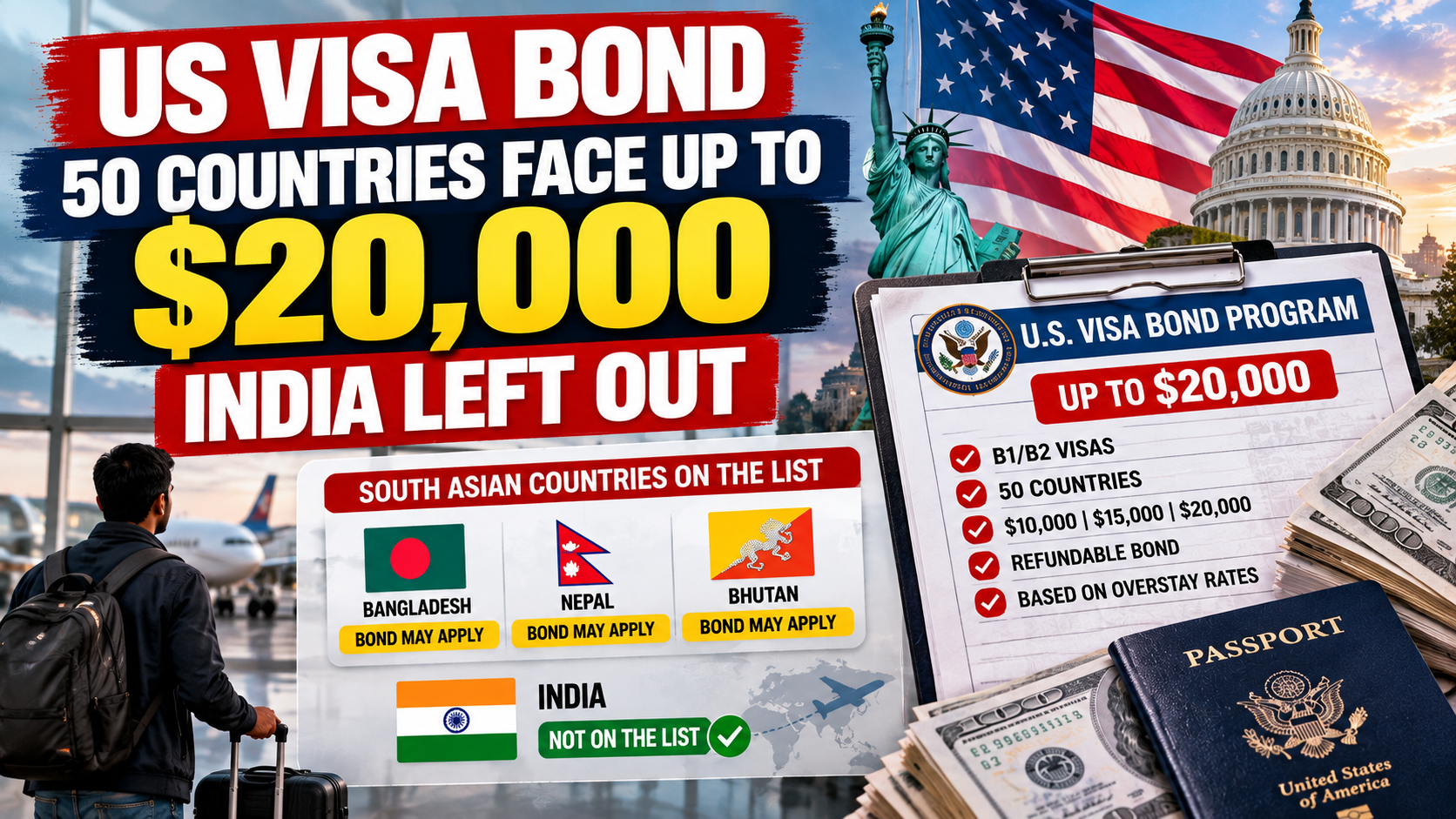
The United States has expanded its US visa bond programme to cover nationals of 50 countries seeking certain B-1/B-2 visitor visas. Eligible applicants from the designated countries may be required to post a refundable bond of $10,000, $15,000 or $20,000 before a visa can be issued.
For Indian travellers, however, there is an important distinction: India is not included on the current U.S. Department of State list of countries subject to visa bonds. Several neighbouring South Asian countries, including Bangladesh, Bhutan and Nepal, are on the list.
The permanent programme operates under Section 221(g)(3) of the Immigration and Nationality Act (INA). A final rule published by the State Department in August 2026 made permanent the visa-bond programme that began as a pilot in 2025.
What is the US visa bond programme?
The US visa bond programme allows a consular officer to require certain otherwise eligible B-1/B-2 applicants to provide a financial guarantee before their visa is issued.
The programme is designed primarily to encourage visitors to comply with the terms of their temporary admission and leave the United States on time. The State Department says country selection is connected to factors including B-1/B-2 overstay rates, while the final rule also references concerns involving information sharing, identity verification, criminal records, screening and travel-document security.
The final rule allows a consular officer to set the bond at one of three levels:
| Bond amount | Who determines it? |
|---|---|
| $10,000 | Consular officer |
| $15,000 | Consular officer |
| $20,000 | Consular officer |
The amount is not automatically the same for every applicant from a particular country. The officer determines the appropriate amount based on the applicant’s circumstances under the programme.
The final rule also makes clear that the bond is a condition of visa issuance, rather than a replacement for the normal visa application process.
Why did the US introduce the visa bond?
The central purpose of the US visa bond system is to address concerns about temporary visitors overstaying their authorised periods of admission.
The State Department says visa-bond country designations are linked to B-1/B-2 overstay data from the Department of Homeland Security’s Entry/Exit Overstay Report. The permanent rule also gives the government a broader framework for addressing countries where it identifies concerns involving information sharing, identity verification, criminal records and the security of travel or civil documents.
The final rule followed a 12-month pilot programme that began in August 2025. According to the State Department, the pilot provided sufficient operational data for the government to conclude that the programme could be continued permanently.
Importantly, being a citizen of a listed country does not mean that every individual has previously overstayed a U.S. visa. The designation applies at the nationality level, while the actual bond requirement is imposed on qualifying applicants through the consular process.
How does the US visa bond work?
The process is different from simply paying an additional visa application fee.
A typical process is:
1. Apply for a B-1/B-2 visa
The applicant completes the normal visitor visa process.
2. Attend the visa interview
The consular officer assesses the application and determines whether the applicant is otherwise eligible for a B-1/B-2 visa.
3. Bond requirement is determined
If the applicant is covered by the programme and a bond is required, the officer determines whether the amount will be $10,000, $15,000 or $20,000.
4. Complete Form I-352
The applicant must submit the required Department of Homeland Security Form I-352 after being instructed to do so.
5. Pay through Pay.gov
The applicant receives instructions and a direct payment link for the U.S. Treasury’s Pay.gov system.
6. Travel under the bond conditions
Visa holders who post a bond must follow specific entry and departure requirements.
The State Department specifically warns applicants not to pay a bond through an unrelated website or third-party platform. Applicants should only use the payment instructions provided by U.S. officials.
Is the visa bond the same as the visa application fee?
No.
The US visa bond is separate from the normal visa application fee.
The visa application fee is a standard processing charge and is generally not refundable simply because a visa is refused. The bond, by contrast, is a financial guarantee connected to compliance with the conditions of the visa.
A bond also does not guarantee that a visa will be approved. The State Department expressly states that paying a bond does not guarantee visa issuance.
This distinction is particularly important because an applicant should not assume that paying $10,000, $15,000 or $20,000 will result in a visa being granted.
What happens to the visa bond after travel?
The US visa bond can be cancelled and the money returned when the conditions of the bond have been satisfied.
According to the State Department, the bond may be cancelled automatically when DHS records show that the visa holder departed the United States on or before the authorised departure date. The bond may also be cancelled if the person never travels to the United States before the visa expires or if the person applies for admission but is denied entry.
The money is therefore not necessarily a permanent government charge.
However, the applicant must comply with the terms attached to the bond.
When can a visa bond be forfeited?
A US visa bond can potentially be breached if the visitor fails to comply with the conditions attached to it.
The State Department lists situations that can trigger a review for breach, including circumstances where DHS records show that the person departed after the date they were authorised to remain in the United States.
The department also identifies remaining in the United States beyond the authorised period without departing and applying to adjust out of nonimmigrant status, including claiming asylum, among circumstances that may result in a bond-breach determination.
The exact consequences depend on the bond terms and the individual’s circumstances.
Which visas are covered by the programme?
The programme is focused on B-1 and B-2 visitor visas.
B-1 visa
B-1 visas are generally associated with temporary business activities.
B-2 visa
B-2 visas are generally used for tourism, visits and other permitted temporary visitor activities.
B-1/B-2 visa
Many travellers receive a combined B-1/B-2 visa covering qualifying business and tourism purposes.
The US visa bond programme does not create a general bond requirement for every U.S. visa category. The final rule specifically addresses temporary visitors for business or pleasure under the B-1/B-2 framework.
Therefore, the programme should not be interpreted as a blanket $20,000 requirement for student, employment or immigrant visa applicants.
Is India on the US visa bond list?
No. India is not on the current list.
The U.S. Department of State’s latest published list contains 50 countries, but India does not appear among them. This means Indian passport holders are not subject to the bond requirement solely because they are Indian nationals under the current country-based programme.
The development is particularly significant because several countries in India’s neighbourhood are covered.
South Asian countries currently listed
| Country | Implementation date |
|---|---|
| Bangladesh | January 21, 2026 |
| Bhutan | January 1, 2026 |
| Nepal | January 21, 2026 |
| India | Not listed |
The State Department’s list is subject to change, so travellers should check the official list before making visa-payment or travel decisions.
Full list of 50 countries under the US visa bond programme
The current State Department list includes countries across Africa, Asia, the Caribbean, the Americas and the Pacific. The implementation dates vary by country.
Africa
- Algeria
- Angola
- Benin
- Botswana
- Burundi
- Cabo Verde
- Central African Republic
- Côte d’Ivoire
- Djibouti
- Ethiopia
- Gabon
- The Gambia
- Guinea
- Guinea-Bissau
- Lesotho
- Malawi
- Mauritania
- Mauritius
- Mozambique
- Namibia
- Nigeria
- São Tomé and Príncipe
- Senegal
- Seychelles
- Tanzania
- Togo
- Uganda
- Zambia
- Zimbabwe
Asia and Central Asia
- Bangladesh
- Bhutan
- Cambodia
- Georgia
- Kyrgyz Republic
- Mongolia
- Nepal
- Tajikistan
- Turkmenistan
Caribbean and Americas
- Antigua and Barbuda
- Cuba
- Dominica
- Grenada
- Nicaragua
- Venezuela
Pacific
- Fiji
- Papua New Guinea
- Tonga
- Tuvalu
- Vanuatu
India is not included in the current 50-country list.
Does applying from another country avoid the visa bond?
No.
The US visa bond requirement is connected to the passport nationality covered by the programme, rather than simply the location where the applicant submits the visa application.
The State Department says the requirement applies regardless of the place of application. Therefore, a national of a listed country generally cannot avoid the requirement simply by applying at a U.S. embassy or consulate in another country.
This is an important point for applicants who live, work or study outside their country of citizenship.
Visa bond holders face special travel conditions
Applicants required to post a US visa bond must also follow specific entry and departure conditions.
The State Department says visa-bond holders must enter and exit the United States through designated commercial air ports of entry, including eligible CBP preclearance locations. They may not use charter aircraft, general aviation, land ports or sea ports for these bond-related entries and departures.
That means a traveller covered by the bond programme should check the applicable travel conditions before booking a trip.
Failing to use the required port or method of travel could create problems with admission or with the government’s ability to record the traveller’s departure properly.
US visa bond scams: applicants urged to be careful
The introduction of a bond worth as much as $20,000 also creates an opportunity for fraudsters to target applicants.
The State Department specifically warns that applicants should not independently submit a bond payment.
Instead, applicants should first attend the visa interview and wait for instructions from the consular officer. If a bond is required, the applicant will receive instructions for submitting Form I-352 and a payment link associated with Pay.gov.
The government also states that it is not responsible for money paid outside its systems.
This means applicants should be especially cautious about websites, agents, social-media messages or individuals claiming that an advance payment is required to “reserve” a visa appointment or guarantee approval.
What Indian applicants should know
For Indian travellers, the biggest takeaway from the current US visa bond rules is that Indian passport holders are not currently included in the designated 50 countries.
Therefore, an Indian applicant applying for a normal B-1/B-2 visa does not face the $10,000-$20,000 bond requirement merely because of Indian nationality.
However, normal U.S. visa requirements continue to apply. Applicants still need to demonstrate eligibility for the relevant visa category, and the bond programme does not change the ordinary consular screening process.
Indian travellers should also remember that the State Department can modify the list of covered countries. The permanent rule provides a mechanism for countries to be added or removed, meaning the list should be checked whenever a new visa application is being prepared.
FAQs : US Visa Bond
What is the US visa bond?
The US visa bond is a financial guarantee that the U.S. government may require from certain otherwise eligible B-1/B-2 visa applicants from designated countries. The bond can be $10,000, $15,000 or $20,000.
Is India included in the visa bond programme?
No. India is not included on the current U.S. Department of State list of 50 countries subject to visa bonds.
Which Indian neighbours are affected by US Visa Bond?
Bangladesh, Bhutan and Nepal are currently included on the list.
Is the $20,000 amount mandatory for everyone?
No. The programme provides three bond levels—$10,000, $15,000 and $20,000. The amount is determined by the consular officer based on the applicant’s circumstances.
Does paying the bond guarantee a U.S. visa?
No. The US visa bond does not guarantee visa issuance. The State Department specifically states that the bond is not a guarantee of approval.
Is the visa bond refundable?
It can be. The bond is generally cancelled and returned when the applicable conditions are satisfied, including timely departure recorded by DHS.
Can I pay the visa bond on any website?
No. Applicants should pay only through the official process and Pay.gov link provided after a consular officer directs them to post the bond.
Does the rule apply to F-1 or H-1B visas?
The programme described in the final rule concerns B-1/B-2 business and visitor visas. It is not a blanket bond requirement for F-1 students or H-1B workers.
Final Takeaway On US Visa Bond
The US visa bond programme now provides the United States with a permanent mechanism to require financial guarantees from qualifying B-1/B-2 applicants from designated countries. The maximum bond is currently $20,000, with $10,000 and $15,000 also available as bond levels.
For Indian travellers, the immediate impact is limited because India is not on the current 50-country list. Bangladesh, Bhutan and Nepal, however, are among the South Asian countries covered.
Applicants from listed countries should not pay a bond before receiving official instructions from a consular officer. The correct process involves Form I-352 and payment through the U.S. Treasury’s Pay.gov system. The bond also comes with specific travel and departure conditions.
Because the State Department can update the list, travellers should verify the latest official information before paying any money or finalising travel arrangements.
Source : Indian Express
Read About : US Visa October Bulletin 2026: What the New Green Card Cut Offs Mean for Indian Applicants