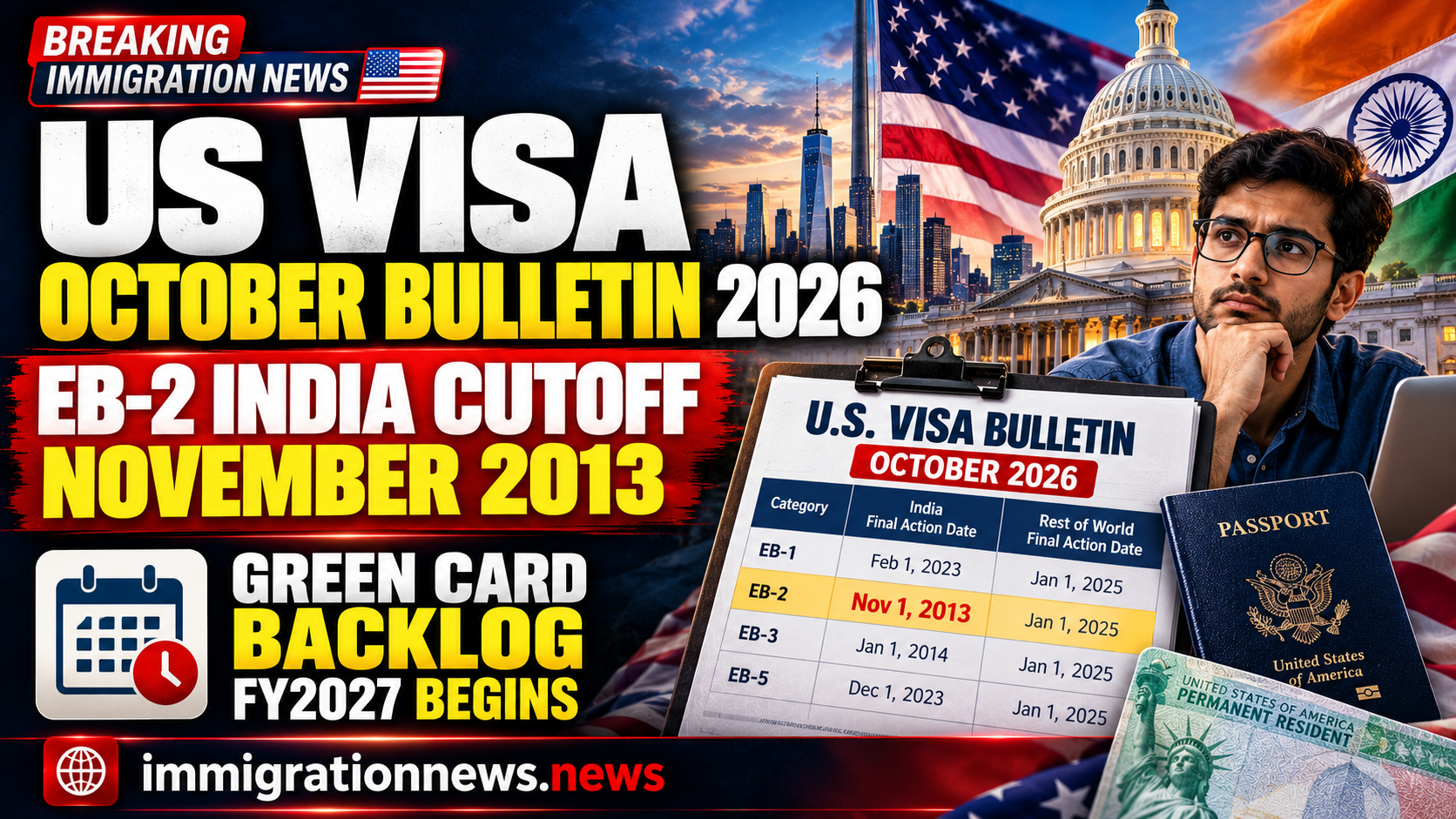
The US Visa October Bulletin 2026 marks the beginning of fiscal year 2027 and brings an important change for Indian employment-based green card applicants: visa availability has resumed after the EB-2 India category reached its annual limit during fiscal year 2026.
However, the restart does not mean the long-standing Indian green card backlog has disappeared.
For October 2026, the EB-2 India Final Action Date remains November 1, 2013, while the EB-2 India Date for Filing is January 15, 2015. By comparison, EB-2 applicants chargeable to most other countries have a Final Action Date of January 1, 2025.
The US Visa October Bulletin 2026 also provides updated dates for EB-1, EB-3, EB-5 and family-sponsored categories, giving applicants a clearer picture of where their green card cases stand at the start of the new fiscal year.
For Indian applicants who have been waiting years for permanent residence, the most important question is whether their priority date is earlier than the applicable cutoff and whether they can use the Final Action or Dates for Filing chart.
US Visa October Bulletin 2026: What Changed for EB-2 India?
The biggest headline in the US Visa October Bulletin 2026 is that EB-2 India visa availability has returned after the category became unavailable during fiscal year 2026.
The U.S. Department of State had announced earlier that India’s FY2026 EB-2 allocation had been reached. Because employment-based immigrant visa numbers are subject to annual limits, additional EB-2 India numbers could not be issued after the allocation was exhausted. Availability reset with the beginning of fiscal year 2027 on October 1, 2026.
Despite the reset, the October cutoff remains highly restrictive.
EB-2 India October 2026 dates
- Final Action Date: November 1, 2013
- Date for Filing: January 15, 2015
The State Department says immigrant visa numbers are authorized only for applicants whose priority dates are earlier than the listed Final Action Date.
Therefore, an applicant with a priority date of October 30, 2013 is ahead of the October Final Action cutoff, while someone with a priority date of November 15, 2013 is not.
The US Visa October Bulletin 2026 therefore provides renewed visa availability, but not a major breakthrough for the Indian EB-2 backlog.
Why Is the EB-2 India Cutoff Still in 2013?
The US Visa October Bulletin 2026 continues to show a huge gap between India and most other countries because India remains an oversubscribed chargeability area.
The State Department identifies India, China, Mexico and the Philippines as oversubscribed areas under the current employment-based allocation system.
The U.S. immigration system generally applies a per-country limitation to preference immigrant visas. Section 202 of the Immigration and Nationality Act establishes a general 7% per-country limit based on the combined annual family-sponsored and employment-based preference limits, subject to statutory provisions and allocation rules.
This becomes particularly significant for India because of the large number of employment-based applicants from the country.
High demand means that many Indian applicants compete for a limited number of available visa numbers. As a result, the cutoff date can remain years behind the dates available to applicants chargeable to countries with lower demand.
The US Visa October Bulletin 2026 reflects that continuing imbalance.
EB-2 India vs Other Countries: The Gap Remains Huge
One of the clearest points from the US Visa October Bulletin 2026 is the difference between India’s EB-2 cutoff and the cutoff for most other countries.
| Chargeability Area | EB-2 Final Action Date | EB-2 Date for Filing |
|---|---|---|
| India | Nov. 1, 2013 | Jan. 15, 2015 |
| China | Oct. 1, 2021 | Jan. 1, 2023 |
| All other countries | Jan. 1, 2025 | Mar. 15, 2026 |
| Mexico | Jan. 1, 2025 | Mar. 15, 2026 |
| Philippines | Jan. 1, 2025 | Mar. 15, 2026 |
The official October bulletin confirms these dates.
This means an Indian applicant with a 2014 priority date remains behind the Final Action cutoff, while an otherwise comparable EB-2 applicant chargeable to most other countries may have a much more recent priority date.
That difference is one of the defining features of the U.S. employment-based green card system.
What Are the October 2026 Green Card Dates for Indians?
The US Visa October Bulletin 2026 includes several important employment-based dates for applicants chargeable to India.
| Category | Final Action Date | Date for Filing |
|---|---|---|
| EB-1 India | Feb. 1, 2023 | July 1, 2024 |
| EB-2 India | Nov. 1, 2013 | Jan. 15, 2015 |
| EB-3 India | Jan. 1, 2014 | Jan. 15, 2015 |
| Other Workers India | Jan. 1, 2014 | Jan. 15, 2015 |
| EB-4 India | Dec. 15, 2022 | Jan. 1, 2025 |
| Certain Religious Workers | Dec. 15, 2022 | Jan. 1, 2025 |
| EB-5 Unreserved India | Dec. 1, 2023 | May 1, 2024 |
| EB-5 Set-Asides | Current | Current |
These figures come from the U.S. Department of State’s October 2026 employment-based charts.
The US Visa October Bulletin 2026 therefore shows that Indian applicants face very different timelines depending on their employment-based category.
Final Action Date vs Date for Filing
Understanding the two charts is essential when reading the US Visa October Bulletin 2026.
Final Action Date
The Final Action Date determines when an immigrant visa number may be available for final action, assuming all other requirements have been met.
For EB-2 India in October 2026, the date is:
November 1, 2013
Applicants generally need a priority date earlier than this date to be eligible for final visa issuance in the category.
Date for Filing
The Dates for Filing chart identifies when eligible immigrant-visa applicants may begin submitting required documentation to the National Visa Center, provided they receive the appropriate notification and meet the applicable requirements.
For EB-2 India, the October Date for Filing is:
January 15, 2015
The State Department explains that applicants with priority dates earlier than the listed date may assemble and submit required documents to the National Visa Center after receiving the relevant instructions.
However, the Dates for Filing chart does not mean that the applicant can immediately receive a green card.
Can Adjustment-of-Status Applicants Use the Filing Chart?
The US Visa October Bulletin 2026 contains an important warning for applicants inside the United States.
The State Department says adjustment-of-status applicants generally use the Final Action Dates chart unless USCIS determines that the Dates for Filing chart may be used for that month. Applicants therefore need to check USCIS’s monthly adjustment-of-status filing guidance before submitting Form I-485 based on the filing chart.
This distinction matters because an applicant could have a priority date that falls within the Dates for Filing range but still not be able to file an adjustment-of-status application if USCIS has not authorized use of that chart for the relevant month.
Applicants should therefore avoid treating the Visa Bulletin alone as permission to file.
What Does the November 1, 2013 EB-2 India Date Mean?
For people following the US Visa October Bulletin 2026, the November 1, 2013 cutoff is particularly important.
Consider these examples:
| Priority Date | EB-2 India Final Action Status |
|---|---|
| October 2012 | Earlier than cutoff |
| October 2013 | Earlier than cutoff |
| October 31, 2013 | Earlier than cutoff |
| November 1, 2013 | Not earlier than cutoff |
| December 2013 | Not current |
| October 2014 | Not current for final action |
| January 2015 | Not current for final action |
The State Department’s rule is that numbers are authorized only for applicants whose priority dates are earlier than the listed date.
Therefore, simply having a priority date in 2013 is not enough; the exact date matters.
What Happened to EB-2 India in FY2026?
The background to the US Visa October Bulletin 2026 goes back to the end of fiscal year 2026.
The State Department had warned during FY2026 that high demand and visa-number use by applicants chargeable to India could require further retrogression or make the EB-2 category unavailable.
Eventually, India’s EB-2 allocation was exhausted.
When an annual or applicable allocation is exhausted, the State Department cannot simply continue issuing additional preference immigrant visas without available numbers.
The new fiscal year provided a fresh allocation, allowing EB-2 India to become available again.
However, the new allocation does not erase existing demand.
This explains why the US Visa October Bulletin 2026 shows the category available again but still maintains a 2013 Final Action Date.
EB-3 India Is Slightly Ahead of EB-2
Another important point in the US Visa October Bulletin 2026 is the EB-3 India cutoff.
For October:
- EB-2 India Final Action Date: November 1, 2013
- EB-3 India Final Action Date: January 1, 2014
Therefore, EB-3 India is currently about two months ahead of EB-2 India on the Final Action Dates chart.
The EB-3 India Date for Filing is also January 15, 2015.
However, applicants should not assume that changing from EB-2 to EB-3 will automatically make a green card available sooner.
Eligibility depends on the underlying employment petition, job requirements, qualifications, priority date and other immigration factors.
EB-1 India Has a Much Newer Cutoff
The US Visa October Bulletin 2026 shows a considerably more recent cutoff for EB-1 India.
The October dates are:
- EB-1 Final Action Date: February 1, 2023
- EB-1 Date for Filing: July 1, 2024
EB-1 covers several types of priority workers, including certain multinational executives and managers, individuals with extraordinary ability, and outstanding professors or researchers.
Because the cutoff is much newer than EB-2 India, an applicant who independently qualifies for EB-1 may have a substantially different green card timeline.
However, EB-1 eligibility has its own statutory and regulatory requirements. It is not simply an alternative category available to every EB-2 applicant.
EB-5 India Dates Also Improve the Picture for Some Applicants
The US Visa October Bulletin 2026 also provides updated EB-5 dates for Indian applicants.
For EB-5 unreserved cases:
- Final Action Date: December 1, 2023
- Date for Filing: May 1, 2024
The EB-5 set-aside categories are listed as Current for India.
The set-aside categories include reserved visa numbers for qualifying investments in areas such as rural locations, high-unemployment areas and infrastructure projects.
The much newer dates in EB-5 compared with EB-2 do not mean every applicant can use the category. EB-5 has separate investment, job-creation and eligibility requirements.
What About Family-Based Green Cards for Indians?
The US Visa October Bulletin 2026 also contains family-sponsored preference dates.
For India, the October Final Action Dates include:
| Family Category | India Final Action Date |
|---|---|
| F1 | Jan. 22, 2020 |
| F2A | Sept. 22, 2026 |
| F2B | Aug. 22, 2019 |
| F3 | Oct. 22, 2014 |
| F4 | Dec. 15, 2006 |
The State Department lists F2A at September 22, 2026 for India in the October Final Action chart.
For the Dates for Filing chart, F2A is listed as Current.
“Current” means applicants can file regardless of priority date under the applicable chart, although other requirements and filing rules still apply.
The difference between the F2A Final Action and filing dates again demonstrates why applicants should carefully distinguish the two charts.
Why Indian Green Card Applicants Should Watch Monthly Visa Bulletins
The US Visa October Bulletin 2026 should not be viewed as a one-time prediction of how the entire fiscal year will unfold.
Visa Bulletin dates can move forward, remain unchanged or move backward depending on demand and available visa numbers.
The State Department specifically monitors visa availability and can make adjustments during the fiscal year.
For Indian applicants with long-standing EB-2 or EB-3 priority dates, even relatively small monthly movements can be significant.
At the same time, applicants should be cautious about assuming that the cutoff will advance by a fixed number of months every month.
What Does the October Bulletin Mean for Indian Green Card Applicants?
The US Visa October Bulletin 2026 is a mixed development for Indian applicants.
The positive news
EB-2 India is no longer unavailable after the FY2026 allocation was exhausted.
The beginning of FY2027 has restored visa-number availability.
The continuing problem
The EB-2 India Final Action Date remains at November 1, 2013.
That means applicants with priority dates from 2014 onward remain outside the Final Action cutoff.
The potential filing opportunity
Applicants with priority dates earlier than January 15, 2015 fall within the October EB-2 India Dates for Filing range.
Whether they can actually file adjustment of status depends on the applicable USCIS filing-chart determination and their individual circumstances.
Could the EB-2 India Cutoff Move Forward Later in FY2027?
The US Visa October Bulletin 2026 does not provide a guaranteed forecast for future months.
The State Department continues to monitor demand and visa-number usage.
If demand is lower than anticipated and sufficient numbers remain available, cutoffs may advance.
If demand is higher, dates could remain unchanged or potentially retrogress.
This is particularly relevant to India because the backlog is large and demand is consistently high.
Therefore, applicants should treat each monthly bulletin as the authoritative update rather than relying on predictions about where the cutoff “should” move.
Key Dates From the US Visa October Bulletin 2026
The following table summarizes the most important employment-based dates for Indian applicants:
| Category | Final Action | Filing Date |
|---|---|---|
| EB-1 India | Feb. 1, 2023 | July 1, 2024 |
| EB-2 India | Nov. 1, 2013 | Jan. 15, 2015 |
| EB-3 India | Jan. 1, 2014 | Jan. 15, 2015 |
| Other Workers | Jan. 1, 2014 | Jan. 15, 2015 |
| EB-4 India | Dec. 15, 2022 | Jan. 1, 2025 |
| EB-5 Unreserved India | Dec. 1, 2023 | May 1, 2024 |
| EB-5 Set-Asides | Current | Current |
| F2A India | Sept. 22, 2026 | Current |
These are the October 2026 dates published by the U.S. Department of State.
What Should Indian Applicants Do Now?
After reviewing the US Visa October Bulletin 2026, applicants should start with their exact priority date.
They should then identify:
- Their employment-based category.
- Their country of chargeability.
- Their Final Action Date.
- Their applicable Date for Filing.
- Whether USCIS permits use of the filing chart for adjustment of status.
- Whether their underlying petition remains valid and eligible.
- Whether any additional documentation or procedural requirement applies.
Applicants should not assume that reaching the Dates for Filing cutoff means their green card will immediately be approved.
Similarly, a current priority date does not eliminate other requirements for adjustment of status or consular immigrant-visa processing.
US Visa October Bulletin 2026: What Indian Applicants Should Watch Next
The biggest issue to watch after the US Visa October Bulletin 2026 is whether the EB-2 India Final Action Date begins moving forward during FY2027.
Indian applicants will also be watching EB-3 because its January 1, 2014 Final Action Date is currently ahead of EB-2.
EB-1 India remains substantially more advanced, while EB-5 set-asides remain Current.
However, the State Department’s monthly Visa Bulletin remains the key source for future changes.
Applicants should also distinguish between visa availability and USCIS processing times. A current priority date does not necessarily mean the entire green card process will be completed immediately.
FAQs : US Visa October Bulletin 2026
What is the EB-2 India cutoff in the US Visa October Bulletin 2026?
The EB-2 India Final Action Date is November 1, 2013, while the Date for Filing is January 15, 2015.
Is EB-2 India available again?
Yes. EB-2 India visa availability has resumed with the beginning of fiscal year 2027 after India’s FY2026 allocation was exhausted.
Can a person with a 2014 EB-2 India priority date get a green card in October 2026?
Not under the October Final Action Date because January 2014 and later priority dates are after the November 1, 2013 cutoff. However, some applicants with qualifying priority dates earlier than January 15, 2015 may fall within the Dates for Filing range, subject to the applicable USCIS filing rules.
What is the EB-3 India cutoff?
The October 2026 EB-3 India Final Action Date is January 1, 2014, with a Date for Filing of January 15, 2015.
What is the EB-1 India cutoff?
EB-1 India has a Final Action Date of February 1, 2023, and a Date for Filing of July 1, 2024.
What is the EB-5 India cutoff?
EB-5 unreserved India has a Final Action Date of December 1, 2023 and a Date for Filing of May 1, 2024. EB-5 set-aside categories are Current.
Can the EB-2 India date move backward?
Yes. Visa Bulletin dates can retrogress if demand and available visa numbers require the State Department to reduce the cutoff.
Does the Dates for Filing date mean I will receive my green card?
No. The Dates for Filing chart can allow eligible applicants to begin submitting documentation, but final visa issuance or adjustment approval depends on the Final Action Date and all other requirements.
Can adjustment-of-status applicants automatically use the Dates for Filing chart?
No. USCIS determines whether adjustment-of-status applicants may use the Dates for Filing chart for a particular month. Applicants should check the applicable USCIS guidance before filing.
Why is the Indian EB-2 backlog so large?
India is an oversubscribed chargeability area with substantial employment-based demand. The statutory allocation system and per-country limitations contribute to the long waiting period.
Final Takeaway On US Visa October Bulletin 2026
The US Visa October Bulletin 2026 brings some relief for Indian employment-based green card applicants because EB-2 India visa availability has returned after the category reached its FY2026 allocation limit.
But the underlying backlog remains substantial.
The EB-2 India Final Action Date is November 1, 2013, while the Date for Filing is January 15, 2015. EB-3 India has a slightly newer Final Action Date of January 1, 2014, while EB-1 India is considerably further ahead at February 1, 2023.
For applicants, the most important step is to determine exactly where their priority date falls in relation to the relevant chart.
The US Visa October Bulletin 2026 should also be viewed as the starting point for FY2027 rather than a prediction of where the dates will be several months from now. The State Department can advance, hold or retrogress the cutoffs depending on demand and available visa numbers.
Indian applicants should therefore continue checking each monthly bulletin, follow USCIS guidance when seeking adjustment of status, and avoid making major immigration decisions based solely on predicted future movement.
Source : Indian Express
Read About : US Visa Wait Time for Indians Reaches 346 Days: Why Are the Queues So Long?