
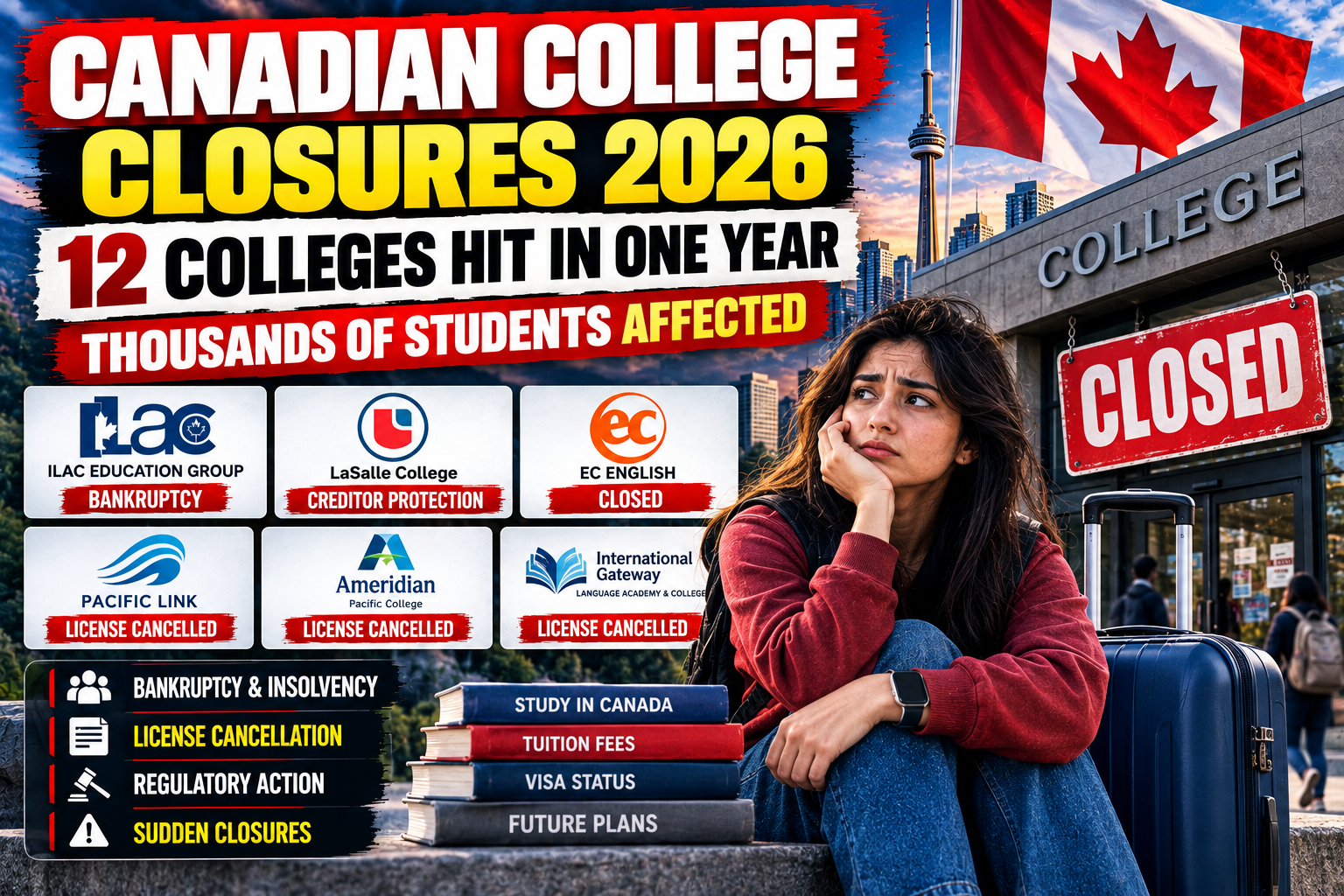
Canadian college closures 2026 have become a major concern for international students, education agents and families after a turbulent 12-month period involving bankruptcy proceedings, creditor protection, license cancellations, registration revocations and sudden closures.
From British Columbia to Ontario and Quebec, students have been forced to consider alternative colleges, tuition-protection options and the potential impact on their education and immigration plans.
Between September 28, 2025, and September 28, 2026, several Canadian private colleges and language schools experienced major regulatory or financial disruptions. Prominent cases include Pacific Link College, Ameridian Pacific College, International Gateway Language Academy & College, LaSalle College, EC English and ILAC Education Group.
However, there is an important distinction: not every institution affected during this period went bankrupt or permanently closed. Some lost provincial authorization, some entered creditor protection, while others temporarily closed during regulatory or legal proceedings.
The term Canadian college closures 2026 therefore covers several different types of institutional disruption rather than a single legal category.
How Many Canadian Colleges Have Closed or Faced Major Disruption?
There is currently no single federal database providing a definitive nationwide count of private-college closures and the exact number of students affected.
Our review of provincial regulators, federal insolvency records and documented reporting identified at least 12 institutions or education groups that experienced significant closure, license cancellation, registration revocation, insolvency proceedings or major license-related disruption during the 12-month period.
However, these cases cannot all be described as bankruptcies.
The documented cases broadly fall into four categories:
- Bankruptcy or insolvency: ILAC Education Group
- Creditor protection: LaSalle College
- Regulatory cancellation or registration revocation: Pacific Link College, Ameridian Pacific College, International Gateway Language Academy & College and Biztech College
- Closure or major license disruption: EC English and several Quebec private colleges
The number of students affected is also difficult to calculate because some institutions have not released enrollment figures, while some reported figures cover only particular programs.
Languages Canada said on September 28 that it was coordinating placements for more than 4,500 students affected by the ILAC and EC English closures, including students who had already started programs as well as some students who had prepaid for future studies. (Languages Canada)
This newer figure should not be combined mechanically with the individual student numbers below because the categories and reporting periods differ.
Pacific Link College Shutdown Affected About 300 Students
One of the first major cases in the Canadian college closures 2026 timeline involved Pacific Link College in British Columbia.
On October 8, 2025, British Columbia’s Private Training Institutions Regulatory Unit (PTIRU) cancelled Pacific Link College’s designation certificate.
The institution was required to stop providing the affected career-training program. Eligible students could seek assistance through British Columbia’s Student Tuition Protection Fund.
PTIRU confirms that the designation certificate was cancelled effective October 8, 2025, and that affected students could potentially file claims through the Student Tuition Protection Fund. (Private Training Institutions Branch)
The regulatory action followed concerns involving the institution’s operations, including issues related to program advertising, admissions, work placements and program delivery.
Media reports subsequently indicated that around 300 international students were affected by the shutdown. This figure was reported as an estimate rather than an official enrollment figure published by the regulator.
For those students, the problem was not simply finding another Canadian college. They also had to consider tuition already paid, academic credits, study-permit requirements and their longer-term immigration plans.
More British Columbia Colleges Faced Regulatory Action
Pacific Link was followed by additional regulatory cases in British Columbia.
Ameridian Pacific College
On January 21, 2026, PTIRU cancelled the designation certificate of Ameridian Pacific College.
The cancellation meant that the institution could no longer provide the affected career-training program. PTIRU stated that affected students could potentially access the provincial tuition-protection system, subject to the applicable requirements. (Private Training Institutions Branch)
A reliable public figure for the number of affected students was not available.
International Gateway Language Academy & College
On May 6, 2026, PTIRU cancelled the designation of International Gateway Language Academy & College in Kelowna.
The institution was required to stop providing its affected career-training programs. Students potentially eligible for tuition protection were directed toward the provincial process.
Again, a verified public enrollment figure was not available.
These cases are important because Canadian college closures 2026 should not automatically be interpreted as a list of bankrupt institutions. Regulatory cancellation and bankruptcy are separate legal events.
Ontario College Registration Revoked
Ontario also experienced private-college regulatory action during the period covered by this report.
On January 12, 2026, the registration of Biztech College of Health Sciences, Business and Technology in Mississauga was revoked.
The Ontario government said the institution had previously lost approval for its Diagnostic Medical Sonography program and had been directed to provide refunds to affected students.
The government stated that the required refunds had not been provided by July 2025.
The case represents a registration revocation rather than a confirmed bankruptcy.
Another Ontario institution, Revolution Truck Training Academy, had its registration revoked in August 2026 following regulatory proceedings concerning training records and instructional requirements.
Ontario’s published decision says the Superintendent revoked the registration after findings concerning false or misleading training records, failure to provide required instruction hours and admission of students who did not meet program requirements. The Licence Appeal Tribunal ordered the Superintendent to carry out the revocation. (Ontario)
The number of students affected in these cases was not publicly established in a sufficiently reliable form to provide a national total.
Quebec College Closures Put 878 International Students in Uncertainty
Quebec experienced one of the most significant license-related disruptions of 2026.
Collège supérieur de Montréal (CSM) and Collège supérieur de Sherbrooke (CSS) initially faced non-renewal of their licenses.
The development affected approximately 878 international students combined, according to reporting at the time. (CityNews Montreal)
For students, the situation initially looked like another sudden Canadian college closure.
But the story did not end there.
On July 28, 2026, the Tribunal administratif du Québec suspended enforcement of the government’s decision concerning the institutions. The colleges were subsequently allowed to resume classes while the legal proceedings continued. (CityNews Montreal)
Therefore, these two institutions should not be counted as permanently closed Canadian colleges based on the latest status available for this reporting period.
The case nevertheless demonstrates how a regulatory dispute can suddenly leave international students questioning where they will study and what happens to tuition they have already paid.
LaSalle College Enters Creditor Protection
Another major Quebec case involved LaSalle College in Montreal.
In August 2026, LaSalle entered proceedings under Canada’s Companies’ Creditors Arrangement Act (CCAA).
The case involved substantial financial liabilities, including a reported claim by Quebec’s Ministry of Higher Education of approximately C$47.2 million. (Proceedings)
Approximately 3,000 students were caught up in the uncertainty surrounding the institution.
But calling LaSalle simply a “bankrupt Canadian college” would be misleading.
The institution entered creditor protection rather than simply being classified as a conventional bankruptcy case. LaSalle subsequently resumed classes after a Quebec Superior Court decision ordered the release of subsidies for the 2026–27 academic year. The college said approximately 3,000 students and 421 teachers and staff resumed classes on September 4. (LaSalle College Montreal)
For students, however, the episode demonstrated that even an established private college can face substantial financial and regulatory pressure.
EC English Closure Affects 471 Students
September 2026 brought another major development to Canada’s international education sector.
EC English closed its Canadian operations, affecting schools in Toronto, Vancouver and Montreal.
Languages Canada initially reported 375 students at the Toronto and Vancouver schools and approximately 40 students in Montreal. Subsequent reporting placed the total number of affected Canadian students at 471. (Languages Canada)
The organization worked with member schools to help affected students continue their studies elsewhere.
Languages Canada later confirmed that all 471 students affected by the EC English closure had been placed with alternate member schools. (Language Canada)
The EC English case is particularly relevant to searches involving English-language schools in Canada, international student closures and Canadian language-school shutdowns because it demonstrates that the disruption is not limited to traditional career colleges.
ILAC Bankruptcy Sends Shockwaves Through Canadian International Education
The biggest and most significant case in the Canadian college closures 2026 timeline came only days later.
On September 18, 2026, ILAC Education Group ceased operations after entering bankruptcy proceedings.
The group included:
- International Language Academy of Canada
- ILAC International College
- Tamwood Careers
- Tamwood Language Centers
British Columbia’s PTIRU confirmed that the relevant institutions surrendered their designation certificates effective September 18, 2026.
ILAC also announced bankruptcy proceedings, with KPMG Inc. appointed as trustee. ILAC’s own announcement said the organization had stopped operations and that bankruptcy proceedings had been initiated. (ILAC China)
The student impact was substantial.
Languages Canada reported 1,362 current in-person ILAC language students affected by the closure. (Languages Canada)
That figure is important, but it should not be interpreted as the total number of people affected across every ILAC-related education program.
The group also operated career-training and other educational programs.
Following the closure, students had to find alternative institutions, while some families faced financial and logistical uncertainty.
For international students, a sudden college bankruptcy can create several simultaneous problems:
- Lost or delayed tuition
- Finding a replacement institution
- Transferring academic credits
- Understanding study-permit requirements
- Adjusting accommodation arrangements
- Reassessing future work or immigration plans
This is why Canadian college closures 2026 and ILAC bankruptcy have become important search topics for students, parents and education agents.
How Many Students Have Been Affected?
There is no verified nationwide figure that can responsibly be presented as the total number of students affected by Canadian college closures 2026 during the past 12 months.
Some of the strongest publicly reported figures include:
| Institution | Reported students affected |
|---|---|
| Pacific Link College | About 300 |
| EC English Canada | 471 |
| ILAC language programs | 1,362 in-person students |
| LaSalle College | About 3,000 potentially affected |
| Collège supérieur de Montréal + Sherbrooke | 878 temporarily affected |
These figures should not simply be added together.
Some students were subsequently transferred to other schools. Some institutions reopened or continued operating following legal proceedings. Some numbers cover only language students rather than an entire education group.
Languages Canada is now coordinating placements for more than 4,500 students connected to the ILAC and EC English closures, a figure that includes different categories of students and prepaid future programs. (Languages Canada)
Consequently, claiming that “more than X students permanently lost their colleges” would overstate what the available evidence establishes.
Why Are Canadian Private Colleges Under Pressure?
The Canadian college closures 2026 cases are taking place during a major transformation of Canada’s international education system.
Canada has introduced significant measures to reduce and manage international student numbers. Provinces have also increased oversight of private institutions and changed policies affecting international education.
The federal government continues to manage international student volumes through measures including provincial and territorial allocations under the international student cap. (Canada)
At the same time, private colleges can depend heavily on international enrollment.
A reduction in international students can therefore create financial pressure for institutions that previously built their business models around high international enrollment.
But it would be incorrect to suggest that every Canadian private college is facing financial collapse.
The cases reviewed here involve different circumstances:
| Institution/group | Main development |
|---|---|
| ILAC | Bankruptcy and operational shutdown |
| LaSalle | Creditor protection and restructuring |
| Pacific Link | Regulatory cancellation |
| Ameridian Pacific | Regulatory cancellation |
| International Gateway | Regulatory cancellation |
| Biztech | Registration revocation |
| Revolution Truck Training Academy | Registration revocation |
| CSM and CSS | License dispute followed by legal relief |
| EC English | Closure of Canadian operations |
The legal and financial circumstances are therefore different from one institution to another.
What Should International Students Check Before Paying Canadian College Tuition?
The recent Canadian college closures 2026 provide an important warning for prospective international students.
Before paying a large tuition deposit, students should verify more than a college’s marketing material.
Students should check:
- Is the institution currently a Designated Learning Institution (DLI)?
- Is the specific program approved?
- Has the college recently faced regulatory action?
- What is the institution’s refund policy?
- Is tuition protected if the school suddenly closes?
- Can credits be transferred if the program disappears?
- What happens to international students if the institution loses authorization?
- What immigration steps are required if the student changes institutions?
The federal government maintains an official DLI list that students can use to verify whether an institution is authorized to host international students. IRCC also notes that students whose DLI is no longer designated may need to transfer to another DLI in certain circumstances. (Canada)
Students should also independently verify information rather than relying exclusively on education agents, social-media advertisements or college marketing material.
What Happens to International Students When a College Closes?
A college closure can create both education and immigration-related issues.
International students may need to determine whether they can transfer to another DLI, whether their program qualifies for the same immigration benefits and whether they need to update information with IRCC.
IRCC states that students whose school is no longer on the DLI list can either continue studying until their current permit expires or transfer to another DLI. Students who need to extend their study permit must enroll at a school with DLI status. (Canada)
This makes the institutional status of a college particularly important for international students.
A replacement school should therefore not be selected solely on tuition cost or location. Students should also verify its DLI status, program eligibility and the immigration implications of transferring.
Canada’s College Closure Story Is Bigger Than Bankruptcy
The last 12 months have shown that Canada’s private education sector is going through significant change.
From Pacific Link College in British Columbia to LaSalle College in Quebec and the September closures of EC English and ILAC, students have experienced very different forms of institutional disruption.
The most important distinction is that “college closure,” “college bankruptcy,” “license cancellation” and “regulatory suspension” are not interchangeable terms.
For international students, however, the practical consequences can sometimes feel very similar: an unexpected need to find another school, protect tuition money and understand what happens next to their Canadian study plans.
The Canadian college closures 2026 cases also show why students should research an institution’s regulatory position before committing substantial amounts of money.
As Canada’s international education system becomes more tightly regulated, students and families may increasingly need to investigate not only which Canadian college offers a particular program, but also how financially and regulatorily secure that institution is.
Because when a college closes unexpectedly, the question is no longer just about education.
It can also become a question of money, immigration status, time and the future plans of an international student.
FAQs : Canadian College Closures 2026
How many Canadian colleges have closed in 2026?
There is no single official nationwide figure for Canadian college closures 2026. The review underlying this article identified at least 12 institutions or education groups that experienced significant closure, regulatory, licensing or insolvency-related disruption during the 12-month period. Not all were permanently closed.
Which Canadian colleges were affected by major disruption in 2026?
The cases covered in this report include Pacific Link College, Ameridian Pacific College, International Gateway Language Academy & College, Biztech College, Revolution Truck Training Academy, Collège supérieur de Montréal, Collège supérieur de Sherbrooke, LaSalle College, EC English and ILAC Education Group, along with other institutions involved in the broader review.
Did all of these Canadian colleges go bankrupt?
No. Bankruptcy was only one type of disruption. ILAC entered bankruptcy proceedings, while LaSalle entered CCAA creditor protection. Other institutions faced regulatory cancellation, registration revocation, license disputes or operational closures.
How many students were affected by the ILAC closure?
Languages Canada reported 1,362 current in-person ILAC language students affected by the closure. Its September 28 update said it was coordinating placements for more than 4,500 students affected by the ILAC and EC English closures when all relevant student categories, including prepaid future studies, are considered. (Languages Canada)
How many students were affected by the EC English closure?
Languages Canada reported 471 affected students in Canada. It subsequently reported that all 471 had been placed with alternate Languages Canada members. (Academica Group)
Did LaSalle College permanently close?
No. LaSalle College entered CCAA creditor protection in August 2026, but classes resumed on September 4 following a Quebec Superior Court ruling. The college reported approximately 3,000 students at its Montreal and Laval campuses. (LaSalle College Montreal)
What happened to the 878 international students at the Quebec colleges?
Collège supérieur de Montréal and Collège supérieur de Sherbrooke initially closed after their license renewals were denied, leaving approximately 878 international students affected. The Tribunal administratif du Québec subsequently suspended the government’s decision, allowing classes to resume while legal proceedings continued. (CityNews Montreal)
What should international students do if their college closes?
Students should contact their institution and the relevant provincial regulator, determine whether tuition protection is available, verify alternative schools through the official DLI list and review any required immigration steps before transferring.
How can students check whether a Canadian college is a DLI?
Students can use IRCC’s official Designated Learning Institutions list to verify whether a school is authorized to host international students and to review eligible programs. (Canada)
Does a college closure automatically cancel a student’s study permit?
Not necessarily. The immigration consequences depend on the student’s circumstances and the status of the institution. IRCC provides specific instructions for students whose DLI is no longer designated, including circumstances in which students may transfer to another DLI. (Canada)
Final Takeaway On Canadian College Closures 2026
The Canadian college closures 2026 story is more complicated than a simple list of bankrupt institutions.
Over the past year, students have encountered bankruptcy, creditor protection, regulatory cancellations, registration revocations, license disputes and operational closures across British Columbia, Ontario and Quebec.
ILAC’s bankruptcy and EC English’s closure affected thousands of students, while other cases such as LaSalle College and the two Quebec colleges demonstrate why regulatory and financial disruptions should not automatically be described as permanent closures.
For international students, the central lesson is to verify a college’s DLI status, program authorization, regulatory history, tuition-protection arrangements and transfer options before paying significant tuition.
The situation also shows why students should treat claims about Canadian college closures 2026 carefully: a college can face serious regulatory or financial disruption without necessarily becoming permanently bankrupt or closed.
Sources for Canadian College Closures 2026
This report draws on provincial and federal regulatory records, insolvency information and established reporting, including:
- British Columbia Private Training Institutions Regulatory Unit (PTIRU) — institutional designation and cancellation records. (Private Training Institutions Branch)
- Ontario government — career-college registration and revocation records. (Ontario)
- Government of Quebec and Quebec tribunal-related reporting — institutional license developments. (CityNews Montreal)
- LaSalle College and CCAA proceedings — creditor-protection developments. (LaSalle College Montreal)
- Languages Canada — EC English and ILAC closure and student-placement information. (Languages Canada)
- Immigration, Refugees and Citizenship Canada — DLI and international-student requirements. (Canada)
Read About : Francophone Immigration in Canada: $1.2 Million Investment to Support New Projects in Newfoundland and Saskatchewan


One thought on “Canadian College Closures 2026: 12 Canadian Colleges Hit in One Year, Thousands of Students Affected by Closures, Bankruptcy and License Disputes”