
New Canada Open Work Permit Rule To Add Language Tests For Applicants : IRCC Moves Closer
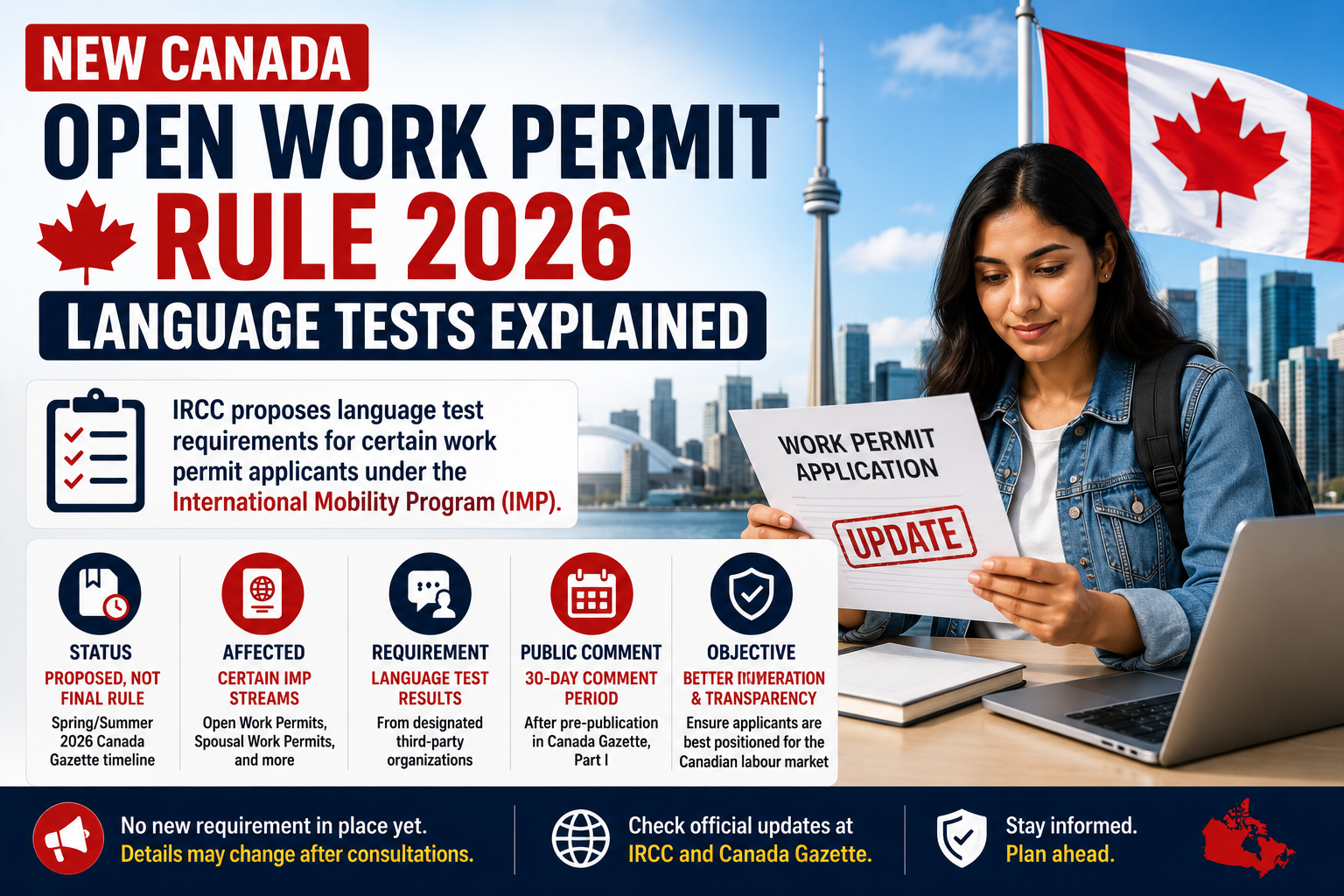
Canada is moving closer to introducing new language test requirements for certain open work permit applicants under the International Mobility Program (IMP).
According to IRCC’s latest 2026 regulatory update, the proposed rules are expected to move toward formal publication in:
📅 Spring or Summer 2026 through the: Canada Gazette
The proposal is NOT yet law, and no applicant is currently required to submit language test results because of this change.
However, Immigration, Refugees and Citizenship Canada (IRCC) has confirmed the proposal has advanced significantly and consultations have already been completed.
Quick Summary : Canada Open Work Permit Rule
| Key Update | Information |
|---|---|
| Country | Canada |
| Main Proposal | Language tests for certain work permit applicants |
| Program Affected | International Mobility Program (IMP) |
| Rule Status | Proposed, not final |
| Expected Publication | Spring/Summer 2026 |
| Possible Impact | Open work permits & spousal work permits |
What Is Proposed In Canada Open Work Permit Rule?
IRCC is proposing amendments to Canada’s immigration regulations that could allow the government to require:
Official language test results
from certain work permit applicants under the:
✔ International Mobility Program (IMP)
The department says the goal is to improve:
- Labour market integration
- Transparency
- Immigration system efficiency
- Long-term settlement outcomes
What Is the International Mobility Program (IMP)?
The:
International Mobility Program
is a major Canadian temporary worker program covering many LMIA-exempt work permits.
It includes pathways such as:
- Open work permits
- Spousal open work permits (SOWP)
- Post-graduation work permits (PGWP)
- Working holiday visas
- Intra-company transfers
- Free trade agreement permits
Important: The Rule Is NOT Active Yet
IRCC has clearly stated:
❌ No new language testing requirement is currently in force.
The proposal still needs to go through:
✔ Canada Gazette pre-publication
✔ Public consultation period
✔ Final approval process
This means:
- Details may still change
- Some categories may be removed
- Implementation could be delayed
Why Canada Wants Language Testing
IRCC says stronger language skills may help temporary residents:
✔ Integrate faster into Canadian workplaces
✔ Improve long-term employment outcomes
✔ Transition more successfully to permanent residence
The proposal aligns with Canada’s broader immigration trend of prioritizing:
Economic integration and language ability
Spousal Open Work Permits Could Be Affected
One of the biggest concerns involves:
Spousal Open Work Permits (SOWP)
IRCC has NOT officially confirmed whether SOWPs will be included.
However, immigration experts believe they are among the most likely categories to face future language requirements.
The government’s official wording currently refers only to:
“Certain work permit applicants under the International Mobility Program.”
What Language Tests Could Be Required?
IRCC has NOT confirmed accepted tests or minimum scores yet.
However, experts expect Canada could potentially use existing immigration language exams such as:
- IELTS General Training
- CELPIP General
- TEF Canada
- TCF Canada
No official score requirements have been announced.
What Has Already Changed in 2026?
IRCC’s updated regulatory plan dated:
📅 April 7, 2026
revealed several major developments.
Key Updates Include:
✔ Provincial consultations completed
✔ Private-sector consultations completed
✔ Canada Gazette publication timeline added
✔ 30-day public comment period confirmed
This means the proposal is now much closer to becoming formal policy.
What Is the Canada Gazette Process?
Before becoming law, the proposed rule must first appear in:
Canada Gazette Part I
This stage allows:
✔ Public review
✔ Written feedback
✔ Industry consultation
After the 30-day comment period, IRCC may revise the proposal before final publication in:
Canada Gazette Part II
which is when the regulation would officially take effect.
When Could the Rule Start?
At the moment:
❌ No final implementation date exists.
However, based on the current timeline:
📅 Earliest likely implementation may occur in 2027
depending on the consultation process and final approval timeline.
Existing Work Permit Holders May Not Be Affected
Current work permit holders are expected to receive:
Transitional protections
although IRCC has NOT officially confirmed the details yet.
Typically, new immigration rules mainly affect:
✔ Future applicants
✔ Renewals
✔ New submissions
rather than existing approved permits.
Canada Already Added Language Rules for Some PGWP Applicants
Canada previously introduced language requirements for certain:
Post-Graduation Work Permit (PGWP)
applicants beginning:
📅 November 1, 2024
depending on their study program type.
This earlier change is seen as a possible preview of broader work permit language testing expansion.
Why This Matters for PR Applicants
Language ability already plays a major role in:
✔ Express Entry
✔ Provincial Nominee Programs (PNPs)
✔ Canadian work experience pathways
If work permit applicants are required to show language ability earlier, it could significantly affect:
- PR planning
- Immigration timelines
- Work permit eligibility
- Employer hiring strategies
Employers Could Also Be Affected
If language testing becomes mandatory for some IMP streams:
Employer hiring pools could shrink
especially for sectors heavily dependent on temporary foreign workers.
Employers may need to:
✔ Prioritize higher-language candidates
✔ Plan recruitment earlier
✔ Adjust immigration strategies
Major Details Still Unknown
IRCC still has NOT confirmed:
❌ Which work permits will be affected
❌ Minimum language scores
❌ Accepted test providers
❌ Exemptions
❌ Transitional rules
❌ Final implementation date
All of these details remain pending until formal publication.
What Applicants Should Do Now
Immigration experts currently recommend:
✔ Monitoring official IRCC updates
✔ Avoiding panic or rushed testing
✔ Preparing language skills gradually
✔ Following Canada Gazette announcements closely
At this stage:
❌ Nobody should assume mandatory testing already applies.
Expert Analysis: Canada Is Moving Toward Earlier Immigration Screening
The proposed rules reflect a larger immigration trend in Canada:
👉 Stronger screening earlier in the immigration process.
Canada increasingly wants temporary residents to demonstrate:
✔ Language ability
✔ Economic integration potential
✔ Long-term settlement readiness
before transitioning toward permanent residence.
FAQs : Canada Open Work Permit Rule
1. Is Canada Open Work Permit Rule In Action now?
No. The proposal has not yet become law.
2. Which work permits could be affected by Canada Open Work Permit Rule?
Certain International Mobility Program (IMP) work permits may be included, but IRCC has not confirmed specific categories.
3. Will spousal open work permits require IELTS?
Possibly, but IRCC has not officially confirmed this yet in Canada Open Work Permit Rule.
4. When could the Canada Open Work Permit Rules begin?
The earliest possible implementation of Canada Open Work Permit Rules may happen in 2027 after consultation and final approval.
5. Which language tests may be accepted in Canada Open Work Permit Rule?
Potential tests could include IELTS, CELPIP, TEF, or TCF, but nothing has been confirmed officially.
Final Take On Canada Open Work Permit Rule
Canada Open Work Permit Rule proposed language testing for certain work permit applicants marks another major shift in the country’s immigration system.
While the policy is still under development, the direction is becoming increasingly clear:
✔ Stronger language requirements
✔ Earlier immigration screening
✔ Greater focus on long-term integration
For temporary residents, open work permit holders, and spousal applicants, staying informed over the next several months may become extremely important as IRCC moves closer to formal publication of the proposed rules.
Source : Immigration News Canada
Read About : New Canada Travel Warnings 2026 Issued for Summer Amid Global Flight & Security Risks



One thought on “Canada Open Work Permit Rule To Add Language Tests 2026: New IRCC Proposal Explained”