
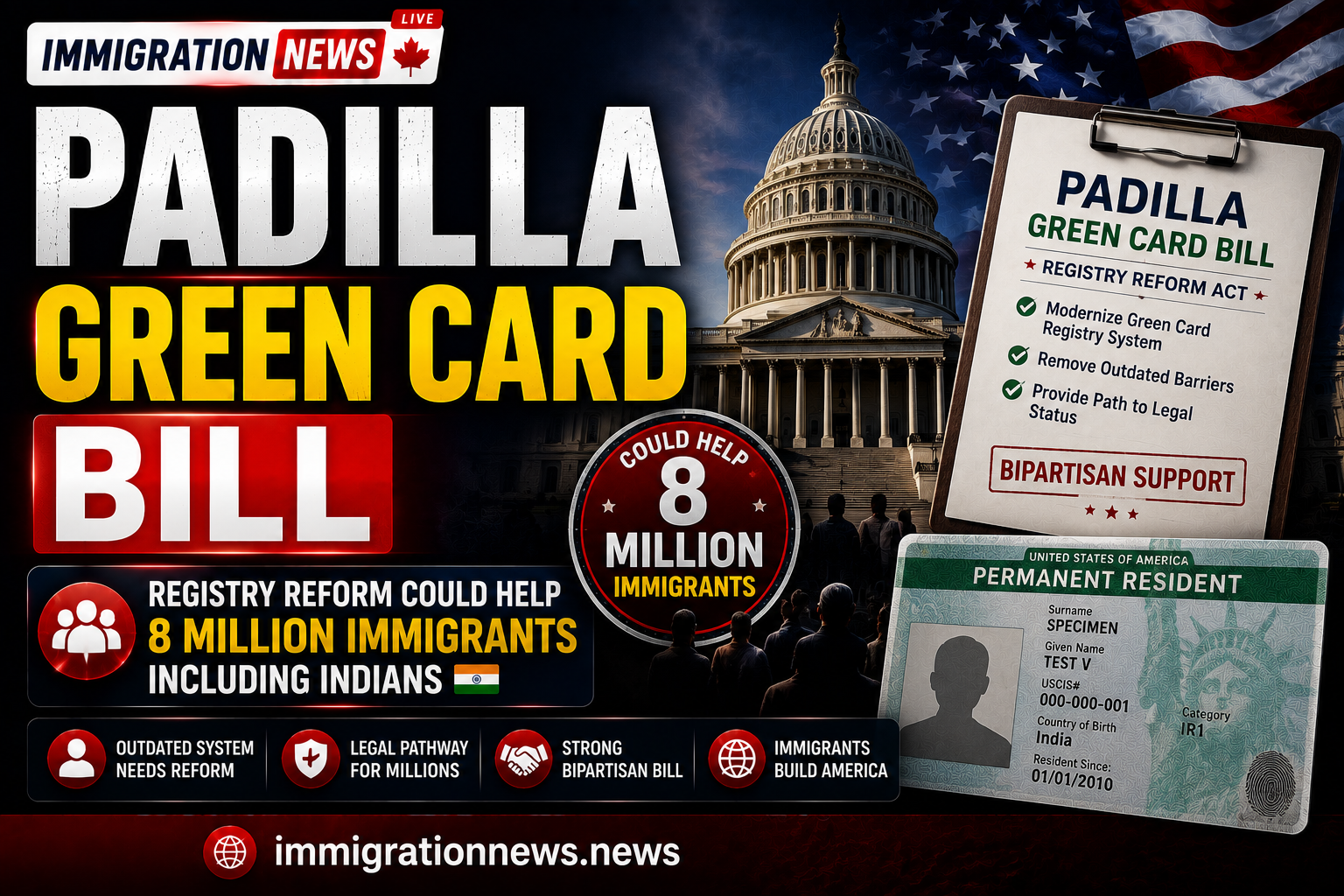
A California senator is renewing his push for one of the most significant immigration reform proposals currently before Congress. The Padilla green card bill, formally titled the Renewing Immigration Provisions of the Immigration Act of 1929, would provide a pathway to permanent residency for immigrants who have lived continuously in the United States for at least seven years—potentially benefiting more than 8 million people, including a substantial share of Indian H-1B visa holders stuck in decades-long green card backlogs.
Senator Alex Padilla of California reaffirmed his support for the bill on Monday, July 27, 2026, first introduced last year. “A year ago, I introduced this bill to push back against the Trump Administration’s cruel treatment of hardworking immigrants,” Padilla said. “Since then, President Trump’s campaign of fear has only escalated, with families living under constant uncertainty despite having built their lives in this country.”
Quick Highlights : Padilla Green Card Bill
- The Padilla green card bill would let immigrants who have lived in the U.S. continuously for at least seven years apply for lawful permanent residency
- The bill amends Section 249 of the Immigration and Nationality Act, known as the Registry provision, last updated in 1986
- The current Registry cutoff date is January 1, 1972—the bill would replace it with a rolling seven-year requirement
- More than 8 million people could become eligible to apply, according to Padilla’s office
- Between 2015 and 2019, only 305 people adjusted status under the existing, outdated provision
- Indians make up roughly 70% of the 85,000 H-1B visas issued annually, and about 1 million are currently in the green card backlog
- Senate Democratic Whip Dick Durbin co-leads the measure, with 14 additional Senate co-sponsors and Rep. Zoe Lofgren leading companion House legislation
What the Padilla Green Card Bill Actually Changes
At the heart of the Padilla green card bill is a fix to something called the Registry provision—Section 249 of the Immigration and Nationality Act. This provision gives the Secretary of Homeland Security discretion to grant lawful permanent resident status to certain individuals who have lived in the country since a specified cutoff date, provided they meet other eligibility requirements.
The problem is that this cutoff date has barely moved since the provision was first codified in 1929. It was last updated in 1986 during the Reagan administration, and the eligibility cutoff currently sits at January 1, 1972—meaning only immigrants who entered the U.S. more than five decades ago can even theoretically qualify. This near-total obsolescence explains why so few people have benefited from it in recent years: between 2015 and 2019, only 305 people adjusted their status through the Registry provision nationwide.
The Padilla green card bill would fundamentally restructure this mechanism by replacing the fixed 1972 cutoff date with a rolling seven-year continuous residency requirement. Applicants would need no criminal record and would still need to meet all other existing green card eligibility requirements. Critically, this rolling structure would eliminate the need for Congress to periodically amend the specific cutoff date going forward, since eligibility would simply be tied to how long someone has lived in the country rather than a fixed calendar date that quickly becomes outdated.
Who Would Benefit From This Legislation
According to Padilla’s office, the Padilla green card bill would make more than 8 million people eligible to apply for green cards. This group spans several distinct populations:
- Dreamers who arrived in the U.S. as children
- Temporary Protected Status (TPS) holders
- Children of long-term visa holders
- Essential workers who have contributed to the U.S. economy for years
- Highly skilled professionals, including H-1B visa holders who have waited years for employment-based green cards
This breadth is significant. Rather than targeting a single narrow category of immigrants, the Padilla green card bill is designed to sweep in long-term residents across multiple legal statuses who share one thing in common: years of continuous residence and contribution without a clear path to permanent status.
Why This Matters So Much for Indian Professionals
The Padilla green card bill carries particular weight for the Indian immigrant community in the United States, given the scale of India’s presence in the H-1B program. Of the approximately 85,000 H-1B visas issued annually, roughly 70% go to Indian nationals—by far the largest share of any single nationality.
According to U.S. Citizenship and Immigration Services data, approximately 1 million Indians currently sit in the employment-based green card backlog, with some families reportedly waiting decades for their applications to be finalized. This backlog stems largely from per-country caps on employment-based green cards that disproportionately affect high-demand countries like India, where applicant volume vastly outpaces the annual allocation.
Immigration experts have also noted the bill’s potential long-term significance for Indian students in the U.S. Each year, thousands of Indian students graduate from American universities, transition to Optional Practical Training (OPT), and later move to H-1B status—entering the very same employment-based green card queue that already stretches for decades. A seven-year continuous residency pathway under the Padilla green card bill could offer these individuals an alternative route to permanent status that doesn’t depend on navigating that backlog at all.
Bipartisan Support and Legislative Backing
The Padilla green card bill is not a solo effort. Senate Democratic Whip Dick Durbin is co-leading the measure alongside Padilla, with 14 additional Senate co-sponsors having signed on. In the House, Representative Zoe Lofgren of California is leading companion legislation. More than 30 labor, immigration, and civil rights organizations have formally endorsed the bill, reflecting a broad coalition of support beyond Congress itself.
If enacted, the change would take effect 60 days after the bill becomes law—a relatively swift implementation timeline compared to many major immigration reforms.
The Uphill Battle Ahead
Despite this coalition of support, passage of the Padilla green card bill through Congress faces significant obstacles. Immigration has become one of the most politically charged issues in Washington, and pro-immigrant legislation has found limited traction in the current Congress.
The contrast is stark when placed alongside competing legislative proposals. In April, Congressman Eli Crane introduced the End H-1B Visa Abuse Act of 2026, which seeks to amend the Immigration and Nationality Act to impose a three-year halt on new H-1B visas and encourage existing H-1B holders to leave the United States during that period. Earlier still, in February, Representative Greg Steube proposed the Ending Exploitative Imported Labour Exemptions (Exile) Act, which would reduce the number of H-1B visas to zero beginning in fiscal year 2027 and every year thereafter—effectively ending the program outright rather than phasing it out gradually.
Against this backdrop of aggressive H-1B restriction proposals from Republican lawmakers, the Padilla green card bill represents a starkly different legislative direction, and its prospects for passage in the current political climate remain genuinely uncertain, notwithstanding its broad base of Senate co-sponsors and outside organizational support.
Why Padilla Calls This a “Commonsense” Fix
Padilla has consistently framed the bill as a straightforward modernization effort rather than a sweeping policy change. “Congress cannot continue to ignore millions of long-term residents who contribute to our economy and communities every day,” Padilla said. “It’s past time to modernise our immigration laws and create a fair pathway to lawful permanent residency.”
By replacing a nearly 40-year-old fixed cutoff date with a rolling requirement, the Padilla green card bill is designed to prevent this exact obsolescence problem from recurring—ensuring the Registry provision continues functioning as intended without requiring future Congresses to periodically revisit and update a specific calendar date.
Key Takeaways Of Padilla Green Card Bill
The Padilla green card bill represents a significant, if politically uncertain, attempt to modernize a decades-old immigration provision that has become almost entirely obsolete. By replacing the fixed 1972 cutoff date with a rolling seven-year continuous residency requirement, the legislation could open a pathway to permanent residency for more than 8 million people, including a substantial number of Indian H-1B holders currently facing some of the longest green card wait times of any nationality. With bipartisan-adjacent Senate co-sponsorship and companion House legislation already in motion, the bill has more institutional backing than many comparable proposals—though it faces a genuinely difficult path forward given the current political climate surrounding immigration policy in Washington.
FAQs : Padilla Green Card Bill
What does the Padilla green card bill actually propose?
It would amend Section 249 of the Immigration and Nationality Act, replacing the current fixed January 1, 1972 eligibility cutoff with a rolling seven-year continuous U.S. residency requirement for lawful permanent resident status.
How many people could benefit from this legislation?
According to Padilla’s office, more than 8 million people could become eligible to apply, including Dreamers, TPS holders, essential workers, children of long-term visa holders, and H-1B visa holders.
Why does this matter specifically for Indian immigrants?
Indians receive roughly 70% of the 85,000 H-1B visas issued annually, and approximately 1 million Indians are currently in the employment-based green card backlog, some waiting decades for approval.
Who supports the Padilla green card bill in Congress?
Senate Democratic Whip Dick Durbin co-leads the measure with 14 additional Senate co-sponsors, while Representative Zoe Lofgren leads companion legislation in the House, alongside endorsements from more than 30 labor and immigration organizations.
When would the bill take effect if passed?
The change would take effect 60 days after the bill becomes law, though its passage through Congress remains uncertain given the current political climate around immigration.
Source : First Post
Read About : End H-1B Abuse Act: Senator Proposes 3-Year Pause On New H-1B Visas


One thought on “Padilla Green Card Bill: Registry Reform Could Help 8 Million Immigrants, Including Indians”