
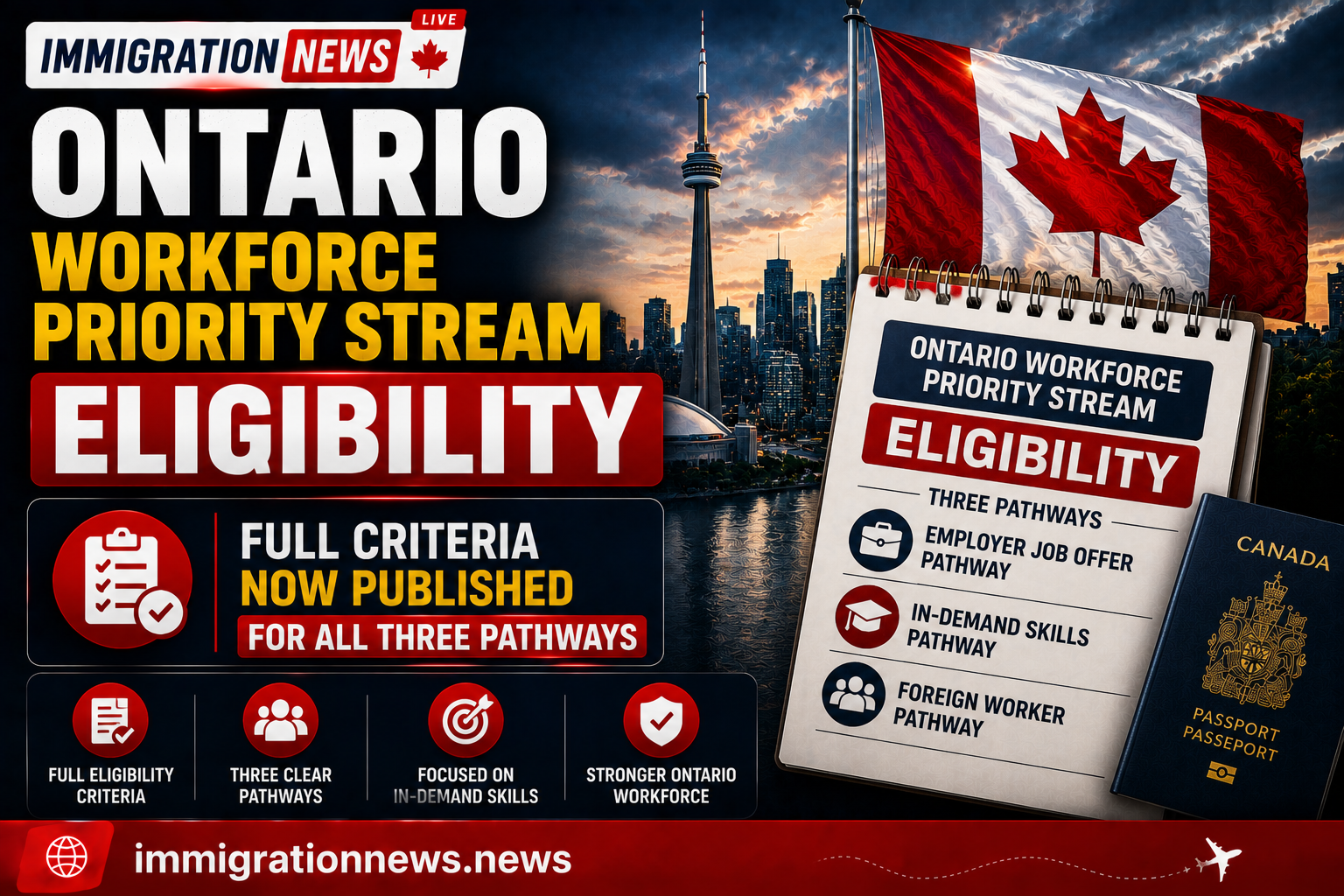
Ontario has finally answered the question tens of thousands of candidates and employers have been asking since the province shut down all eight former OINP streams last month. The Ontario Workforce Priority stream eligibility criteria are now officially confirmed and published on the provincial government’s website, giving candidates and employers their first full look at the requirements governing the province’s completely redesigned immigration nomination program.
Every requirement across all three pathways—covering skilled workers, essential workers, and self-employed physicians—is now publicly accessible for the first time since the June 26 overhaul took effect.
Quick Highlights : Ontario Workforce Priority Stream Eligibility
- Ontario Workforce Priority stream eligibility criteria are now published, covering all three new pathways
- The changes reflect amendments to Ontario Regulation 422/17, in force since June 25, 2026
- TEER 0–3 pathway requires CLB 6 language proficiency and a post-secondary credential
- TEER 4–5 pathway now requires CLB 4 language proficiency for the first time
- Self-employed physicians can qualify without any job offer requirement
- The Expression of Interest system is expected to reopen later this summer, though the OINP e-Filing Portal remains under maintenance as of July 20, 2026
- Old EOI profiles and job offers from former streams do not carry over to the new system
What Changed in the OINP Redesign
The Ministry of Labour, Immigration, Training and Skills Development eliminated all eight existing OINP streams and replaced them with a single new stream: the Ontario Workforce Priority stream. This represents the largest structural overhaul in the program’s history.
| # | Former OINP Stream | Status |
|---|---|---|
| 1 | Employer Job Offer: Foreign Worker | Closed |
| 2 | Employer Job Offer: International Student | Closed |
| 3 | Employer Job Offer: In-Demand Skills | Closed |
| 4 | Express Entry: Human Capital Priorities | Closed |
| 5 | Express Entry: Skilled Trades | Closed |
| 6 | Express Entry: French-Speaking Skilled Worker | Closed |
| 7 | Masters Graduate | Closed |
| 8 | PhD Graduate | Closed |
No further invitations will be issued under any of these former pathways. Applications already submitted before June 26 continue to be assessed under the rules in effect at submission time, while EOIs that didn’t result in an invitation are being automatically withdrawn.
The Three Pathways at a Glance
Understanding Ontario Workforce Priority stream eligibility starts with knowing which of the three pathways applies to you, based on your occupation’s TEER level.
| Requirement | TEER 0–3 Pathway | TEER 4–5 Pathway | Self-Employed Physicians |
|---|---|---|---|
| Job Offer | Full-time, permanent | Full-time, permanent | Not required |
| Language (CLB) | CLB 6 (CLB 5 for certain occupations) | CLB 4 | Not specified |
| Education | Post-secondary degree or diploma (ECA if foreign) | Canadian secondary diploma or equivalent | CPSO registration required |
| Work Experience | 6 months / 2 years / 3 months (3 options) | 9 months cumulative with job offer employer | N/A |
| Licensing Exemption | Yes | No | Must hold CPSO registration |
TEER 0–3 Pathway: Skilled Workers
This pathway targets workers with a full-time, permanent job offer in higher-skilled occupations, spanning management roles (TEER 0), professional occupations requiring a university degree (TEER 1), technical roles requiring a college diploma or apprenticeship (TEER 2), and intermediate occupations (TEER 3).
Language requirement: Most applicants need CLB 6 or higher across all four abilities, tested within the past two years through IELTS General Training, CELPIP General, TEF Canada, or TCF Canada. Certain occupations—including truck drivers, trades workers, cooks, natural resource workers, production occupations, and nurse aides under NOC 33102—qualify for a reduced CLB 5 threshold. Recent Ontario graduates are exempt from this language requirement entirely.
Education requirement: Most applicants need a post-secondary degree or diploma. Those qualifying under the reduced CLB 5 occupation list only need a Canadian secondary school diploma or foreign equivalent with an ECA.
Work experience: Three options exist under this pathway’s Ontario Workforce Priority stream eligibility framework:
- Option A: 6 consecutive months of full-time work in the last 12 months with the job offer employer
- Option B: 2 years cumulative experience in the last 5 years in the same NOC occupation
- Option C: 3 consecutive months for recent Ontario graduates already working for their sponsoring employer
Licensed professionals in Ontario may be exempt from the work experience requirement entirely—though this exemption applies only to the TEER 0–3 pathway.
Alternate NOC combinations: The regulation permits limited cross-occupation experience, including certain engineering professionals qualifying for engineering technical roles, pharmacists qualifying for pharmacy assistant positions, and registered or licensed practical nurses qualifying for nurse aide roles. Applicants must verify their specific combination is expressly listed before relying on this provision.
TEER 4–5 Pathway: Essential Workers
This pathway represents a significant broadening compared to the former In-Demand Skills stream, now covering all TEER 4 and 5 occupations rather than a restricted list—including home support workers, retail salespersons, construction trades helpers, and industrial cleaners.
Language requirement: This is where Ontario Workforce Priority stream eligibility marks its most significant departure from the previous system. Applicants must now demonstrate CLB 4 across all four abilities—a mandatory requirement that did not exist for TEER 4–5 workers under the former In-Demand Skills stream.
Education requirement: A Canadian secondary school diploma or foreign equivalent with an ECA—a lower bar than the TEER 0–3 pathway.
Work experience requirement: Applicants need 9 months of cumulative experience in the last 2 years, specifically with the job offer employer. Unlike the TEER 0–3 pathway, there is no licensing exemption, no reduced requirement for recent graduates, and experience with a different employer in the same occupation does not count.
Self-Employed Physicians Pathway
This is the only track within the redesigned OINP that doesn’t require a job offer. To qualify, physicians must simultaneously meet three conditions:
- Be a member in good standing with the College of Physicians and Surgeons of Ontario (CPSO)
- Hold a valid certificate of registration in the independent, academic, or provisional class
- Be eligible to bill through the Ontario Health Insurance Plan (OHIP)
This pathway addresses physicians working under independent practice arrangements rather than traditional employment contracts, a structure that made previous employer-focused pathways difficult to access.
Employer Eligibility Requirements
A qualifying job offer under the TEER 0–3 and TEER 4–5 pathways requires an eligible Ontario employer meeting eight criteria: at least 3 years of active business operation; minimum gross annual revenue thresholds based on location; a genuinely full-time, permanent position with no end date providing at least 1,560 hours per year; demonstrated business need; work occurring primarily in Ontario; wages meeting the required regional level; no active labour dispute; and minimum staffing thresholds of Canadian citizens and permanent residents.
| Employer Location | Former Minimum Gross Revenue |
|---|---|
| Greater Toronto Area (GTA) | $1,000,000 |
| Outside GTA | $500,000 |
The redesigned program introduces reduced revenue requirements for employers in rural communities—census divisions with a population under 150,000—and wages for recent Ontario graduates under TEER 0–3 may meet the regional low-wage level instead of the median wage.
How to Apply Once the Portal Reopens
Once the system reopens, the application process follows ten steps: confirm your TEER category via your NOC code; take or retake your language test; obtain or verify your ECA; secure a qualifying job offer; have your employer register the job offer through the Employer Portal; register a new Expression of Interest; wait for an invitation to apply through periodic draws; submit a complete application through the e-Filing Portal; receive your provincial nomination; and finally apply to IRCC for permanent residence.
Employers who previously registered in the OINP Employer Portal don’t need to re-register, but must submit a new job offer and application for employment position approval, since previous approvals do not carry over.
Important system note: As of July 20, 2026, the OINP e-Filing Portal is undergoing maintenance, with EOI registration and new job offer creation temporarily unavailable. Ontario has confirmed the system is expected to reopen later this summer, though no specific date has been announced.
What Happens to Masters and PhD Graduates
The former Masters Graduate and PhD Graduate streams, which did not require a job offer, are among the eight permanently closed pathways. Under current Ontario Workforce Priority stream eligibility rules, international graduates generally need a qualifying job offer to access the new stream. Those without one may consider federal alternatives like the Canadian Experience Class.
Ontario has indicated Phase 2 of the redesign may introduce additional streams—a Priority Healthcare Stream, an Exceptional Talent Stream, and a redesigned Entrepreneur Stream—though none have confirmed eligibility rules or launch dates.
Ontario’s 2026 Nomination Allocation
Ontario received approximately 14,119 nomination spots for 2026 under the federal PNP allocation, part of a national target increase to 91,500 admissions, up from 55,000 in 2025. Provincial nominees receive a significant CRS boost in Express Entry, making this one of the most effective permanent residence pathways available to candidates already in the federal pool.
Key Takeaways Of Ontario Workforce Priority Stream Eligibility
The publication of the Ontario Workforce Priority stream eligibility criteria closes the information gap that followed June’s dramatic overhaul. Candidates and employers now have the complete regulatory framework needed to assess their eligibility, prepare documentation, and position themselves ahead of the EOI system reopening. Workers should use this preparation window to confirm their NOC TEER category, complete or renew language testing, and verify educational credentials, since those fully prepared when the system reopens will have a clear advantage in the first rounds of invitations.
FAQs : Ontario Workforce Priority Stream Eligibility
What is the language requirement under Ontario Workforce Priority stream eligibility?
TEER 0–3 applicants generally need CLB 6 (CLB 5 for certain occupations), while TEER 4–5 applicants need CLB 4—a new mandatory requirement that didn’t previously exist for this group.
Do TEER 4–5 workers need an LMIA under this stream?
No, provincial nomination and LMIA serve different purposes. A worker may still need a separate LMIA-supported work permit to work while their PR application is processed.
Can international graduates without a job offer still qualify?
Recent Ontario graduates get a reduced 3-month work experience requirement under TEER 0–3, but a qualifying job offer is still required. The former no-job-offer Masters and PhD streams are permanently closed.
When will the EOI system reopen?
Ontario has confirmed reopening is expected later this summer, but no specific date has been announced as of July 20, 2026.
Do old EOI profiles carry over to the new stream?
No. Candidates must register a completely new Expression of Interest profile under the Ontario Workforce Priority stream once the system reopens.
Source : Immigration News Canada
Read About : Portage College PGWP Refusals Leave 100s Of Indian Students In Limbo

One thought on “Ontario Workforce Priority Stream Eligibility Criteria Officially Published Since June 26 Overhaul”