

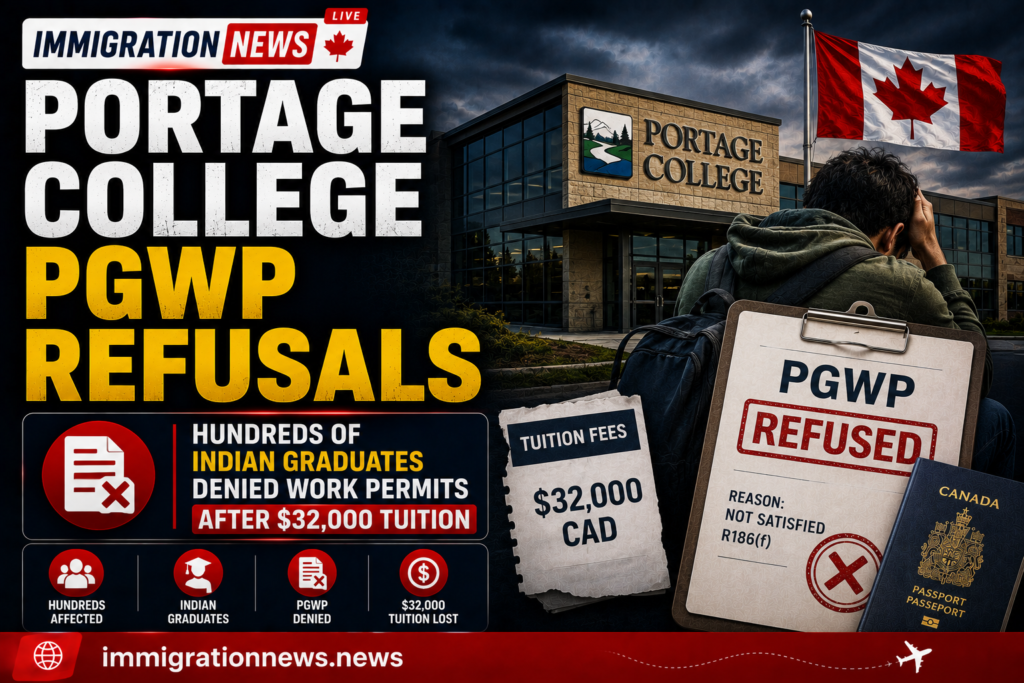
Thousands of dollars in tuition, years of study, and a promised pathway to Canadian work experience have collapsed for hundreds of international students. The Portage College PGWP refusals crisis is unfolding across Calgary, where graduates of business management diploma programs delivered through Portage College and its delivery partner, the Canadian Institute of Osteopathic Therapy (CIOT Calgary), are being denied post-graduation work permits en masse—despite having paid roughly $32,000 in tuition over two years.
Graduates say Immigration, Refugees and Citizenship Canada quietly changed eligibility rules after they had already enrolled and applied. IRCC maintains no rule has changed. Caught in the middle are students like Jaspinder Kaur, whose entire future in Canada now hangs on a single sentence buried in a refusal letter.
Quick Highlights : Portage College PGWP Refusals
- The Portage College PGWP refusals affect hundreds of graduates, mostly from India, who completed business management diplomas via CIOT Calgary
- Refusal letters cite the program as “non-credit,” disqualifying it under regulation R205(c)(ii)
- A quiet IRCC webpage change on June 24, 2026 is at the center of the dispute
- One Calgary immigration lawyer alone is handling 200 affected student files
- Portage College has stopped issuing letters of support, advising affected students to seek independent legal counsel
- A Change.org petition demands IRCC pause all refusals and reopen previously denied files
- Some graduates from the identical program have reportedly received approvals, deepening confusion
What Triggered the Portage College PGWP Refusals
According to documentation reviewed by immigration consultants, IRCC officers began issuing refusals in near-identical wording starting in late June 2026. The standard refusal language reads: “The completed [program] is a non-credit program, as such the program does not meet the criteria for work authorization under R205(c)(ii). Application refused under R200(1)(c)(ii).”
The Portage College PGWP refusals trace back to programs delivered not directly through Portage College’s main campus, but through third-party delivery partners—specifically CIOT Calgary and, in related cases, Campbell College. These arrangements, sometimes called curriculum-licensing or “P3” programs, allowed students to complete a Portage-affiliated diploma through a different physical institution.
Critically, affected students say they applied for their post-graduation work permits before any rule change took effect, believing their program qualified based on information available at the time of enrollment and application.
The Disputed June 24 Webpage Change
At the heart of the Portage College PGWP refusals controversy is an unpublished policy change that appears to have been quietly added to the IRCC website on June 24, 2026. Advocates organizing against the refusals argue this change was never formally announced, published in the Canada Gazette, or subjected to public consultation—standard steps typically expected for immigration policy shifts affecting large numbers of applicants.
A petition circulating on Change.org, directed at Immigration Minister Lena Metlege Diab and IRCC, specifically calls for the department to reverse the June 24 change or, at minimum, apply it only prospectively—meaning only to students who enrolled after the change was published, rather than retroactively affecting those who had already committed years and tens of thousands of dollars to their programs.
IRCC, for its part, has stated there has been no change to any rule, creating a direct contradiction between the department’s public position and the experience of hundreds of affected graduates.
Student Voices Behind the Portage College PGWP Refusals
The human impact of this situation has been laid bare through student testimony to Canadian media. “My father spent his whole lifetime saving for me,” Jaspinder Kaur told CTV News. “After completing my two years of study, I thought I would be able to work and gain some Canadian experience.”
Mukul Rana, another affected student, described the broader toll on the community: “This is a betrayal of thousands of international students; it is not just administrative, it is a human crisis.” Rana noted that students who received refusals are now struggling both financially and mentally after losing their ability to legally work in Canada.
Legal Representation Overwhelmed by Demand
The scale of the Portage College PGWP refusals has created significant demand for immigration legal services in Calgary. Laura-Anne Goulding, an immigration lawyer with Shory Law, told CTV News that her office alone has been contacted by dozens of affected students, with her firm currently handling 200 student files connected to this issue.
Immigration consultants reviewing individual cases have found inconsistencies in how the “non-credit” designation is being applied. In at least one documented case, a student’s credential was classified by Portage College’s own official program materials as credit-bearing, suggesting the “non-credit” characterization used in some refusal letters may be factually incorrect for certain program streams, even as it appears accurate for others delivered specifically through CIOT Calgary.
Portage College’s Response on Portage College PGWP Refusals
Facing mounting pressure, Portage College published an update on its website on July 14, 2026, acknowledging that some graduates have received PGWP refusals. On July 15, the college added a further update: following legal advice, it would no longer issue letters of support for PGWP applications, stating that such letters “would not be relevant to the assessment” of these applications. Instead, the college is now recommending that affected students rely on completion letters.
Portage College has explicitly stated that its previous letters of support did not constitute legal advice, did not represent a guarantee to IRCC on behalf of any student, and did not confirm or guarantee PGWP eligibility or any other immigration outcome. The college has urged affected students to seek independent advice from an authorized immigration lawyer or Regulated Canadian Immigration Consultant promptly, citing time limits that may apply to legal and immigration processes.
The college has also advised students to gather and retain a full set of documentation, including study permits, letters of acceptance, enrolment records, program completion documents, transcripts, PGWP applications, and any IRCC refusal letters or officer notes, since these records may be relevant to future applications or reconsideration requests.
Understanding the Post-Graduation Work Permit
A post-graduation work permit (PGWP) is an open work permit issued by the Canadian government allowing eligible international students to work in Canada after completing a qualifying program at a designated learning institution. Two factors are critical to eligibility: the specific program completed and the institution through which it was delivered. The PGWP cannot be renewed, but it offers valuable Canadian work experience and functions as an important pathway toward eventual Canadian permanent residence.
This is precisely why the Portage College PGWP refusals carry such weight for affected students—without this permit, the entire strategy many students pursued when choosing their program and institution collapses, cutting off both immediate employment authorization and the longer-term PR pathway they had been planning around.
Public Reaction and Broader Debate On Portage College PGWP Refusals
Coverage of a student protest held on a recent Friday drew significant social media attention, much of it focused on the demographic makeup of the protesters, who were predominantly Punjabi. Reactions online have been sharply divided. Some commenters have argued that a two-year diploma program should never have guaranteed a pathway to a work permit and eventual residency, suggesting students should simply leave Canada after completing their studies regardless of the circumstances.
Others have focused criticism specifically on the institutions involved, arguing that if these programs were structured in a way that made PGWP ineligibility foreseeable, students were effectively charged full tuition under false pretenses—raising serious questions about institutional transparency and accountability rather than placing blame on the students themselves.
What Affected Students Should Do Now
Students facing Portage College PGWP refusals should act quickly given the time-sensitive nature of immigration reconsideration processes. Consultants handling these cases recommend gathering the complete document package Portage College has outlined, including the original letter of acceptance, full transcript, and tuition invoices, and comparing these carefully against the specific program stream completed.
Because the “non-credit” designation appears to apply differently depending on whether a student completed their diploma through Portage’s main campus or through a delivery partner like CIOT Calgary or Campbell College, individual case assessment by a qualified immigration professional is essential before pursuing any reconsideration request or appeal.
Key Takeaways Of Portage College PGWP Refusals
The Portage College PGWP refusals represent a significant and rapidly escalating crisis affecting hundreds of primarily Indian international students who invested substantial tuition and years of study based on the reasonable expectation that their program would qualify for a post-graduation work permit. With IRCC denying any rule change, Portage College distancing itself from prior representations, and a formal petition demanding reversal of an unpublished June 24 policy update, affected students face genuine uncertainty about both their immediate work authorization and their longer-term plans in Canada. Anyone facing a refusal should seek independent legal advice immediately given the time-sensitive nature of any reconsideration process.
FAQs : Portage College PGWP Refusals
What caused the Portage College PGWP refusals?
IRCC began refusing PGWP applications in late June 2026, citing that the completed business management diploma programs delivered through CIOT Calgary were classified as “non-credit” and therefore ineligible under regulation R205(c)(ii).
Did IRCC actually change any rules?
IRCC has stated there has been no rule change. However, advocates point to an unpublished policy update quietly added to the IRCC website on June 24, 2026, which they argue effectively changed how these programs are assessed.
How many students are affected by the Portage College PGWP refusals?
The exact total is unclear, but one Calgary immigration law firm alone is handling 200 affected student files, with dozens more contacting other legal offices across the city.
Is Portage College providing any support to affected students?
Portage College has stopped issuing letters of support for PGWP applications, stating such letters are not relevant to IRCC’s assessment. The college is recommending completion letters instead and urging students to seek independent immigration legal advice.
Can students appeal a PGWP refusal?
Yes, but immigration professionals stress that appeal and reconsideration options may be subject to strict time limits, making it essential for affected students to consult an authorized immigration lawyer or Regulated Canadian Immigration Consultant as quickly as possible.
Source : The Times Of India
Read About : Parents and Grandparents Program Paused: Canada Halts New PGP Applications On July 15, 2026



One thought on “Portage College PGWP Refusals Leave 100s Of Indian Students In Limbo”