
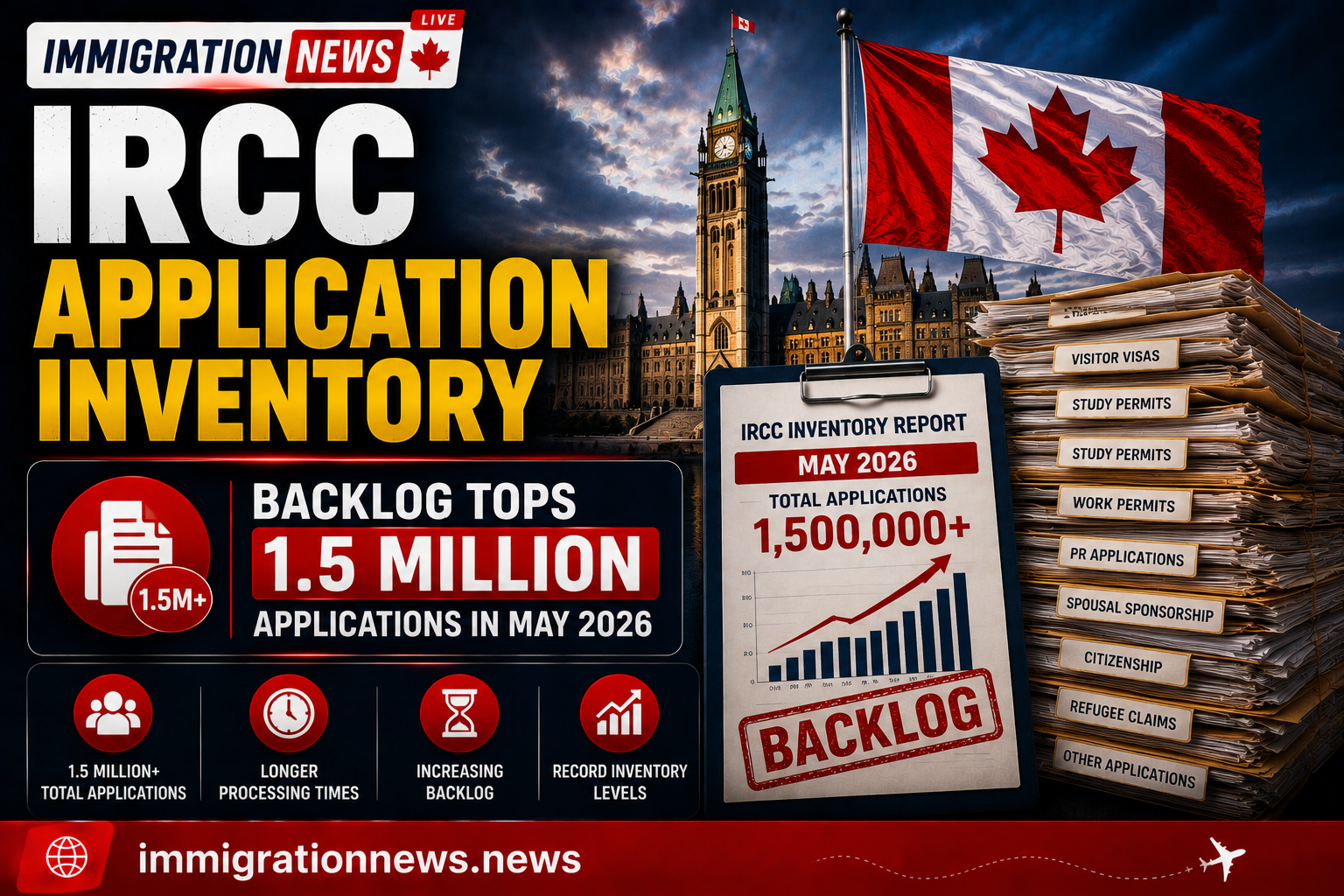
Canada’s immigration department is managing a backlog of unprecedented scale. The IRCC application inventory reached 1,517,770 applications awaiting processing as of May 31, 2026, according to newly released department data covering permanent residence, temporary residence, and Canadian citizenship applications not yet finalized by an immigration officer.
This figure was published on IRCC’s revamped Inside IRCC’s application processing system webpage on July 21, though the updated version notably no longer discloses what proportion of the IRCC application inventory is being processed within official service standards—a transparency reduction from the previous version of this reporting page.
Quick Highlights : IRCC Application Inventory
- The IRCC application inventory stood at 1,517,770 applications as of May 31, 2026
- IRCC finalized 1,648,965 applications between January 1 and May 31, 2026
- Permanent residence applications account for 705,315 of the total inventory
- The Protection category, entirely new to IRCC’s reporting, holds 307,215 applications
- Temporary residence applications total 404,070, dominated by visitor visas at 337,365
- Citizenship applications in the inventory reached 408,385, including certificates for the first time
- All figures have been rounded to the nearest multiple of five
Breaking Down the IRCC Application Inventory by Category
The overall IRCC application inventory spans three major processing categories: permanent residence, temporary residence, and citizenship. Each has been restructured with new sub-categories that provide considerably more granular detail than IRCC’s previous reporting format.
Permanent Residence: 705,315 Applications Pending
As of May 31, permanent residence applications accounted for 705,315 of the total IRCC application inventory. Previously, this category simply covered Express Entry, enhanced Provincial Nominee Program, and family sponsorship applications. IRCC has now restructured this into three distinct sub-categories: Economic, Family, and Protection—each covering considerably more pathways than the prior reporting structure.
Between January 1 and May 31, 2026, IRCC finalized a total of 198,700 PR applications across all three sub-categories.
Economic Category
The Economic sub-category holds 238,335 applications awaiting finalization, with 75% actively in processing and the remaining 25% waiting for available permanent residence admission spaces under the 2026-2028 Immigration Levels Plan. IRCC finalized 111,000 economic immigration applications during the January-to-May period.
This category encompasses Express Entry, federal business programs including the Start-Up Visa Program and Self-Employed Persons Program, along with regional economic programs such as the Provincial Nominee Program, Atlantic Immigration Program, Rural Community Immigration Pilot, and Francophone Community Immigration Pilot. Notably, the inclusion of PR applications waitlisted for future processing is an entirely new addition to this monthly IRCC application inventory update.
Family Category
The Family sub-category held 159,765 applications as of May 31, with 60% in active processing and 40% waiting for available space. IRCC finalized 45,900 applications under this category during the reporting period.
This category covers family reunification and international adoption, including sponsorship of spouses, partners, and dependent children, as well as sponsorship under the Parents and Grandparents Program. Previously, IRCC referred to this simply as “Family sponsorship” without providing any further breakdown.
Protection Category
The Protection sub-category represents the single largest share of permanent residence applications within the IRCC application inventory, totalling 307,215 applications. Of these, 54% were in active processing while 46% remained waiting for available space. IRCC finalized 42,800 applications under this category during the first five months of the year.
This category did not exist in IRCC’s former inventory reporting structure. It now includes protected persons already in Canada, government-assisted refugees, privately sponsored refugees, and applications made on humanitarian and compassionate grounds.
Temporary Residence: 404,070 Applications Pending
Temporary residence applications make up 404,070 of the total IRCC application inventory as of May 31. This category remains limited to initial study permits, work permits, and visitor visas—unchanged from IRCC’s previous reporting structure. Between January 1 and May 31, the department finalized 1,288,905 applications across these three categories combined, representing by far the largest volume of any segment in this data release.
| Application Type | Inventory (May 31) | Finalized (Jan 1–May 31) |
|---|---|---|
| Work permits | 35,040 | 140,775 |
| Study permits | 31,665 | 74,370 |
| Visitor visas | 337,365 | 1,073,755 |
Visitor visas dominate the temporary residence portion of the IRCC application inventory, accounting for the overwhelming majority of both pending applications and finalizations in this category, reflecting the sheer volume of travel-related applications Canada processes on an ongoing basis.
Citizenship Applications: 408,385 Pending
As of May 31, IRCC reported 408,385 citizenship applications within the broader IRCC application inventory still requiring a final decision. This category has also been restructured, now including proof of citizenship certificates for the first time—previously, IRCC only published data on citizenship grants specifically.
Citizenship grants: 326,365 applications remained unfinalized as of May 31, with IRCC reporting 131,420 new citizens finalized since January 1.
Proof of citizenship certificates: 82,020 applications were awaiting finalization, with 28,940 certificates issued between January 1 and May 31.
Why the Reporting Changes Matter
The restructuring behind this latest IRCC application inventory release represents a significant shift in how the department communicates backlog data to the public. The introduction of the Protection category alone adds visibility to more than 300,000 applications that were not previously broken out separately, while the Economic and Family sub-categories under permanent residence now explicitly show the split between applications actively being processed versus those simply waiting for an available admission space under Canada’s annual immigration levels targets.
At the same time, the removal of service standard compliance data—information that previously told the public what percentage of applications were being processed within IRCC’s own target timelines—represents a notable reduction in transparency. Without this metric, it becomes harder to assess whether the department is meeting its own performance commitments across each category of the IRCC application inventory.
What This Means for Applicants
For anyone with a pending application, understanding where their category sits within the broader IRCC application inventory offers useful context, even without service standard data. The Economic PR category, for instance, shows a meaningful 25% of applications simply waiting for admission space rather than active processing delays—a distinction that matters for setting realistic expectations, since these applicants aren’t necessarily facing processing problems, but rather annual admission caps under the current Immigration Levels Plan.
Similarly, the Protection category’s 46% waiting for space illustrates that a substantial portion of this backlog reflects capacity constraints tied to Canada’s annual protected persons and refugee admission targets, rather than simple processing inefficiency.
Applicants across all categories should continue monitoring IRCC’s official processing times pages for category-specific updates, since the broader inventory figures released here provide context on backlog scale but not individual timeline guarantees.
Key Takeaways Of IRCC Application Inventory
The IRCC application inventory surpassing 1.5 million applications in May 2026 reflects both the sheer scale of Canada’s immigration system and a meaningful restructuring of how the department categorizes and reports its backlog. With new Economic, Family, and Protection sub-categories under permanent residence, and citizenship certificates now tracked alongside citizenship grants, applicants and observers have more granular visibility into where specific bottlenecks exist—even as the removal of service standard compliance data leaves a notable gap in understanding overall departmental performance.
FAQs : IRCC Application Inventory
How large is the current IRCC application inventory?
As of May 31, 2026, the IRCC application inventory totalled 1,517,770 applications across permanent residence, temporary residence, and citizenship categories combined.
What is the new Protection category in the IRCC application inventory?
This newly introduced category includes protected persons in Canada, government-assisted refugees, privately sponsored refugees, and humanitarian and compassionate grounds applications, totalling 307,215 pending applications as of May 31.
Why did some Economic and Family PR applications get classified as “waiting for space”?
Under the 2026-2028 Immigration Levels Plan, Canada sets annual admission caps for permanent residence categories. Applications in this status have completed processing steps but are waiting for an available admission space rather than facing active processing delays.
How many applications has IRCC finalized in 2026 so far?
Between January 1 and May 31, 2026, IRCC finalized 1,648,965 applications across all categories, including 198,700 permanent residence applications and 1,288,905 temporary residence applications.
Why doesn’t the new IRCC application inventory page show service standard compliance?
IRCC’s revamped reporting page, published July 21, no longer includes data on what proportion of applications are processed within official service standards, representing a reduction in transparency compared to the previous version of this webpage.
Source : CIC News
Read About : Ontario Workforce Priority Stream Eligibility Criteria Officially Published Since June 26 Overhaul

One thought on “IRCC Application Inventory Exceeds 1.5 Million In May 2026”